
BuddhistCatholicContemplativeEvangelicalGeneral ChristianHinduJewishLatter-day SaintMuslimNew VisionsProgressive Christian
Beliefs
- Buddhist
- Catholic
- Contemplative
- Evangelical
- General Christian
- Hindu
- Jewish
- Latter-day Saint
- More Voices
- Muslim
- New Visions
- Pagan
- Progressive Christian
Topics
- Religion News
- Food and Religion
- Sports and Religion
- Religious Art
- Religious Music and Entertainment
- Religious Events
- History and Religion
- Style and Religion
- Politics and Religion
- Women in Religion
- Recreation Outdoors and Religion
- Business Finance and Religion
- Careers Workplace and Religion
- Education and Religion
- Family Parenting and Religion
- Health Fitness and Religion
- Home and Religion
- Relationships and Religion
- Technology and Religion
- Travel and Religion
Columnists
- Buddhist Columnists
- Business Finance and Religion Columnists
- Careers Workplace and Religion Columnists
- Catholic Columnists
- Contemplative Columnists
- Education and Religion Columnists
- Evangelists Columnists
- Family Parenting and Religion Columnists
- General Christian Columnists
- Health Fitness and Religion Columnists
- Hindu Columnists
- History and Religion Columnists
- Home and Religion Columnists
- Jewish Columnists
- More Voices Columnists
- Latter Day Columnists
- Muslim Columnists
- New Visions Columnists
- Nonreligious Columnists
- Pagan Columnists
- Politics and Religion Columnists
- Progressive Columnists
- Recreation Outdoors and Religion Columnists
- Relationships and Religion Columnists
- Religion News Columnists
- Religious Art Columnists
- Religious Events Columnists
- Religious Music and Entertainment Columnists
- Sports and Religion Columnists
- Style and Religion Columnists
- Technology and Religion Columnists
- Travel and Religion Columnists
- Women in Religion Columnists
Resource Library
- 2026 Calendar
- Library of World Religions
- The 100 Most Holy Places on Earth
- Patheos Answers
- Podcasts
- Videos
- Faith Leaders Database
- Anglican Episcopalian
- Bahai
- Baptist
- Buddhism
- Christianity
- Confucianism
- Eastern Orthodoxy
- Hinduism
- Holiness and Pentecostal
- ISKCON
- Islam
- Judaism
- Lutheran
- Methodist
- The Church of Jesus Christ of Latter-day Saints
- New Age
- Paganism
- Presbytarian and Reformed
- Protestantism
- Religion Behind the Scenes
- Roman Catholic
- Scientology
- Shia Islam
- Sikhism
- Sufism
- Sunni Islam
- Taoism
- Zen
- See all religions
Research Tools
 Ad-Free & Subscriber Log-In Subscription Support
Follow Patheos 

- Trending:
- Advent
- |
- Forgiveness
- |
- Thanksgiving
- |
- Election
- |
- Seasonal Holidays
- |
- Marriage
 Pagan Families
- Home
- Pagan
- Family, Parenting and Religion
- Book birthday party: of life and labyrinths
Book birthday party: of life and labyrinths
Last updated on: June 6, 2013 at 4:28 pm by Priestess Molly
Book birthday party: of life and labyrinths 2013-06-06T16:28:55-04:00 Priestess Molly
Patheos Explore the world's faith through different perspectives on religion and spirituality! Patheos has the views of the prevalent religions and spiritualities of the world.
In 2005, my mother and I attended a Speaking of Women’s Health conference event in Columbia, Missouri. While there, we attended a session  on labyrinths. I had only briefly heard of labyrinths before this time and they were new to my mom, but we were both instantly captivated by the symbol, metaphor, and process and have remained so ever since. The speaker shared that there was a labyrinth on the grounds of Boone Hospital, designed for patients to walk and also open for community use. My mom and I couldn’t help ourselves—we drove through the streets of town looking for it and walked it together feeling an exhilaration of discovery. It took me a little while, but I eventually discovered that a labyrinth is a perfect metaphor for birth and could be of potent use during birth education, as well as a tool for birth preparation and for processing one’s birth story, feelings about birth, and birth experiences. I was inspired by Pam England’s work with the LabOrinth and began to incorporate the concept into my own birth classes. Most couples seem to connect with it, regardless of their own religious background, though I think on the surface it feels a little too “New Agey” to some of them. Labyrinths are actually ancient (oldest found is 3500 years old!) and have been found in many cultures and places. According to England, they were used by midwives in England 500 years ago as tools for healing. And, centuries ago, mosaic labyrinths inlaid in the floors of churches were walked by pilgrims on their knees (those who could not actually make pilgrimages to the Holy Land in person, would crawl through the labyrinth in the church on their knees as their pilgrimage). I use the crawling example in class to explain that in the “labyrinth” of birth, you can go at your own pace and speed and you can even crawl if you need to! You can also find your own way blindfolded or walking or running or dancing. When Pam subsequently wrote a book expanding on the labyrinth as a metaphor for birth, I eagerly bought the first edition and then the second as well!
Last year, while browsing through the Kindle store on Amazon, I made the chance discovery of a delightful little treasure of a book called Birth on the Labyrinth Path, by Pagan Families’ own Sarah Whedon. It was very affordable and so I snapped it up and devoured it right away! The book’s lyrical explorations inspired a brief blog post, through which Sarah then discovered me. After some time enjoying each other’s writing, she invited me to become a contributor here at Pagan Families. How fun that our life labyrinths led us together in this way 🙂 This week we’re celebrating the anniversary of Sarah’s lovely book with a fun giveaway and a series of thematic posts. I’m also running a companion giveaway on my personal blog.
Labyrinths are not mazes. There is only one path to the center and the same path back out again (though the route is circuitous). They can be used a walking meditation, a spiritual pilgrimage, a metaphor for life, prayer walks, healing, balance, etc. There are several historic churches with labyrinths on their floors and, as with the one at Boone Hospital in Columbia, MO, there is a move to include them on the grounds of hospitals as a tool for healing and renewal. The book Childbirth Education: Practice, Research, and Theory actually suggests that there should be a labyrinth available at every hospital specifically for pregnant women to walk during labor.

Labyrinth of pregnancy mandala drawing from my last pregnancy—the path goes all the way into her spiral belly!
Based on Pam England’s LabOrinth article, during birth workshops or in birth art sessions, I enjoy showing expectant parents how to draw a birth labyrinth. Drawing a labyrinth with an explanation of how this type of image can be used to explain/explore the progress of labor as opposed to medical models such as cervical dilation charts or labor progress “bell curves,” can be a very eye-opening exercise for parents. The resulting image is a powerful visual of “normal birth,” instead of “clock watching” birth. I’ve made two posters than I use when I teach birth classes. The first shows a rough Friedman’s curve and a cervical dilation chart—these images are part of a deeply ingrained cultural view of birth and it is hard to shake these associations. This linear birth structure may be how we view labor from the outside, but it is not how we experience it from the inside*,* the labyrinth is a more appropriate birthing image as it feels from within and this is why…
-
-
- No shortcuts—have to keep going til the end.
- Speed varies.
- Can’t get off the path (no falling off the curve).
- Can get through blindfolded.
- One step at a time will get you through—one foot in front of the other (one contraction at a time).
- Can’t get lost. If you get out of the lines, you get lost—try to take shortcuts, get lost. Have to continue on your path.
- Can crawl if you need to (or run!).
- Circular (nonlinear)
- No right way to finish.
- Contemplative
- Meditative
- Journey
- Everyone gets to the same place eventually—can go own speed, some fast, some slow
- Do not need instruction to complete (no birth plan)
- No timeline
- No need to study.
- Can rest if you need to.
-

This picture was taken shortly after my mom completed her labyrinth and it has changed significantly since then–different bench, etc.
In the summer of 2008, my mom built a seven circuit Cretan labyrinth on their property (in a dry pond bed, which is the perfect recessed nook for a labyrinth—it has a bank around it that separates it from the rest of their place). Special people in her life contributed rocks for it and she continues to add to it with rocks from travels, meaningful events, and friends’ homes. In this process, she really created something special and it has a palpable sacred energy there. It is also the most effective walking meditation tool I’ve experienced. On our tenth wedding anniversary five years ago, my husband and I built a small three circuit Cretan labyrinth in our front yard. I wrote a simple ceremony and we walked our new labyrinth together to commemorate our ten years of marriage. We each walked in separately symbolizing our separate paths through life and then met in the center, symbolizing our joining. Our kids walked in separately to join us, we shared some special readings with each other and then we all walked out together to symbolize our joined life paths. On our eleventh anniversary, we were in California and we drew a labyrinth in the sand with our toes and walked it together at sunset.

Our little yard labyrinth! We collected all the stones just lying around our yard and woods and put this together in about three hours on our anniversary.

Then, just this week we were back at Pismo Beach in California and we drew another three circuit Cretan labryinth with our toes in the sand and enjoyed walking it as a family.

photo courtesy of the author

photo courtesy of the author

photo courtesy of the author

photo courtesy of the author
The remainder of this post is a pictorial exploration of the ongoing significance of the labyrinth in my own life and how I have expressed my connection to the symbol artistically. (*Please note that I had a lot of trouble with the images in this post—captions not showing up, alignment not working properly, etc. I hope to go back in when I have more time and try to fix them, but for now, this is what I can do! See the end of the post for some links to previous posts that help explain more about the images shown):

Beautiful labyrinth sewn by a friend for my blessingway ceremony in 2011.
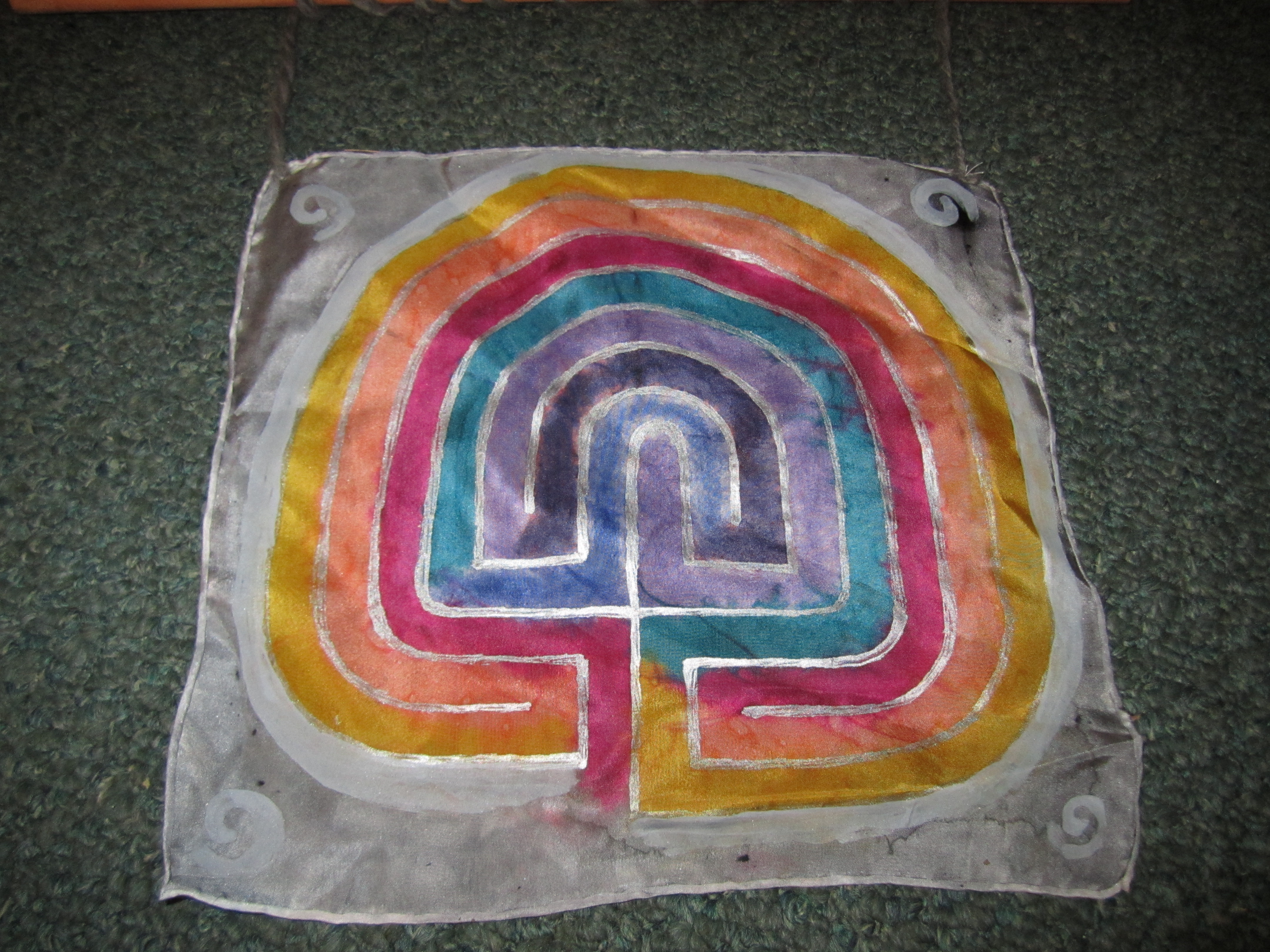
Hand-dyed silk labyrinth gift from another friend at my blessingway.

Labyrinth of pregnancy mandala drawing from my last pregnancy.

Birth doll on labyrinth backdrop.

First attempt at a sculpey finger labyrinth many years ago.

Womb labyrinth drawing following second pregnancy.


Congratulations to Sarah on her book-aversary! Remember to enter the giveaway!
—
Some past posts on my personal that include descriptions of some of the art shown:
Celebrating Pregnancy & Birth Through Art
Mother Blessing Ceremony
Pregnancy Update
Birth Art–Final Chapter
Adventures in Birth Art
More Birth Art
Previous Post
June 5, 2013
Wednesday Wisdom, book birthday party edition: Labyrinths
Next Post

June 7, 2013 Book Birthday: And the winner is...
Browse Our Archives
Select a Category abortion Adoption birth Birth Guardians birth stories breastfeeding Contraception divorce Flash Points From the Editor's Desk grandparenting home infertility marriage menstruation Miscarriage Pagan Families Parenting poetry postpartum pregnancy review ritual sex education Uncategorized Wednesday Wisdom
Select a Month September 2015 August 2015 July 2015 June 2015 May 2015 April 2015 March 2015 February 2015 January 2015 December 2014 November 2014 October 2014 September 2014 August 2014 July 2014 June 2014 May 2014 April 2014 March 2014 February 2014 January 2014 December 2013 November 2013 October 2013 September 2013 August 2013 July 2013 June 2013 May 2013 April 2013 March 2013 February 2013 January 2013 December 2012 November 2012 October 2012 September 2012 August 2012 July 2012 June 2012 May 2012 April 2012 March 2012 February 2012 January 2012 December 2011 November 2011 October 2011 September 2011 August 2011 July 2011 June 2011 May 2011
Follow Us!
TAKE THE
Religious Wisdom Quiz
True or False: Nehemiah was a cupbearer to King Nebuchadnezzar.
Select your answer to see how you score.
TRUE FALSE
Related posts from Pagan Families
Sharing Our Spiritual Path With Our Children, Part...
Sharing Our Spiritual Path With Our Children, Part...

Birth Guardians: Catherine Rivera
TRENDING AT PATHEOS Pagan

10 years of the Power Sigil & Moving...
Last week while reorganizing my studio space, I found the sketchbook that...
Here comes a rant (and TLDR: if you're a US citizen eligible...

Why are younger seekers drawn to Paganism and...
One of the things I've noticed the most is that I'm far...

When we talk about Greek religion, we often begin with the dodekatheion—the...

I was recently chatting with someone on Instagram. She asked me what...

On July 23, I saw Christopher Nolan's The Odyssey which is Homer’s...
view all Pagan blogs
Ad-Free & Subscriber Log-In Subscription Support
- About Us
- 2026 Calendar
- Videos
- Podcasts
- Library of World Religions
- Faith In Media Tracker
- Advertise With Us
- Write for Us
- Privacy Policy
- Terms of Service
- Do Not Sell My Data
- Contact Us
- Radiant Digital
- Manage Newsletter Subscriptions
- Unsubscribe From Notifications
- Sitemap
Copyright 2008-2026, Patheos. All rights reserved.
Subscription Support Ad-Free & Subscriber Log-In
Follow Patheos