
BuddhistCatholicContemplativeEvangelicalGeneral ChristianHinduJewishLatter-day SaintMuslimNew VisionsProgressive Christian
Beliefs
- Buddhist
- Catholic
- Contemplative
- Evangelical
- General Christian
- Hindu
- Jewish
- Latter-day Saint
- More Voices
- Muslim
- New Visions
- Pagan
- Progressive Christian
Topics
- Religion News
- Food and Religion
- Sports and Religion
- Religious Art
- Religious Music and Entertainment
- Religious Events
- History and Religion
- Style and Religion
- Politics and Religion
- Women in Religion
- Recreation Outdoors and Religion
- Business Finance and Religion
- Careers Workplace and Religion
- Education and Religion
- Family Parenting and Religion
- Health Fitness and Religion
- Home and Religion
- Relationships and Religion
- Technology and Religion
- Travel and Religion
Columnists
- Buddhist Columnists
- Business Finance and Religion Columnists
- Careers Workplace and Religion Columnists
- Catholic Columnists
- Contemplative Columnists
- Education and Religion Columnists
- Evangelists Columnists
- Family Parenting and Religion Columnists
- General Christian Columnists
- Health Fitness and Religion Columnists
- Hindu Columnists
- History and Religion Columnists
- Home and Religion Columnists
- Jewish Columnists
- More Voices Columnists
- Latter Day Columnists
- Muslim Columnists
- New Visions Columnists
- Nonreligious Columnists
- Pagan Columnists
- Politics and Religion Columnists
- Progressive Columnists
- Recreation Outdoors and Religion Columnists
- Relationships and Religion Columnists
- Religion News Columnists
- Religious Art Columnists
- Religious Events Columnists
- Religious Music and Entertainment Columnists
- Sports and Religion Columnists
- Style and Religion Columnists
- Technology and Religion Columnists
- Travel and Religion Columnists
- Women in Religion Columnists
Resource Library
- 2026 Calendar
- Library of World Religions
- The 100 Most Holy Places on Earth
- Patheos Answers
- Podcasts
- Videos
- Faith Leaders Database
- Anglican Episcopalian
- Bahai
- Baptist
- Buddhism
- Christianity
- Confucianism
- Eastern Orthodoxy
- Hinduism
- Holiness and Pentecostal
- ISKCON
- Islam
- Judaism
- Lutheran
- Methodist
- The Church of Jesus Christ of Latter-day Saints
- New Age
- Paganism
- Presbytarian and Reformed
- Protestantism
- Religion Behind the Scenes
- Roman Catholic
- Scientology
- Shia Islam
- Sikhism
- Sufism
- Sunni Islam
- Taoism
- Zen
- See all religions
Research Tools
 Ad-Free & Subscriber Log-In Subscription Support
Ad-Free & Subscriber Log-In Subscription Support
Follow Patheos 

- Trending:
- Forgiveness
- |
- Marriage
- |
- Consciousness
- |
- Death Penalty
- |
- Election
- |
- Halloween
 Pagan Families
- Home
- Pagan
- Family, Parenting and Religion
- Becoming a Woman – Book Review
Becoming a Woman – Book Review
Last updated on: May 16, 2013 at 9:46 am by Niki Whiting
Becoming a Woman – Book Review 2013-05-16T09:46:39-04:00 Niki Whiting
Patheos Explore the world's faith through different perspectives on religion and spirituality! Patheos has the views of the prevalent religions and spiritualities of the world.
I really wish I’d had a book on what it means to become a woman when I was 12. The only text I had was Judy Blume’s generation defining book, Are You There God? It’s Me, Margaret. I wish that some one would have told me that my cycles would be erratic for a couple of years, not just in spacing, but in flow. Finding that out at a slumber party in the 8th grade was a deeply embarrassing experience (imagine having to knock on your friend’s parents’ bedroom door in the middle of the night, because your period started all of a sudden and has soaked through everything you’re wearing, and is running down your legs. Yikes.) I wish I had known at 15 what I know now about cramps – that certain foods can exacerbate them, that giving yourself some down time, instead of just ‘pushing through’, can help minimize them. I wish I had had the confidence then in my body that I do now. I felt shame when my cramps immobilized me. I just told people I was sick when I was found crawling on hands and knees to the nurse’s office through my high school halls because I was unable to stand up.
Because of my personal menstruation history I was looking forward to reviewing Jane Harwicke Collings’ book, Becoming a Woman, a book designed for girls on the cusp of menstruating and for the women who love them. The feminist in me loves that Hardwicke Collings does not talk down to her readers. She uses science to explain the biological process of menstruation. No fluffy language used here to talk about cervices, blood, and mucus! I like that females are encouraged to get intimately acquainted with their cycles, and not just in a calendrical sense; girls are encouraged to feel their way through their cycles and see how their bodies and emotions respond to different parts of the hormonal cycle. Women are encouraged to take days of rest. This is powerful, and empowering, stuff.
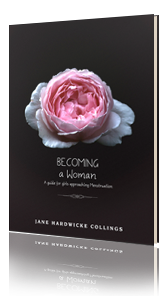
But surrounding all of that is terrible scholarship and a style of language that screams gender essentialism (women across space and time are like This because they are Female, men across space and time are like That because they are Male). I don’t know how to avoid some of the latter in a book written specifically about a female biological process. The long opening story is illustrative of the tone. In the story, a young girl is met by the Moon Goddess as she becomes a woman, and the girl meets the moon goddess every month for the rest of her life. It’s a beautiful relationship, but the Goddess tells her, “boys never get to meet me.” The Moon Goddess is for girls only.
There are issues with historical scholarship here, too. I cannot find any footnotes to back up her broad generalizations. Hardwicke Collings makes statements about “traditional cultures,” referring to red tents and moon lodges. What does she mean by “traditional cultures”? Which cultures had which? Not all “traditional cultures” had such things, and it was not usually a woman-centered joyful celebration, but rather a forced isolation to avoid communal contamination.
Another example: “Many matriarchal cultures conducted agricultural fertility rites in spring time with menstrual blood to ensure bountiful crops.” Oh yeah? Which ones? Hardwicke Collings also claims that the red bindi Hindu women wear used to be made with menstrual blood. As far as I know from my own religious studies (and a cursory glance around the internet suggests nothing different) this would violate every purity law that orthodox Hindus hold dear, even far back in the Vedic era.
There is an entire chapter on Herstory. While I am an ardent supporter of history from the feminist perspective, I can’t encourage a book that is so riddled with bad ‘feminist’ writing. I think it does feminism a disservice when scholarship is manipulated to suit one’s agenda, even though I ultimately support her overarching goals. There is plenty of legitimate history and anthropology out there to support a book like this.
I think girls (and boys, too) need coming of age rituals, and menstruation is an obvious choice for girls. Menstruation is a taboo topic in Western society. We’re encouraged to pretend it’s never happening, to push through any discomfort we might feel, to line the pockets of pharmaceutical companies with monthly purchases of pads and tampons, and to always smell like candy-coated roses. I completely support the aims of this book and Hardwicke Collings’ efforts to support women, but I would not give this book to any of my loved ones. I hope some one can take the best of this book (science, love of the female body, ritual ideas, and sacredness) and combine it with the best of feminism, not the worst. That’s the book I’d buy.
You can buy the ebook here for 10 Australian dollars.
Previous Post

May 14, 2013
Four Simple Ways to Honor Spirit in Baby's First Year
Next Post

May 20, 2013 Threshold Moments
Browse Our Archives
Select a Category abortion Adoption birth Birth Guardians birth stories breastfeeding Contraception divorce Flash Points From the Editor's Desk grandparenting home infertility marriage menstruation Miscarriage Pagan Families Parenting poetry postpartum pregnancy review ritual sex education Uncategorized Wednesday Wisdom
Select a Month September 2015 August 2015 July 2015 June 2015 May 2015 April 2015 March 2015 February 2015 January 2015 December 2014 November 2014 October 2014 September 2014 August 2014 July 2014 June 2014 May 2014 April 2014 March 2014 February 2014 January 2014 December 2013 November 2013 October 2013 September 2013 August 2013 July 2013 June 2013 May 2013 April 2013 March 2013 February 2013 January 2013 December 2012 November 2012 October 2012 September 2012 August 2012 July 2012 June 2012 May 2012 April 2012 March 2012 February 2012 January 2012 December 2011 November 2011 October 2011 September 2011 August 2011 July 2011 June 2011 May 2011
Follow Us!
TAKE THE
Religious Wisdom Quiz
Which city did Paul describe as "a city filled with idols"?
Select your answer to see how you score.
Athens Corinth Rome Jerusalem
Related posts from Pagan Families

Sharing Our Spiritual Path With Our Children, Part...
Sharing Our Spiritual Path With Our Children, Part...

Birth Guardians: Catherine Rivera

Sharing Our Spiritual Path With Our Children, Part...
TRENDING AT PATHEOS Pagan

When we talk about Greek religion, we often begin with the dodekatheion—the...

I was recently chatting with someone on Instagram. She asked me what...

While there are many people who share their results, the end of...

On July 23, I saw Christopher Nolan's The Odyssey which is Homer’s...

As I write this two big events have just finished up. One...

Restoring the Watershed of Divine Love
Perhaps cooperation is not something we manufacture through legislation, ideology, or moral...
view all Pagan blogs
Ad-Free & Subscriber Log-In Subscription Support
- About Us
- 2026 Calendar
- Videos
- Podcasts
- Library of World Religions
- Faith In Media Tracker
- Advertise With Us
- Write for Us
- Privacy Policy
- Terms of Service
- Do Not Sell My Data
- Contact Us
- Radiant Digital
- Manage Newsletter Subscriptions
- Unsubscribe From Notifications
- Sitemap
Copyright 2008-2026, Patheos. All rights reserved.
Subscription Support Ad-Free & Subscriber Log-In
Follow Patheos