
BuddhistCatholicContemplativeEvangelicalGeneral ChristianHinduJewishLatter-day SaintMuslimNew VisionsProgressive Christian
Beliefs
- Buddhist
- Catholic
- Contemplative
- Evangelical
- General Christian
- Hindu
- Jewish
- Latter-day Saint
- More Voices
- Muslim
- New Visions
- Pagan
- Progressive Christian
Topics
- Religion News
- Food and Religion
- Sports and Religion
- Religious Art
- Religious Music and Entertainment
- Religious Events
- History and Religion
- Style and Religion
- Politics and Religion
- Women in Religion
- Recreation Outdoors and Religion
- Business Finance and Religion
- Careers Workplace and Religion
- Education and Religion
- Family Parenting and Religion
- Health Fitness and Religion
- Home and Religion
- Relationships and Religion
- Technology and Religion
- Travel and Religion
Columnists
- Buddhist Columnists
- Business Finance and Religion Columnists
- Careers Workplace and Religion Columnists
- Catholic Columnists
- Contemplative Columnists
- Education and Religion Columnists
- Evangelists Columnists
- Family Parenting and Religion Columnists
- General Christian Columnists
- Health Fitness and Religion Columnists
- Hindu Columnists
- History and Religion Columnists
- Home and Religion Columnists
- Jewish Columnists
- More Voices Columnists
- Latter Day Columnists
- Muslim Columnists
- New Visions Columnists
- Nonreligious Columnists
- Pagan Columnists
- Politics and Religion Columnists
- Progressive Columnists
- Recreation Outdoors and Religion Columnists
- Relationships and Religion Columnists
- Religion News Columnists
- Religious Art Columnists
- Religious Events Columnists
- Religious Music and Entertainment Columnists
- Sports and Religion Columnists
- Style and Religion Columnists
- Technology and Religion Columnists
- Travel and Religion Columnists
- Women in Religion Columnists
Resource Library
- 2026 Calendar
- Library of World Religions
- The 100 Most Holy Places on Earth
- Patheos Answers
- Podcasts
- Videos
- Faith Leaders Database
- Anglican Episcopalian
- Bahai
- Baptist
- Buddhism
- Christianity
- Confucianism
- Eastern Orthodoxy
- Hinduism
- Holiness and Pentecostal
- ISKCON
- Islam
- Judaism
- Lutheran
- Methodist
- The Church of Jesus Christ of Latter-day Saints
- New Age
- Paganism
- Presbytarian and Reformed
- Protestantism
- Religion Behind the Scenes
- Roman Catholic
- Scientology
- Shia Islam
- Sikhism
- Sufism
- Sunni Islam
- Taoism
- Zen
- See all religions
Research Tools
 Ad-Free & Subscriber Log-In Subscription Support
Ad-Free & Subscriber Log-In Subscription Support
Follow Patheos 

- Trending:
- Forgiveness
- |
- Marriage
- |
- Consciousness
- |
- Death Penalty
- |
- Election
- |
- Halloween
 Pagan Families
- Home
- Pagan
- Family, Parenting and Religion
- Placenta Magic
Placenta Magic
Last updated on: March 15, 2013 at 6:08 am by Priestess Molly
Placenta Magic 2013-03-13T10:09:13-04:00 Priestess Molly
Patheos Explore the world's faith through different perspectives on religion and spirituality! Patheos has the views of the prevalent religions and spiritualities of the world.
…And when you see this wondrous thing
That grew me up so well,
Say thank you to the Goddess
Who made us from one cell…*–Dr. Sarah Buckley, “Ode to My Placenta”
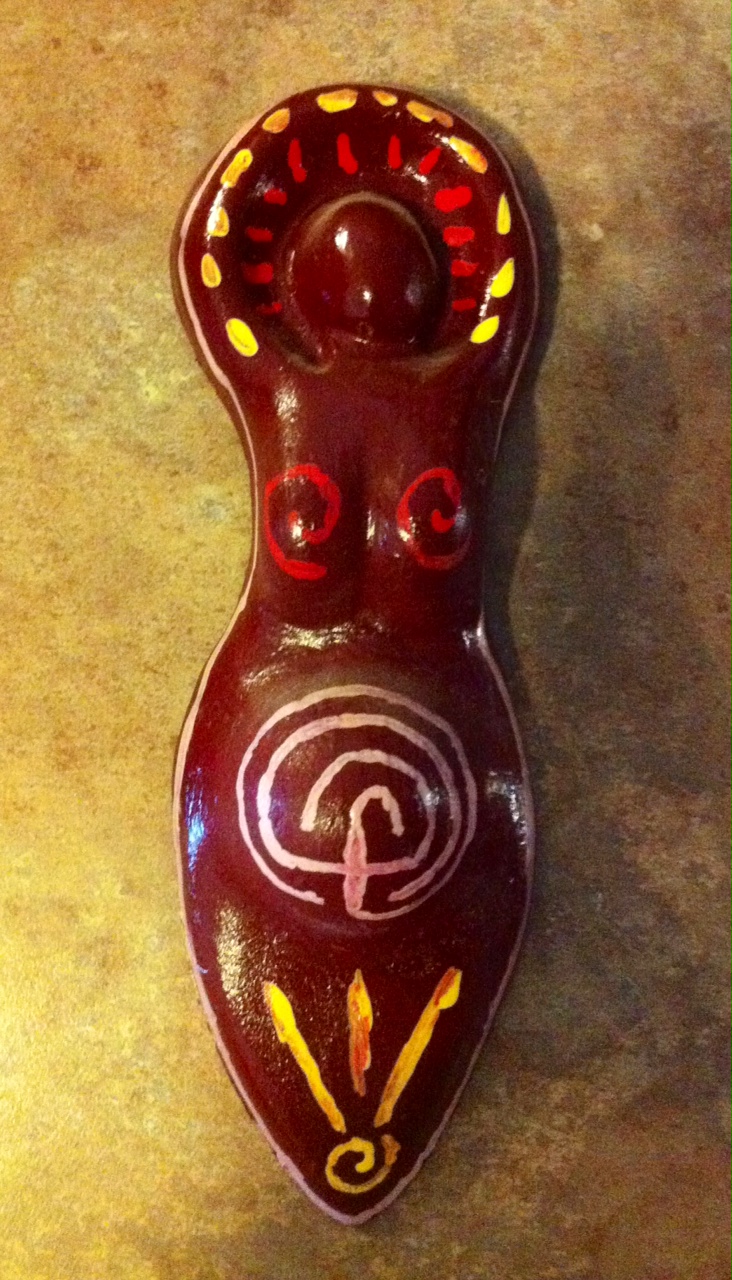
I’ve said for many years now that my favorite color is “placenta red.” A deep, rich, life-saturated red. I’m amazed by the placenta. How cool is it that we can grow a whole new organ and then just release it from our bodies when it is no longer needed? Pretty cool. I think the reason the placenta might not get as much acknowledgement and appreciation as it deserves is because it then pales in comparison to the miracle of a whole new person suddenly showing up on the earth as well. Forget growing a new organ, I just gave birth to a new person!!!! And so, the placenta may be cast aside with hardly a glance or even much thought to its powerful role in pregnancy and the sustaining gift of life it offers.
In a lovely article called “The Placenta Project: An Artful Birth-based Inquiry,” Nane Jordan (writing in the current issue of Midwifery Today) explains:
I love the placenta as a literal metaphor for communication and communion, for reclaiming birth, midwifery, and women’s body knowledge in a society that seems to have lost connection to the earthy mother-fabric of our origins.
Though shrouded in ‘blood taboo,’ as is a woman’s menstrual and postpartum blood…the placenta is truly an honorable life-giver. A sign of its taboo status is the immediate disgust so many people feel at seeing the placenta’s incomprehensible blood-filled mass. The stigma of women’s blood is augmented by fears of contamination and disease through contact with blood. After birth, the placenta is most commonly treated as refuse (what is refused) or garbage and discarded as a waste product. Though our society has an insatiable appetite for gore and violent bloodshed, we are seemingly lost when it comes to viewing the blood that gives life (p. 50).
So, how might we give the placenta a little bit of recognition? Here are some possibilities:
- Have a lotus birth—leave the placenta and cord attached to the baby until it naturally separates on its own timetable. Women writing about lotus birth experiences describe a very mystical sense of communion with the placenta and are adamant that it is still beneficial to the baby after birth. Sarah Buckley describes more about this process in her article: Lotus birth – a Ritual for our Times
- Plant it—many families choose to plant a special tree, shrub, or plant over their baby’s placenta, feeling that just as the placenta nourished the baby, it can now nourish the earth and another life.
- Create art with it—using blood or paint, place a sheet or paper or cloth over the placenta. Lift up gently to create a “placenta print.” Other women shape and dry the cord to save as a sort of ornament. Recently, I read an article about using a cross section of the cord to create a unique art portrait of the greatly magnified life-giving tissue specimen.
- Encapsulate it—in this process, the placenta is dried and powdered and put into capsules for the mother to ingest postpartum. Though research is not ample on this process, anecdotal reports are very enthusiastic about the benefits of doing so.
I’d love to hear your ideas, particularly about additional rituals of celebration! In my own case, I wish I’d done a little more to celebrate the placenta’s role in each of my children’s lives. Here’s what I actually did:
- First birth: I meant to take my first son’s placenta home from the birth center to plant under a tree, but then forgot it. When we back for a postpartum visit, we asked for it, but it had already been discarded with the other “hazardous waste.”
- Second birth: My mother was tasked with making a placenta print. It was hard to handle and resulted in very limited success! (I rolled the print up and keep it behind my belly cast from this pregnancy, which seems fitting. In honor of this post, I unrolled it for the first time in almost seven years and took a picture! See gallery below). When this son was about two years old, we finally buried his placenta ceremonially underneath a nectarine tree. We experienced two redneck moments with regard to this solemn occasion: we cracked up while planting it because the tree had a label around it that said “super sweet” and it looked like it was pointing the placenta. And, when we were digging through the freezer to find it, my husband said, “here it is!” and I had to say, “actually, I think that is a squirrel.” You know you’re a redneck if…you confuse the squirrel in your freezer with your placenta…
- Third birth: this was a second trimester miscarriage at home in which the placenta did not release until 6 days later. I was desperate for the placenta to come out and I talked to it, saying that I would do something special with it if only it would just come out. When it finally had to be gently twisted free by a midwife, it had decomposed enough that it came out in many little chunks. At the time, I was so relieved to have it gone, that I didn’t care when she tossed it in the trash. Later, I wished I had brought it home to bury and to acknowledge for having tried so hard to keep my baby alive that it wasn’t willing to let go even after my baby left me.
- Fourth birth: my postpartum doula was tasked with making a placenta print. She did so on paper with marginal success. Paint would probably have been helpful, but since we were also encapsulating it, we did not use paint (as with my son, I rolled this print up and stored it behind my belly cast from the pregnancy). After this birth, I consumed a dime-sized piece of the placenta immediately after the birth and then my doula took it home to encapsulate. I became a huge fan of placenta encapsulation after this experience (more about my personal experience is here).
- After each newborn, I also chose to keep their cord stumps after they fell off and I keep them all in an amulet bag that I originally wore around my neck throughout my first labor.
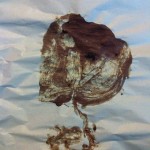
Placenta print from last pregnancy. Something that is interesting to me to see about this is how very small her placenta was! photo courtesy of the author
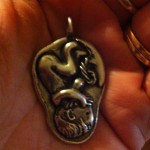
“Sacred Body Jewelry”–I love that it includes this nice, healthy looking placenta and cord. photo courtesy of the author
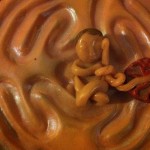
Birth labyrinth that I made during my last pregnancy and a lovely little baby-and-placenta gift made by my friend as a mother blessing gift. photo courtesy of the author
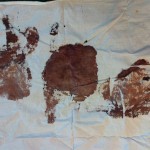
Placenta prints from second birth. I actually laughed out loud as I unrolled them, since they are so “artistic.” photo courtesy of the author
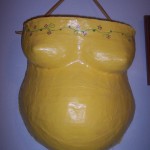
Belly cast from second pregnancy. photo courtesy of the author
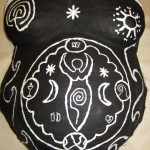
Belly cast from last pregnancy. photo courtesy of the author
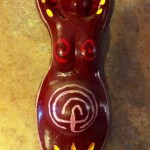
Plaster birth goddess painted in “placenta red.” photo courtesy of the author
*In the version of Buckley’s Ode to the Placenta that I had saved in a folder on my computer, this is the last line. Googling for it, so I could link to it in this post, only produced a handful of websites (not hers) that had the poem reproduced, but with “Goddess” replaced with “God.” I’m really curious to know which version is correct! I find the differences interesting…
Previous Post
March 13, 2013
Wednesday Wisdom: Inhale
Next Post

March 18, 2013 Creating a Birth Altar, Part 1
Browse Our Archives
Select a Category abortion Adoption birth Birth Guardians birth stories breastfeeding Contraception divorce Flash Points From the Editor's Desk grandparenting home infertility marriage menstruation Miscarriage Pagan Families Parenting poetry postpartum pregnancy review ritual sex education Uncategorized Wednesday Wisdom
Select a Month September 2015 August 2015 July 2015 June 2015 May 2015 April 2015 March 2015 February 2015 January 2015 December 2014 November 2014 October 2014 September 2014 August 2014 July 2014 June 2014 May 2014 April 2014 March 2014 February 2014 January 2014 December 2013 November 2013 October 2013 September 2013 August 2013 July 2013 June 2013 May 2013 April 2013 March 2013 February 2013 January 2013 December 2012 November 2012 October 2012 September 2012 August 2012 July 2012 June 2012 May 2012 April 2012 March 2012 February 2012 January 2012 December 2011 November 2011 October 2011 September 2011 August 2011 July 2011 June 2011 May 2011
Follow Us!
TAKE THE
Religious Wisdom Quiz
How many times did Elijah pray for rain?
Select your answer to see how you score.
7 5 9 3
Related posts from Pagan Families

Birth Guardians: Catherine Rivera

Ritual after a traumatic birth


TRENDING AT PATHEOS Pagan

I was recently chatting with someone on Instagram. She asked me what...

While there are many people who share their results, the end of...

On July 23, I saw Christopher Nolan's The Odyssey which is Homer’s...

As I write this two big events have just finished up. One...

Restoring the Watershed of Divine Love
Perhaps cooperation is not something we manufacture through legislation, ideology, or moral...

Many UUs don’t pray because of bad experiences in a previous religion,...
view all Pagan blogs
Ad-Free & Subscriber Log-In Subscription Support
- About Us
- 2026 Calendar
- Videos
- Podcasts
- Library of World Religions
- Faith In Media Tracker
- Advertise With Us
- Write for Us
- Privacy Policy
- Terms of Service
- Do Not Sell My Data
- Contact Us
- Radiant Digital
- Manage Newsletter Subscriptions
- Unsubscribe From Notifications
- Sitemap
Copyright 2008-2026, Patheos. All rights reserved.
Subscription Support Ad-Free & Subscriber Log-In
Follow Patheos