
BuddhistCatholicContemplativeEvangelicalGeneral ChristianHinduJewishLatter-day SaintMuslimNew VisionsProgressive Christian
Beliefs
- Buddhist
- Catholic
- Contemplative
- Evangelical
- General Christian
- Hindu
- Jewish
- Latter-day Saint
- More Voices
- Muslim
- New Visions
- Pagan
- Progressive Christian
Topics
- Religion News
- Food and Religion
- Sports and Religion
- Religious Art
- Religious Music and Entertainment
- Religious Events
- History and Religion
- Style and Religion
- Politics and Religion
- Women in Religion
- Recreation Outdoors and Religion
- Business Finance and Religion
- Careers Workplace and Religion
- Education and Religion
- Family Parenting and Religion
- Health Fitness and Religion
- Home and Religion
- Relationships and Religion
- Technology and Religion
- Travel and Religion
Columnists
- Buddhist Columnists
- Business Finance and Religion Columnists
- Careers Workplace and Religion Columnists
- Catholic Columnists
- Contemplative Columnists
- Education and Religion Columnists
- Evangelists Columnists
- Family Parenting and Religion Columnists
- General Christian Columnists
- Health Fitness and Religion Columnists
- Hindu Columnists
- History and Religion Columnists
- Home and Religion Columnists
- Jewish Columnists
- More Voices Columnists
- Latter Day Columnists
- Muslim Columnists
- New Visions Columnists
- Nonreligious Columnists
- Pagan Columnists
- Politics and Religion Columnists
- Progressive Columnists
- Recreation Outdoors and Religion Columnists
- Relationships and Religion Columnists
- Religion News Columnists
- Religious Art Columnists
- Religious Events Columnists
- Religious Music and Entertainment Columnists
- Sports and Religion Columnists
- Style and Religion Columnists
- Technology and Religion Columnists
- Travel and Religion Columnists
- Women in Religion Columnists
Resource Library
- 2026 Calendar
- Library of World Religions
- The 100 Most Holy Places on Earth
- Patheos Answers
- Podcasts
- Videos
- Faith Leaders Database
- Anglican Episcopalian
- Bahai
- Baptist
- Buddhism
- Christianity
- Confucianism
- Eastern Orthodoxy
- Hinduism
- Holiness and Pentecostal
- ISKCON
- Islam
- Judaism
- Lutheran
- Methodist
- The Church of Jesus Christ of Latter-day Saints
- New Age
- Paganism
- Presbytarian and Reformed
- Protestantism
- Religion Behind the Scenes
- Roman Catholic
- Scientology
- Shia Islam
- Sikhism
- Sufism
- Sunni Islam
- Taoism
- Zen
- See all religions
Research Tools
 Ad-Free & Subscriber Log-In Subscription Support
Ad-Free & Subscriber Log-In Subscription Support
Follow Patheos 

- Trending:
- Forgiveness
- |
- Marriage
- |
- Consciousness
- |
- Death Penalty
- |
- Election
- |
- Halloween
 Orthodoxy in Communion With Rome
- Home
- Catholic
- Orthodox! But in communion with Rome? Choosing Sides in America’s Francis Feud
Orthodox! But in communion with Rome? Choosing Sides in America’s Francis Feud
Last updated on: June 2, 2018 at 3:16 pm by Pete Vere
Orthodox! But in communion with Rome? Choosing Sides in America’s Francis Feud 2018-06-02T15:16:48-05:00 Pete Vere
Patheos Explore the world's faith through different perspectives on religion and spirituality! Patheos has the views of the prevalent religions and spiritualities of the world.
Would I consider jumping to an Eastern Orthodox jurisdiction prior to restoration of full communion between Constantinople, Moscow and Rome?
It’s an interesting question. Especially for a former Traditional Latin Mass apologist turned Byzantine Catholic ecumenist. And especially for one who already practices and considers himself Orthodox in communion with Rome.
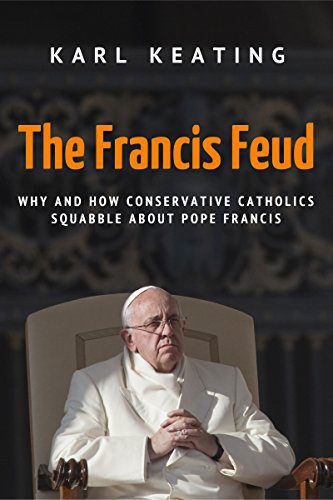
Yet here I am again wrestling with this question. Or perhaps I should say mulling it over given my after-hours gig as a professional wrestling referee. In large part, the mulling over is sparked by the publication of my friend Karl Keating’s new book: The Francis Feud: Why and How Conservative Catholics Squabble about Pope Francis.
Responding to Lawler’s “Bad” Pope
It was Karl who first questioned how much further I was headed in my spiritual trajectory to the East. I believe Karl was asking rhetorically and out of exasperation. Along with mutual friend Dave Armstrong, we were debating the need to read Phil Lawler’s new book criticizing Pope Francis in order to draw conclusions about it. Especially with Phil’s wife Leila having declared publicly that she and Phil were seeking to expose Francis as “a bad pope”.
As Karl notes in his new book, his comments promoting Lawler’s book, and the ensuing online discussion in which my trajectory to the East was questioned, “seem to have surprised some of my apologist friends, among them Dave Armstrong and Pete Vere. […] Before this we seldom had disagreed on any substantial point of theology or ecclesiology, but now a divide appeared. I was on one side of the gap, and they were on the other.”
My response to Phil and Leila was to list off various professional Catholics who had embraced sedevacantism after becoming critical of a recently reigning Roman Pontiff. Sedevacantism is the belief that the Seat of St Peter (sede) is empty (vacante). Some sedevacantists believe the string of false popes began with John XXIII or Paul VI. Others believe that Francis is an anti-pope who usurped the papal throne from his predecessor Benedict XVI. In every case, the trajectory toward sedevacantism began with the individual accusing the Roman Pontiff of secretly undermining orthodox Catholic teaching.
Of course my response to Karl’s question at the time was as follows: Eastern Catholicism is Eastern Christianity. So unless one is proposing that Eastern Catholics are not real Catholics unless they are Latinized, how can one go any further than Eastern Catholicism in one’s spiritual trajectory as an Eastern Catholic?
This was my take-home from the three-way exchange with Karl and Dave. To read Dave’s, please click on the following link.
Rome and the Charism of Unity
Six months later, would I answer Karl’s question the same way?
Yes, I would. At least here in Canada. And likely throughout most of the world as well. As Karl himself explains in his book’s introduction:
Those familiar with ecclesiastical history know—or at least they sense—that the Petrine office has been key in keeping the Church from going off the rails. “Confirm your brethren,” Christ instructed Peter (Luke 22:32). The authority given to Peter, whose nickname means “Rock,” is awe-full. It is Christ’s own authority, given to Peter, as head of the apostles, in a way not given to the other apostles.
Christ in the Divine Liturgy and Eucharist unites the Church throughout time and space. However, it is the Roman Pontiff as successor to St Peter who visibly unites Christians here on earth. I respect my Eastern Orthodox brothers and sisters, and I yearn for restoration of full communion between our Churches. Nevertheless, I find myself as a Byzantine Christian in need of communion with the Roman Pontiff. This is because of the unity he represents among Christians throughout the world.
The American Ecclesial Anomaly
So why might I personally consider Orthodoxy apart from full juridical communion with the Roman Pontiff?
In looking at the U.S. Church right now, one encounters a strange anomaly within both Catholicism and Orthodoxy. Especially in how each relates to Pope Francis. Politically neo-conservative American Catholic commentators–including well-known Catholic apologists and media personalities–are attacking and/or undermining Pope Francis constantly. The trend is worrying to many Catholics elsewhere in the English-speaking world–such as myself as a Canadian political conservative, or my friend British conservative and papal biographer Stephen Walford.
Often, the Holy Father is mocked for voicing the concerns of other parts of the Church, such as developing nations. Or the issue may be one like capital punishment where Pope Francis is simply expressing the consensus that has arisen among Catholics in the rest of the world. Either way, American Catholic neo-conservatives don’t like Pope Francis.
In contrast, many “big O” Orthodox American-based theologians and spiritual leaders are defending the Holy Father. So I question whether in the current U.S. ecclesial climate, going from Catholicism to Orthodoxy when crossing the border would be considered a jump. At least in relation to attitudes toward Pope Francis and his presentation of Catholic teaching. Whereas American Catholicism is in communion with Rome according to the letter of canon law, American Orthodoxy strikes me today as closer to universal Catholicism in spirit. At least when one looks at various recent controversies to arise in the American Church.
A Jesuit with Franciscan Humility
As mentioned above, American Catholic celebrity couple Phil and Leila Lawler argue Francis is a bad pope. Judging from Phil’s media appearances surrounding the release of his book, he has many supporters among his American co-religionists.
What do American Orthodox think? The majority of American-based Orthodox who I come across think Francis is a good pope. In fact, my previous blog reflects upon how Abbott Tryphon of the Russian Orthodox Church Outside of Russia (ROCOR) describes Pope Francis as “a Jesuit with a Franciscan’s humility.” Fr Tryphon then declares Francis “a pope that we Orthodox can work with and a man that we can love.”
Which of these two attitudes better represents the universal spirit of Catholicism? Phil and Leila’s in dismissing Francis as a ‘bad’ pope? Or Fr Tryphon in acknowledging Francis as a pope to love and work with as one’s own?
In answering this question, I would invite you to reflect upon Christ’s parable of the Good Samaritan. Except in this case it is neo-conservative Catholic commentators who are attacking Pope Francis and ditching his papacy.
Pope Francis and Hell
Another example of American Orthodox defending Pope Francis from American Catholic critics is with regards to the recent hell tempest. For those who have forgotten, this was another incident in which 93-year-old atheist and journalist Eugenio Scalfari incorrectly reported an informal and unrecorded interview between the two. Despite Pope Francis’s prior warning to mafioso on their eternal fate should they fail to repent, Scalfari (incorrectly) reported that Pope Francis denies hell’s existence.
The immediate reaction of Phil Lawler and Catholics of his ilk was to denounce Pope Francis. Some suggested he was a closet heretic. Others accused the Holy Father of intentionally spreading confusion. The remainder denounced Francis for recklessness and of papal negligence in continuing to grant Scalfari interviews. For a thorough rebuttal of these positions, please see Dave Armstrong’s Lawler vs. Pope Francis #3: The Pope Annihilated Hell? To his credit, Dave has been the one American-based professional Catholic apologist to consistently defend Pope Francis from professional Catholic critics.
Yet Dave’s apologia for Pope Francis was seconded by that of Sister Vassa, a ROCOR nun and theologian popular in Eastern Christian social media. (Sister is sometimes described by Byzantine Catholics as the Orthodox Church’s Mother Angelica.) Sister Vassa immediately drew her listeners’ attention to Scalfari’s unreliability in previous papal interviews. She also reminded her audience of previous papal statements in which Pope Francis spoke candidly of hell and the devil.
Most importantly, Sister Vassa asked people to give Pope Francis the benefit of any doubt. You can view the video beginning around the 13:20 mark by clicking here.
As my friend Rosemarie Scott wrote at the time:
If only [Pope Francis’s] Catholic critics could have such grace and charity toward him. She’s right, it is not healthy for Christians to not give him the benefit of the doubt, especially when the doubt is this substantial: an alleged paraphrase of something he supposedly said in a private discussion which flatly contradicts multiple clear statements he made publicly in the past, coming from an atheist who has misrepresented his words before.
In short, Sister Vassa accurately demonstrated a spirit of Catholic charity toward Pope Francis. Whereas most of the Holy Father’s Catholic critics immediately assumed the worst. Which of the two responses demonstrated a Catholic spirit?
Young People and the Church
Raymond Arroyo’s EWTN coverage of Pope Francis has become increasingly scrutinized by Catholics faithful to the Holy Father. One of these individuals is Mike Lewis, with whom I am part of a group blog faithful to Pope Francis. The name of the blog is Where Peter Is.
In Raymond Arroyo: Derision Over Truth, Mike shares a clip from Arroyo’s The World Over. In it Arroyo mocks a gathering of young Catholics in Rome. “Why are we listening to young people, who really haven’t experienced a lot of life, or God, frankly?” Arroyo sneers. (If you think “sneer” is an exaggeration, please watch the clip.)
As Mike explains:
The implications here are nothing short of dismissive, not only to to the concerns of Catholic young people in general, but the the 305 young adults who gathered in Rome from March 19 to 25 to discuss issues relevant to vocations and the faith of young people. His tone arguably projects an air of condescension that infects the entire segment of the program.
Regarding the youth he was questioning: this was not a random sample of teenagers picked up off the street. First of all, the entire delegation was made up of young adults (18 years or older). Participants were selected by their national bishops’ conferences and represented a wide variety of life experiences and cultural backgrounds. They came from all continents: Africa, Asia, the Americas, Australia, and Europe.
My own passing commentary, also written at Where Peter Is in a blog differentiating Traditionalism from Fundamentalism, is as follows:
By way of comparing attitudes, please listen to Ancient Faith Radio’s podcast Why Young People Are Leaving the [Eastern Orthodox] Church and What to Do About It. The lecture, given by Orthodox seminary faculty and former Princeton Seminary assistant director Seraphim Danckaert, addresses the need to encourage young people in their traditional Orthodox Christianity. “We need to have young people entering professional life still committed to their Orthodox faith to have a vibrant Church,” Danckaert states.
If Sister Vassa is often described at the Orthodox Church’s Mother Angelica, then Ancient Faith Radio is similarly described as the Orthodox Church’s EWTN. At least prior to the latter’s American politicization. Fortunately, in contrast to EWTN’s Raymond Arroyo, Pope Francis’s attitude toward youth involvement is closer to that of Professor Danckaert.
Poverty
Nowhere are differing attitudes between popular American Catholicism and popular American Orthodoxy more noticeable than when it comes to helping the poor with our tax dollars. As urged by Pope Francis in Evangelii Gaudium (par 57): “I encourage financial experts and political leaders to ponder the words of [Saint John Chrysostom], one of the sages of antiquity: ‘Not to share one’s wealth with the poor is to steal from them and to take away their livelihood. It is not our own goods which we hold, but theirs.'”
And again in paragraph 187, Pope Francis teaches: “Each individual Christian and every community is called to be an instrument of God for the liberation and promotion of the poor, and for enabling them to be fully a part of society. This demands that we be docile and attentive to the cry of the poor and to come to their aid.”
One finds a jarring disjoint between the Catholic language of Pope Francis’s exhortation, and Austin Ruse’s following protest against Catholic political support for social assistance. (Hat Tip to fellow Patheos blogger Melinda Selmys for her piece Poverty Is Not What Austin Ruse Wants You To Think It Is.) For a good Catholic critique of Ruse’s article, see Mindy Selmis Not surprisingly, Ruse published his critique in Crisis Magazine, which is the flagship publication of American Catholic neo-conservatism:
Any criticism of federal programs for the poor is met by the political left in the Church with charges of “hating the poor” and that you have committed a mortal sin for supposedly opposing the teachings of the Church. Such charges in this case would be false and defamatory. Rather, this should be read as a call for a realistic view of poverty in America. The poor deserve our love and support. But, in order to alleviate poverty, one must begin with a true picture, and what we have been given to believe is to a large extent fake science.
Over at Ancient Faith Radio, the aforementioned Fr Tryphon tackles the same topic in his blog A Morning Offering:
Saint John Chrysostom taught that, “the poor are not the spectacle of human misery and suffering that evokes compassion or disgust, but they are the icons of Christ, the presence of Christ in the broken world.” […]
In an age when so many rich are resisting the possibility of increased taxation, we must remember that we are all, rich or poor, required by the Gospels to share with those around us. Christian nations from the time of Byzantium have taxed the wealthy in order to provide for the least of their people. The heretical teachings being floated about that abundance and prosperity are signs of a strong Christian faith, has infected many in our nation.
In comparing these two American religious authors, who better exemplifies the traditional spirit of Catholicism as exhorted by Pope Francis? The Catholic or the Orthodox?
Capital Punishment
One last example of differing attitudes toward Pope Francis and the universal Church concerns the topic of capital punishment. America Magazine recently captured the Holy Father’s position as follows:
“One has to strongly affirm that condemnation to the death penalty is an inhuman measure that humiliates personal dignity, in whatever form it is carried out. And [it] is, of itself, contrary to the Gospel, because it is freely decided to suppress a human life that is always sacred in the eyes of the Creator, and of which, in the final analysis, God alone is the true judge and guarantor,” Pope Francis said.
As one would expect, the pope’s statement garnered very little controversy throughout most of the world. The Holy Father was simply articulating the universal Catholic consensus for abolition of capital punishment–one that had developed since the Second Vatican Council. Recent popes, patriarchs, bishops, clergy, learned theologians, and laity throughout the world had come to discern what Pope Francis expressed.
The one exception was neo-conservative American Catholic media and its satellites in the English-speaking world. For these folks, the universal Catholic consensus over capital punishment was tantamount to heresy. Some even compared it to Arianism and other Christological heresies that threatened the early Church.
Among the more notable examples of American neo-conservative overreaction is Catholic apologist and philosopher Dr Ed Feser. He wrote:
This is only the tip of the iceberg. In our book By Man Shall His Blood Be Shed: A Catholic Defense of Capital Punishment, Joseph Bessette and I assemble a mountain of evidence […] that shows conclusively that the legitimacy of capital punishment is irreformable Catholic teaching. And if that is so, then it follows that a pope who taught that capital punishment was always and intrinsically wrong would be as manifestly guilty of doctrinal error as he would be if he denied the Trinity. (Such doctrinal error is possible when a pope is not speaking ex cathedra, though it is extremely rare […])
First, why would any serious Catholic today expend the time and energy necessary to “assemble a mountain of evidence […] that shows conclusively the legitimacy of capital punishment as irreformable Catholic teaching”? To paraphrase these same proponents of capital punishment when it comes to Catholic opposition to waterboarding, other forms of torture, mistreatment of immigrants and refugees, sexual assault in Catholic colleges, Tweets of the First Lady’s backside in tight-fitting clothing, and other issues that reduce the dignity of the human person, should not priority be given to fighting abortion?
Why the sudden apoplectic apologetic for capital punishment? Why not adopt the consensus of pro-life Catholic activists outside the United States who oppose both capital punishment and abortion? Even if only to maintain solidarity with the rest of the Catholic communion.
Second, By Man Shall His Blood Be Shed is a horribly bloodthirsty title. It resonates more as a stereotype for American Bible Fundamentalism, unless one is talking about Our Lord’s self-sacrifice during His Passion. Certainly it does not resonate with the universal spirit of Catholicism following the Second Vatican Council.
In America, two Orthodox philosophers and theologians called out Feser. The first is Aristotle Papanikolaou in a one-line tweet pointing out the absurdity of comparing capital punishment to the Mystery of the Most Holy Trinity.
The second was David Bentley Hart who wrote an extensive article refuting Feser, subtitled There is no Patron Saint of Executioners. I would invite you to read the entire essay. However, the following paragraph is particular pithy for its defence of Catholic teaching and the Catholic consensus that has developed over capital punishment:
Feser and Bessette are clearly struggling against the inexorable course magisterial pronouncements on this matter have been taking for decades. They twist and turn in every direction trying to evade or relativize the current teachings of the Catholic Church, and acknowledge the authority of those teachings only with extreme qualifications. They do their damnedest to suggest that all of it constitutes no more than a prudential judgment regarding current social circumstances. To no avail. Admittedly, the Catholic Church has never committed itself doctrinally to the abolition of the death penalty, and it is true that magisterial interpretations of doctrine are somewhat fluid and of less than dogmatic authority. Still, in the eyes of the Catholic Church, the explicit teaching of the magisterium on matters of faith and morals is universally binding on the consciences of the faithful. And as regards this question that teaching is clearly stated in the Catechism: the death penalty may be permissible solely “if this is the only possible way of effectively defending human lives against the unjust aggressor,” though today, given the facilities available to the state for detaining criminals, such cases “are very rare, if not practically nonexistent” (2267). That is quite unambiguous. The only time execution may be acceptable is when it is otherwise impossible to prevent a criminal from killing again. That means that all the other arguments advanced by Feser and Bessette have already been decisively ruled out by the magisterium as morally insufficient; and this is not going to change. If any position, then, is to be regarded as contrary to Catholic orthodoxy, it is theirs.
Forget rhetorical questions. Between the two American philosophers and Christian apologists–one Catholic and the other Orthodox–there is no question who rises to the defence of Pope Francis and his articulation of the near-universal Catholic consensus on this topic. Hart even appeals to the Catechism of the Catholic Church!
Conclusion
St Jerome once wrote famously: “The whole world awoke and groaned to find itself Arian.” Today this could be rewritten as “The English-speaking Catholic world awoke and groaned to find itself politically neo-conservative with a dose of American Bible Fundamentalism.”
In response to Karl today, as a Byzantine Catholic who practices Orthodoxy in communion with Rome, I remain committed to both the Traditions of Orthodoxy and to communion with the Roman Pontiff. Yet what does this mean given the current context of American ecclesiastical politics? In terms of what you have labelled the Francis Feud, please count me among the American Orthodox cited.
Previous Post
June 1, 2018
"A Jesuit with a Franciscan's humility," states Russian Orthodox abbott
Next Post

June 16, 2018 Breaking the Stranger's Family: When Canada terrorized children
Browse Our Archives
Select a Category Canon Law Catholic Apologetics East-West Ecumenism Eastern Christian Identity Eucharistic Ecclesiology Faith and Family Faith and Pop Culture Family Adventures Liturgy and Eucharist Living the Byzantine Catholic Faith Mormon and Community of Christ Motorcycling Pope Francis Pro-life Professional Wrestling and MMA Sex Abuse Scandal Social Justice Uncategorized
Select a Month November 2019 August 2019 July 2019 April 2019 March 2019 February 2019 December 2018 October 2018 June 2018 May 2018 April 2018 March 2018
Follow Us!
TAKE THE
Religious Wisdom Quiz
What was the rider of the Red Horse in Revelation given?
Select your answer to see how you score.
A large sword A balance scale A bow A crown
Related posts from Orthodoxy in Communion With Rome
"Rejoice, O Wood and Tree of Life, the...
Orthodoxy in Communion With Rome
Orthodoxy in Communion With Rome
The Pro-Life Movement is Bigger Than America: A...
Orthodoxy in Communion With Rome
Pope Emeritus Benedict: No longer the voice of...
Orthodoxy in Communion With Rome
TRENDING AT PATHEOS Catholic

The Parable Of The Sower And The Word...
One of Christ’s most famous parables is that of the sower who...

Rejecting Doom: Christian Hope And Human Action
Christianity is a religion of hope. We are to have hope and...

Why I Choose the Eucharist Over the Sermon
Choose the Eucharist, Not the Sermon What are we supposed to get...

5 Design Elements Found in Spiritually Rooted Homes
Putting Spirituality Into Home Decor Our homes are more than our living...

Credo: A Story of God Told with the...
About 10 years ago, I began to imagine a personal "Credo" that...

The Anatomy of Divine Revelation in Catholic Thought
The claim that God has made Himself known to human beings is...
view all Catholic blogs
Ad-Free & Subscriber Log-In Subscription Support
- About Us
- 2026 Calendar
- Videos
- Podcasts
- Library of World Religions
- Faith In Media Tracker
- Advertise With Us
- Write for Us
- Privacy Policy
- Terms of Service
- Do Not Sell My Data
- Contact Us
- Radiant Digital
- Manage Newsletter Subscriptions
- Unsubscribe From Notifications
- Sitemap
Copyright 2008-2026, Patheos. All rights reserved.
Subscription Support Ad-Free & Subscriber Log-In
Follow Patheos