
BuddhistCatholicContemplativeEvangelicalGeneral ChristianHinduJewishLatter-day SaintMuslimNew VisionsProgressive Christian
Beliefs
- Buddhist
- Catholic
- Contemplative
- Evangelical
- General Christian
- Hindu
- Jewish
- Latter-day Saint
- More Voices
- Muslim
- New Visions
- Pagan
- Progressive Christian
Topics
- Religion News
- Food and Religion
- Sports and Religion
- Religious Art
- Religious Music and Entertainment
- Religious Events
- History and Religion
- Style and Religion
- Politics and Religion
- Women in Religion
- Recreation Outdoors and Religion
- Business Finance and Religion
- Careers Workplace and Religion
- Education and Religion
- Family Parenting and Religion
- Health Fitness and Religion
- Home and Religion
- Relationships and Religion
- Technology and Religion
- Travel and Religion
Columnists
- Buddhist Columnists
- Business Finance and Religion Columnists
- Careers Workplace and Religion Columnists
- Catholic Columnists
- Contemplative Columnists
- Education and Religion Columnists
- Evangelists Columnists
- Family Parenting and Religion Columnists
- General Christian Columnists
- Health Fitness and Religion Columnists
- Hindu Columnists
- History and Religion Columnists
- Home and Religion Columnists
- Jewish Columnists
- More Voices Columnists
- Latter Day Columnists
- Muslim Columnists
- New Visions Columnists
- Nonreligious Columnists
- Pagan Columnists
- Politics and Religion Columnists
- Progressive Columnists
- Recreation Outdoors and Religion Columnists
- Relationships and Religion Columnists
- Religion News Columnists
- Religious Art Columnists
- Religious Events Columnists
- Religious Music and Entertainment Columnists
- Sports and Religion Columnists
- Style and Religion Columnists
- Technology and Religion Columnists
- Travel and Religion Columnists
- Women in Religion Columnists
Resource Library
- 2026 Calendar
- Library of World Religions
- The 100 Most Holy Places on Earth
- Patheos Answers
- Podcasts
- Videos
- Faith Leaders Database
- Anglican Episcopalian
- Bahai
- Baptist
- Buddhism
- Christianity
- Confucianism
- Eastern Orthodoxy
- Hinduism
- Holiness and Pentecostal
- ISKCON
- Islam
- Judaism
- Lutheran
- Methodist
- The Church of Jesus Christ of Latter-day Saints
- New Age
- Paganism
- Presbytarian and Reformed
- Protestantism
- Religion Behind the Scenes
- Roman Catholic
- Scientology
- Shia Islam
- Sikhism
- Sufism
- Sunni Islam
- Taoism
- Zen
- See all religions
Research Tools
 Ad-Free & Subscriber Log-In Subscription Support
Ad-Free & Subscriber Log-In Subscription Support
Follow Patheos 

- Trending:
- Forgiveness
- |
- Marriage
- |
- Consciousness
- |
- Death Penalty
- |
- Election
- |
- Halloween
 Orthodixie
- Home
- Eastern Orthodox
- The Fourteenth Amendment Does Not Mandate Same-Sex Marriage
The Fourteenth Amendment Does Not Mandate Same-Sex Marriage
Last updated on: June 18, 2015 at 9:26 am by Fr. Joseph Huneycutt
The Fourteenth Amendment Does Not Mandate Same-Sex Marriage 2015-06-18T09:26:34-05:00 Fr. Joseph Huneycutt
Patheos Explore the world's faith through different perspectives on religion and spirituality! Patheos has the views of the prevalent religions and spiritualities of the world.
Building the Resistance to Same-Sex Marriage
(Part two of a series)
The Fourteenth Amendment Does Not Mandate Same-Sex Marriage
By Herbert W. Titus and William J. Olson
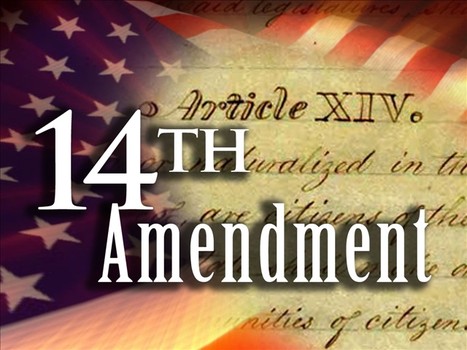 Within the month, the nation will receive the opinion of the U.S. Supreme Court as to whether the U.S. Constitution requires all of the states to jettison their domestic laws and sanction same-sex marriage. Numerous federal judges have so ruled, and most states have simply yielded to those federal court decisions. In a few cases, beginning with Vermont and Massachusetts, state courts ruled for same sex marriage, and state officials have accepted passively those decisions as well.
Generally, courts have ruled for same-sex marriage using either the “due process clause” or the “equal protection clause” of the Fourteenth Amendment, or both. That raises a simple question: is it really possible that when the Fourteenth Amendment was ratified in 1868 the framers intended that it sanction same-sex marriage? Of course not. The U.S. Constitution says nothing about same-sex marriage. Then, how could the Constitution be manipulated to support a decision in favor of same-sex marriage? Well it has not been easy. The Constitutional case for same-sex marriage is pathetically weak — unless you adopt the notion of an “evolving” Constitution — which is, of course, the polar opposite of the notion of our “written” Constitution.
There are actually four cases, all from the U.S. Court of Appeals for the Sixth Circuit, which have been consolidated for decision in the U.S. Supreme Court — Obergefell, DeBoer, Tanco, and Bourke. If you would like to know more about how this case developed, a great deal of information, and links to all documents, is available on SCOTUSblog. The amicus curiae brief which we filed in the Sixth Circuit in support of traditional marriage is available, as is the amicus curiae brief which we filed in the U.S. Supreme Court.
The opinion by Judge Sutton of the U.S. Court of Appeals for the Sixth Circuit — upholding traditional marriage against five challenges in four states — begins with a remarkable observation that should have resolved the case in that once sentence, but did not. Judge Sutton points out that “[n]obody in this case … argues that the people who adopted the Fourteenth Amendment understood it to require the States to change the definition of marriage.” DeBoer v. Snyder, 772 F.3d 388, 403 (6th Cir. 2014) (emphasis added).
Laymen logically deduce that if the Fourteenth Amendment as written had nothing to do with same-sex marriage, that’s the end of the matter. After all, Justice Douglas succinctly described the Amendment in his autobiography: “The Fourteenth Amendment was passed to give blacks first-class citizenship.” William O. Douglas, The Court Years, p. 154 (Random House: 1980). But for those lawyers who want unelected judges to set the public policy of our nation, it simply doesn’t matter what the Framers intended. And neither does it matter to many judges who are all too willing to give effect to their own political views. Discovering the “authorial intent” of the Framers is only a small part of their concern — a step they sometimes skip over entirely.
Recently, Justice Alito observed that “[s]ame-sex marriage presents a highly emotional … question … but not a difficult question of constitutional law.” United States v. Windsor, 570 U.S. ___, 133 S.Ct. 2675, 2714 (2013) (Alito, J., dissenting):
The Constitution does not guarantee the right to enter into a same-sex marriage. Indeed, no provision of the Constitution speaks to the issue. It is beyond dispute that the right to same-sex marriage is not deeply rooted in this Nation’s history and tradition. [Id. at 2714-15.]
Therefore, Justice Alito explained that challengers to traditional marriage:
seek … not the protection of a deeply rooted right but the recognition of a very new right, and they seek this innovation not from a legislative body elected by the people, but from unelected judges. [Id. at 2715.]
If we are now considering a new right, one could legitimately ask when and where did this new right come from. Indeed, during oral argument in the case of Hollingsworth v. Perry, Justice Scalia asked this very question to same-sex marriage champion lawyer Ted Olson:
Justice Scalia: “When did it become unconstitutional to prohibit gays from marrying?… Was it always unconstitutional?”
Ted Olson: “It was [un]constitutional when we — as a culture determined that sexual orientation is a characteristic of individuals that they cannot control…”
Justice Scalia: “I see. When did that happen?…”
Ted Olson: “There’s no specific date in time. This is an evolutionary cycle.”
Of course, a written constitution that is subject to evolutionary change is no longer a written constitution. A constitution that is always evolving provides no fixed guarantees for the rights of the people. If the “Due Process Clause” of the Fourteenth Amendment can morph into a mandate for homosexual marriage, then the “right to keep and bear arms” can become a right to call the police when attacked. Once we abandon the author’s meaning of a text, we are left treating the U.S. Constitution as poetry, asking “what does the Constitution mean to me?”
Unable to ground their challenge in the Fourteenth Amendment as written, the advocates of same-sex marriage have used an assemblage of fabrications, purportedly derived from this Court’s precedents, but without any support in fact or law.
One of the briefs in the Supreme Court asserted that the High Court has already established that “[t]he right to marry the person of one’s choice is a fundamental freedom.” The claim is patently false.
To the contrary, the Supreme Court has always assumed that marriage law was originally governed by the common law which required consummation between one male and one female. See Maynard v. Hill, 125 U.S. 190, 213 (1888). See also 1 William Blackstone, Commentaries on the Laws of England, 424 (Univ. Of Chi. Facsimile ed.: 1765).
The Court in Maynard explained: “though formed by contract … the relation of husband and wife, deriv[ed] both its rights and duties from a source higher than any contract of which the parties are capable, and, as to these, uncontrollable by any contract which they can make.” And “[w]hen formed,” the Court continued, the relation between husband and wife was “no more a contract than ‘fatherhood’ or ‘sonship’ is a contract.” Instead, marriage “partakes more of the character of an institution regulated and controlled by public authority, upon principles of public policy, for the benefit of the community.” Thus, it is just pretense to claim that the Supreme Court previously established the right “to marry the person of one’s choice.”
Any such claim is a total fabrication designed to hide the fact that at the time the nation was founded not only was same-sex marriage not legally sanctioned, but sexual relations between men constituted, as Sir William Blackstone declared, “the infamous crime against nature[,] a disgrace to human nature,” and punishable by death. 4 Blackstone’s Commentaries at 215-16.
In addition to this condemnation of “unnatural” sexual coupling, the English common law of marriage exclusively adopted the Biblical matrimonial order. First, the common law limited the relationship to one between “husband and wife,” that is, “baron and feme.” I Blackstone’s Commentaries at 421. And second, the common law made “voidable” any union between a man and a woman under the “canonical disabilities” of “consanguinity, or relation by blood; and affinity, or relation by marriage.” Id. at 422. Thus, it is wildly false for Petitioners to presume, as they have, that there is a well-established right to marry any person of one’s choice.
The same-sex marriage proponents now ask the Supreme Court to take the nation one step further away from our written constitution, by fundamentally changing the meaning of its text based on the will of a bare majority of five lawyers serving on this Court, rather than complying with the exclusive process for amending the Constitution, as set out in its Article V. Freed from textual constraint, Professor Lino Graglia has observed that:
[o]ver the past half-century the justices have chosen to make themselves the final lawmakers on most basic issues of domestic social policy in American society. These include issues literally of life and death … and issues of public morality…. In essence, the Court now performs in the American system of government a role similar to that performed by the Grand Council of Ayatollahs in the Iranian system…. [L. Graglia, “Constitutional Law Without the Constitution: The Supreme Court’s Remaking of America,” in “A Country I Do Not Recognize” (R. Bork ed., Hoover Press 2005).]
Nearly two decades ago, Justice Scalia warned:
[t]his Court has no business imposing upon all Americans the resolution favored by the elite class from which the Members of this institution are selected, pronouncing that “animosity” toward homosexuality … is evil. [Romer v. Evans, 517 U.S. 620, 636 (1996) (Scalia, J., dissenting).]
And, exactly as Justice Scalia predicted in Romer, the American people have seen a flurry of judicial opinions with “no foundation in American constitutional law” overturning laws which were “designed to prevent piecemeal deterioration of the sexual morality” desired by the People. These court opinions together constitute what he described as “acts, not of judicial judgment, but of political will.” Id. at 653.
As such, they are not just “bad law,” but as Blackstone stated, they are “not law” at all.
_____________
William J. Olson served in three positions in the Reagan Administration. Herbert W. Titus taught Constitutional Law for 26 years, and concluded his academic career as the Founding Dean of Regent Law School. Together they have filed over 80 briefs in the U.S. Supreme Court, and scores more in lower courts, addressing important public policy issues. They now practice law together at William J. Olson, P.C. They can be reached at [email protected] or twitter.com/Olsonlaw.
Permission is freely granted to publish, copy, reproduce, distribute, or excerpt from this article for any purpose.
Next Post

June 19, 2015 Marriage: It’s Not Political, It’s Biblical
Browse Our Archives
Select a Category Uncategorized
Select a Month November 2016 October 2016 August 2016 May 2016 April 2016 January 2016 September 2015 August 2015 June 2015 May 2015 April 2015 March 2015 January 2015 December 2014 November 2014 October 2014 September 2014 August 2014 July 2014 June 2014 May 2014 April 2014 March 2014 February 2014 January 2014 December 2013 November 2013 October 2013 September 2013 August 2013 July 2013 June 2013 May 2013 April 2013 March 2013 February 2013 January 2013 December 2012 November 2012 October 2012 September 2012 August 2012 July 2012 June 2012 May 2012 April 2012 March 2012 February 2012 January 2012 December 2011 November 2011 October 2011 September 2011 August 2011 July 2011 June 2011 May 2011 April 2011 March 2011 February 2011 January 2011 December 2010 November 2010 October 2010 September 2010 August 2010 July 2010 June 2010 May 2010 April 2010 March 2010 February 2010 January 2010 December 2009 November 2009 October 2009 September 2009 August 2009 July 2009 June 2009 May 2009 April 2009 March 2009 February 2009 January 2009 December 2008 November 2008 October 2008 September 2008 August 2008 July 2008 June 2008 May 2008 April 2008 March 2008 February 2008 January 2008 December 2007 November 2007 October 2007 September 2007 August 2007 July 2007 June 2007 May 2007 April 2007 March 2007 February 2007 January 2007 December 2006 November 2006 October 2006 September 2006 August 2006 July 2006 June 2006 May 2006 April 2006 March 2006 February 2006 January 2006 December 2005 November 2005 October 2005 September 2005 August 2005 July 2005 June 2005 May 2005 April 2005 March 2005 February 2005 January 2005 December 2004 November 2004 October 2004 September 2004 August 2004 July 2004 June 2004 May 2004
Follow Us!
TAKE THE
Religious Wisdom Quiz
What nation conquered the Northern Kingdom of Israel?
Select your answer to see how you score.
Babylon Philistia Egypt Assyria
Related posts from Orthodixie
We Have No King ... but Caesar?

Holy Cow! Batman, St Cuthbert, Jack Chick –...


BREAKING NEWS: Men & Women Are Different!
TRENDING AT PATHEOS Eastern Orthodox

Did Prayer Cure His Cancer? Or Was It...
At 4 AM one morning, Joshua W. Brown’s wife awoke to a...

8 Ways a Near-Death Experience Rewires the Soul
Does Consciousness Survive Physical Death? After 50 Years of Research, Dr. Raymond...

Holy Longing: What Our Restlessness Is Telling Us
“One can find so many pains when the rain is falling.” -John...

What this is NOT about. This blog is definitely not about...

Who said the Israelites were God’s chosen? That’s right, they did. Who...

The Spirit World Is the Real World: God...
A Monk’s Wisdom on Body and Spirit I sit with Brother Martin...
view all Eastern Orthodox blogs
Ad-Free & Subscriber Log-In Subscription Support
- About Us
- 2026 Calendar
- Videos
- Podcasts
- Library of World Religions
- Faith In Media Tracker
- Advertise With Us
- Write for Us
- Privacy Policy
- Terms of Service
- Do Not Sell My Data
- Contact Us
- Radiant Digital
- Manage Newsletter Subscriptions
- Unsubscribe From Notifications
- Sitemap
Copyright 2008-2026, Patheos. All rights reserved.
Subscription Support Ad-Free & Subscriber Log-In
Follow Patheos