
BuddhistCatholicContemplativeEvangelicalGeneral ChristianHinduJewishLatter-day SaintMuslimNew VisionsProgressive Christian
Beliefs
- Buddhist
- Catholic
- Contemplative
- Evangelical
- General Christian
- Hindu
- Jewish
- Latter-day Saint
- More Voices
- Muslim
- New Visions
- Pagan
- Progressive Christian
Topics
- Religion News
- Food and Religion
- Sports and Religion
- Religious Art
- Religious Music and Entertainment
- Religious Events
- History and Religion
- Style and Religion
- Politics and Religion
- Women in Religion
- Recreation Outdoors and Religion
- Business Finance and Religion
- Careers Workplace and Religion
- Education and Religion
- Family Parenting and Religion
- Health Fitness and Religion
- Home and Religion
- Relationships and Religion
- Technology and Religion
- Travel and Religion
Columnists
- Buddhist Columnists
- Business Finance and Religion Columnists
- Careers Workplace and Religion Columnists
- Catholic Columnists
- Contemplative Columnists
- Education and Religion Columnists
- Evangelists Columnists
- Family Parenting and Religion Columnists
- General Christian Columnists
- Health Fitness and Religion Columnists
- Hindu Columnists
- History and Religion Columnists
- Home and Religion Columnists
- Jewish Columnists
- More Voices Columnists
- Latter Day Columnists
- Muslim Columnists
- New Visions Columnists
- Nonreligious Columnists
- Pagan Columnists
- Politics and Religion Columnists
- Progressive Columnists
- Recreation Outdoors and Religion Columnists
- Relationships and Religion Columnists
- Religion News Columnists
- Religious Art Columnists
- Religious Events Columnists
- Religious Music and Entertainment Columnists
- Sports and Religion Columnists
- Style and Religion Columnists
- Technology and Religion Columnists
- Travel and Religion Columnists
- Women in Religion Columnists
Resource Library
- 2026 Calendar
- Library of World Religions
- The 100 Most Holy Places on Earth
- Patheos Answers
- Podcasts
- Videos
- Faith Leaders Database
- Anglican Episcopalian
- Bahai
- Baptist
- Buddhism
- Christianity
- Confucianism
- Eastern Orthodoxy
- Hinduism
- Holiness and Pentecostal
- ISKCON
- Islam
- Judaism
- Lutheran
- Methodist
- The Church of Jesus Christ of Latter-day Saints
- New Age
- Paganism
- Presbytarian and Reformed
- Protestantism
- Religion Behind the Scenes
- Roman Catholic
- Scientology
- Shia Islam
- Sikhism
- Sufism
- Sunni Islam
- Taoism
- Zen
- See all religions
Research Tools
 Ad-Free & Subscriber Log-In Subscription Support
Ad-Free & Subscriber Log-In Subscription Support
Follow Patheos 

- Trending:
- Forgiveness
- |
- Marriage
- |
- Consciousness
- |
- Death Penalty
- |
- Election
- |
- Halloween
 On the Catholic Beat
- Home
- Catholic
- Religion News
- What Is A Saint?
What Is A Saint?
Last updated on: December 29, 2019 at 10:56 pm by Brian Fraga
What Is A Saint? 2019-12-29T22:56:04-05:00 Brian Fraga
Patheos Explore the world's faith through different perspectives on religion and spirituality! Patheos has the views of the prevalent religions and spiritualities of the world.
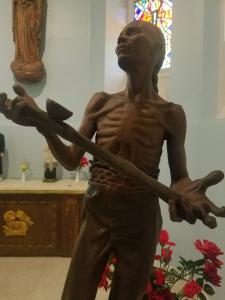
St. Mark Ji Tianxiang, opium addict and martyr/Brian Fraga
“Can someone be uncanonized? Asking for a friend.”
A Twitter follower asked that question in jest. But enough people have seriously asked me that – the answer is no, by the way – that it has me thinking about sainthood, the canonization process, sanctity, the universal call to holiness and what it means when we talk about Christian perfection.
There are many misconceptions about what a saint is and isn’t. To put in succinctly, a saint is someone who exhibited heroic virtue, became holy with God’s sanctifying grace and is now in heaven. A saint loved God and neighbor, and truly became all that God intended them to be from before they were even conceived.
But that does not mean the saints lived perfect, pristine lives. They had weaknesses and made mistakes. At times, they made errors in judgement and said things they shouldn’t have. They had human emotions and had to apologize to people they might have offended.
The saints were flesh-and-blood human beings, and were subject to the same effects of original sin that you and I deal with in this life. I recently wrote about the life of St. Mark Ji Tianxiang, a 19th century Chinese layman who was martyred for his faith. He struggled with an opium addiction for the last 30 years of his life, which prompted his confessor, who didn’t have the benefit of modern science, to bar him from receiving Holy Communion.
St. Mark Ji was hooked on opium, but he was still a man who was growing spiritually and loved Jesus to the point of death. If he could become a saint, then so can the alcoholic who relapses, the heroin addict on the street corner or the person who continually confesses the sin of viewing pornography.
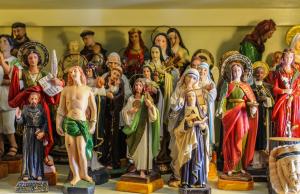
Don’t be fooled by the old hagiographies or a prayer card that presents a saint as an airbrushed ingenue holding a bouquet of lilies. Strip away the hagiography and the airbrushing and you find a flawed person who was made holy by God’s grace.
Santo Subito
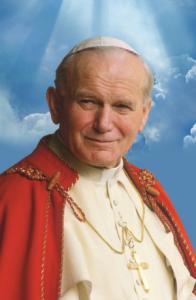
Vatican Canonization Photo of St. Pope John Paul II
Remembering the saints’ humanity prevents me from getting too disappointed or scandalized at some of their shortcomings.
We’ve learned enough in recent years to know that St. Pope John Paul II in some ways dropped the ball on the clergy sex abuse scandals, especially with how he failed to act on credible information that the late Father Marcial Maciel Degollado was a fraud and a sexual predator.
Father Degollado, the disgraced founder of the Legion of Christ, was back in the news last week when the Legion released a report stating that 33 of its priests and 71 seminarians had sexually abused minors over the last 80 years. Maciel, a charismatic figure whom JPII once described as “an efficacious guide to youth,” abused 60 victims.
The late pontiff’s failure to respond to the documented concerns regarding Maciel inspired my above-mentioned Twitter follower to indirectly inquire if the Church could strip John Paul II of his halo. Of course, the Church cannot do that. A canonization is an irreversible affirmation of someone’s sanctity and an acknowledgement that they now behold the beatific vision. A saint cannot be kicked out of Heaven because of what happens on Earth after their death.
Whether it was wise to canonize John Paul II only eight years after his death is another matter, especially when there is still so much about the global clergy sex abuse crisis that we don’t yet know. There is something to be said in waiting for decades to pass so that we have the benefit of perspective when judging whether someone should be elevated to the altars.
For years, I had a devotion to John Paul II, who was the only pope I knew growing up as a kid in the 80s and 90s. I probably would have been one of those people in St. Peter’s Square chanting, “Santo Subito!” during the pontiff’s funeral Mass in 2005. But, for now anyway, my devotion has cooled and it probably wouldn’t break my heart if his feast day were to be removed from the Universal Church’s liturgical calendar.
The Politics of Sainthood
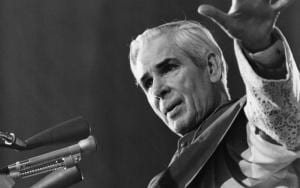
Archbishop Fulton J. Sheen Foundation/Twitter
A somewhat similar situation is playing itself out regarding the beatification cause of Venerable Fulton Sheen, the archbishop who became one of the great media evangelizers of the 20th century. His cause is on hold amid concerns that a statewide probe, being coordinated by the New York State Attorney General, could turn up evidence that Sheen mishandled clergy sex abuse cases when he was the bishop of Rochester from 1966 to 1969.
But even if documents were to surface indicating that Sheen assigned an abusive priest to a parish – the information we have so far suggests that didn’t happen – it still wouldn’t change the fact that Archbishop Sheen was, by all accounts, a devout man of prayer whose intercession was confirmed to have brought a stillborn baby boy back to life. The faithful have attributed other miraculous recent healings to his intercession.
The Sheen controversy reveals the paradoxical reality that personal sanctity may get you to Heaven, but it alone will not get the Catholic Church to declare you a saint. Political considerations over someone’s decisions, even those that were not made with malice, are sometimes factors in the canonization process. There is a reason why you don’t see a push right now to beatify Pope Pius XII.
It would be a huge public relations problem, to put it mildly, for the Catholic Church if Bishop Sheen were beatified only to have documents surface showing that he had reassigned an abusive priest to a parish. Fairly or not, that seems to be the standard moving forward for bishops and popes in the canonization process.
Role models and intercessors
Via Shutterstock
By canonizing “some of the faithful,” as the Catechism of the Catholic Church puts it in Paragraph 828, the Church looks to “sustain the hope of believers” by proposing the saints to them as models and intercessors. In the most difficult moments in the Church’s history, it is the saints who have always been the source and origin of renewal.
With God’s grace, wonderful men and women have been canonized throughout the Church’s history to inspire us. They include St. Augustine, St. Theresa of Avila, St. Teresa of Calcutta, St. Francis de Sales, St. Rose of Lima, St. Josephine Bakhita, to name a few.
Of course, we are all called to that level of holiness, whether or not our names are ever read out loud in a canonization ceremony. There are countless scores of saints that we as a Church will never know this side of Heaven. For every St. Therese of Lisieux, there are innumerable lay men and women, priests and bishops, brothers and religious sisters whose names perhaps have been lost to history but who embodied the heroic virtues in life.
Thankfully for them, and us, they can’t be “uncanonized.”
Previous Post
December 27, 2019
2019 In Review: Bishop Accountability

Browse Our Archives
Select a Category Uncategorized
Select a Month June 2021 May 2021 April 2021 March 2021 February 2021 January 2021 December 2020 November 2020 October 2020 September 2020 August 2020 July 2020 June 2020 May 2020 April 2020 March 2020 February 2020 January 2020 December 2019 November 2019
Follow Us!
TAKE THE
Religious Wisdom Quiz
True or False: Hebrews teaches that Jesus is the same yesterday, today, and forever.
Select your answer to see how you score.
TRUE FALSE
Related posts from On the Catholic Beat
An Interview with Gloria Purvis on the Catholic...
Cleared of Sexual Abuse, Chicago's Father Michael Pfleger...
Father Altman Vows to Resist His Bishop's Request...

Jesuit Provincial in China To Become New Bishop...
TRENDING AT PATHEOS Catholic

Rejecting Doom: Christian Hope And Human Action
Christianity is a religion of hope. We are to have hope and...

It’s What Comes From Within Which Matters
One of the most difficult things for us to understand is why...

Why I Choose the Eucharist Over the Sermon
Choose the Eucharist, Not the Sermon What are we supposed to get...

5 Design Elements Found in Spiritually Rooted Homes
Putting Spirituality Into Home Decor Our homes are more than our living...

Credo: A Story of God Told with the...
About 10 years ago, I began to imagine a personal "Credo" that...

The Anatomy of Divine Revelation in Catholic Thought
The claim that God has made Himself known to human beings is...
view all Catholic blogs
Ad-Free & Subscriber Log-In Subscription Support
- About Us
- 2026 Calendar
- Videos
- Podcasts
- Library of World Religions
- Faith In Media Tracker
- Advertise With Us
- Write for Us
- Privacy Policy
- Terms of Service
- Do Not Sell My Data
- Contact Us
- Radiant Digital
- Manage Newsletter Subscriptions
- Unsubscribe From Notifications
- Sitemap
Copyright 2008-2026, Patheos. All rights reserved.
Subscription Support Ad-Free & Subscriber Log-In
Follow Patheos