
BuddhistCatholicContemplativeEvangelicalGeneral ChristianHinduJewishLatter-day SaintMuslimNew VisionsProgressive Christian
Beliefs
- Buddhist
- Catholic
- Contemplative
- Evangelical
- General Christian
- Hindu
- Jewish
- Latter-day Saint
- More Voices
- Muslim
- New Visions
- Pagan
- Progressive Christian
Topics
- Religion News
- Food and Religion
- Sports and Religion
- Religious Art
- Religious Music and Entertainment
- Religious Events
- History and Religion
- Style and Religion
- Politics and Religion
- Women in Religion
- Recreation Outdoors and Religion
- Business Finance and Religion
- Careers Workplace and Religion
- Education and Religion
- Family Parenting and Religion
- Health Fitness and Religion
- Home and Religion
- Relationships and Religion
- Technology and Religion
- Travel and Religion
Columnists
- Buddhist Columnists
- Business Finance and Religion Columnists
- Careers Workplace and Religion Columnists
- Catholic Columnists
- Contemplative Columnists
- Education and Religion Columnists
- Evangelists Columnists
- Family Parenting and Religion Columnists
- General Christian Columnists
- Health Fitness and Religion Columnists
- Hindu Columnists
- History and Religion Columnists
- Home and Religion Columnists
- Jewish Columnists
- More Voices Columnists
- Latter Day Columnists
- Muslim Columnists
- New Visions Columnists
- Nonreligious Columnists
- Pagan Columnists
- Politics and Religion Columnists
- Progressive Columnists
- Recreation Outdoors and Religion Columnists
- Relationships and Religion Columnists
- Religion News Columnists
- Religious Art Columnists
- Religious Events Columnists
- Religious Music and Entertainment Columnists
- Sports and Religion Columnists
- Style and Religion Columnists
- Technology and Religion Columnists
- Travel and Religion Columnists
- Women in Religion Columnists
Resource Library
- 2026 Calendar
- Library of World Religions
- The 100 Most Holy Places on Earth
- Patheos Answers
- Podcasts
- Videos
- Faith Leaders Database
- Anglican Episcopalian
- Bahai
- Baptist
- Buddhism
- Christianity
- Confucianism
- Eastern Orthodoxy
- Hinduism
- Holiness and Pentecostal
- ISKCON
- Islam
- Judaism
- Lutheran
- Methodist
- The Church of Jesus Christ of Latter-day Saints
- New Age
- Paganism
- Presbytarian and Reformed
- Protestantism
- Religion Behind the Scenes
- Roman Catholic
- Scientology
- Shia Islam
- Sikhism
- Sufism
- Sunni Islam
- Taoism
- Zen
- See all religions
Research Tools
 Ad-Free & Subscriber Log-In Subscription Support
Ad-Free & Subscriber Log-In Subscription Support
Follow Patheos 

- Trending:
- Forgiveness
- |
- Marriage
- |
- Consciousness
- |
- Death Penalty
- |
- Election
- |
- Halloween
 One Degree to Another
- Home
- Evangelical
- The Best Quotes from Acedia and Its Discontents
The Best Quotes from Acedia and Its Discontents
Last updated on: August 24, 2018 at 1:07 pm by Scott Slayton
The Best Quotes from Acedia and Its Discontents 2018-08-24T13:07:10-05:00 Scott Slayton
Patheos Explore the world's faith through different perspectives on religion and spirituality! Patheos has the views of the prevalent religions and spiritualities of the world.
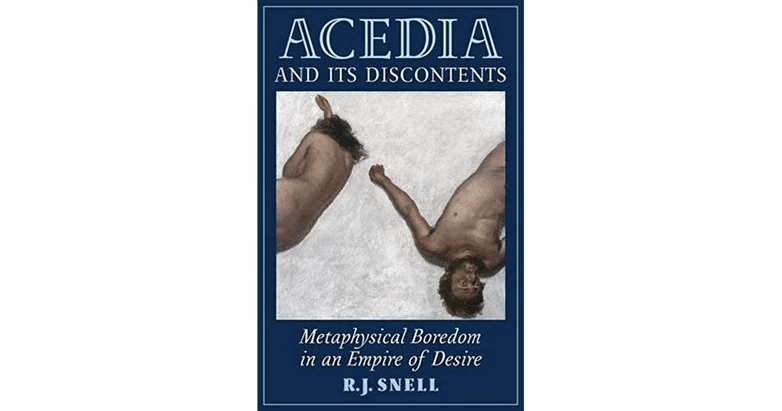
Last year I heard someone refer to R.J. Snell’s book Acedia and Its Discontents in a sermon on slothfulness. I love books related to any of the major themes in Proverbs, so I picked it up and discovered one of the best books I have read in the past year.
Acedia refers to slothfulness, which is more than just laziness. Slothfulness despises our reason for being and rejects God’s good plan for creating us. Slothfulness shirks off responsibilities, caves in to every desire, and focuses solely on the self.
In Acedia and Its Discontents, R.J. Snell helps us understand slothfulness and how we can rediscover the beauty of why God created us. Snell writes from a Catholic perspective, and it shows in a few places in the book, but much of what he says would be affirmed by Christians of all stripes and traditions.
Here are the best from Acedia and Its Discontents.
“Many feverishly obsess about their kids’ athletic and academic accomplishments, stricken with moral shame if they fail to land an internship, but unperturbed at their religious inactivity or sexual activity.” (1)
“It is a mistake to think that sloth is laziness. The slothful might very well be busy doing things. Evagrius claims, in fact, that the slothful are often in a frenzy of pointless action–now this, now that–in their disgust at the actual work given to them by God.” (11)
“All too often work is considered a curse, which it is not. In Scripture work is given to humans even before the fall, and although one result of sin is work’s disorder, it is not itself a curse.”(27)ds
“No other creature bears this weight; certainly our awareness of the task as an obligation and test of our selfhood appears unique, for no other animal loses sleep agonizing over their purpose on earth.” (31)
“If our stance towards the world is one of eager and passionate interest, the world sparkles and captivates,; if we aggressively seek profit and gain, the world appears as a resource; if we are bored, the world fails to engage.” (59)
“No longer a vice afflicting individuals only, acedia has become a cultural reality; nestled deep in the roots of our ways of acting and living, sloth seeps into our loves and lives in virtually every domain, before finally transforming itself into boredom and nihilism.” (61)
“In sloth, we abhor what is there; we abhor what it is; we abhor limits, place, order, being. Our misguided addiction to freedom without truth is a revolt of the self against any charged world which might demand attendance, care, obligation, or respect, and certainly any mandate of working to fill God’s beautiful kingdom.” (63)
“We might actually anticipate the slothful individual and culture to be very busy, and, as the purposelessness and arbitrary nature of their business is revealed, to be ever more distracted, exhausted, and bitter in the unending attempt to express and display freedom without humility before the yokes of place, limit, order. There will not be good work, there will not be the leisure of exultation in the delight of work, but there might be a culture of total work, or the complete victory of grasping, making, producing, developing, buying and selling–and all for naught.” (66)
“Boredom is a heresy, declaring God was wrong when he saw the goodness of the world.” (76)
“As vice, sloth is a failure of love–an aversion to being, a sadness at the good, and an inability to act well. Sloth is not overcome by non-sloth but by the fullness of virtue, by approving or affirming the world, seeing it as God sees it.” (111)
“Too many of us, too often, fantasize about great deeds, imagining accolades to follow, only to give up when the toil and strain of the actual work presents itself.” (114)
“But ordinary work, good work, is about the difficult and good; work is given to us by God, and staying put in the cell is hard. The ordinary is extraordinary. Small things are not trifles.” (114)
‘Sloth’s cure is staying in the cell, remaining yoked to the work God has given, including the universal vocation of the creation mandates, the task of our particular vocations, and the various disciplines of the life well-ordered. We stay in the cell in very concrete ways–keeping the prayers, finishing the report, paying our bills on time, wiping away childish tears, doing the dishes, cleaning the car, caring for our tools–through staying in the quotidian, the mundane ordinary work.” (118)
“We become the people we are by what we choose to do again.” (118)
Our own time seems to imagine that friendship with God is a matter of enthusiasm and emotions, as if God is worshipped only when someone feels like they have worshipped.” (119)
“We meet God in our work, we reach out to his divine friendship when we stay in our cell, loving our place and the goodness residing in its things and tasks and mandates.” (121)
“If we remain at our work we love the world back into graciousness as we refuse sloth’s abhorrence of place, sadness at the good, and refusal to act.” (122)
“The vice of sloth promises life but brings death; the way of the cross demands death but gives life.” (126)
You can read the best quotes from other books here.
Related Posts:
“The Best Quotes from The Tech-Wise Family“
“The Best Quotes from Our Secular Age“
Previous Post

August 21, 2018
Why Our Need to Sleep is a Theological Issue
Next Post
August 28, 2018 When Pastors Walk Through a Dark Night of the Soul
Browse Our Archives
Select a Category Bible Books Church Life Marriage Parenting Photos The Ministry Uncategorized
Select a Month August 2021 July 2021 June 2021 February 2021 December 2020 November 2020 October 2020 March 2020 July 2019 April 2019 December 2018 November 2018 October 2018 September 2018 August 2018 July 2018 June 2018 May 2018 April 2018 March 2018 February 2018 January 2018 December 2017 November 2017 October 2017 September 2017 August 2017 July 2017 June 2017 May 2017 April 2017 March 2017 February 2017 January 2017 December 2016 November 2016 October 2016 September 2016 August 2016 July 2016 June 2016 May 2016 April 2016 March 2016 February 2016 January 2016 December 2015 November 2015 October 2015 September 2015 August 2015 July 2015 May 2015 April 2015 March 2015 February 2015 January 2015 December 2014 November 2014 October 2014 September 2014 August 2014 July 2014 June 2014 May 2014 April 2014 March 2014 February 2014 January 2014 December 2013 November 2013 October 2013 September 2013 August 2013 July 2013
Follow Us!
TAKE THE
Religious Wisdom Quiz
In Colossians, Paul says that Christ is the head of what?
Select your answer to see how you score.
The body, the church The apostles All creation The believers
Related posts from One Degree to Another
The Best Quotes from Gentle and Lowly
The Best Quotes from The Possibility of Prayer

The Best Quotes from Your Future Self Will...

TRENDING AT PATHEOS Evangelical

How the author of the world's best hymn...
I've been working with John Newton for a while now. This makes...

Long before this Lectio Divina, Psalm 130 - the song - started...

What About the Trees? Another Living Parable
After I finished writing the last article about falling leaves as a...

Why Classical Education Is a Conversation, Not a...
Come and Read: Joy in Classical Education When I was a little...

Falling Leaves: A Living Parable on Letting Go
I’ve spent the vast majority of my life in the southeast corner...

Cornell University has received a great deal of negative publicity and intense...
view all Evangelical blogs
Ad-Free & Subscriber Log-In Subscription Support
- About Us
- 2026 Calendar
- Videos
- Podcasts
- Library of World Religions
- Faith In Media Tracker
- Advertise With Us
- Write for Us
- Privacy Policy
- Terms of Service
- Do Not Sell My Data
- Contact Us
- Radiant Digital
- Manage Newsletter Subscriptions
- Unsubscribe From Notifications
- Sitemap
Copyright 2008-2026, Patheos. All rights reserved.
Subscription Support Ad-Free & Subscriber Log-In
Follow Patheos