
BuddhistCatholicContemplativeEvangelicalGeneral ChristianHinduJewishLatter-day SaintMuslimNew VisionsProgressive Christian
Beliefs
- Buddhist
- Catholic
- Contemplative
- Evangelical
- General Christian
- Hindu
- Jewish
- Latter-day Saint
- More Voices
- Muslim
- New Visions
- Pagan
- Progressive Christian
Topics
- Religion News
- Food and Religion
- Sports and Religion
- Religious Art
- Religious Music and Entertainment
- Religious Events
- History and Religion
- Style and Religion
- Politics and Religion
- Women in Religion
- Recreation Outdoors and Religion
- Business Finance and Religion
- Careers Workplace and Religion
- Education and Religion
- Family Parenting and Religion
- Health Fitness and Religion
- Home and Religion
- Relationships and Religion
- Technology and Religion
- Travel and Religion
Columnists
- Buddhist Columnists
- Business Finance and Religion Columnists
- Careers Workplace and Religion Columnists
- Catholic Columnists
- Contemplative Columnists
- Education and Religion Columnists
- Evangelists Columnists
- Family Parenting and Religion Columnists
- General Christian Columnists
- Health Fitness and Religion Columnists
- Hindu Columnists
- History and Religion Columnists
- Home and Religion Columnists
- Jewish Columnists
- More Voices Columnists
- Latter Day Columnists
- Muslim Columnists
- New Visions Columnists
- Nonreligious Columnists
- Pagan Columnists
- Politics and Religion Columnists
- Progressive Columnists
- Recreation Outdoors and Religion Columnists
- Relationships and Religion Columnists
- Religion News Columnists
- Religious Art Columnists
- Religious Events Columnists
- Religious Music and Entertainment Columnists
- Sports and Religion Columnists
- Style and Religion Columnists
- Technology and Religion Columnists
- Travel and Religion Columnists
- Women in Religion Columnists
Resource Library
- 2026 Calendar
- Library of World Religions
- The 100 Most Holy Places on Earth
- Patheos Answers
- Podcasts
- Videos
- Faith Leaders Database
- Anglican Episcopalian
- Bahai
- Baptist
- Buddhism
- Christianity
- Confucianism
- Eastern Orthodoxy
- Hinduism
- Holiness and Pentecostal
- ISKCON
- Islam
- Judaism
- Lutheran
- Methodist
- The Church of Jesus Christ of Latter-day Saints
- New Age
- Paganism
- Presbytarian and Reformed
- Protestantism
- Religion Behind the Scenes
- Roman Catholic
- Scientology
- Shia Islam
- Sikhism
- Sufism
- Sunni Islam
- Taoism
- Zen
- See all religions
Research Tools
 Ad-Free & Subscriber Log-In Subscription Support
Ad-Free & Subscriber Log-In Subscription Support
Follow Patheos 

- Trending:
- Forgiveness
- |
- Marriage
- |
- Consciousness
- |
- Death Penalty
- |
- Election
- |
- Halloween
 One Degree to Another
- Home
- Evangelical
- My Year with Teddy Roosevelt
My Year with Teddy Roosevelt
Last updated on: December 14, 2015 at 1:52 pm by Scott Slayton
My Year with Teddy Roosevelt 2015-12-14T13:52:13-05:00 Scott Slayton
Patheos Explore the world's faith through different perspectives on religion and spirituality! Patheos has the views of the prevalent religions and spiritualities of the world.
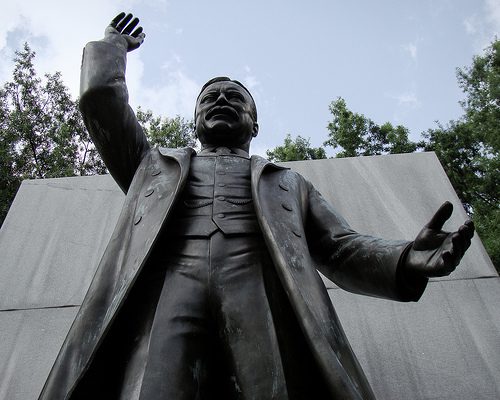
For the past year I have immersed myself in reading about the life of our 26th President, Theodore Roosevelt after a post on The Art of Manliness drew me to this magnetic figure. Roosevelt grew from a fragile boy to a man with boundless energy. He led the Rough Riders to victory in Cuba, ensured the building of the Panama Canal, busted trusts, advocated for the working man, brokered peace between Japan and Russia, wrote over one hundred thousand letters, and participated in the exploration of an unmapped river in the Amazon. Through reading about his life I learned four important lessons.
Cultivate Mind and Body
Sickness and weakness marked Roosevelt’s youngest years. He suffered from frequent panic attacks and some of his earliest memories were of his father carrying him around in the middle of the night while he struggled for breath. While his body suffered from great weakness, he demonstrated strong mental abilities. At the age of twelve his father told him he had a strong mind, but his weak body would hinder its growth. His father encouraged him to strengthen his body so his mind might achieve its fullest potential.
Roosevelt set out to strengthen his body and became a man of great physical ability. He boxed, hiked, rode horses, played tennis, and took part in numerous physical activities. His physical exploits did not decrease his scholastic efforts. He continued to collect and catalog birds while writing many books, the first of which being a history of Naval battles in the War of 1812. In a time when we like to distinguish between those who work and those who learn, his example encourages us to devour books, get into the outdoors, cultivate curiosity, push the limits of our physical abilities, and put our thoughts into writing.
Work Hard at Whatever Your Do
In almost every picture in which he is seated, Theodore Roosevelt’s fists are clinched as if he cannot stand to be still. This stance exemplified the energy he brought to everything he did. He preached about “The Strenuous Life” and frequently called upon people to “get action.” These were not empty words, but the mantra of a man who did not know how to do anything at half-speed. He threw himself into everything he did, taking what many considered to be the most menial tasks with the utmost seriousness.
Roosevelt would be appalled at the passive culture which prevails today. He did not spend his twenties “finding himself,” but instead serving as a state assemblyman in Albany. He used a seemingly meaningless post as a police commissioner to root out corruption in the New York City Police Department. When he served as an assistant to the Secretary of the Navy, he used the opportunity to boost the nation’s naval preparedness. (Something he had strong convictions about because of his study of the War of 1812.) The years after his presidency ended he did not retreat into the sunset. He went on a year-long African safari, campaigned for Republican candidates in New York, ran for President again, started a new political party, and led an expedition to map the “River of Doubt.” (Now known as “Rio Roosevelt.”) The remarkable achievements of his life came as a result of strenuous effort and his life encourages us to do the same.
Use Your Position for the Sake of Others
Teddy Roosevelt was born into a prosperous family and had every reason see the accumulation of more wealth as the greatest ambition of his life. This did not happen though because he saw his father take part in great charitable activities and advocate for those who were less fortunate. His father’s example had a great effect on young Teddy and at every turn in his life he used his growing influence to work for the greater social good.
In the New York Assembly Roosevelt fought against the political machine and at great personal cost sought to lessen the influence money had on politics. He worked to improve conditions and wages for workers, particularly those employed by big business tycoons. He invited Booker T. Washington to dine with him at the White House, earning the permanent scorn of many in the South. These are only a few examples of his labors in this arena, but they call us to look out for the poor and disenfranchised. The idea of people working in dangerous conditions for substandard wages while having no voice in the political process sickened him; and it should produce the same response in us as well.
Avoid Hero Worship
“Even the best of men are men at best.” I do not know the origin of this quote, but we should write it over the lives of every one of our heroes. Roosevelt evidenced many qualities we would be wise to avoid. In particular, he demonstrated an inclination to demonize those with whom he disagreed and this tendency became more pronounced in his later years. His friend William Howard Taft was his choice to succeed him as President and he quickly regretted this decision. Convinced the new President was forwarding the progressive agenda, he ran against Taft for the Republican nomination in 1912 and grew increasingly harsh in his rhetoric towards his former friend. He believed the nomination was stolen from him at the convention in Chicago and he started a third party to run against Taft and Woodrow Wilson in the general election. This decision handed the Presidency to Wilson and left a scar on his friendship with Taft which was not healed until the last year of his life.
When European powers started fighting with each other in 1914, Roosevelt itched for the United States to intervene. He grew impatient with what he saw as the inaction of Wilson and Secretary of State William Jennings Bryan. His heated denunciations of them escalated with each editorial and letter that came from his pen. His inflammatory criticism grew to the point that he forfeited much of the respect and acclaim he previously commanded. Those who pay attention to his life would do well to avoid the hostility he showed towards those with whom he disagreed. While times of conflict will inevitably come, we must be careful not vilify those with whom we disagree. Hateful rhetoric may inflame the passions of those who disagree with us, but it puts the other side on the defensive and alienates those in the middle. To use the Apostle Paul’s language, Roosevelt’s errors remind us to speak the truth in love in hopes that with our gentleness we may win those who differ from us.
Books on Theodore Roosevelt:
The Rise of Theodore Roosevelt by Edmund Morris
Theodore Rex by Edmund Morris
Colonel Roosevelt by Edmund Morris
The Bully Pulpit: Theodore Roosevelt, William Howard Taft, and the Golden Age of Journalism by Doris Kearns Goodwin
Mornings on Horseback: The Story of an Extraordinary Family, a Vanished Way of Life and the Unique Child Who Became Theodore Roosevelt by David McCullough
The River of Doubt: Theodore Roosevelt’s Darkest Journey by Candice Millard
When Trumpets Call: Theodore Roosevelt after the White House by Patricia O’Toole
The Strenuous Life: Essays and Addresses by Theodore Roosevelt
Previous Post

December 11, 2015
A Few Good Reads
Next Post
December 17, 2015 A Few Good Reads
Browse Our Archives
Select a Category Bible Books Church Life Marriage Parenting Photos The Ministry Uncategorized
Select a Month August 2021 July 2021 June 2021 February 2021 December 2020 November 2020 October 2020 March 2020 July 2019 April 2019 December 2018 November 2018 October 2018 September 2018 August 2018 July 2018 June 2018 May 2018 April 2018 March 2018 February 2018 January 2018 December 2017 November 2017 October 2017 September 2017 August 2017 July 2017 June 2017 May 2017 April 2017 March 2017 February 2017 January 2017 December 2016 November 2016 October 2016 September 2016 August 2016 July 2016 June 2016 May 2016 April 2016 March 2016 February 2016 January 2016 December 2015 November 2015 October 2015 September 2015 August 2015 July 2015 May 2015 April 2015 March 2015 February 2015 January 2015 December 2014 November 2014 October 2014 September 2014 August 2014 July 2014 June 2014 May 2014 April 2014 March 2014 February 2014 January 2014 December 2013 November 2013 October 2013 September 2013 August 2013 July 2013
Follow Us!
TAKE THE
Religious Wisdom Quiz
True or False: The fruit of the Spirit includes love, joy, peace, and twelve other qualities.
Select your answer to see how you score.
FALSE TRUE
Related posts from One Degree to Another

The Lord is Near in Our Pain- 1...

Why You Should Embrace Boredom

Love is the Mark of a Christian

TRENDING AT PATHEOS Evangelical

The REST of Your Life: A Creative Wrestles...
This week I had a conversation with a good friend from church....

How the author of the world's best hymn...
I've been working with John Newton for a while now. This makes...

Long before this Lectio Divina, Psalm 130 - the song - started...

What About the Trees? Another Living Parable
After I finished writing the last article about falling leaves as a...

Why Classical Education Is a Conversation, Not a...
Come and Read: Joy in Classical Education When I was a little...

Cornell University has received a great deal of negative publicity and intense...
view all Evangelical blogs
Ad-Free & Subscriber Log-In Subscription Support
- About Us
- 2026 Calendar
- Videos
- Podcasts
- Library of World Religions
- Faith In Media Tracker
- Advertise With Us
- Write for Us
- Privacy Policy
- Terms of Service
- Do Not Sell My Data
- Contact Us
- Radiant Digital
- Manage Newsletter Subscriptions
- Unsubscribe From Notifications
- Sitemap
Copyright 2008-2026, Patheos. All rights reserved.
Subscription Support Ad-Free & Subscriber Log-In
Follow Patheos