
BuddhistCatholicContemplativeEvangelicalGeneral ChristianHinduJewishLatter-day SaintMuslimNew VisionsProgressive Christian
Beliefs
- Buddhist
- Catholic
- Contemplative
- Evangelical
- General Christian
- Hindu
- Jewish
- Latter-day Saint
- More Voices
- Muslim
- New Visions
- Pagan
- Progressive Christian
Topics
- Religion News
- Food and Religion
- Sports and Religion
- Religious Art
- Religious Music and Entertainment
- Religious Events
- History and Religion
- Style and Religion
- Politics and Religion
- Women in Religion
- Recreation Outdoors and Religion
- Business Finance and Religion
- Careers Workplace and Religion
- Education and Religion
- Family Parenting and Religion
- Health Fitness and Religion
- Home and Religion
- Relationships and Religion
- Technology and Religion
- Travel and Religion
Columnists
- Buddhist Columnists
- Business Finance and Religion Columnists
- Careers Workplace and Religion Columnists
- Catholic Columnists
- Contemplative Columnists
- Education and Religion Columnists
- Evangelists Columnists
- Family Parenting and Religion Columnists
- General Christian Columnists
- Health Fitness and Religion Columnists
- Hindu Columnists
- History and Religion Columnists
- Home and Religion Columnists
- Jewish Columnists
- More Voices Columnists
- Latter Day Columnists
- Muslim Columnists
- New Visions Columnists
- Nonreligious Columnists
- Pagan Columnists
- Politics and Religion Columnists
- Progressive Columnists
- Recreation Outdoors and Religion Columnists
- Relationships and Religion Columnists
- Religion News Columnists
- Religious Art Columnists
- Religious Events Columnists
- Religious Music and Entertainment Columnists
- Sports and Religion Columnists
- Style and Religion Columnists
- Technology and Religion Columnists
- Travel and Religion Columnists
- Women in Religion Columnists
Resource Library
- 2026 Calendar
- Library of World Religions
- The 100 Most Holy Places on Earth
- Patheos Answers
- Podcasts
- Videos
- Faith Leaders Database
- Anglican Episcopalian
- Bahai
- Baptist
- Buddhism
- Christianity
- Confucianism
- Eastern Orthodoxy
- Hinduism
- Holiness and Pentecostal
- ISKCON
- Islam
- Judaism
- Lutheran
- Methodist
- The Church of Jesus Christ of Latter-day Saints
- New Age
- Paganism
- Presbytarian and Reformed
- Protestantism
- Religion Behind the Scenes
- Roman Catholic
- Scientology
- Shia Islam
- Sikhism
- Sufism
- Sunni Islam
- Taoism
- Zen
- See all religions
Research Tools
 Ad-Free & Subscriber Log-In Subscription Support
Ad-Free & Subscriber Log-In Subscription Support
Follow Patheos 

- Trending:
- Forgiveness
- |
- Marriage
- |
- Consciousness
- |
- Death Penalty
- |
- Election
- |
- Halloween
 Oikonomia
- Home
- Business, Finance and Religion
- Spiritual Change in the Great Enrichment
Spiritual Change in the Great Enrichment
Last updated on: September 7, 2016 at 11:49 am by Acton Institute
Spiritual Change in the Great Enrichment 2016-09-07T11:49:25-04:00 Acton Institute
Patheos Explore the world's faith through different perspectives on religion and spirituality! Patheos has the views of the prevalent religions and spiritualities of the world.
By Joseph Sunde
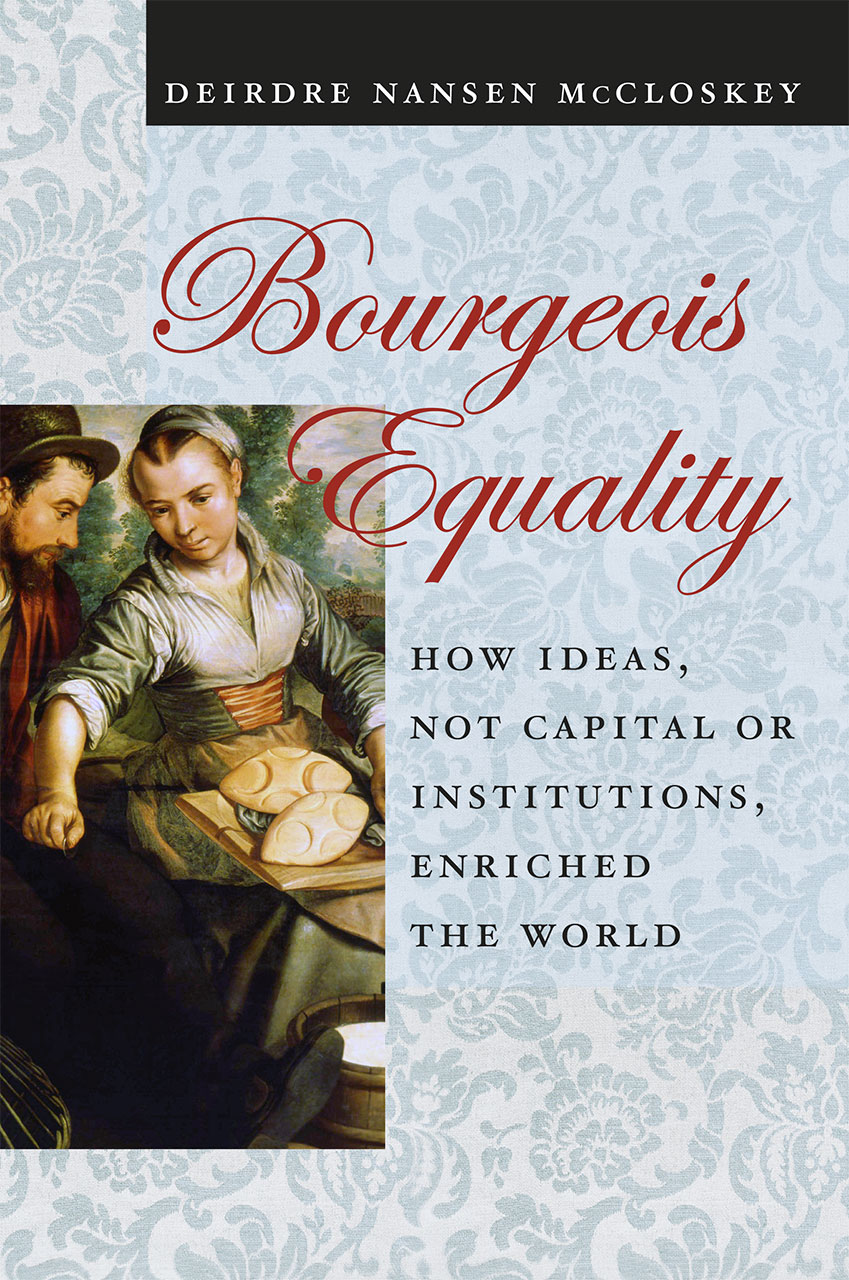 In Dierdre McCloskey’s latest book, Bourgeois Equality: How Ideas, Not Capital or Institutions, Enriched the World, she builds on her ongoing thesis that our newfound prosperity is not due to systems, tools, or materials, but the ideas, virtues, and rhetoric behind them.
Much has been made of her argument as it relates to the (ir)relevance of those material features as causes: “coal or thrift or capital or exports or exploitation or imperialism or good property rights or even good science.” But less has been said about her views on the spiritual/material as it relates to the byproducts.
I’m not yet finished with the book, but on page 70, she offers her view on the spiritual dynamics of what’s to come.
Contrary to popular claims that an increasingly prosperous free society will necessarily trend toward greed, envy, and idleness, McCloskey sees a future with more resources, and thus, more time and space for the transcendent. “One would hope that the Great Enrichment would be used for higher purposes,” she writes…”Enrichment leads to enrichment, not loss of one’s own soul.”
The resulting spiritual change, as I have noted, has been and will be as impressive as the material change. At the level of the purpose of a human life it is the more important outcome. For what is a man profited, if he shall gain the whole world, and lose his own soul? The sacred and meaning-giving virtues of hope, faith, and transcendent love for science or baseball or medicine or God are enabled by our riches in our present lives to bulk larger than the profane and practical virtues of prudence and temperance necessary among people living in extreme poverty. True, in our modern times even unworthy uses of our higher income – eating more Fritos, watching more reality TV – are better physically than in ancient times starving in beggary by the West Gate. Look again at falling death rates worldwide. But one would hope that the Great Enrichment would be used for higher purposes.
And on the most high-minded criteria, it has been, and will be. Enrichment leads to enrichment, not loss of one’s own soul. The American journalist and essayist H.L. Mencken, no softie, noted in 1917 a propos of Sister Carrie’s good fortune, that “with the rise from want to security, from fear to ease, comes an awakening of the finer perceptions, a widening of the sympathies, a gradual unfolding of the delicate flower called personality, an increased capacity for loving and living.” Nor was the University of Iowa economist Frank Knight a softie, yet he too spoke in 1923 about such an increased capacity: “As the standard of living rises, the economic interests of people are transferred more and more out of the sphere of fundamental needs into that of aesthetic and social gratification and pure experimentation.” And no blame attaches.
Contrary to popular predictions and perceptions, the spread of economic prosperity has created more room, not less, for activities centered around the transcendent, and not just through the “extras” it provides in time and treasure. In the work itself, our increasingly enriched economy is enriched by further interconnectedness. The more those connections accelerate, the more our work arcs toward service vs. self-reliance.
Prior to the Great Enrichment, many people simply worked for themselves. Now, thanks to a global economy increasingly driven by free and open exchange, we have the ability to point our service to the other.
“Civilization is sharing in the work of others,” as theologian Lester DeKoster puts it. “It is a circle we will finally see close: Our working puts us in the service of others; the civilization that work creates puts others in the service of ourselves. Thus, work restores the broken family of humankind.”
This new frontier of prosperity – of abundant time and resources and energetic collaboration – can certainly be abused, if neglected. Indeed, the “transcendent” space of civilization can be wholly occupied by spiritual darkness, if we so choose. But that’s where the Christian finds his entrance.
We live at a time where we have incredible channels and resources to respond, creating meaningful enterprises and institutions that remind society of its fundamental purpose and foremost obligations.
We have, as McCloskey puts it, “increased capacity for loving and living,” and we best get to it.
Previous Post

August 29, 2016
The Rise Campaign: Restoring New York City through the Workplace
Next Post

September 15, 2016 Can Overproduction Ever Be Good Stewardship?
Browse Our Archives
Select a Category Art Charity Church Common Grace Culture Curriculum Economics Education Family Justice Order Theology Uncategorized Vocation Wisdom Wonder Work
Select a Month January 2017 December 2016 November 2016 October 2016 September 2016 August 2016 July 2016 June 2016 May 2016 April 2016 March 2016 February 2016 January 2016 December 2015 November 2015 October 2015 September 2015 August 2015 July 2015 June 2015 May 2015 April 2015 March 2015 February 2015 January 2015 December 2014 November 2014 October 2014 September 2014 August 2014
Follow Us!
TAKE THE
Religious Wisdom Quiz
Who led the Israelites into the Promised Land?
Select your answer to see how you score.
Joshua Caleb Aaron Moses
Related posts from Oikonomia

Thomas Sowell on the Origins of Prosperity


Are Christianity and Communism Mutually Exclusive?

What Christians Can Learn from Adam Smith’s ‘Paradox...
TRENDING AT PATHEOS Business, Finance and Religion

St. Francis by Bill Droel Pope Leo XIV declares 2026 as “Year...

Catholics are schooled in the faith by memorizing dogmatic points and lots...

The Good News of Our Human Limitations -...
After another day of trying to meet deadlines and working on projects,...

Quiet Holy Attentiveness (podcast) with Sarah Clarkson
We know that quiet is an essential aspect of the spiritual life,...

Every Vocation Everywhere All At Once
What is a vocation? How does it endure through the years? Can...

I promise this is not going to become a Taylor Swift Studies...
view all Business, Finance and Religion blogs
Ad-Free & Subscriber Log-In Subscription Support
- About Us
- 2026 Calendar
- Videos
- Podcasts
- Library of World Religions
- Faith In Media Tracker
- Advertise With Us
- Write for Us
- Privacy Policy
- Terms of Service
- Do Not Sell My Data
- Contact Us
- Radiant Digital
- Manage Newsletter Subscriptions
- Unsubscribe From Notifications
- Sitemap
Copyright 2008-2026, Patheos. All rights reserved.
Subscription Support Ad-Free & Subscriber Log-In
Follow Patheos