
BuddhistCatholicContemplativeEvangelicalGeneral ChristianHinduJewishLatter-day SaintMuslimNew VisionsProgressive Christian
Beliefs
- Buddhist
- Catholic
- Contemplative
- Evangelical
- General Christian
- Hindu
- Jewish
- Latter-day Saint
- More Voices
- Muslim
- New Visions
- Pagan
- Progressive Christian
Topics
- Religion News
- Food and Religion
- Sports and Religion
- Religious Art
- Religious Music and Entertainment
- Religious Events
- History and Religion
- Style and Religion
- Politics and Religion
- Women in Religion
- Recreation Outdoors and Religion
- Business Finance and Religion
- Careers Workplace and Religion
- Education and Religion
- Family Parenting and Religion
- Health Fitness and Religion
- Home and Religion
- Relationships and Religion
- Technology and Religion
- Travel and Religion
Columnists
- Buddhist Columnists
- Business Finance and Religion Columnists
- Careers Workplace and Religion Columnists
- Catholic Columnists
- Contemplative Columnists
- Education and Religion Columnists
- Evangelists Columnists
- Family Parenting and Religion Columnists
- General Christian Columnists
- Health Fitness and Religion Columnists
- Hindu Columnists
- History and Religion Columnists
- Home and Religion Columnists
- Jewish Columnists
- More Voices Columnists
- Latter Day Columnists
- Muslim Columnists
- New Visions Columnists
- Nonreligious Columnists
- Pagan Columnists
- Politics and Religion Columnists
- Progressive Columnists
- Recreation Outdoors and Religion Columnists
- Relationships and Religion Columnists
- Religion News Columnists
- Religious Art Columnists
- Religious Events Columnists
- Religious Music and Entertainment Columnists
- Sports and Religion Columnists
- Style and Religion Columnists
- Technology and Religion Columnists
- Travel and Religion Columnists
- Women in Religion Columnists
Resource Library
- 2026 Calendar
- Library of World Religions
- The 100 Most Holy Places on Earth
- Patheos Answers
- Podcasts
- Videos
- Faith Leaders Database
- Anglican Episcopalian
- Bahai
- Baptist
- Buddhism
- Christianity
- Confucianism
- Eastern Orthodoxy
- Hinduism
- Holiness and Pentecostal
- ISKCON
- Islam
- Judaism
- Lutheran
- Methodist
- The Church of Jesus Christ of Latter-day Saints
- New Age
- Paganism
- Presbytarian and Reformed
- Protestantism
- Religion Behind the Scenes
- Roman Catholic
- Scientology
- Shia Islam
- Sikhism
- Sufism
- Sunni Islam
- Taoism
- Zen
- See all religions
Research Tools
 Ad-Free & Subscriber Log-In Subscription Support
Ad-Free & Subscriber Log-In Subscription Support
Follow Patheos 

- Trending:
- Forgiveness
- |
- Marriage
- |
- Consciousness
- |
- Death Penalty
- |
- Election
- |
- Halloween
 Oikonomia
- Home
- Business, Finance and Religion
- Why Religious Liberty Cannot Prosper without Economic Liberty
Why Religious Liberty Cannot Prosper without Economic Liberty
Last updated on: August 23, 2016 at 12:29 pm by Acton Institute
Why Religious Liberty Cannot Prosper without Economic Liberty 2016-08-23T12:29:13-04:00 Acton Institute
Patheos Explore the world's faith through different perspectives on religion and spirituality! Patheos has the views of the prevalent religions and spiritualities of the world.
By Jay Richards
 In recent years, religious freedom in the United States has been treated by its defenders as a special form of freedom distinct from, say, political or economic freedom. This is not a viable long-term strategy for protecting religious freedom.
Both economic and religious freedom tend to exist together in the same societies; they are both based on the same principles; they tend to reinforce each other; and over the long haul, they arguably stand or fall together. As a result, when Christians surrender economic freedom, they unwittingly surrender their religious freedom as well.
Our most important ideas are often the ones we take for granted; the unstated premises that inform as if by an invisible hand our conscious thoughts and deliberate actions. Because of the way religious freedom has developed and has been purified by history, it is easy for Americans to dwell blissfully in the branches of the tree of liberty and forget entirely the roots that anchor the tree to the ground.
We take it for granted that in matters of religious faith people should not be coerced. We assume that religious and political institutions should be separate. Indeed, most Americans think that true religious faith requires the exercise of freedom. We assume that that which is compelled is not true faith but mere pretense.
Few of us can articulate the original source for these convictions. I suspect this is because the theological premise that justifies it has become buried out of sight in the moral intuitions of even those who reject it. Thomas Jefferson summarized the premise as well as any when he wrote in the Declaration of Independence that we are endowed by our Creator with certain “unalienable rights,” such as “life, liberty and the pursuit of happiness.” If human beings have such rights by virtue of our divine origin, if we are the kind of creatures that ought to be accorded respect and given wide jurisdiction over the sorts of beliefs we affirm, then it follows that in certain matters, including but not limited to religion, no one should be coerced.
The American founder George Mason made the point lucidly in his draft of the Virginia Declaration of Rights (1776), a document that later became the model for the United States Bill of Rights. He wrote, in part, that “religion, or the duty which we owe to our Creator, and the manner of discharging it, can be directed only by reason and conviction, not by force or violence; and therefore all men are equally entitled to the free exercise of religion, according to the dictates of conscience; and that it is the mutual duty of all to practice Christian forbearance, love, and charity toward each other.”
Note that religious freedom here is not justified by relativism — the favorite but faulty argument of sophomores — but by reference to religion, by which Mason means the duty that each of us owes to God. The basis for religious liberty is itself religious.
George Mason, Thomas Jefferson, James Madison, and other American founders did not think they were invoking a parochial custom that they picked up from their European heritage. They claimed, rather, that these rights were universal, and that if one understood the truth about man, then one would simply see by reason that such rights obtained. They even went so far as to claim that the rights to life and liberty were self-evident.
Besides this commitment to the universal rights of man, the American founders were acutely aware of past religious conflicts, not just in far-away England but in the early American colonies as well. Although the founders were theologically diverse, they all believed that the existence of both a Creator and the moral law could be known by reason and should inform our legal and political lives. At the same time, they thought questions concerning the trinity, the proper form of baptism, church government, and the like were sectarian rather than strictly public concerns.
These dual convictions led them to a position perplexing both to modern secularists and to those who assume the founders meant to establish a Christian republic. The founders affirmed the public expression of religious faith and its importance to public morality while refusing to establish a national religion. Instead, they opted for widespread religious liberty, which meant that citizens could bring their religious convictions into the public square.
The First Amendment to the U.S. Constitution captures their balanced approach: “Congress shall make no law respecting an establishment of religion, nor prohibiting the free exercise thereof.” A just and limited state must recognize domains and institutions outside its jurisdiction. Such “prepolitical realities” include, most prominently, the right of every human being to “life, liberty and the pursuit of happiness.” The right to liberty, in turn, implies a right to free speech, to freedom of association, and to freedom of religion.
By economic freedom, I refer to the social condition in which individuals, families, and associations enjoy the rule of law, respect for their rights, limited government, a vibrant civil society outside the jurisdiction of the state, well-delineated rights to private property and contracts, and broad discretion on economic matters. If it is easy to start a business; to seek employment; to hire employees without invasive dictates from political authorities, private cartels, or organized crime; to negotiate salary, benefits, and responsibilities; to have fair contracts enforced; and the like, then a society enjoys some measure of economic freedom.
The philosophical basis for religious freedom rests on the same foundation as the case for economic freedom: individual rights, freedom of association and the family, and the presence of a government with limited jurisdiction.
Economic freedom just as much as religious freedom requires limited government: a “government limited by laws.” The government helps create and maintain the public space (along with other institutions of civil society) in which free economic decisions can be made. Economic freedom exists on a spectrum between anarchy at one extreme and statism on the other. A society in which the strong are “free” to prey on and enslave the weak is not economically free. Neither is a society free when all economic decisions are made by political fiat.
Because the economic and religious realms involve man as an individual, as a member of a family, and as a member of society, it is unrealistic to imagine that we can cordon off our religious liberty from our economic liberty.
An environment in which economic liberty is enjoyed is one in which religious liberty is likely to be enjoyed and vice versa. It is a virtuous circle. Similarly, in environments where our economic liberty is restrained, either by the state or by general lawlessness, our religious liberty is likely to suffer as well. This is a vicious circle.
If that is the case, then, if we wish to preserve religious liberty, what we need are robust defenses of both economic and religious liberty, framed in a way that makes it clear that these two liberties, these two freedoms, are mutually reinforcing and indivisible.
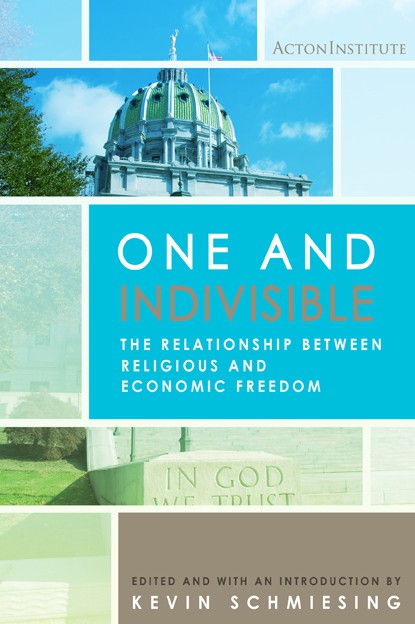
Jay W. Richards is assistant research professor in the School of Business and Economics at the Catholic University of America. This commentary is excerpted from newly released Acton Institute volume, One and Indivisible: The Relationship between Religious and Economic Freedom.
This excerpt originally appeared at Acton Commentary.
Previous Post
August 17, 2016
Is God Opposed to Christians Making Lots of Money?
Next Post

August 29, 2016 The Rise Campaign: Restoring New York City through the Workplace
Browse Our Archives
Select a Category Art Charity Church Common Grace Culture Curriculum Economics Education Family Justice Order Theology Uncategorized Vocation Wisdom Wonder Work
Select a Month January 2017 December 2016 November 2016 October 2016 September 2016 August 2016 July 2016 June 2016 May 2016 April 2016 March 2016 February 2016 January 2016 December 2015 November 2015 October 2015 September 2015 August 2015 July 2015 June 2015 May 2015 April 2015 March 2015 February 2015 January 2015 December 2014 November 2014 October 2014 September 2014 August 2014
Follow Us!
TAKE THE
Religious Wisdom Quiz
What does Paul say is hidden in Christ according to Colossians?
Select your answer to see how you score.
The riches of glory All the treasures of wisdom and knowledge Eternal life The mysteries of God
Related posts from Oikonomia

Thomas Sowell on the Origins of Prosperity

Politics, Character, and Competition


Lessons on Christian Vocation from ‘Chewbacca Mom’
TRENDING AT PATHEOS Business, Finance and Religion

St. Francis by Bill Droel Pope Leo XIV declares 2026 as “Year...

Catholics are schooled in the faith by memorizing dogmatic points and lots...

The Good News of Our Human Limitations -...
After another day of trying to meet deadlines and working on projects,...

Quiet Holy Attentiveness (podcast) with Sarah Clarkson
We know that quiet is an essential aspect of the spiritual life,...

Every Vocation Everywhere All At Once
What is a vocation? How does it endure through the years? Can...

I promise this is not going to become a Taylor Swift Studies...
view all Business, Finance and Religion blogs
Ad-Free & Subscriber Log-In Subscription Support
- About Us
- 2026 Calendar
- Videos
- Podcasts
- Library of World Religions
- Faith In Media Tracker
- Advertise With Us
- Write for Us
- Privacy Policy
- Terms of Service
- Do Not Sell My Data
- Contact Us
- Radiant Digital
- Manage Newsletter Subscriptions
- Unsubscribe From Notifications
- Sitemap
Copyright 2008-2026, Patheos. All rights reserved.
Subscription Support Ad-Free & Subscriber Log-In
Follow Patheos