
BuddhistCatholicContemplativeEvangelicalGeneral ChristianHinduJewishLatter-day SaintMuslimNew VisionsProgressive Christian
Beliefs
- Buddhist
- Catholic
- Contemplative
- Evangelical
- General Christian
- Hindu
- Jewish
- Latter-day Saint
- More Voices
- Muslim
- New Visions
- Pagan
- Progressive Christian
Topics
- Religion News
- Food and Religion
- Sports and Religion
- Religious Art
- Religious Music and Entertainment
- Religious Events
- History and Religion
- Style and Religion
- Politics and Religion
- Women in Religion
- Recreation Outdoors and Religion
- Business Finance and Religion
- Careers Workplace and Religion
- Education and Religion
- Family Parenting and Religion
- Health Fitness and Religion
- Home and Religion
- Relationships and Religion
- Technology and Religion
- Travel and Religion
Columnists
- Buddhist Columnists
- Business Finance and Religion Columnists
- Careers Workplace and Religion Columnists
- Catholic Columnists
- Contemplative Columnists
- Education and Religion Columnists
- Evangelists Columnists
- Family Parenting and Religion Columnists
- General Christian Columnists
- Health Fitness and Religion Columnists
- Hindu Columnists
- History and Religion Columnists
- Home and Religion Columnists
- Jewish Columnists
- More Voices Columnists
- Latter Day Columnists
- Muslim Columnists
- New Visions Columnists
- Nonreligious Columnists
- Pagan Columnists
- Politics and Religion Columnists
- Progressive Columnists
- Recreation Outdoors and Religion Columnists
- Relationships and Religion Columnists
- Religion News Columnists
- Religious Art Columnists
- Religious Events Columnists
- Religious Music and Entertainment Columnists
- Sports and Religion Columnists
- Style and Religion Columnists
- Technology and Religion Columnists
- Travel and Religion Columnists
- Women in Religion Columnists
Resource Library
- 2026 Calendar
- Library of World Religions
- The 100 Most Holy Places on Earth
- Patheos Answers
- Podcasts
- Videos
- Faith Leaders Database
- Anglican Episcopalian
- Bahai
- Baptist
- Buddhism
- Christianity
- Confucianism
- Eastern Orthodoxy
- Hinduism
- Holiness and Pentecostal
- ISKCON
- Islam
- Judaism
- Lutheran
- Methodist
- The Church of Jesus Christ of Latter-day Saints
- New Age
- Paganism
- Presbytarian and Reformed
- Protestantism
- Religion Behind the Scenes
- Roman Catholic
- Scientology
- Shia Islam
- Sikhism
- Sufism
- Sunni Islam
- Taoism
- Zen
- See all religions
Research Tools
 Ad-Free & Subscriber Log-In Subscription Support
Ad-Free & Subscriber Log-In Subscription Support
Follow Patheos 

- Trending:
- Forgiveness
- |
- Marriage
- |
- Consciousness
- |
- Death Penalty
- |
- Election
- |
- Halloween
 Oikonomia
- Home
- Business, Finance and Religion
- McDonald’s as Social Enterprise: Capitalism’s Community Center?
McDonald’s as Social Enterprise: Capitalism’s Community Center?
Last updated on: July 12, 2016 at 11:46 pm by Acton Institute
McDonald’s as Social Enterprise: Capitalism’s Community Center? 2016-07-12T23:46:14-04:00 Acton Institute
Patheos Explore the world's faith through different perspectives on religion and spirituality! Patheos has the views of the prevalent religions and spiritualities of the world.
By Joseph Sunde
 We live, work, and consume within an increasingly grand, globalized economy. Yet standing amidst its many fruits and blessings, we move about our lives giving little thought to why we’re working, who we’re serving, and how exactly our needs are being met. Adam Smith’s “invisible hand” feels more invisible than ever.
In response to our newfound economic order, big and blurry as it is, many have aimed to pave paths toward more “communitarian” ends, epitomized by recent waves of “localist consumerism,” “artisanal shops,” and “social entrepreneurship.” Such efforts can be tremendously fruitful, and insofar as they meet real human needs, we should heed their resistance to blind marches toward “progress.”
I only wish that such movements would appreciate the broader range of possible solutions. The slow and local is all well and good, but something as mundane and mainstream as a local McDonald’s can serve community needs just as well as the trendy mom-and-pops of the future. The big and global is not necessarily the enemy of the small and local.
As Chris Arnade demonstrates through a series of stories, for many low- and middle-income areas, “McDonald’s have become de-facto community centers and reflections of the surrounding neighborhood,” offering a hub for the very sort of social fabric-weaving that crunchy communitarians crave. (Note: I was an employee and then shift manager of a McDonald’s during my teenage years.)
One can be resistant to the nutritional risks of the food — just as I remain resistant to the budgetary risks of overpriced “artisanal donuts” — and still perceive the value that such enterprises bring to local communities everywhere: economic, social, and (dare I say) spiritual.
For many, McDonald’s serves the same function of the latest glorified “social epicenters” and “third spaces” of mobile freelancers, often with even more intricate circles of community. Indeed, though the new wave of hip-and-homey start-ups have surely done their share of community transformation, few can beat McDonald’s at serving within the common constraints of lower-income Americans.
When many lower-income Americans are feeling isolated by the deadening uniformity of things, by the emptiness of many jobs, by the media, they still yearn for physical social networks. They are not doing this by going to government-run community service centers. They are not always doing this by utilizing the endless array of well-intentioned not-for-profit outreach programs. They are doing this on their own, organically across the country, in McDonald’s.
Walk into any McDonald’s in the morning and you will find a group of mostly retired people clustering in a corner, drinking coffee, eating and talking. They are drawn to the McDonald’s because it has inexpensive good coffee, clean bathrooms, space to sprawl. Unlike community centers, it is also free of bureaucracy.
Whether frequented by elderly and retired folks, prayer groups and Bible studies, political organizations, neighborhood associations, or various marginalized persons on the streets, McDonald’s provides a cheap, accessible, and comfortable place for all, delivering services and providing jobs with great efficiency.
Arnade’s article is filled with stories of people who find peace and refuge in the very place that loftier minds are wont to disdain as a curse on the poor:
For many of the poorest, for the homeless, and for people caught in an addiction, McDonald’s are an integral part of their lives. They have cheap and filling food, they have free Wi-Fi, outlets to charge phones, and clean bathrooms. McDonald’s is also generally gracious about letting people sit quietly for long periods – longer than other fast-food places…
In almost every franchise, there are tables with people like Betty [who is homeless during daytime hours] escaping from the streets for a short bit. They prefer McDonald’s to shelters and to non-profits, because McDonald’s are safer, provide more freedom, and most importantly, the chance to be social, restoring a small amount of normalcy.
In the Bronx, many of my friends who live on the streets are regulars. Steve, who has been homeless for 20 years, uses the internet to check up on sports, find discarded papers to do the crossword puzzle, and generally escape for a while. He and his wife Takeesha will turn a McDonald’s meal into an evening out. Beauty, who has been homeless for five years, uses the internet to check up on her family back in Oklahoma when she can find a computer to borrow.
Most importantly though, McDonald’s provide many with the chance to make real and valuable connections. When faced with the greatest challenges, with a personal loss, wealthier Americans turn to expensive therapists, others without the resources or the availability, turn to each other.
Once again, these sorts of community hubs exist everywhere, and they come in all shapes and sizes. They needn’t be businesses like McDonald’s, but it does seem that our appetite for “enterprise solutions” is limited to “social signalers” and the confines of the small and independent.
The success of McDonald’s in weaving communities doesn’t mean that the economics don’t matter — small, big, whatever. It simply means that we should be careful that our justified fears about big business and rapid change ought not be replaced by a blind prejudice.
Each community is different, and each will require its own set of solutions. As we seek to unpack what really matters and what really works — looking at the roots and fruits of each solution — our economic imaginations ought to remain as wide as possible.
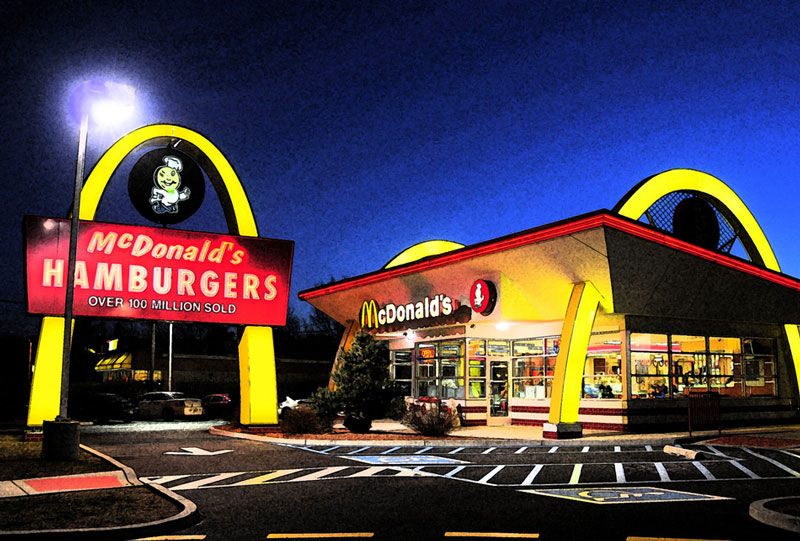
Image credit: Tony Fischer
Previous Post

July 5, 2016
Bruce Wayne: A Capitalist Superhero
Next Post

July 21, 2016 What Is the Meaning of Work?
Browse Our Archives
Select a Category Art Charity Church Common Grace Culture Curriculum Economics Education Family Justice Order Theology Uncategorized Vocation Wisdom Wonder Work
Select a Month January 2017 December 2016 November 2016 October 2016 September 2016 August 2016 July 2016 June 2016 May 2016 April 2016 March 2016 February 2016 January 2016 December 2015 November 2015 October 2015 September 2015 August 2015 July 2015 June 2015 May 2015 April 2015 March 2015 February 2015 January 2015 December 2014 November 2014 October 2014 September 2014 August 2014
Follow Us!
TAKE THE
Religious Wisdom Quiz
True or False: 3 John commends Diotrephes for his hospitality and love for the brethren.
Select your answer to see how you score.
TRUE FALSE
Related posts from Oikonomia

Thomas Sowell on the Origins of Prosperity

Politics, Character, and Competition


Are Christianity and Communism Mutually Exclusive?
TRENDING AT PATHEOS Business, Finance and Religion

St. Francis by Bill Droel Pope Leo XIV declares 2026 as “Year...

Catholics are schooled in the faith by memorizing dogmatic points and lots...

The Good News of Our Human Limitations -...
After another day of trying to meet deadlines and working on projects,...

Quiet Holy Attentiveness (podcast) with Sarah Clarkson
We know that quiet is an essential aspect of the spiritual life,...

Every Vocation Everywhere All At Once
What is a vocation? How does it endure through the years? Can...

I promise this is not going to become a Taylor Swift Studies...
view all Business, Finance and Religion blogs
Ad-Free & Subscriber Log-In Subscription Support
- About Us
- 2026 Calendar
- Videos
- Podcasts
- Library of World Religions
- Faith In Media Tracker
- Advertise With Us
- Write for Us
- Privacy Policy
- Terms of Service
- Do Not Sell My Data
- Contact Us
- Radiant Digital
- Manage Newsletter Subscriptions
- Unsubscribe From Notifications
- Sitemap
Copyright 2008-2026, Patheos. All rights reserved.
Subscription Support Ad-Free & Subscriber Log-In
Follow Patheos