
BuddhistCatholicContemplativeEvangelicalGeneral ChristianHinduJewishLatter-day SaintMuslimNew VisionsProgressive Christian
Beliefs
- Buddhist
- Catholic
- Contemplative
- Evangelical
- General Christian
- Hindu
- Jewish
- Latter-day Saint
- More Voices
- Muslim
- New Visions
- Pagan
- Progressive Christian
Topics
- Religion News
- Food and Religion
- Sports and Religion
- Religious Art
- Religious Music and Entertainment
- Religious Events
- History and Religion
- Style and Religion
- Politics and Religion
- Women in Religion
- Recreation Outdoors and Religion
- Business Finance and Religion
- Careers Workplace and Religion
- Education and Religion
- Family Parenting and Religion
- Health Fitness and Religion
- Home and Religion
- Relationships and Religion
- Technology and Religion
- Travel and Religion
Columnists
- Buddhist Columnists
- Business Finance and Religion Columnists
- Careers Workplace and Religion Columnists
- Catholic Columnists
- Contemplative Columnists
- Education and Religion Columnists
- Evangelists Columnists
- Family Parenting and Religion Columnists
- General Christian Columnists
- Health Fitness and Religion Columnists
- Hindu Columnists
- History and Religion Columnists
- Home and Religion Columnists
- Jewish Columnists
- More Voices Columnists
- Latter Day Columnists
- Muslim Columnists
- New Visions Columnists
- Nonreligious Columnists
- Pagan Columnists
- Politics and Religion Columnists
- Progressive Columnists
- Recreation Outdoors and Religion Columnists
- Relationships and Religion Columnists
- Religion News Columnists
- Religious Art Columnists
- Religious Events Columnists
- Religious Music and Entertainment Columnists
- Sports and Religion Columnists
- Style and Religion Columnists
- Technology and Religion Columnists
- Travel and Religion Columnists
- Women in Religion Columnists
Resource Library
- 2026 Calendar
- Library of World Religions
- The 100 Most Holy Places on Earth
- Patheos Answers
- Podcasts
- Videos
- Faith Leaders Database
- Anglican Episcopalian
- Bahai
- Baptist
- Buddhism
- Christianity
- Confucianism
- Eastern Orthodoxy
- Hinduism
- Holiness and Pentecostal
- ISKCON
- Islam
- Judaism
- Lutheran
- Methodist
- The Church of Jesus Christ of Latter-day Saints
- New Age
- Paganism
- Presbytarian and Reformed
- Protestantism
- Religion Behind the Scenes
- Roman Catholic
- Scientology
- Shia Islam
- Sikhism
- Sufism
- Sunni Islam
- Taoism
- Zen
- See all religions
Research Tools
 Ad-Free & Subscriber Log-In Subscription Support
Ad-Free & Subscriber Log-In Subscription Support
Follow Patheos 

- Trending:
- Forgiveness
- |
- Marriage
- |
- Consciousness
- |
- Death Penalty
- |
- Election
- |
- Halloween
 Oikonomia
- Home
- Business, Finance and Religion
- What Christians Should Know About Crony Capitalism
What Christians Should Know About Crony Capitalism
Last updated on: February 23, 2016 at 1:20 am by Acton Institute
What Christians Should Know About Crony Capitalism 2016-02-23T01:20:46-04:00 Acton Institute
Patheos Explore the world's faith through different perspectives on religion and spirituality! Patheos has the views of the prevalent religions and spiritualities of the world.
By Joe Carter
Note: This is part of an Acton blog series titled, “What Christians Should Know About Economics.” For other entries in the series, click here.
Crony capitalism is a general term for the range of activities in which particular individuals or businesses in a market economy receive government-granted privileges over their customers and/or competitors.
For as long as there have been government officials, there have been economic cronies — friends, family, and associates who use their connections for their own financial gain. In ancient Israel, for example, when the prophet Samuel appointed his own sons as leaders, they began to engage in cronyism: “[Samuel’s] sons did not follow his ways. They turned aside after dishonest gain and accepted bribes and perverted justice.” (1 Samuel 8:3).
Unsatisfied with these corrupt leaders, the elders of Israel asked Samuel to appoint a king over them. God told Samuel to warn the people of the consequences, which included even worse forms of economic cronyism: “[The king] will take the best of your fields and vineyards and olive groves and give them to his attendants. He will take a tenth of your grain and of your vintage and give it to his officials and attendants” (1 Samuel 8:14-15).
We read passages like that and instantly recognize this as unfair and unjust, a corrupting influence on both the people and the government. Yet we tend not to even notice the cronyism that occurs in our own economic system. Because the “dishonest gain” is often more subtle than the examples found in the Bible, we often do not recognize cronyism because we don’t know what to look for.
To help in the identification process, here are the most common types of government-granted privileges individuals and businesses receive that give them an unfair advantage (click here for detailed explanations of each):
- Monopoly privilege: Government uses its power to directly protect certain firms or industries from competition by limiting or keeping other firms out of the market. This type of direct cronyism is relatively rare. (Examples: cable companies, utilities, the USPS)
- Regulatory privilege: Large corporations used to lobby government to reduce the regulatory burden on their industries. But many corporation realized they could gain a competitive advantage by lobbying for specific regulations that benefit their firm and hamstring their competitors. (Examples: Obamacare’s mandate requiring insurance companies to buy contraceptives, a regulation that benefits the pharmaceutical companies that make them.)
- Subsides: Subsidies, which are sometimes referred to as “corporate welfare”, occur when the government gives taxpayer money directly to a business or industry. According to a report by Philip Mattera and Kasia Tarczynska, “two-thirds of the $68 billion in business grants and special tax credits awarded by the federal government over the past 15 years have gone to large corporations.” The largest recipient is the Spanish energy company Iberdrola, which has collected about $2.2 billion in subsidies “by investing heavily in U.S. power generation facilities, including wind farms that have made use of a renewable energy provision of the 2009 Recovery Act.”
- Other common types of government-granted privileges include Loan Guarantees, Tax Privileges, Bailouts (and expected bailouts), Tariffs and Quotas on Foreign Competition, Noncompetitive Bidding, and Occupational Licensing.
So what’s wrong with some firms getting special privileges?
The main reason we should oppose crony capitalism is because it circumvents the moral process involved in a free exchange of goods and services. In a free exchange, the one who most often benefits is the individual consumer. As Frederick Bastiat argued:
Consumption [i.e.,the use of goods and services by households] is the great end and purpose of political economy; that good and evil, morality and immorality, harmony and discord, everything finds its meaning in the consumer, for he represents mankind.
He summarizes his argument for the consumer and against cronyism as follows:
There is a fundamental antagonism between the seller and the buyer.
The former wants the goods on the market to be scarce, in short supply, and expensive.
The latter wants them abundant, in plentiful supply, and cheap.
Our laws, which should at least be neutral, take the side of the seller against the buyer, of the producer against the consumer, of high prices against low prices, of scarcity against abundance.
They operate, if not intentionally, at least logically, on the assumption that a nation is rich when it is lacking in everything.
Bastiat uses this as the basis of his argument that the interests of the consumer, rather than the producer, align more closely with the interests of mankind (you should read his essay to fully appreciate the connection). The producer tends to have their own self-interest in mind, and so has a strong incentive to get the government to use its force and power to help them gain an economic benefit over the consumer. This causes goods to be either more expensive and/or more scarce than they normally would be without government intervention.
The result is that cronies get richer, while everyone else is made poorer.
Other stuff you should know:
Increasing the power of the government is often posited as a way to keep “Big Business” in check. But as Randall G. Holcombe notes, “The substantial and well-established economic literature on the components of crony capitalism shows that big government is the cause of crony capitalism, not the solution.”
Cronyism often leads to corruption, though it can be rather subtle. Take, for example, intertemporal corruption. An intertemporal choice occurs when a choice at one time influences the possibilities available at other points in time. For example, you may decide to spend less money today in order to save and be able to spend more at a future point in time, such as during retirement. When combined with cronyism, such intertemporal choices can lead to intertemporal corruption. As economist Bryan Caplan explains:
If a major corporation gives a U.S. Senator a ten-million-dollar “gift,” it’s likely to be punished as corruption. It doesn’t matter if the corporation protests, “We’re only expressing our affection for this fine Senator” or if the Senator bellows, “How dare you claim my vote is for sale!” However, if the same Senator retires, and the major corporation gives him a ten-million-dollar sinecure on its Board of Directors, it’s perfectly legal – and few demur.
The painfully obvious flaw with both norms: Intertemporal corruption is a wonderful substitute for ordinary corruption. A professor is unlikely to give an F to his current girlfriend; but he’s also unlikely to give an F to his future girlfriend. A Senator is unlikely to vote against a corporation that gives him millions of dollars; but he’s also unlikely to vote against a corporation that’s going to give him millions of dollars. What comes around, goes around.
Originally published at the Acton PowerBlog
This is part of an Acton blog series titled, “What Christians Should Know About Economics.” For other entries in the series, click here.
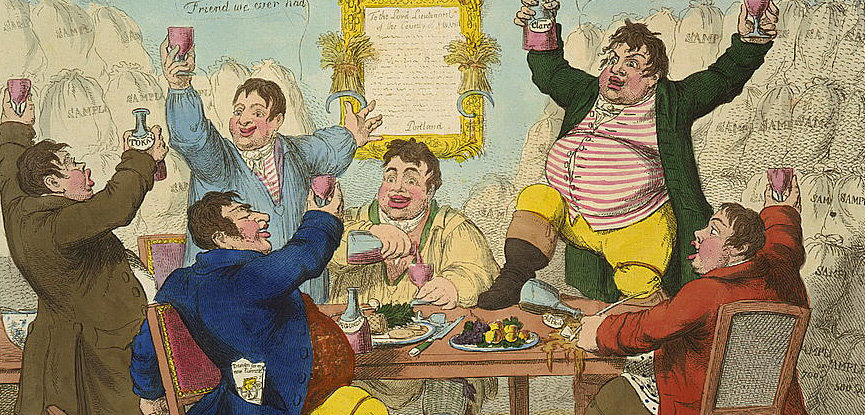
Image: The Farmers toast

Previous Post

February 18, 2016
Kuyper’s Impact on Chuck Colson
Next Post

February 26, 2016 Living in the Mystery of Kingdom Stewardship
Browse Our Archives
Select a Category Art Charity Church Common Grace Culture Curriculum Economics Education Family Justice Order Theology Uncategorized Vocation Wisdom Wonder Work
Select a Month January 2017 December 2016 November 2016 October 2016 September 2016 August 2016 July 2016 June 2016 May 2016 April 2016 March 2016 February 2016 January 2016 December 2015 November 2015 October 2015 September 2015 August 2015 July 2015 June 2015 May 2015 April 2015 March 2015 February 2015 January 2015 December 2014 November 2014 October 2014 September 2014 August 2014
Follow Us!
TAKE THE
Religious Wisdom Quiz
Who was Samson's mother?
Select your answer to see how you score.
Delilah Manoah's wife Ruth Hannah
Related posts from Oikonomia

Thomas Sowell on the Origins of Prosperity

Politics, Character, and Competition


Are Christianity and Communism Mutually Exclusive?
TRENDING AT PATHEOS Business, Finance and Religion

St. Francis by Bill Droel Pope Leo XIV declares 2026 as “Year...

Catholics are schooled in the faith by memorizing dogmatic points and lots...

The Good News of Our Human Limitations -...
After another day of trying to meet deadlines and working on projects,...

Quiet Holy Attentiveness (podcast) with Sarah Clarkson
We know that quiet is an essential aspect of the spiritual life,...

Every Vocation Everywhere All At Once
What is a vocation? How does it endure through the years? Can...

I promise this is not going to become a Taylor Swift Studies...
view all Business, Finance and Religion blogs
Ad-Free & Subscriber Log-In Subscription Support
- About Us
- 2026 Calendar
- Videos
- Podcasts
- Library of World Religions
- Faith In Media Tracker
- Advertise With Us
- Write for Us
- Privacy Policy
- Terms of Service
- Do Not Sell My Data
- Contact Us
- Radiant Digital
- Manage Newsletter Subscriptions
- Unsubscribe From Notifications
- Sitemap
Copyright 2008-2026, Patheos. All rights reserved.
Subscription Support Ad-Free & Subscriber Log-In
Follow Patheos