
BuddhistCatholicContemplativeEvangelicalGeneral ChristianHinduJewishLatter-day SaintMuslimNew VisionsProgressive Christian
Beliefs
- Buddhist
- Catholic
- Contemplative
- Evangelical
- General Christian
- Hindu
- Jewish
- Latter-day Saint
- More Voices
- Muslim
- New Visions
- Pagan
- Progressive Christian
Topics
- Religion News
- Food and Religion
- Sports and Religion
- Religious Art
- Religious Music and Entertainment
- Religious Events
- History and Religion
- Style and Religion
- Politics and Religion
- Women in Religion
- Recreation Outdoors and Religion
- Business Finance and Religion
- Careers Workplace and Religion
- Education and Religion
- Family Parenting and Religion
- Health Fitness and Religion
- Home and Religion
- Relationships and Religion
- Technology and Religion
- Travel and Religion
Columnists
- Buddhist Columnists
- Business Finance and Religion Columnists
- Careers Workplace and Religion Columnists
- Catholic Columnists
- Contemplative Columnists
- Education and Religion Columnists
- Evangelists Columnists
- Family Parenting and Religion Columnists
- General Christian Columnists
- Health Fitness and Religion Columnists
- Hindu Columnists
- History and Religion Columnists
- Home and Religion Columnists
- Jewish Columnists
- More Voices Columnists
- Latter Day Columnists
- Muslim Columnists
- New Visions Columnists
- Nonreligious Columnists
- Pagan Columnists
- Politics and Religion Columnists
- Progressive Columnists
- Recreation Outdoors and Religion Columnists
- Relationships and Religion Columnists
- Religion News Columnists
- Religious Art Columnists
- Religious Events Columnists
- Religious Music and Entertainment Columnists
- Sports and Religion Columnists
- Style and Religion Columnists
- Technology and Religion Columnists
- Travel and Religion Columnists
- Women in Religion Columnists
Resource Library
- 2026 Calendar
- Library of World Religions
- The 100 Most Holy Places on Earth
- Patheos Answers
- Podcasts
- Videos
- Faith Leaders Database
- Anglican Episcopalian
- Bahai
- Baptist
- Buddhism
- Christianity
- Confucianism
- Eastern Orthodoxy
- Hinduism
- Holiness and Pentecostal
- ISKCON
- Islam
- Judaism
- Lutheran
- Methodist
- The Church of Jesus Christ of Latter-day Saints
- New Age
- Paganism
- Presbytarian and Reformed
- Protestantism
- Religion Behind the Scenes
- Roman Catholic
- Scientology
- Shia Islam
- Sikhism
- Sufism
- Sunni Islam
- Taoism
- Zen
- See all religions
Research Tools
 Ad-Free & Subscriber Log-In Subscription Support
Ad-Free & Subscriber Log-In Subscription Support
Follow Patheos 

- Trending:
- Forgiveness
- |
- Marriage
- |
- Consciousness
- |
- Death Penalty
- |
- Election
- |
- Halloween
 Oikonomia
- Home
- Business, Finance and Religion
- Charles Koch’s Metaphysics of Business
Charles Koch’s Metaphysics of Business
Last updated on: February 8, 2016 at 4:17 pm by Acton Institute
Charles Koch’s Metaphysics of Business 2016-02-08T16:17:44-04:00 Acton Institute
Patheos Explore the world's faith through different perspectives on religion and spirituality! Patheos has the views of the prevalent religions and spiritualities of the world.
By Stephen Schmalhofer
 Adam Smith, that venerable a supporter of free enterprise, held businessmen in low regard, alleging that their every meeting “ends in a conspiracy against the public, or in some contrivance to raise prices.” While deference is due to the Scottish master’s lasting insights into the sources of the values of men in The Theory of Moral Sentiments and their success in The Wealth of Nations, I observe that many executives tout their “core values,” but not all of these companies are successful.
Businessman and philanthropist Charles Koch is successful by any financial measure and his unique approach to the creation of value and values at Koch Industries in Wichita, Kansas, where he is chief executive officer, positions him against Smith’s caricature of scheming backroom businessmen.
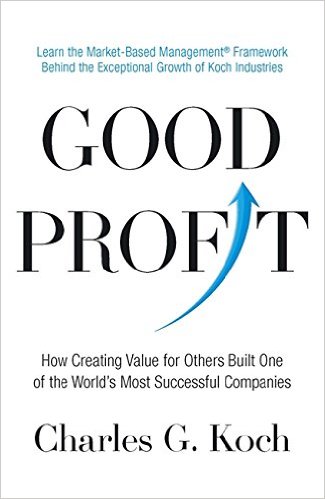
Since 1967, Koch has overseen operations at Koch Industries where he developed and implemented “Market-Based Management.” Following a large acquisition by Koch Industries in 2004, he urgently systematized the method and continues to share it with the fervor of an evangelist. Koch’s first book on the method was grandiosely titled The Science of Success: How Market Based Management Built the World’s Largest Private Company, but in 2015 he re-entered the marketplace of ideas with a more accessible version — Good Profit: How Creating Value for Others Built One of the World’s Most Successful Companies.
Removing the pretense of science from the title better reflects the method’s foundation in the ideas of spontaneous order and the price system articulated by Austrian economist F.A. Hayek rather than in the pseudo-scientific central planning opposed by the Nobel laureate. Koch Industries’ business model is based on acquiring complementary companies that either enhance, or can be improved by, the performance of existing Koch business units. Koch managers seek to integrate these new acquisitions into the company’s operations to realize the expected gains from economies of scale and knowledge sharing. But this integration can blunt the information signals provided by external networks as well as create wasteful internal political battles, especially over budgets and other signs of corporate status unrelated to “good profit.”
To reduce the sclerotic effects of bureaucracy, Koch reintroduces internal market practices. For example, when one Koch businesses purchases products from another Koch business, the transactions are done at prevailing market prices, not with a “family discount.” Internal support services such as accounting or credit compete alongside external service providers to earn the right to serve each Koch business. This is done not to spark a destructive Hobbesian “war of all against all” but to ensure good stewardship of economic resources (opportunity cost) but also to avoid wasting human talent and creativity (comparative advantage).
Koch’s book is more business philosophy than process, a style shared by entrepreneur and venture capitalist Peter Thiel’s recent reflections on innovation in Zero to One: Notes on Startups, or How to Invent the Future. Both books bring to life the observation of Binx Bollings in Walker Percy’s The Moviegoer that “businessmen are our only metaphysicians.” The end to which Koch orders the actions of his company of more than 100,000 people is to earn “good profit” by striving “to be the counter-party of choice to our customers, vendors, communities, and employees.” Striving for this end requires the constant discernment of what your customers value and for how much. To discern and ideally anticipate what your customers need requires a set of personal values to guide decision making within the organization. In Market-Based Management, the cardinal “guiding principle” is integrity.
Too often, integrity is offered up like just another generic corporate value, but trust and reputation are at the heart of commercial life. When a business like online retailer Amazon operates with integrity and a deep commitment to all of its customers, enormous opportunities are created. Netflix, the popular video streaming service, is a significant business customer of Amazon Web Services, the cloud computing platform powering the e-commerce giant and available as a service to startups and Fortune 500 corporations alike. Netflix chooses to use AWS despite competing directly in the market with Amazon Instant Video’s streaming service. AWS is a technical and business achievement (Revenue: $2 billion Q3-2015) that would not be possible without earning the trust of peer businesses.
The rise of highly-valued and popular two-sided network or marketplace businesses may signal that economist Ronald Coase is due for a revival. The Nobel laureate’s 1937 article answered an ambitious question: Why do firms exist? His simple but powerfully developed response was that transaction costs are not zero and are not ignored by entrepreneurs. Traditionally entrepreneurs respond to these costs with vertical integration and other supersessions of the price system. At Koch, the formation of employees and selection of partners and customers with integrity is emphasized, partly due to the human duty of moral action but also because of the saved “time and money spent on controls, contracts, litigation, and security.”
The internet has helped entrepreneurs slim down the scope of their firms, instead facilitating peer to peer connections (e.g. dating apps) or commerce (e.g. Etsy, Thumbtack). The speed of communication has aided growth but the most successful marketplace businesses have developed ways of signaling the reputation and integrity of buyers and sellers. After an Uber ride, the driver and passenger both rate each other with consequences for their future access to the network and service. Similarly, AirBNB and other vacation property rental marketplaces encourage the host and guest to both provide feedback on their stay. New businesses are providing transparency and aggregating reputation so customers and producers can make better decisions (e.g. TripAdvisor, Yelp, Angie’s List). This is both transactional (“Where should I stay on my trip?”) but also character forming (“How can our team better serve others?”). Third parties are also building on top of this reputational ecosystem. For example, the lender OnDeck Capital has incorporated Yelp reviews and similar data when underwriting loans for small businesses.
Good Profit only briefly notes Charles Koch’s political activities. While the political press focuses on his electoral gamesmanship, Koch spends a significant amount of his philanthropic time and money supporting research and education to enhance the public’s understanding of the integrity of free enterprise. A loss of confidence in free enterprise emerges from the growth of “crony capitalism” as a Legatum Institute survey reports that 65 percent of Americans believe most big businesses have dodged taxes, polluted, or bought favors. In other words, a majority of American believe the large corporations lack integrity.
For his part, Charles Koch has advocated (in the Wall Street Journal and elsewhere) for an end to government subsidies and protectionism favoring some industries, producers, and consumers over others. Returning once more to the creation of value and values, Koch predicts that with the end of corporate welfare and restoration of integrity in enterprise “[o]ur economy will rebound. Our liberties will be restored.”
Stephen Schmalhofer writes from New York City, where he works in technology and venture capital. He is a graduate of Yale University.
Stay in touch! Like Oikonomia on Facebook:
Previous Post

February 3, 2016
Social Justice and the Evangelical Church Today
Next Post

February 9, 2016 Music Box: A Parable on Finding Joy at Work (and in Life)
Browse Our Archives
Select a Category Art Charity Church Common Grace Culture Curriculum Economics Education Family Justice Order Theology Uncategorized Vocation Wisdom Wonder Work
Select a Month January 2017 December 2016 November 2016 October 2016 September 2016 August 2016 July 2016 June 2016 May 2016 April 2016 March 2016 February 2016 January 2016 December 2015 November 2015 October 2015 September 2015 August 2015 July 2015 June 2015 May 2015 April 2015 March 2015 February 2015 January 2015 December 2014 November 2014 October 2014 September 2014 August 2014
Follow Us!
TAKE THE
Religious Wisdom Quiz
I became queen through a beauty contest, hiding my Jewish identity at my cousin's advice. Who am I?
Select your answer to see how you score.
Vashti Sarah Ruth Esther
Related posts from Oikonomia

Thomas Sowell on the Origins of Prosperity

Politics, Character, and Competition


Lessons on Christian Vocation from ‘Chewbacca Mom’
TRENDING AT PATHEOS Business, Finance and Religion

St. Francis by Bill Droel Pope Leo XIV declares 2026 as “Year...

Catholics are schooled in the faith by memorizing dogmatic points and lots...

The Good News of Our Human Limitations -...
After another day of trying to meet deadlines and working on projects,...

Quiet Holy Attentiveness (podcast) with Sarah Clarkson
We know that quiet is an essential aspect of the spiritual life,...

Every Vocation Everywhere All At Once
What is a vocation? How does it endure through the years? Can...

I promise this is not going to become a Taylor Swift Studies...
view all Business, Finance and Religion blogs
Ad-Free & Subscriber Log-In Subscription Support
- About Us
- 2026 Calendar
- Videos
- Podcasts
- Library of World Religions
- Faith In Media Tracker
- Advertise With Us
- Write for Us
- Privacy Policy
- Terms of Service
- Do Not Sell My Data
- Contact Us
- Radiant Digital
- Manage Newsletter Subscriptions
- Unsubscribe From Notifications
- Sitemap
Copyright 2008-2026, Patheos. All rights reserved.
Subscription Support Ad-Free & Subscriber Log-In
Follow Patheos