
BuddhistCatholicContemplativeEvangelicalGeneral ChristianHinduJewishLatter-day SaintMuslimNew VisionsProgressive Christian
Beliefs
- Buddhist
- Catholic
- Contemplative
- Evangelical
- General Christian
- Hindu
- Jewish
- Latter-day Saint
- More Voices
- Muslim
- New Visions
- Pagan
- Progressive Christian
Topics
- Religion News
- Food and Religion
- Sports and Religion
- Religious Art
- Religious Music and Entertainment
- Religious Events
- History and Religion
- Style and Religion
- Politics and Religion
- Women in Religion
- Recreation Outdoors and Religion
- Business Finance and Religion
- Careers Workplace and Religion
- Education and Religion
- Family Parenting and Religion
- Health Fitness and Religion
- Home and Religion
- Relationships and Religion
- Technology and Religion
- Travel and Religion
Columnists
- Buddhist Columnists
- Business Finance and Religion Columnists
- Careers Workplace and Religion Columnists
- Catholic Columnists
- Contemplative Columnists
- Education and Religion Columnists
- Evangelists Columnists
- Family Parenting and Religion Columnists
- General Christian Columnists
- Health Fitness and Religion Columnists
- Hindu Columnists
- History and Religion Columnists
- Home and Religion Columnists
- Jewish Columnists
- More Voices Columnists
- Latter Day Columnists
- Muslim Columnists
- New Visions Columnists
- Nonreligious Columnists
- Pagan Columnists
- Politics and Religion Columnists
- Progressive Columnists
- Recreation Outdoors and Religion Columnists
- Relationships and Religion Columnists
- Religion News Columnists
- Religious Art Columnists
- Religious Events Columnists
- Religious Music and Entertainment Columnists
- Sports and Religion Columnists
- Style and Religion Columnists
- Technology and Religion Columnists
- Travel and Religion Columnists
- Women in Religion Columnists
Resource Library
- 2026 Calendar
- Library of World Religions
- The 100 Most Holy Places on Earth
- Patheos Answers
- Podcasts
- Videos
- Faith Leaders Database
- Anglican Episcopalian
- Bahai
- Baptist
- Buddhism
- Christianity
- Confucianism
- Eastern Orthodoxy
- Hinduism
- Holiness and Pentecostal
- ISKCON
- Islam
- Judaism
- Lutheran
- Methodist
- The Church of Jesus Christ of Latter-day Saints
- New Age
- Paganism
- Presbytarian and Reformed
- Protestantism
- Religion Behind the Scenes
- Roman Catholic
- Scientology
- Shia Islam
- Sikhism
- Sufism
- Sunni Islam
- Taoism
- Zen
- See all religions
Research Tools
 Ad-Free & Subscriber Log-In Subscription Support
Ad-Free & Subscriber Log-In Subscription Support
Follow Patheos 

- Trending:
- Forgiveness
- |
- Marriage
- |
- Consciousness
- |
- Death Penalty
- |
- Election
- |
- Halloween
 Oikonomia
- Home
- Business, Finance and Religion
- Aslan’s Song of Stewardship
Aslan’s Song of Stewardship
Last updated on: January 13, 2016 at 2:21 pm by Acton Institute
Aslan’s Song of Stewardship 2016-01-13T14:21:20-04:00 Acton Institute
Patheos Explore the world's faith through different perspectives on religion and spirituality! Patheos has the views of the prevalent religions and spiritualities of the world.
By Joseph Sunde
 When we think about “stewardship,” our minds tend to revert to the material and the predictable. We think about money or the allocation of resources. We think about growing crops or creating goods or financial investment and generosity.
For the Christian, however, stewardship goes much further, weaving closely together the tangible and transcendent in all areas of life. “Stewardship is far more than the handling of our money,” write Lester DeKoster and Gerard Berghoef. “Stewardship is the handling of life, and time, and destiny.”
In For the Life of the World, God’s oikonomia is compared to a song, with our activity in each sphere of creation harmonizing together even as it plays in its own distinct way and through its own “modes of operation” — whether in family, business, education, or elsewhere. God has given us stewardship as a gift, granting the responsibility to manage his house and the availability to partner with the divine in that remarkable task.
C.S. Lewis points to this reality in The Magician’s Nephew, where he writes at length about the origins of Narnia and the creative call of humankind.
Digory and Polly (the book’s protagonists) first stumble into the world via a London lamppost, accompanied by Digory’s uncle Andrew, an evil sorceress (long story), and a series of other tag-alongs. Yet the group has less stumbled into a world than they have entered into the creation of a world itself.
When they enter, there is simply nothing: no light, no wind, no stars, no sound. Soon enough, a voice begins singing in the distance, creating a sound that is “beyond comparison, the most beautiful noise [Digory] had ever heard.” The voice continues to grow and is soon joined by other voices. “they were in harmony with it, but far higher up the scale: cold, tingling, silvery voices.” Stars are soon strewn across the sky. A brilliant sun appears, as well as land filled with color.
And then, they see its source:
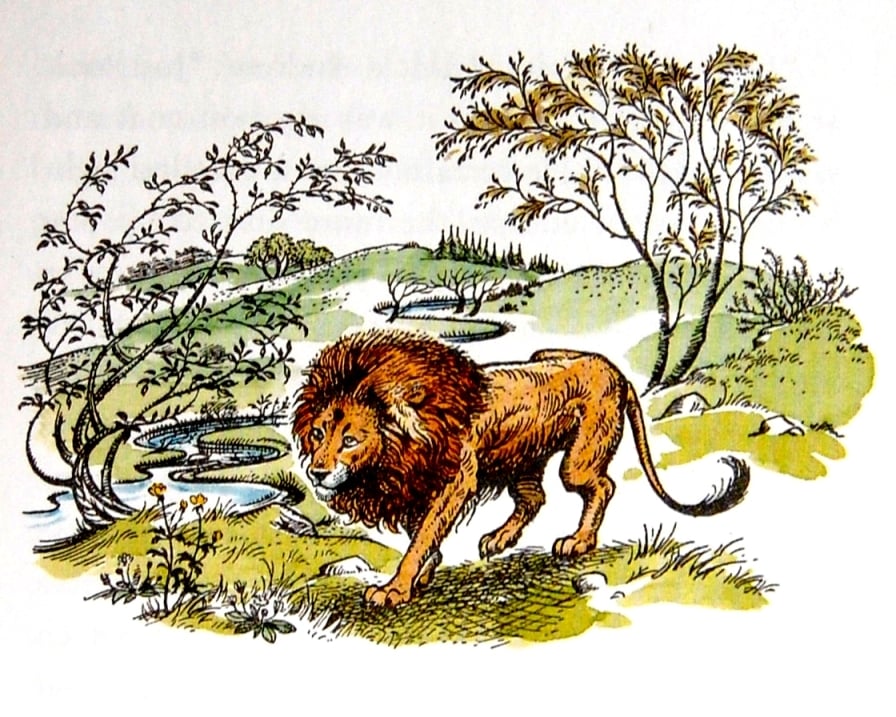
The lion was pacing to and fro about that empty land and singing his new song. It was softer and more lilting than the song by which he had called up the stars and the sun; a gentle rippling music. And as he walked and sang the valley grew green with grass. It spread out from the Lion like a pool. It ran up the sides of the little hills like a wave…
Polly was finding the song more and more interesting because she thought she was beginning to see the connection between the music and the things that were happening. When a line of dark firs sprang up on a ridge about a hundred yards away she felt that they were connected with a series of deep, prolonged notes which the Lion had sung a second before. And when he burst into a rapid series of lighter notes she was not surprised to see primroses suddenly appearing in every direction. Thus, with an unspeakable thrill, she felt quite certain that all the things were coming (as she said) “out of the Lion’s head.” When you listened to his song you heard the things he was making up: when you looked round you, you saw them. This was so exciting that she had no time to be afraid.
Everyone was stirred and shaken by the song, yet their exact responses varied.
The sorceress, after attempting to fight the lion, flees the scene in fear. Uncle Andrew, though entranced and inspired by the beauty that now surrounds him, quickly proceeds to ponder how he might plunder it for personal gain. “I have discovered a world where everything is bursting with life and growth,” he says, going on to dream of how he might it exploit it for wealth and power. “The commercial possibilities of this country are unbounded…The first thing is to get that brute shot.”
The children, by contrast, keep their focus on the Creator, on his beautiful song and its designs and purposes, beholding in fear and wonder at the gifts and mystery he continues to unleash. In response to Andrew’s greed, Polly promptly replies, “You’re just like the Witch. All you think of is killing things.”
Digory, whose mother is gravely ill, does indeed long to ask the lion for healing. But upon approaching him further, he sees Aslan calling together all of his new creations, and he is rather stunned by what follows.
The Lion opened his mouth, but no sound came from it; he was breathing out, a long, warm breath; it seemed to sway all the beasts as the wind sways a line of trees. Far overhead from beyond the veil of blue sky which hid them the stars sang again; a pure, cold, difficult music. Then there came a swift flash like fire (but it burnt nobody) either from the sky or from the Lion itself, and every drop of blood tingled in the children’s bodies, and the deepest, wildest voice they had ever heard was saying:
“Narnia, Narnia, Narnia, awake. Love. Think. Speak. Be walking trees. Be talking beasts. Be divine waters.”
The beasts and birds, by contrasts, cry out a reply in harmonic unity. “Hail, Aslan. We hear and obey. We are awake. We love. We think. We speak. We know.”
 It is here, contrasted with the greed and personal plans of Uncle Andrew, that Aslan shares what the song is all about: gift.
“Creatures, I give you yourselves,” says the strong, happy voice of Aslan. “I give to you forever this land of Narnia. I give you the woods, the fruits, the rivers. I give you the stars and I give you myself.”
This is not, as Uncle Andrew presupposed, about maximizing resources for the sake of railways, vacation spas, or industrial might, though those can and will be fruitful outcomes. This is not, as he seems to believe, a new conquest of a new world that may involve spiritual nods and handshakes where necessary.
This is about a heart transformed grace, one that conforms to the divine love of God and pours out gifts to our neighbors according to his character and his will. As DeKoster and Berghoef write elsewhere, “basic stewardship is concerned with sweetening human relationships in our everyday world.”
The song of Aslan, the song of creation, is a call to intimate obedience — an embrace of the awesome, all-consuming blessing to serve and participate, to sing and harmonize, to cultivate and co-create alongside a loving Father in the corresponding song of stewardship.
Originally published at the Acton PowerBlog
Image credit: The Magician’s Nephew, illustrated by Pauline Baynes
Previous Post

January 12, 2016
The Trinity and Human Flourishing: A New Ode to Joy
Next Post

January 15, 2016 The Mundane Morality of Les Misérables
Browse Our Archives
Select a Category Art Charity Church Common Grace Culture Curriculum Economics Education Family Justice Order Theology Uncategorized Vocation Wisdom Wonder Work
Select a Month January 2017 December 2016 November 2016 October 2016 September 2016 August 2016 July 2016 June 2016 May 2016 April 2016 March 2016 February 2016 January 2016 December 2015 November 2015 October 2015 September 2015 August 2015 July 2015 June 2015 May 2015 April 2015 March 2015 February 2015 January 2015 December 2014 November 2014 October 2014 September 2014 August 2014
Follow Us!
TAKE THE
Religious Wisdom Quiz
The Jews whipped Paul with 39 stripes how many times?
Select your answer to see how you score.
17 1 5 3
Related posts from Oikonomia

Lessons in Humility from the Christ Child

Are Christianity and Communism Mutually Exclusive?

What Christians Can Learn from Adam Smith’s ‘Paradox...

Help People, Not Banks: Reflections on the 2016...
TRENDING AT PATHEOS Business, Finance and Religion

St. Francis by Bill Droel Pope Leo XIV declares 2026 as “Year...

Catholics are schooled in the faith by memorizing dogmatic points and lots...

The Good News of Our Human Limitations -...
After another day of trying to meet deadlines and working on projects,...

Quiet Holy Attentiveness (podcast) with Sarah Clarkson
We know that quiet is an essential aspect of the spiritual life,...

Every Vocation Everywhere All At Once
What is a vocation? How does it endure through the years? Can...

I promise this is not going to become a Taylor Swift Studies...
view all Business, Finance and Religion blogs
Ad-Free & Subscriber Log-In Subscription Support
- About Us
- 2026 Calendar
- Videos
- Podcasts
- Library of World Religions
- Faith In Media Tracker
- Advertise With Us
- Write for Us
- Privacy Policy
- Terms of Service
- Do Not Sell My Data
- Contact Us
- Radiant Digital
- Manage Newsletter Subscriptions
- Unsubscribe From Notifications
- Sitemap
Copyright 2008-2026, Patheos. All rights reserved.
Subscription Support Ad-Free & Subscriber Log-In
Follow Patheos