
BuddhistCatholicContemplativeEvangelicalGeneral ChristianHinduJewishLatter-day SaintMuslimNew VisionsProgressive Christian
Beliefs
- Buddhist
- Catholic
- Contemplative
- Evangelical
- General Christian
- Hindu
- Jewish
- Latter-day Saint
- More Voices
- Muslim
- New Visions
- Pagan
- Progressive Christian
Topics
- Religion News
- Food and Religion
- Sports and Religion
- Religious Art
- Religious Music and Entertainment
- Religious Events
- History and Religion
- Style and Religion
- Politics and Religion
- Women in Religion
- Recreation Outdoors and Religion
- Business Finance and Religion
- Careers Workplace and Religion
- Education and Religion
- Family Parenting and Religion
- Health Fitness and Religion
- Home and Religion
- Relationships and Religion
- Technology and Religion
- Travel and Religion
Columnists
- Buddhist Columnists
- Business Finance and Religion Columnists
- Careers Workplace and Religion Columnists
- Catholic Columnists
- Contemplative Columnists
- Education and Religion Columnists
- Evangelists Columnists
- Family Parenting and Religion Columnists
- General Christian Columnists
- Health Fitness and Religion Columnists
- Hindu Columnists
- History and Religion Columnists
- Home and Religion Columnists
- Jewish Columnists
- More Voices Columnists
- Latter Day Columnists
- Muslim Columnists
- New Visions Columnists
- Nonreligious Columnists
- Pagan Columnists
- Politics and Religion Columnists
- Progressive Columnists
- Recreation Outdoors and Religion Columnists
- Relationships and Religion Columnists
- Religion News Columnists
- Religious Art Columnists
- Religious Events Columnists
- Religious Music and Entertainment Columnists
- Sports and Religion Columnists
- Style and Religion Columnists
- Technology and Religion Columnists
- Travel and Religion Columnists
- Women in Religion Columnists
Resource Library
- 2026 Calendar
- Library of World Religions
- The 100 Most Holy Places on Earth
- Patheos Answers
- Podcasts
- Videos
- Faith Leaders Database
- Anglican Episcopalian
- Bahai
- Baptist
- Buddhism
- Christianity
- Confucianism
- Eastern Orthodoxy
- Hinduism
- Holiness and Pentecostal
- ISKCON
- Islam
- Judaism
- Lutheran
- Methodist
- The Church of Jesus Christ of Latter-day Saints
- New Age
- Paganism
- Presbytarian and Reformed
- Protestantism
- Religion Behind the Scenes
- Roman Catholic
- Scientology
- Shia Islam
- Sikhism
- Sufism
- Sunni Islam
- Taoism
- Zen
- See all religions
Research Tools
 Ad-Free & Subscriber Log-In Subscription Support
Ad-Free & Subscriber Log-In Subscription Support
Follow Patheos 

- Trending:
- Forgiveness
- |
- Marriage
- |
- Consciousness
- |
- Death Penalty
- |
- Election
- |
- Halloween
 Oikonomia
- Home
- Business, Finance and Religion
- Work: When the Journey is Too Much
Work: When the Journey is Too Much
Last updated on: September 3, 2015 at 11:22 pm by Acton Institute
Work: When the Journey is Too Much 2015-09-03T23:22:23-04:00 Acton Institute
Patheos Explore the world's faith through different perspectives on religion and spirituality! Patheos has the views of the prevalent religions and spiritualities of the world.
By Evan Koons
 Work, by its very nature, is gift-giving! It is is a mysterious collaboration of harmony and abundance! And in the brokenness of a fallen world, it is a form of sanctification, a daily call to deny ourselves and take up our cross.
What a glorious silver lining to the doldrums of our day-to-day tasks! Right? I mean, when we enter into work that is toilsome and spirit-breaking, we are becoming more like Christ!
Isn’t this powerful stuff?! Isn’t it a majestic privilege to work!? Isn’t this all a glorious case for rejoicing no matter our pole position in the rat race we call work!?
It is at this point, I imagine some of you are reading this post and would like nothing more than to get in your car, drive to my house, and punch me in the throat. And, as I lay writhing on the floor, you might wish to scream something like this, “But you don’t understand! My job is killing me! It’s sucking out my soul through tiny straws shoved under my fingernails, okay!? And you want to talk to me about work and the ‘nature of a tree’?! Have you lost your mind!?”

Of course, I would not be able to answer because you punched me in throat. Your point would be well taken, though. And here’s why:
The reality of the aforementioned “truths” about what our work and service actually is, does not provide a palatable answer to the pain we experience when our work—what Lester DeKoster argues is our daily calling in life—is a living hell. If we’re being honest, I don’t think there are any words that can relieve the woundings of poor leadership or divisive employees, outlandish workloads or sub-standard paychecks, or even jobs that are just plain-and-simple a bad fit. To stress that all work is about gift-giving, to marvel at its vast community of relationships, or allude to the suffering one share’s with Christ by remaining in said environments, doesn’t make the experience any more pleasant. In most cases, it only makes it worse.
The truth is, there are times in all of our lives, and especially in our work, when the words of the Lord to Elijah resound with us, too:
“The journey is too much for you.”
SO WHAT NOW?
What are we supposed to do with this information in exile (remember, we live in exile, here). How do we move from this place of despair and into life? How do help ourselves and/or our neighbor who is floundering in her work?
Answer: we show up to the pain and we mourn.
I think we need to recognize that when our work fails us (or we fail it), a tremendous loss has a occurred. In these times, there are no words that will suffice. There is no soothing balm. We must weep. As Paul writes (Romans 12:15), “Rejoice with those who rejoice; mourn with those who mourn.” Even Jesus, who had all the power of heaven and earth at his command, met Mary’s heartache with his own. He could have jumped right to work, spouted off all the answers to life’s great mysteries; he could have resurrected Lazarus with little more than a snap of his finger, but he did not. He wept with Mary.
In today’s culture, in exile, we are so quick to diagnose a problem, cook up solutions, and give advice. Somehow, we’ve come to the conclusion that just being present in the discomfort and dis-ease, is not enough or it’s too uncomfortable or it’s some kind of stagnation—after all, time’s a-wastin’!
No, mourn the loss. Enter into the suffering. Know, and trust, that the tears are holy. They are the beginning of transformation. Like the rain, our tears are lifeblood of flourishing. We cannot forget. And growth will happen; comfort will come—who knows how or when, but it will happen. God will restore us. He will come, and slung over his shoulder will be more gifts of grace and joy than the world can bear.
I am reminded of the Israelites in the desert. Even though they were freed from the bondage of slavery, they still wandered. For forty years, they wandered. The promised land was nowhere in sight. In many ways, we do the same. This is the tension we live in today, here in exile. This is the anxiety we are confronted with on a daily basis, for years at a time, and especially when our work doesn’t work out. Our tears are welcome here. They are expected.
As Stephen Grabill put it, “Our work is a form of whole-life discipleship. It is a stewardship responsibility. Which means, like all forms of stewardship, or discipleship, God is attempting to accomplish certain things over time.” He pointed me to the Stewardship Study Bible (which, of course, he and my other main man, Brett Elder, edited). One of the seven purposes of stewardship, they write, is Conformity. Our work—and the suffering that goes along wit—are slowly and mysteriously conforming us to refract better God’s image. Refract—I like that word. Grabill told me, “that the mourning that comes from painful work (in all the senses of painful) is a means, that some of us get called to for a time, of imaging God in a cruciform sort of way.” He assured me, “This kind of pain isn’t the norm or in keeping with the basic design of work from the perspective of its purpose, but it is something all of us will experience living as we do ‘east of Eden.’”
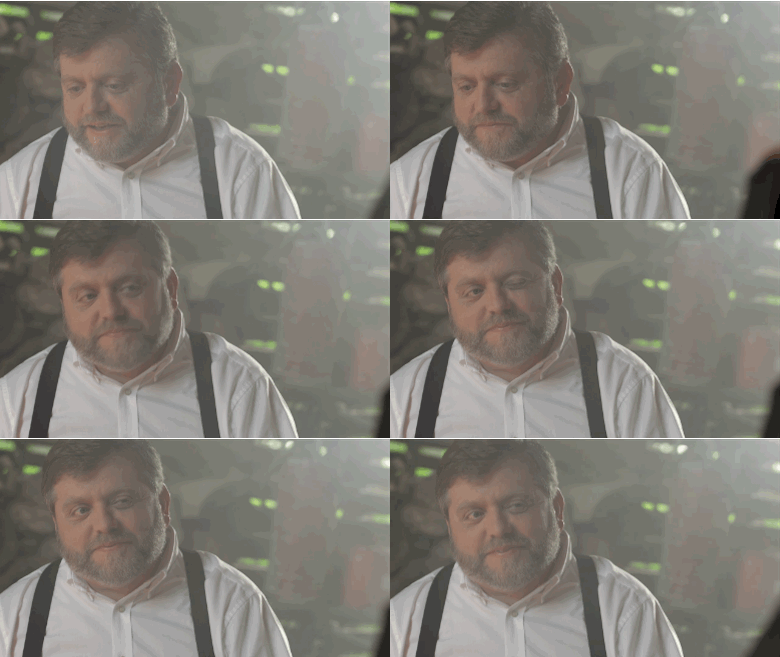
That Grabill, he’s a pretty smart guy.
So, if you are wandering through the desert-landscape that has become your work, if you are a confidant of someone else who is, enter into that barrenness and mourn. Look to the heavens and weep. Our tears are the spring that the cracked earth and our parched hearts need. Trust and live into the greatest truth of our creative service, “We are not alone, and we are never meant to be.”
Know that there is no greater work, one that requires more creativity and service, than that of the human heart.
“Prone to wander, Lord, I feel it, Prone to leave the God I love; Here’s my heart, O take and seal it; Seal it for Thy courts above.”
ONE MORE THING
I’m not a very smart guy. Most of what I know comes from listening to other people who know a lot more than me. So, thanks to my neighbor, Craig. Thanks to the preaching of Len Kuyvenhoven, Scott Hoezee, and Dave Beelen—while I may not have looked like I was paying attention there in the pew, I really was—your words have stuck with me and I’m so grateful for God’s gifts to you. And thanks to my men Stephen Grabill and Brett Elder and to my editor-extraordinaire, Heidi Segal, y’all are so graceful at keeping me in line.
Finally, when the pain of your work subsiding, I invite you to revisit this post and consider these questions. Perhaps they’ll be worth pondering. There are also some other good resources here for you to explore. So, maybe throw this link in your bookmarks for another time.
Questions
- Where do you turn in the midst of suffering? To God, to friends, to more work, to food, to something else?
- Do you have someone to simply sit with you in your sorrow? Or, how are you at being present and sharing in the sorrows of others?
- In regards to life (or lack thereof) at work, what are some tiny promptings you could follow? What are some small next steps to take?
- I also really recommend reading Michael Hyatt’s blog. Specifically his stuff on personal development and leadership. It’s inspiring and practical and can really provide some direction through the mess of life and work.
Other Resources
- Tim Keller Sermon – “Praying our Tears”
- Posts on Leadership (Good Leaders, Bad Leaders, and Everything in Between)
- Posts on Personal Development and Navigating Our Messes
Originally published at the FLOW
Photo credit: Chris Costes
Previous Post

August 31, 2015
‘Need Is Universal': Entrepreneurship and Faith
Next Post

September 9, 2015 What a Fingerless Goldsmith Can Teach Us About the Mirage of Disability
Browse Our Archives
Select a Category Art Charity Church Common Grace Culture Curriculum Economics Education Family Justice Order Theology Uncategorized Vocation Wisdom Wonder Work
Select a Month January 2017 December 2016 November 2016 October 2016 September 2016 August 2016 July 2016 June 2016 May 2016 April 2016 March 2016 February 2016 January 2016 December 2015 November 2015 October 2015 September 2015 August 2015 July 2015 June 2015 May 2015 April 2015 March 2015 February 2015 January 2015 December 2014 November 2014 October 2014 September 2014 August 2014
Follow Us!
TAKE THE
Religious Wisdom Quiz
Dry bones in a valley came together, received sinews and flesh, then breath entered them. What did this valley represent?
Select your answer to see how you score.
The house of Israel God's army The resurrection The dead
Related posts from Oikonomia

Thomas Sowell on the Origins of Prosperity


Lessons on Christian Vocation from ‘Chewbacca Mom’

Are Christianity and Communism Mutually Exclusive?
TRENDING AT PATHEOS Business, Finance and Religion

St. Francis by Bill Droel Pope Leo XIV declares 2026 as “Year...

Catholics are schooled in the faith by memorizing dogmatic points and lots...

The Good News of Our Human Limitations -...
After another day of trying to meet deadlines and working on projects,...

Quiet Holy Attentiveness (podcast) with Sarah Clarkson
We know that quiet is an essential aspect of the spiritual life,...

Every Vocation Everywhere All At Once
What is a vocation? How does it endure through the years? Can...

I promise this is not going to become a Taylor Swift Studies...
view all Business, Finance and Religion blogs
Ad-Free & Subscriber Log-In Subscription Support
- About Us
- 2026 Calendar
- Videos
- Podcasts
- Library of World Religions
- Faith In Media Tracker
- Advertise With Us
- Write for Us
- Privacy Policy
- Terms of Service
- Do Not Sell My Data
- Contact Us
- Radiant Digital
- Manage Newsletter Subscriptions
- Unsubscribe From Notifications
- Sitemap
Copyright 2008-2026, Patheos. All rights reserved.
Subscription Support Ad-Free & Subscriber Log-In
Follow Patheos