
BuddhistCatholicContemplativeEvangelicalGeneral ChristianHinduJewishLatter-day SaintMuslimNew VisionsProgressive Christian
Beliefs
- Buddhist
- Catholic
- Contemplative
- Evangelical
- General Christian
- Hindu
- Jewish
- Latter-day Saint
- More Voices
- Muslim
- New Visions
- Pagan
- Progressive Christian
Topics
- Religion News
- Food and Religion
- Sports and Religion
- Religious Art
- Religious Music and Entertainment
- Religious Events
- History and Religion
- Style and Religion
- Politics and Religion
- Women in Religion
- Recreation Outdoors and Religion
- Business Finance and Religion
- Careers Workplace and Religion
- Education and Religion
- Family Parenting and Religion
- Health Fitness and Religion
- Home and Religion
- Relationships and Religion
- Technology and Religion
- Travel and Religion
Columnists
- Buddhist Columnists
- Business Finance and Religion Columnists
- Careers Workplace and Religion Columnists
- Catholic Columnists
- Contemplative Columnists
- Education and Religion Columnists
- Evangelists Columnists
- Family Parenting and Religion Columnists
- General Christian Columnists
- Health Fitness and Religion Columnists
- Hindu Columnists
- History and Religion Columnists
- Home and Religion Columnists
- Jewish Columnists
- More Voices Columnists
- Latter Day Columnists
- Muslim Columnists
- New Visions Columnists
- Nonreligious Columnists
- Pagan Columnists
- Politics and Religion Columnists
- Progressive Columnists
- Recreation Outdoors and Religion Columnists
- Relationships and Religion Columnists
- Religion News Columnists
- Religious Art Columnists
- Religious Events Columnists
- Religious Music and Entertainment Columnists
- Sports and Religion Columnists
- Style and Religion Columnists
- Technology and Religion Columnists
- Travel and Religion Columnists
- Women in Religion Columnists
Resource Library
- 2026 Calendar
- Library of World Religions
- The 100 Most Holy Places on Earth
- Patheos Answers
- Podcasts
- Videos
- Faith Leaders Database
- Anglican Episcopalian
- Bahai
- Baptist
- Buddhism
- Christianity
- Confucianism
- Eastern Orthodoxy
- Hinduism
- Holiness and Pentecostal
- ISKCON
- Islam
- Judaism
- Lutheran
- Methodist
- The Church of Jesus Christ of Latter-day Saints
- New Age
- Paganism
- Presbytarian and Reformed
- Protestantism
- Religion Behind the Scenes
- Roman Catholic
- Scientology
- Shia Islam
- Sikhism
- Sufism
- Sunni Islam
- Taoism
- Zen
- See all religions
Research Tools
 Ad-Free & Subscriber Log-In Subscription Support
Ad-Free & Subscriber Log-In Subscription Support
Follow Patheos 

- Trending:
- Forgiveness
- |
- Marriage
- |
- Consciousness
- |
- Death Penalty
- |
- Election
- |
- Halloween
 Oikonomia
- Home
- Business, Finance and Religion
- The High Price of Human Trafficking
The High Price of Human Trafficking
Last updated on: August 14, 2015 at 1:51 am by Acton Institute
The High Price of Human Trafficking 2015-08-14T01:51:54-04:00 Acton Institute
Patheos Explore the world's faith through different perspectives on religion and spirituality! Patheos has the views of the prevalent religions and spiritualities of the world.
By Elise Hilton
“Human trafficking is an open wound on the body of contemporary society, a scourge upon the body of Christ. It is a crime against humanity. The very fact of our being here to combine our efforts means that we want our strategies and areas of expertise to be accompanied and reinforced by the mercy of the Gospel, by closeness to the men and women who are victims of this crime.” – Pope Francis, in his address at a 2014 Conference on Human Trafficking
 On January 1, 1863, President Abraham Lincoln issued the Emancipation Proclamation. While it did not entirely end the practice of slavery in the United States, it stood as a symbol to many as the end to the atrocious idea that one human being can own another. Lincoln declared that the American government would recognize and maintain the freedom of all people in the seceded states, and that the government would uphold “no act or acts to repress such persons, or any of them, in any efforts they may make for their actual freedom.”
In the minds and hearts of many, both in the United States and elsewhere, this was the end of slavery. If only that were so. Slavery, now more commonly known as human trafficking, has not ended. In fact, this human scandal is more extensive than ever.
Today, human trafficking impacts entire industries, and job sectors – both legitimate and illegitimate. Monetarily, it is the second largest criminal activity in the world. Only the illegal drug trade is more profitable. The profits generated from human trafficking play an enormous role in national and global economies. There is also the untold human cost. It is, as Pope Francis said, an open wound on humanity.
Human trafficking is broader in scope than most people realize. According to the United Nations Office on Drugs and Crime, it can be defined as:
…the recruitment, transportation, transfer, harbouring or receipt of persons, by means of the threat or use of force or other forms of coercion, of abduction, of fraud, of deception, of the abuse of power or of a position of vulnerability or of the giving or receiving of payments or benefits to achieve the consent of a person having control over another person, for the purpose of exploitation. Exploitation shall include, at a minimum, the exploitation of the prostitution of others or other forms of sexual exploitation, forced labour or services, slavery or practices similar to slavery, servitude or the removal of organs.
According to the Geneva, Switzerland-based International Labour Organization, 21 million people are trafficked annually (bear in mind that these numbers are estimates.) Females and children are most at risk: over 11 million women are known to be trafficked every year, and five and a half million children (ages 18 and under).
Trafficking knows no boundaries. There is no country that is immune, no demographic that is untouched.
Jerome Elam appears to be an unlikely victim. He is a journalist and a former Marine. Yet his story illustrates that human trafficking is not a crime limited to Southeast Asia or to drug-addicted prostitutes on street corners.
Following my mother’s divorce from my biological father, her life began a downward spiral that left me abandoned and alone, vulnerable to those who prey upon the innocent. My mother’s world existed at the bottom of a bottle and when she met a man who began to molest me, alcohol facilitated her complete escape from the reality of what was happening to me. My mother eventually married the man and before long he shared me with the pedophile ring he belonged to. Soon I was being trafficked sexually, trapped by threats of violence against my mother and forced to take cocaine and alcohol.
For seven long years I was trapped in a hell no one deserves. I was nothing more than a shell of a human being enduring suffering and torture at the hands of psychopaths and sociopaths as the world looked on. I attended school, and from the outside appeared to be a ‘normal child’ but I was being trafficked in plain sight.
It was 1970 in the southern U.S.; Elam was just five years old when his abuse began.
Why does human trafficking continue to thrive? It thrives because of two of humanity’s deadliest sins: greed and lust. It is estimated that human trafficking generates over $150 billion in annual profits, with two-thirds of that from sexual exploitation.
In the next ten years, human trafficking (if left unchecked) will become more profitable to criminals than drugs and arms sales, growing in both the developed and developing world. It is our duty to mend this “open wound” which threatens to hinder true human flourishing.
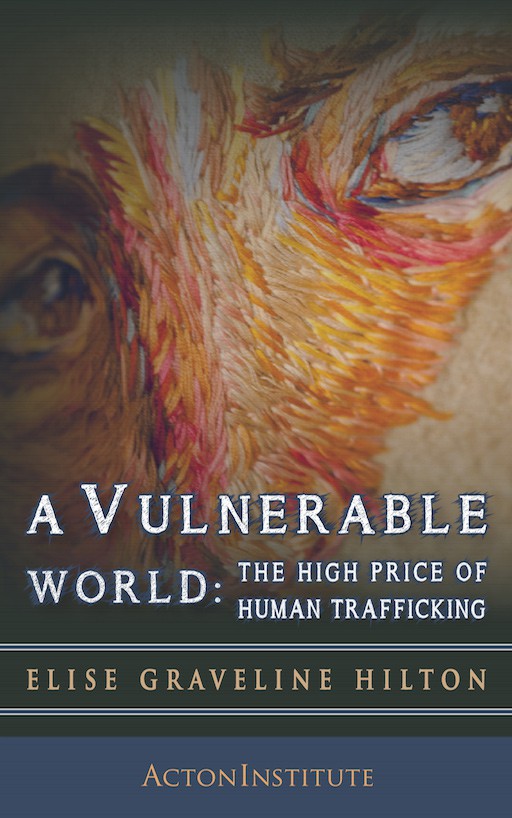
This essay was adapted from Elise Hilton’s A Vulnerable World: The High Price of Human Trafficking and was originally published at Acton Commentary.
Previous Post
August 11, 2015
Chalk Art For the Life of the World
Next Post
August 17, 2015 The Messy Vlog
Browse Our Archives
Select a Category Art Charity Church Common Grace Culture Curriculum Economics Education Family Justice Order Theology Uncategorized Vocation Wisdom Wonder Work
Select a Month January 2017 December 2016 November 2016 October 2016 September 2016 August 2016 July 2016 June 2016 May 2016 April 2016 March 2016 February 2016 January 2016 December 2015 November 2015 October 2015 September 2015 August 2015 July 2015 June 2015 May 2015 April 2015 March 2015 February 2015 January 2015 December 2014 November 2014 October 2014 September 2014 August 2014
Follow Us!
TAKE THE
Religious Wisdom Quiz
How many years did the Israelites wander in the wilderness?
Select your answer to see how you score.
10 years 40 years 100 years 25 years
Related posts from Oikonomia

Thomas Sowell on the Origins of Prosperity


Are Christianity and Communism Mutually Exclusive?

What Christians Can Learn from Adam Smith’s ‘Paradox...
TRENDING AT PATHEOS Business, Finance and Religion

St. Francis by Bill Droel Pope Leo XIV declares 2026 as “Year...

Catholics are schooled in the faith by memorizing dogmatic points and lots...

The Good News of Our Human Limitations -...
After another day of trying to meet deadlines and working on projects,...

Quiet Holy Attentiveness (podcast) with Sarah Clarkson
We know that quiet is an essential aspect of the spiritual life,...

Every Vocation Everywhere All At Once
What is a vocation? How does it endure through the years? Can...

I promise this is not going to become a Taylor Swift Studies...
view all Business, Finance and Religion blogs
Ad-Free & Subscriber Log-In Subscription Support
- About Us
- 2026 Calendar
- Videos
- Podcasts
- Library of World Religions
- Faith In Media Tracker
- Advertise With Us
- Write for Us
- Privacy Policy
- Terms of Service
- Do Not Sell My Data
- Contact Us
- Radiant Digital
- Manage Newsletter Subscriptions
- Unsubscribe From Notifications
- Sitemap
Copyright 2008-2026, Patheos. All rights reserved.
Subscription Support Ad-Free & Subscriber Log-In
Follow Patheos