
BuddhistCatholicContemplativeEvangelicalGeneral ChristianHinduJewishLatter-day SaintMuslimNew VisionsProgressive Christian
Beliefs
- Buddhist
- Catholic
- Contemplative
- Evangelical
- General Christian
- Hindu
- Jewish
- Latter-day Saint
- More Voices
- Muslim
- New Visions
- Pagan
- Progressive Christian
Topics
- Religion News
- Food and Religion
- Sports and Religion
- Religious Art
- Religious Music and Entertainment
- Religious Events
- History and Religion
- Style and Religion
- Politics and Religion
- Women in Religion
- Recreation Outdoors and Religion
- Business Finance and Religion
- Careers Workplace and Religion
- Education and Religion
- Family Parenting and Religion
- Health Fitness and Religion
- Home and Religion
- Relationships and Religion
- Technology and Religion
- Travel and Religion
Columnists
- Buddhist Columnists
- Business Finance and Religion Columnists
- Careers Workplace and Religion Columnists
- Catholic Columnists
- Contemplative Columnists
- Education and Religion Columnists
- Evangelists Columnists
- Family Parenting and Religion Columnists
- General Christian Columnists
- Health Fitness and Religion Columnists
- Hindu Columnists
- History and Religion Columnists
- Home and Religion Columnists
- Jewish Columnists
- More Voices Columnists
- Latter Day Columnists
- Muslim Columnists
- New Visions Columnists
- Nonreligious Columnists
- Pagan Columnists
- Politics and Religion Columnists
- Progressive Columnists
- Recreation Outdoors and Religion Columnists
- Relationships and Religion Columnists
- Religion News Columnists
- Religious Art Columnists
- Religious Events Columnists
- Religious Music and Entertainment Columnists
- Sports and Religion Columnists
- Style and Religion Columnists
- Technology and Religion Columnists
- Travel and Religion Columnists
- Women in Religion Columnists
Resource Library
- 2026 Calendar
- Library of World Religions
- The 100 Most Holy Places on Earth
- Patheos Answers
- Podcasts
- Videos
- Faith Leaders Database
- Anglican Episcopalian
- Bahai
- Baptist
- Buddhism
- Christianity
- Confucianism
- Eastern Orthodoxy
- Hinduism
- Holiness and Pentecostal
- ISKCON
- Islam
- Judaism
- Lutheran
- Methodist
- The Church of Jesus Christ of Latter-day Saints
- New Age
- Paganism
- Presbytarian and Reformed
- Protestantism
- Religion Behind the Scenes
- Roman Catholic
- Scientology
- Shia Islam
- Sikhism
- Sufism
- Sunni Islam
- Taoism
- Zen
- See all religions
Research Tools
 Ad-Free & Subscriber Log-In Subscription Support
Ad-Free & Subscriber Log-In Subscription Support
Follow Patheos 

- Trending:
- Forgiveness
- |
- Marriage
- |
- Consciousness
- |
- Death Penalty
- |
- Election
- |
- Halloween
 Oikonomia
- Home
- Business, Finance and Religion
- Why An Urban Church Abandoned Traditional Charity
Why An Urban Church Abandoned Traditional Charity
Last updated on: April 1, 2015 at 11:33 pm by Acton Institute
Why An Urban Church Abandoned Traditional Charity 2015-04-01T23:33:59-04:00 Acton Institute
Patheos Explore the world's faith through different perspectives on religion and spirituality! Patheos has the views of the prevalent religions and spiritualities of the world.
By Joseph Sunde
I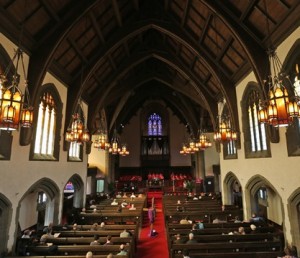 n the early 2000s, Broadway United Methodist Church had a series of outreach programs, including a food pantry, after-school program, clothing ministry, and a summer youth program that served up to 250 children per day. Today, these programs are completely absent, and it’s no accident.
“They’ve been killed off,” writes Robert King in a fascinating profile of the transformation. “In many cases, they were buried with honors. But those ministries, staples of the urban church, are all gone from Broadway. Kaput.”
“One of the things we literally say around here is, ‘Stop helping people.’” says Rev. Mike Mather, the church’s pastor. “I’m serious.”
Although Mather was the first to initiate many of these programs, with some efforts going back as far as the late 1980s, after several circumstances, including a series of community tragedies, he began to believe that a new approach was needed. “I started paying attention to what they really cared about,” he says.
Rather than simply identifying and meeting immediate needs, the church has decided to emphasize, affirm, and elevate the gifts and contributions of those in their community:
“The church, and me in particular,” Mather said, “has done a lot of work where we have treated the people around us as if, at worst, they are a different species and, at best, as if they are people to be pitied and helped by us.”
With that in mind, Broadway has — for more than a decade now — been reorienting itself. Rather than a bestower of blessings, the church is aiming to be something more humble. “The church decided its call was to be good neighbors. And that we should listen and see people as children of God,” said De’Amon Harges, a church member who sees Broadway’s transformation in terms not unlike Christ’s death, burial and resurrection.
Harges was eventually hired as a “roving listener” who “wound up spending hours sitting on people’s porches and hovering near them as they worked in their backyard gardens,” writes King. Yet unlike similar positions where the goal would be to uncover surface-level “holes” in the community, Harges is listening instead for “hints about their gifts.” “I was curious about what was good in people,” Harges says, “and that was what I was going to find out.”
The approach has been called “asset-based community development,” a philosophy that professor John McKnight of Northwestern University helped conceive. McKnight has personally visited Broadway to observe the various goings on, and he acknowledges it as an astounding success:
“What [Harges] is listening for is their gifts — ‘What has God given you?’” McKnight said. He doesn’t advocate ignoring people’s needs and problems, but rather to look first for solutions within the community itself. Later, he said, institutions and services can help.
“John 15:15 tells us that, at the Last Supper, Jesus said to the disciples, ‘I no longer call you servants. … I call you friends.’ So the final way of defining what Christianity is based on is friendship, not service. … I think Mike and De’Amon are guided by that spiritual principle.”
The new approach has led to people rediscovering and harnessing their God-given gifts, sharing in various services and activities with those around them, uncovering a renewed sense of dignity and purpose, pursuing paths to new businesses or livelihoods, and discovering an overall sense of community connectedness and flourishing.
And indeed, it shouldn’t be a surprise. As Christians who believe in a God who fashioned us with dignity, creativity, and capacity, freeing us unto love, service, and sacrifice through the gift of his own Son, it’s an approach that we would do well to heed. As resources like PovertyCure and For the Life of the World continue to proclaim and affirm, we are created to be gift-givers and image bearers, not mere consumers or objects of pity. Our stewardship, generosity, and exchanges with others ought to reflect that reality.
In Episode 1 of FLOW, Evan Koons puts the bigger Biblical story of all this in perspective, explaining how, despite our fallen nature and brokenness, God made a way to restore us to that original priesthood. “All is gift,” he reminds us.
God himself becomes a man, and the gift he offers to the Father is himself, and all of creation is in tow behind him. Once and for all he restores the way of our purpose. He restores our priesthood. We can once again offer to God our lives, our work, knowledge — everything. We join our gifts with Christ, to offer the world to the Father in love and for the life of the world. And that is the purpose of our salvation. That’s what it’s for — for the life of the world.
As we seek to alleviate injustice in the world — familial, social, economic, or otherwise — we can look to Broadway as a reminder of how we ought to approach our neighbors: not out of humanistic striving or materialistic shifting, but by affirming and stirring up the gifts of others for the glory of God and the good of the world.
As John Perkins says in Episode 4: “You don’t give people dignity. You affirm it.”
Originally published at the Acton PowerBlog
Photo credit: Faith and Leadership
Previous Post

March 27, 2015
How Entrepreneurs Practice Their Faith Through Companies
Next Post

April 3, 2015 Dietrich Bonhoeffer on the Economy of Love
Browse Our Archives
Select a Category Art Charity Church Common Grace Culture Curriculum Economics Education Family Justice Order Theology Uncategorized Vocation Wisdom Wonder Work
Select a Month January 2017 December 2016 November 2016 October 2016 September 2016 August 2016 July 2016 June 2016 May 2016 April 2016 March 2016 February 2016 January 2016 December 2015 November 2015 October 2015 September 2015 August 2015 July 2015 June 2015 May 2015 April 2015 March 2015 February 2015 January 2015 December 2014 November 2014 October 2014 September 2014 August 2014
Follow Us!
TAKE THE
Religious Wisdom Quiz
According to Hebrews, who serves as a copy and shadow of what is in heaven?
Select your answer to see how you score.
The apostles The prophets The priests in the earthly sanctuary The angels
Related posts from Oikonomia

Thomas Sowell on the Origins of Prosperity

Lessons in Humility from the Christ Child


Lessons on Christian Vocation from ‘Chewbacca Mom’
TRENDING AT PATHEOS Business, Finance and Religion

St. Francis by Bill Droel Pope Leo XIV declares 2026 as “Year...

Catholics are schooled in the faith by memorizing dogmatic points and lots...

The Good News of Our Human Limitations -...
After another day of trying to meet deadlines and working on projects,...

Quiet Holy Attentiveness (podcast) with Sarah Clarkson
We know that quiet is an essential aspect of the spiritual life,...

Every Vocation Everywhere All At Once
What is a vocation? How does it endure through the years? Can...

I promise this is not going to become a Taylor Swift Studies...
view all Business, Finance and Religion blogs
Ad-Free & Subscriber Log-In Subscription Support
- About Us
- 2026 Calendar
- Videos
- Podcasts
- Library of World Religions
- Faith In Media Tracker
- Advertise With Us
- Write for Us
- Privacy Policy
- Terms of Service
- Do Not Sell My Data
- Contact Us
- Radiant Digital
- Manage Newsletter Subscriptions
- Unsubscribe From Notifications
- Sitemap
Copyright 2008-2026, Patheos. All rights reserved.
Subscription Support Ad-Free & Subscriber Log-In
Follow Patheos