
BuddhistCatholicContemplativeEvangelicalGeneral ChristianHinduJewishLatter-day SaintMuslimNew VisionsProgressive Christian
Beliefs
- Buddhist
- Catholic
- Contemplative
- Evangelical
- General Christian
- Hindu
- Jewish
- Latter-day Saint
- More Voices
- Muslim
- New Visions
- Pagan
- Progressive Christian
Topics
- Religion News
- Food and Religion
- Sports and Religion
- Religious Art
- Religious Music and Entertainment
- Religious Events
- History and Religion
- Style and Religion
- Politics and Religion
- Women in Religion
- Recreation Outdoors and Religion
- Business Finance and Religion
- Careers Workplace and Religion
- Education and Religion
- Family Parenting and Religion
- Health Fitness and Religion
- Home and Religion
- Relationships and Religion
- Technology and Religion
- Travel and Religion
Columnists
- Buddhist Columnists
- Business Finance and Religion Columnists
- Careers Workplace and Religion Columnists
- Catholic Columnists
- Contemplative Columnists
- Education and Religion Columnists
- Evangelists Columnists
- Family Parenting and Religion Columnists
- General Christian Columnists
- Health Fitness and Religion Columnists
- Hindu Columnists
- History and Religion Columnists
- Home and Religion Columnists
- Jewish Columnists
- More Voices Columnists
- Latter Day Columnists
- Muslim Columnists
- New Visions Columnists
- Nonreligious Columnists
- Pagan Columnists
- Politics and Religion Columnists
- Progressive Columnists
- Recreation Outdoors and Religion Columnists
- Relationships and Religion Columnists
- Religion News Columnists
- Religious Art Columnists
- Religious Events Columnists
- Religious Music and Entertainment Columnists
- Sports and Religion Columnists
- Style and Religion Columnists
- Technology and Religion Columnists
- Travel and Religion Columnists
- Women in Religion Columnists
Resource Library
- 2026 Calendar
- Library of World Religions
- The 100 Most Holy Places on Earth
- Patheos Answers
- Podcasts
- Videos
- Faith Leaders Database
- Anglican Episcopalian
- Bahai
- Baptist
- Buddhism
- Christianity
- Confucianism
- Eastern Orthodoxy
- Hinduism
- Holiness and Pentecostal
- ISKCON
- Islam
- Judaism
- Lutheran
- Methodist
- The Church of Jesus Christ of Latter-day Saints
- New Age
- Paganism
- Presbytarian and Reformed
- Protestantism
- Religion Behind the Scenes
- Roman Catholic
- Scientology
- Shia Islam
- Sikhism
- Sufism
- Sunni Islam
- Taoism
- Zen
- See all religions
Research Tools
 Ad-Free & Subscriber Log-In Subscription Support
Ad-Free & Subscriber Log-In Subscription Support
Follow Patheos 

- Trending:
- Forgiveness
- |
- Marriage
- |
- Consciousness
- |
- Death Penalty
- |
- Election
- |
- Halloween
 Oikonomia
- Home
- Business, Finance and Religion
- The Forms of Stewardship
The Forms of Stewardship
Last updated on: January 8, 2015 at 2:51 am by Acton Institute
The Forms of Stewardship 2015-01-08T02:51:10-04:00 Acton Institute
Patheos Explore the world's faith through different perspectives on religion and spirituality! Patheos has the views of the prevalent religions and spiritualities of the world.
The following excerpt comes from Faithful in All God’s House, and is reprinted here with the permission of Christian’s Library Press.
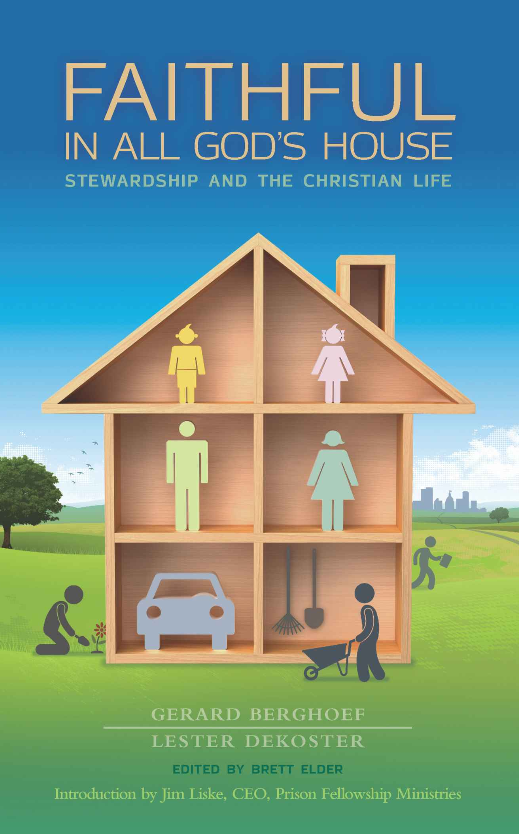 By Lester DeKoster and Gerard Berghoef
Stewardship is far more than the handling of our money. Stewardship is the handling of life, and time, and destiny.
Money does indeed do many things. Using our money as good stewards is certainly one of the severest tests of our citizenship in his kingdom. However, stewardship extends beyond giving money.
THE COMMON FORMS
The forms which stewardship assumes are defined, first of all, by the human needs we encounter. And the needs we meet are the needs that we in fact become aware of. Be assured that God provides a need, within reach, for every talent, every skill, and every gift of any kind that he gives us. It is simply hardness of heart that blinds the eye, closes the ear, and lames the limbs when opportunities for good stewardship are unobserved.
Like the pussy cat who went to London, in the fable, for to see the queen, but who saw only a mouse beneath her throne, so we perceive in the world about us—beginning at home—only what we have the heart bent on encountering. A heart softened by grace and beating, now, in tune with divine love finds opportunities for stewardship in direct proportion to the gifts that God has given for that purpose. Gift and need are divinely matched. The need may, in fact, alert us to gifts we did not know we had.
The basic forms of stewardship are twice defined: (1) by the opportunities for doing good that we learn to become aware of, and (2) by the gifts God has on deposit with us designed to meet such opportunities.
The Bible puts the basic forms of stewardship within everyone’s reach by speaking in terms of cups of cold water, going an extra mile, crusts of bread, a helping hand, the exercise of patience, and the like. Make a list sometime of the very ordinary forms of stewardship the Bible asks of us. It will become clear that basic stewardship is concerned with sweetening human relationships in our everyday world. Nothing momentous. Something like a genuine smile, nod, wave, kindly word, the steadying hand; and the sensitive heart, compassionate spirit, flowing out into acts of kindness, generosity, trust, and grace. Time invested in these virtues is time invested in heaven. None is beyond our reach—if the heart is aware, and the will bent to do God’s service wherever and whenever.
SPECIAL FORMS
Some aspects of stewardship are defined by the extent of the gifts God entrusts to us.
Has he given you wealth? Steward it in service of the needy, both in kind and by way of the influence which wealth gives.
Has he given you position? Fill it gracefully and for the good of all those whose lives you affect.
Has he given you talents of various kinds? Use yours for the benefit of the community. Whatever the uncommon gift, it is given to serve. So steward it.
WORK
The basic form of stewardship is daily work. No matter what that work may be.
No matter if you have never before looked on your job as other than a drudge, a bore, or a fearful trial. Know that the harder it is for you to face each working day, the more your will to persevere schools the soul.
Work is the fundamental form of stewardship because:
God himself works: “My Father is always at his work to this very day, and I, too, am working” (John 5:17), the Lord says. It is not recounted that God plays, but he works. That is to say, God is ever-busy making provision for our existence. Work is that which serves another. Play is that which serves ourselves.
Work knits the fabric of civilization. We take for granted all the possibilities which work alone provides. And we become aware of how work sustains the order which makes life possible when that order is rent by lightning flashes of riot or war, and the necessities which work normally provides become difficult to come by.
Man’s history begins in a garden and mounts to a city. A garden is what God the Holy Spirit does, without man, with a wilderness. A city is what God the Holy Spirit does through man’s work.
It is of the nature of work to serve the community. Whether work is done in the home, on the land, or in the countless forms of enterprise developed across the centuries, work is doubly blessed: (1) it provides for the family of man, and (2) it matures the worker.
Work matures the worker because it requires ethical decision. Merely to rise to one’s daily tasks requires an act of will, a decision to serve the community, however reluctantly, however unaware the worker may be that such is the case. Such willed acts of service not only make and sustain the fabric of civilization and culture, but also develop the soul. And, while the object of work is destined to perish, the soul formed by daily decision to do work carries over into eternity.
This perspective on work, as a maturing of the soul, liberates the believer from undue concern over the monotony of the assembly line, the threat of technology, or the reduction of the worker to but an easily replaceable cog in the industrial machine. One’s job may be done by another. But each doer is himself unique, and what carries over beyond life and time is not the work but the worker. What doing the job does for each of us is not repeated in anyone else. What the exercise of will, of tenacity, of courage, of foresight, of triumph over temptations to get by, does for you is uniquely your own. One worker may replace another on the assembly line, but what each worker carries away from meeting the challenge of doing the day’s shift will ever be his own. The lasting and creative consequence of daily work happens to the worker. God so arranges that civilization grows out of the same effort that develops the soul.
The forms of work are countless, but the typical one is work with the hands. The Bible has reference to the sower, to the making of tents and of things out of clay, to tilling the fields and tending the vine. Handwork makes visible the plan in the mind, just as the deed makes visible the love in the heart. While the classic Greek mind tended to scorn work with the hands, the Bible suggests that something about it structures the soul.
The results of one’s work can never be fully known. What will become of the produce raised, of the machine built, of the person fed? No one can foretell what will be the final consequence of today’s effort. Nor does the paycheck really measure the value, nor the effort, of the work for which it is given. Wages are set by the market, and the results of work are hidden in the mists of tomorrow. What endures is what happens to the worker who bravely makes it through the day.
Seen in this light, which is the light shed by the Bible on work, it is easy to understand why work is the primary form of stewardship. To work, most of us give the largest unit of our lives. By work, we together raise the level of our culture, keep its order, supply its needs, and point to its promise of better living for more of the world’s peoples.
For the believer; then, stewardship begins with the day’s work. Done well, as unto God, in the full knowledge that by work the world lives, work serves God and man and the self.
PLAY
We have spoken of play as that which is done to please or serve the self. Play may absorb much effort, long planning, and lots of time. But so long as the end in view is the satisfaction of the self, such effort cannot be called work. This is true whatever the form of play, whatever its esteem in the community as compared with work. What the self heaps up in time for its own use does not carry over into eternity, and burdens the soul that is thus occupied.
Play may be indulged as recreation, that is, as preparation for doing work better when the worker has been so refreshed.
You will know whether it is work, or play, which is occupying your time, your effort, and . . . your life. And knowing, you can yourself judge whether the time and effort you give to any activity is work, an investment in eternity, or play, and an investment in temporality.
Previous Post

January 7, 2015
Necessity as the Mother of Innovation
Next Post

January 13, 2015 How to Develop a Christian Mind in Business School (Part III)
Browse Our Archives
Select a Category Art Charity Church Common Grace Culture Curriculum Economics Education Family Justice Order Theology Uncategorized Vocation Wisdom Wonder Work
Select a Month January 2017 December 2016 November 2016 October 2016 September 2016 August 2016 July 2016 June 2016 May 2016 April 2016 March 2016 February 2016 January 2016 December 2015 November 2015 October 2015 September 2015 August 2015 July 2015 June 2015 May 2015 April 2015 March 2015 February 2015 January 2015 December 2014 November 2014 October 2014 September 2014 August 2014
Follow Us!
TAKE THE
Religious Wisdom Quiz
Who prayed in a den of lions?
Select your answer to see how you score.
David Noah Daniel Elijah
Related posts from Oikonomia

Lessons on Christian Vocation from ‘Chewbacca Mom’

Help People, Not Banks: Reflections on the 2016...
How Economic Freedom Leads to Human Flourishing
TRENDING AT PATHEOS Business, Finance and Religion

St. Francis by Bill Droel Pope Leo XIV declares 2026 as “Year...

Catholics are schooled in the faith by memorizing dogmatic points and lots...

The Good News of Our Human Limitations -...
After another day of trying to meet deadlines and working on projects,...

Quiet Holy Attentiveness (podcast) with Sarah Clarkson
We know that quiet is an essential aspect of the spiritual life,...

Every Vocation Everywhere All At Once
What is a vocation? How does it endure through the years? Can...

I promise this is not going to become a Taylor Swift Studies...
view all Business, Finance and Religion blogs
Ad-Free & Subscriber Log-In Subscription Support
- About Us
- 2026 Calendar
- Videos
- Podcasts
- Library of World Religions
- Faith In Media Tracker
- Advertise With Us
- Write for Us
- Privacy Policy
- Terms of Service
- Do Not Sell My Data
- Contact Us
- Radiant Digital
- Manage Newsletter Subscriptions
- Unsubscribe From Notifications
- Sitemap
Copyright 2008-2026, Patheos. All rights reserved.
Subscription Support Ad-Free & Subscriber Log-In
Follow Patheos