
BuddhistCatholicContemplativeEvangelicalGeneral ChristianHinduJewishLatter-day SaintMuslimNew VisionsProgressive Christian
Beliefs
- Buddhist
- Catholic
- Contemplative
- Evangelical
- General Christian
- Hindu
- Jewish
- Latter-day Saint
- More Voices
- Muslim
- New Visions
- Pagan
- Progressive Christian
Topics
- Religion News
- Food and Religion
- Sports and Religion
- Religious Art
- Religious Music and Entertainment
- Religious Events
- History and Religion
- Style and Religion
- Politics and Religion
- Women in Religion
- Recreation Outdoors and Religion
- Business Finance and Religion
- Careers Workplace and Religion
- Education and Religion
- Family Parenting and Religion
- Health Fitness and Religion
- Home and Religion
- Relationships and Religion
- Technology and Religion
- Travel and Religion
Columnists
- Buddhist Columnists
- Business Finance and Religion Columnists
- Careers Workplace and Religion Columnists
- Catholic Columnists
- Contemplative Columnists
- Education and Religion Columnists
- Evangelists Columnists
- Family Parenting and Religion Columnists
- General Christian Columnists
- Health Fitness and Religion Columnists
- Hindu Columnists
- History and Religion Columnists
- Home and Religion Columnists
- Jewish Columnists
- More Voices Columnists
- Latter Day Columnists
- Muslim Columnists
- New Visions Columnists
- Nonreligious Columnists
- Pagan Columnists
- Politics and Religion Columnists
- Progressive Columnists
- Recreation Outdoors and Religion Columnists
- Relationships and Religion Columnists
- Religion News Columnists
- Religious Art Columnists
- Religious Events Columnists
- Religious Music and Entertainment Columnists
- Sports and Religion Columnists
- Style and Religion Columnists
- Technology and Religion Columnists
- Travel and Religion Columnists
- Women in Religion Columnists
Resource Library
- 2026 Calendar
- Library of World Religions
- The 100 Most Holy Places on Earth
- Patheos Answers
- Podcasts
- Videos
- Faith Leaders Database
- Anglican Episcopalian
- Bahai
- Baptist
- Buddhism
- Christianity
- Confucianism
- Eastern Orthodoxy
- Hinduism
- Holiness and Pentecostal
- ISKCON
- Islam
- Judaism
- Lutheran
- Methodist
- The Church of Jesus Christ of Latter-day Saints
- New Age
- Paganism
- Presbytarian and Reformed
- Protestantism
- Religion Behind the Scenes
- Roman Catholic
- Scientology
- Shia Islam
- Sikhism
- Sufism
- Sunni Islam
- Taoism
- Zen
- See all religions
Research Tools
 Ad-Free & Subscriber Log-In Subscription Support
Ad-Free & Subscriber Log-In Subscription Support
Follow Patheos 

- Trending:
- Forgiveness
- |
- Marriage
- |
- Consciousness
- |
- Death Penalty
- |
- Election
- |
- Halloween
 Oikonomia
- Home
- Business, Finance and Religion
- ‘The Gift of the Magi’ and the Power of Exchange
‘The Gift of the Magi’ and the Power of Exchange
Last updated on: December 22, 2014 at 12:53 pm by Acton Institute
‘The Gift of the Magi’ and the Power of Exchange 2014-12-22T12:53:39-04:00 Acton Institute
Patheos Explore the world's faith through different perspectives on religion and spirituality! Patheos has the views of the prevalent religions and spiritualities of the world.
By Joseph Sunde
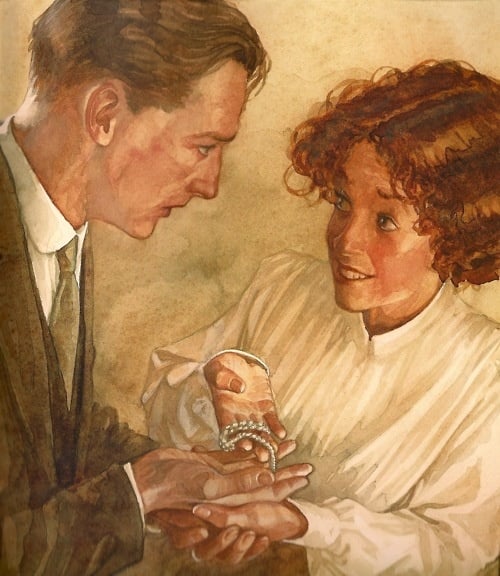 Amid the wide array of quaint and compelling Christmas tales, O. Henry’s classic short story,“The Gift of the Magi,” continues to stand out as a uniquely captivating portrait of the power of sacrificial exchange.
On the day before Christmas, Della longs to buy a present for her husband, Jim, restlessly counting and recounting her measly $1.87 before eventually surrendering to her poverty and bursting into tears. “Only $1.87 to buy a present for Jim,” the narrator laments. “Her Jim. Many a happy hour she had spent planning for something nice for him. Something fine and rare and sterling—something just a little bit near to being worthy of the honor of being owned by Jim.”
Wishing to buy him a new fob chain for his gold watch — his most valuable and treasured possession — Della decides to sell her beautiful brunette hair — her most valuable and treasured possession. “Rippling and shining like a cascade of brown waters,” Della’s hair was so long “it made itself almost a garment for her.” And yet, shedding but a “tear or two,” she goes through with it, trading her lovely hair to secure the $20 needed to buy a present for Jim.
Rushing to find just the right chain, Della scours the village market until she finds the perfect match. “There was no other like it in any of the stores,” the narrator explains. “It was like him. Quietness and value—the description applied to both.”
Later that evening, waiting anxiously for Jim to come home, Della tries to make her newly chopped hair look presentable. When Jim finally arrives, he looks at Della’s short hair and is stunned, proceeding to offer up the gift he himself had been busy purchasing for her:
For there lay The Combs–the set of combs, side and back, that Della had worshipped long in a Broadway window. Beautiful combs, pure tortoise shell, with jewelled rims–just the shade to wear in the beautiful vanished hair. They were expensive combs, she knew, and her heart had simply craved and yearned over them without the least hope of possession. And now, they were hers, but the tresses that should have adorned the coveted adornments were gone.
Filling out the comic irony, we learn how Jim afforded such a thing: by selling his prized gold watch. “Dell,” he says, “let’s put our Christmas presents away and keep ‘em a while. They’re too nice to use just at present. I sold the watch to get the money to buy your combs.”
The two had sacrificed their greatest treasures — wealth that Della didn’t even know she possessed — to lavish gifts on those they loved. And thus, O. Henry concludes the tale:
The magi, as you know, were wise men—wonderfully wise men—who brought gifts to the Babe in the manger. They invented the art of giving Christmas presents. Being wise, their gifts were no doubt wise ones, possibly bearing the privilege of exchange in case of duplication. And here I have lamely related to you the uneventful chronicle of two foolish children in a flat who most unwisely sacrificed for each other the greatest treasures of their house. But in a last word to the wise of these days let it be said that of all who give gifts these two were the wisest. O all who give and receive gifts, such as they are wisest. Everywhere they are wisest. They are the magi.
But although the story itself centers on sacrifice and gift-giving in the typical Christmas context, the power bound up in its central irony is actually echoed and imitated across our lives in more ways than we typically acknowledge. If “all is gift,” as Evan Koons discovers in For the Life of the World: Letters to the Exiles, and if we are called to render these gifts to neighbor and thus to God across all spheres of life — in our families, work, creativity, and worship — how many of these opportunities linger in our day-to-day lives?
Indeed, we often participate in such exchanges without even knowing it. We show up to work and yield our time, talent, and energy in the service of God and neighbor, receiving our own share of blessings in turn, from the paychecks we receive to the cars we drive to the gas that fills them to the food we purchase to the love and support and wisdom we’re given by friends and family and the communities that surround us. Exchange is everywhere all the time — others-oriented investment and sacrifice is being met by others-oriented investment and sacrifice — creating webs of human relationship and collaboration that have the potential to generate mighty waves of love, generosity, charitability, creativity, and whole-life flourishing, economic, spiritual, and otherwise.
The challenge, then, is to not take it for granted — to know and appreciate it, yes, but further, to actively respond to God’s call toward service in all that we do. To create and innovate, invest and reap, trade and exchange, and do so for the glory of God, not ourselves. To enter the workplace not just to make a buck or to gain status and comfortability, but to give of our talents, gifts, knowledge, and wealth in active obedience to the voice of the Holy Spirit.
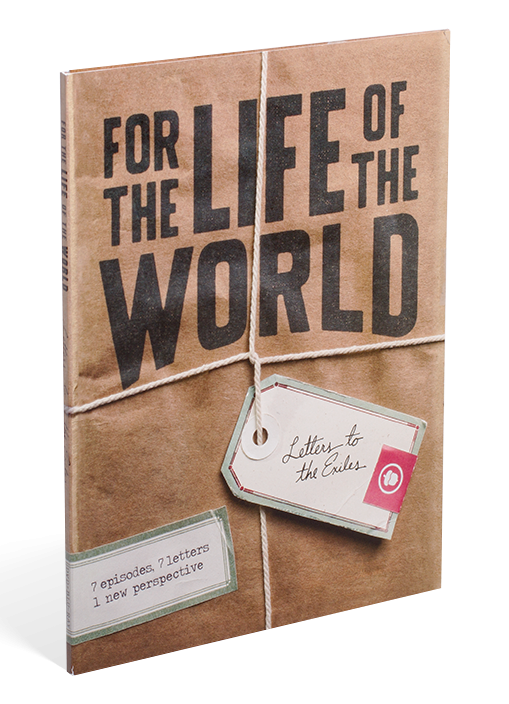 As Evan Koons concludes at the end of Episode 3 of FLOW, God gave us a “gift nature” not that we might plod along as cogs in some grand machine, but that we might participate in God’s movement of divine generosity and vast abundance:
Jesus commands us not to be anxious about our needs, so then why do we toil? Merely to tend our bodies? Or also to shape our souls? In giving us work, God invites us to blend the creativity of our minds with the labor of our bodies and then to share the products of this work with one another in free exchange —to make real our communal nature, our gift nature, through our personal callings. We must never see our work as simply a way to gain. We must never see our labor as an impersonal force of efficiency. We must never see our work merely as a mechanism we might control with levers and switches of power.
All our work together, what we call the economy, that’s not a machine, either. Work is always personal, because work is always relational…So let us cherish our work as the glorious gift it is — the opportunity to join with others, literally millions of others, in a divine project of vast creativity, vast abundance for the meeting of needs, for the flourishing of cities, for the life of the world.
We, like Della, Jim, and the Magi before them, can wake up each and every day, grateful and eager to bear what O. Henry so poetically refers to as “the privilege of exchange.”
“O all who give and receive gifts, such as they are wisest. Everywhere they are wisest.”
(Originally published at the Acton PowerBlog)
Previous Post

December 19, 2014
My Letter from the Economy of Wisdom
Next Post

December 23, 2014 How to Develop a Christian Mind in Business School (Part II)
Browse Our Archives
Select a Category Art Charity Church Common Grace Culture Curriculum Economics Education Family Justice Order Theology Uncategorized Vocation Wisdom Wonder Work
Select a Month January 2017 December 2016 November 2016 October 2016 September 2016 August 2016 July 2016 June 2016 May 2016 April 2016 March 2016 February 2016 January 2016 December 2015 November 2015 October 2015 September 2015 August 2015 July 2015 June 2015 May 2015 April 2015 March 2015 February 2015 January 2015 December 2014 November 2014 October 2014 September 2014 August 2014
Follow Us!
TAKE THE
Religious Wisdom Quiz
What vision did Daniel have of four beasts representing empires?
Select your answer to see how you score.
Four dragons Lion, bear, leopard, terrifying beast Ox, ram, goat, lion Horse, eagle, serpent, leopard
Related posts from Oikonomia

Thomas Sowell on the Origins of Prosperity

Lessons in Humility from the Christ Child


Lessons on Christian Vocation from ‘Chewbacca Mom’
TRENDING AT PATHEOS Business, Finance and Religion

St. Francis by Bill Droel Pope Leo XIV declares 2026 as “Year...

Catholics are schooled in the faith by memorizing dogmatic points and lots...

The Good News of Our Human Limitations -...
After another day of trying to meet deadlines and working on projects,...

Quiet Holy Attentiveness (podcast) with Sarah Clarkson
We know that quiet is an essential aspect of the spiritual life,...

Every Vocation Everywhere All At Once
What is a vocation? How does it endure through the years? Can...

I promise this is not going to become a Taylor Swift Studies...
view all Business, Finance and Religion blogs
Ad-Free & Subscriber Log-In Subscription Support
- About Us
- 2026 Calendar
- Videos
- Podcasts
- Library of World Religions
- Faith In Media Tracker
- Advertise With Us
- Write for Us
- Privacy Policy
- Terms of Service
- Do Not Sell My Data
- Contact Us
- Radiant Digital
- Manage Newsletter Subscriptions
- Unsubscribe From Notifications
- Sitemap
Copyright 2008-2026, Patheos. All rights reserved.
Subscription Support Ad-Free & Subscriber Log-In
Follow Patheos