
BuddhistCatholicContemplativeEvangelicalGeneral ChristianHinduJewishLatter-day SaintMuslimNew VisionsProgressive Christian
Beliefs
- Buddhist
- Catholic
- Contemplative
- Evangelical
- General Christian
- Hindu
- Jewish
- Latter-day Saint
- More Voices
- Muslim
- New Visions
- Pagan
- Progressive Christian
Topics
- Religion News
- Food and Religion
- Sports and Religion
- Religious Art
- Religious Music and Entertainment
- Religious Events
- History and Religion
- Style and Religion
- Politics and Religion
- Women in Religion
- Recreation Outdoors and Religion
- Business Finance and Religion
- Careers Workplace and Religion
- Education and Religion
- Family Parenting and Religion
- Health Fitness and Religion
- Home and Religion
- Relationships and Religion
- Technology and Religion
- Travel and Religion
Columnists
- Buddhist Columnists
- Business Finance and Religion Columnists
- Careers Workplace and Religion Columnists
- Catholic Columnists
- Contemplative Columnists
- Education and Religion Columnists
- Evangelists Columnists
- Family Parenting and Religion Columnists
- General Christian Columnists
- Health Fitness and Religion Columnists
- Hindu Columnists
- History and Religion Columnists
- Home and Religion Columnists
- Jewish Columnists
- More Voices Columnists
- Latter Day Columnists
- Muslim Columnists
- New Visions Columnists
- Nonreligious Columnists
- Pagan Columnists
- Politics and Religion Columnists
- Progressive Columnists
- Recreation Outdoors and Religion Columnists
- Relationships and Religion Columnists
- Religion News Columnists
- Religious Art Columnists
- Religious Events Columnists
- Religious Music and Entertainment Columnists
- Sports and Religion Columnists
- Style and Religion Columnists
- Technology and Religion Columnists
- Travel and Religion Columnists
- Women in Religion Columnists
Resource Library
- 2026 Calendar
- Library of World Religions
- The 100 Most Holy Places on Earth
- Patheos Answers
- Podcasts
- Videos
- Faith Leaders Database
- Anglican Episcopalian
- Bahai
- Baptist
- Buddhism
- Christianity
- Confucianism
- Eastern Orthodoxy
- Hinduism
- Holiness and Pentecostal
- ISKCON
- Islam
- Judaism
- Lutheran
- Methodist
- The Church of Jesus Christ of Latter-day Saints
- New Age
- Paganism
- Presbytarian and Reformed
- Protestantism
- Religion Behind the Scenes
- Roman Catholic
- Scientology
- Shia Islam
- Sikhism
- Sufism
- Sunni Islam
- Taoism
- Zen
- See all religions
Research Tools
 Ad-Free & Subscriber Log-In Subscription Support
Ad-Free & Subscriber Log-In Subscription Support
Follow Patheos 

- Trending:
- Forgiveness
- |
- Marriage
- |
- Consciousness
- |
- Death Penalty
- |
- Election
- |
- Halloween
 Oikonomia
- Home
- Business, Finance and Religion
- All Is Gift: Lessons in Stewardship from C.S. Lewis’ ‘Perelandra’
All Is Gift: Lessons in Stewardship from C.S. Lewis’ ‘Perelandra’
Last updated on: November 11, 2014 at 2:03 pm by Acton Institute
All Is Gift: Lessons in Stewardship from C.S. Lewis’ ‘Perelandra’ 2014-11-11T14:03:07-04:00 Acton Institute
Patheos Explore the world's faith through different perspectives on religion and spirituality! Patheos has the views of the prevalent religions and spiritualities of the world.
By Joseph Sunde
 One of the primary themes in the Acton Institute’s new series, For the Life of the World, is the notion that “all is gift” — that we were created to be gift-givers, and that through the atoning power of Jesus Christ, we are empowered to render our activities, nay, our very lives to God and those around us.
As Evan Koons explains at the end of Episode 1: “All our work in this world is made of stuff of the earth — our families, our labor, our governments and charities and schools and art forms — all of it takes place here below, but all of it is pointed toward heaven.” Or, as he wrote last week: “A life of ‘All is Gift’ has no room for the ‘self-made’ man or woman. We are all edified by the gifts of God and by his gifts reflected in others… ‘All is gift’ recognizes and radiates this truth. Know it or not, we are always fashioning bootstraps for someone else.”
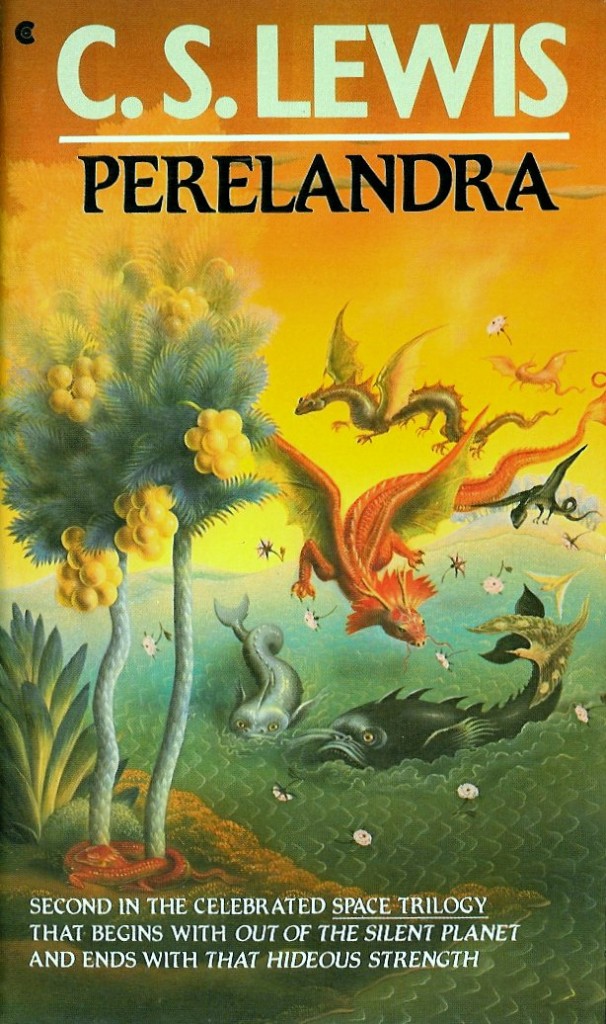
I was therefore a bit struck when I came upon the exact phrase and notion when reading the final chapter of C.S. Lewis’ Perelandra, the second novel in his remarkable Space Trilogy.
Early in the story, Ransom, the chief protagonist, arrives at Perelandra (i.e. Venus), and upon meeting a mysterious lady (“the Queen”), he soon learns that she is an Eve of sorts — innocent and obedient, in all of her pre-Fall-of-Man glory. The human race of Perelandra is still in its earliest stages, without any knowledge or influence of Evil.
The setting is soon disrupted, however, when Weston, an opportunistic scientist from the first novel, arrives on the planet. After spouting a long sermon of overly-spiritualized individualism, Weston is eventually overtaken by what appears to be demonic possession, after which he attempts to lure the Queen toward disobedience to Maleldil (the Creator God), much like the Serpent of old.
Ransom recognizes the parallels to Genesis, and engages in a long, embattled struggle with the demon, struggling to persuade the Queen to resist such temptation. After tireless pursuit, first through intellectual debate, and later through the shedding of blood, Ransom eventually wins, throwing Weston’s body into volcanic fire and avoiding yet another Fall of Man.
Yet having only encountered the Queen thus far, Ransom soon learns that all of his toil—the risks he took, the bruises he bore, the sacrifices he made — would also be a benefit for the King as well. Due to the Queen’s obedience amid such trials, the King and Queen are promoted by Maleldil to be rulers of the planet (known as “Oyarsu”), to grow in “the full management of the dominion which Maleldil puts into our hands.” The two are gifted with expanded knowledge of Good and Evil, but “not as the Evil One wished us to learn,” as the King explains.
For Ransom, however, such a reward is hardly fair.
Yes, the Queen resists temptation, but the King has not done anything — has not given anything — to deserve his reward. Trapped in his earthly understanding, Ransom cannot fathom how this mirror of Adam is able to relish in the gifts of God’s wisdom and power when The Fruit was never even offered as a test. How can the King possibly be trusted with dominion of the planet and the knowledge, wisdom, and obedience it requires, when he has given nothing as proof or investment? “I see how evil has been made known to the Queen,” says Ransom, “but not how it was made known to you.”
Then unexpectedly the King laughed. His body was very big and his laugh was like an earthquake in it, loud and deep and long, till in the end Ransom laughed too, though he had not seen the joke, and the Queen laughed as well. And the birds began clapping their wings and the beasts wagging their tails, and the light seemed brighter and the pulse of the whole assembly quickened, and new modes of joy that had nothing to do with mirth as we understand it passed into them all, as it were from the very air, or as if there were dancing in Deep Heaven. Some say there always is.
“I know what he is thinking,” said the King, looking upon the Queen. “He is thinking that you suffered and strove and I have a world for my reward.” Then he turned to Ransom and continued. “You are right,” he said, “I know now what they say in your world [Earth] about justice. And perhaps they say well, for in that world things always fall below justice. But Maleldil always goes above it. All is gift. I am Oyarsa not by His gift alone but by our foster mother’s, not by hers alone but by yours, not by yours alone but my wife’s—nay, in some sort, by gift of the very beasts and birds. Through many hands, enriched with many different kinds of love and labour, the gift comes to me. It is the Law. The best fruits are plucked for each by some hand that is not his own.” (emphasis added)
What a powerful picture of the aim and end of Christian service, and how it is enacted, shared, and spread across life.
We are not alone. Our efforts are not isolated. Our gifts are not designed to be shut up in a stuffy attic, nor are they meant to be indulged without regard to God’s wondrous creation that surrounds us—our families, our neighbors, the animals, the earth itself.
We give our gifts to God by giving our gifts to our neighbors. Like Ransom, we give so that others might give, and that others might live. And despite our fallen instincts and tendencies to keep score or take credit for ourselves, those very gifts are also due to the gifts of those before and beyond us.
Like the King, we ought to align our attitudes and actions accordingly, as those who, without God’s generosity and mercy, are powerless and fruitless. “Even our proverbial bootstraps are a gift,” as Koons notes, and we ought to leverage them in turn, set forth in praise and honor of a God whose ways always stretch above justice, not below it.
The gift comes to us, and is given through us, “through many hands, enriched with many different kinds of love and labour.”
[Originally published at the Acton PowerBlog]
Previous Post

November 6, 2014
Graceful Marketing in a Broken World
Next Post

November 12, 2014 Are Christians in Ministry the Only ‘Real’ Christians?
Browse Our Archives
Select a Category Art Charity Church Common Grace Culture Curriculum Economics Education Family Justice Order Theology Uncategorized Vocation Wisdom Wonder Work
Select a Month January 2017 December 2016 November 2016 October 2016 September 2016 August 2016 July 2016 June 2016 May 2016 April 2016 March 2016 February 2016 January 2016 December 2015 November 2015 October 2015 September 2015 August 2015 July 2015 June 2015 May 2015 April 2015 March 2015 February 2015 January 2015 December 2014 November 2014 October 2014 September 2014 August 2014
Follow Us!
TAKE THE
Religious Wisdom Quiz
According to Philippians, what should we think about?
Select your answer to see how you score.
The suffering of Christ Whatever is true, noble, right, pure, lovely, and admirable The word of God day and night The needs of others
Related posts from Oikonomia

Lessons in Humility from the Christ Child

Lessons on Christian Vocation from ‘Chewbacca Mom’


Help People, Not Banks: Reflections on the 2016...
TRENDING AT PATHEOS Business, Finance and Religion

St. Francis by Bill Droel Pope Leo XIV declares 2026 as “Year...

Catholics are schooled in the faith by memorizing dogmatic points and lots...

The Good News of Our Human Limitations -...
After another day of trying to meet deadlines and working on projects,...

Quiet Holy Attentiveness (podcast) with Sarah Clarkson
We know that quiet is an essential aspect of the spiritual life,...

Every Vocation Everywhere All At Once
What is a vocation? How does it endure through the years? Can...

I promise this is not going to become a Taylor Swift Studies...
view all Business, Finance and Religion blogs
Ad-Free & Subscriber Log-In Subscription Support
- About Us
- 2026 Calendar
- Videos
- Podcasts
- Library of World Religions
- Faith In Media Tracker
- Advertise With Us
- Write for Us
- Privacy Policy
- Terms of Service
- Do Not Sell My Data
- Contact Us
- Radiant Digital
- Manage Newsletter Subscriptions
- Unsubscribe From Notifications
- Sitemap
Copyright 2008-2026, Patheos. All rights reserved.
Subscription Support Ad-Free & Subscriber Log-In
Follow Patheos