
BuddhistCatholicContemplativeEvangelicalGeneral ChristianHinduJewishLatter-day SaintMuslimNew VisionsProgressive Christian
Beliefs
- Buddhist
- Catholic
- Contemplative
- Evangelical
- General Christian
- Hindu
- Jewish
- Latter-day Saint
- More Voices
- Muslim
- New Visions
- Pagan
- Progressive Christian
Topics
- Religion News
- Food and Religion
- Sports and Religion
- Religious Art
- Religious Music and Entertainment
- Religious Events
- History and Religion
- Style and Religion
- Politics and Religion
- Women in Religion
- Recreation Outdoors and Religion
- Business Finance and Religion
- Careers Workplace and Religion
- Education and Religion
- Family Parenting and Religion
- Health Fitness and Religion
- Home and Religion
- Relationships and Religion
- Technology and Religion
- Travel and Religion
Columnists
- Buddhist Columnists
- Business Finance and Religion Columnists
- Careers Workplace and Religion Columnists
- Catholic Columnists
- Contemplative Columnists
- Education and Religion Columnists
- Evangelists Columnists
- Family Parenting and Religion Columnists
- General Christian Columnists
- Health Fitness and Religion Columnists
- Hindu Columnists
- History and Religion Columnists
- Home and Religion Columnists
- Jewish Columnists
- More Voices Columnists
- Latter Day Columnists
- Muslim Columnists
- New Visions Columnists
- Nonreligious Columnists
- Pagan Columnists
- Politics and Religion Columnists
- Progressive Columnists
- Recreation Outdoors and Religion Columnists
- Relationships and Religion Columnists
- Religion News Columnists
- Religious Art Columnists
- Religious Events Columnists
- Religious Music and Entertainment Columnists
- Sports and Religion Columnists
- Style and Religion Columnists
- Technology and Religion Columnists
- Travel and Religion Columnists
- Women in Religion Columnists
Resource Library
- 2026 Calendar
- Library of World Religions
- The 100 Most Holy Places on Earth
- Patheos Answers
- Podcasts
- Videos
- Faith Leaders Database
- Anglican Episcopalian
- Bahai
- Baptist
- Buddhism
- Christianity
- Confucianism
- Eastern Orthodoxy
- Hinduism
- Holiness and Pentecostal
- ISKCON
- Islam
- Judaism
- Lutheran
- Methodist
- The Church of Jesus Christ of Latter-day Saints
- New Age
- Paganism
- Presbytarian and Reformed
- Protestantism
- Religion Behind the Scenes
- Roman Catholic
- Scientology
- Shia Islam
- Sikhism
- Sufism
- Sunni Islam
- Taoism
- Zen
- See all religions
Research Tools
 Ad-Free & Subscriber Log-In Subscription Support
Ad-Free & Subscriber Log-In Subscription Support
Follow Patheos 

- Trending:
- Forgiveness
- |
- Marriage
- |
- Consciousness
- |
- Death Penalty
- |
- Election
- |
- Halloween
 Oikonomia
- Home
- Business, Finance and Religion
- Walking on Water
Walking on Water
Last updated on: October 10, 2014 at 10:23 am by Acton Institute
Walking on Water 2014-10-10T10:23:02-04:00 Acton Institute
Patheos Explore the world's faith through different perspectives on religion and spirituality! Patheos has the views of the prevalent religions and spiritualities of the world.
By Evan Koons
World-renowned fine artist, and special guest in Episode 6 of For the Life of the World, Makoto Fujimura recently came to Grand Rapids to promote his latest work “Walking on Water – Azurite” for the nationally-recognized art competition ArtPrize.

An elegy to the 2011 Tsunami that obliterated the coasts of Japan’s northern islands, “Walking on Water” seizes the essence of destruction, chaos, and crushing violence that the earth carries at its core. He reminds us that in simple pivots, the earth can drown out entire nations. “Walking on Water” is a reflection of the horrible truth that the world is a broken place, that we live in exile. What’s more, “Walking on Water” is a response to exile. And yet, there is beauty, truth, and goodness. Hope coexists with pain. The more I think about it, it is a glistening example of justice and the Economy of Order.

In “Walking on Water,” Makoto enters into the unfathomable calamity. He stares into the dreadful reality that over 15,000 people were choked out by an ocean’s fury. He gives voice to the more than 45,000 homes and businesses, the hundreds of thousands of livelihoods, that were swept away. He gifts us with the memory of the immense humanity thatwas sucked into a dark abyss, never to return. In this piece, Makoto renders all that’s wrong with world. He lays it bear on a canvas, in deep and shimmering color and joins us in their suffering, if we let it. (Photographs do this piece no justice. You must see the layers upon layers of azurite prisms reflecting light.),
“Walking on Water” confronts us with the reality of justice. A just world that Mako writes “ought to be” begins in experiencing the inescapable reality of what “is.” This awareness doesn’t leave us hopeless. It doesn’t abandon us in despair to tread water in an apathetic ocean. Makoto reminds us through his title, “Walking on Water,” of the story from Matthew 14, where Jesus and Peter walk on water. We are reminded that when we enter into injustice, with our eyes fixed on Jesus – we will mourn, yes – but we will also do the impossible. We will rise above the waves. We trample the tumult of death, and reveal the impossible life of “what ought to be.” We will walk on water.

I see this same justice reveal itself in the life and work of John M. Perkins (special guest from Episode 4), a man all too familiar with injustice and the wages of sin. He experienced firsthand the horrors of racism and inequality in the South. White landowners and business men exploited him and his community at every turn. His brother was gunned down by white police officers. Perkins himself was beaten nearly to death and thrown in jail.
Still, he refused to turn away from the injustice. He refused to grow bitter and sink into despair. He refused to run away from the dark reality of the South. He chose to be, and to bring, the “oughtness” of Jesus. You can see it in the very first principle Perkins developed for the Christian Community Development Association (CCDA): Relocation.
Just as “Walking on Water” asks us to enter into the suffering of the tsunami victims, John Perkins reminds us that seeking justice requires us to move into the communities and thereby into the lives those experiencing injustice. According to his philosophy, “By relocating, a person will understand most clearly the real problems…and then he or she may begin to look for real solutions…Relocation transforms ‘you, them, and theirs’ to ‘we, us, and ours.’” Perkins sites John 1:14, “The Word became flesh and dwelt among us, and we beheld His glory as of the only begotten from the Father, full of grace and truth.”
In this world of exile, for justice to prevail there can be no “us” and “them.” There can only be “us.” The ideas of Martin Luther King, Jr. come to mind: we are a brotherhood, all part of one family, and we are all connected. What is unjust for one, is unjust for all.
As I unpack what the Economy of Order is and how we bring justice – Shalom – to a fallen world, I know I don’t have it all figured out. I’m not even scratching the surface. Yet, from all that I’ve seen and heard, I can’t deny that it starts with a person. It’s Jesus, God with us, who pours out in Makoto and his canvas and John Perkins into his community. It’s all of us taking the time to know our neighbors. Justice starts with us, stepping out in faith, relocating into the cold and uncaring waters of life that will certainly swallow us up, but for our faith in the impossible grace of God.
[Originally published at the FLOW Blog]
Previous Post
October 7, 2014
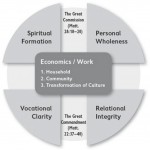
The 'Transformational Quartet' of Christian Stewardship
Next Post

October 14, 2014 Exile Supply Pack: Expand Your FLOW Experience
Browse Our Archives
Select a Category Art Charity Church Common Grace Culture Curriculum Economics Education Family Justice Order Theology Uncategorized Vocation Wisdom Wonder Work
Select a Month January 2017 December 2016 November 2016 October 2016 September 2016 August 2016 July 2016 June 2016 May 2016 April 2016 March 2016 February 2016 January 2016 December 2015 November 2015 October 2015 September 2015 August 2015 July 2015 June 2015 May 2015 April 2015 March 2015 February 2015 January 2015 December 2014 November 2014 October 2014 September 2014 August 2014
Follow Us!
TAKE THE
Religious Wisdom Quiz
How many specific prophecies about Messiah?
Select your answer to see how you score.
300+ 250 200 150
Related posts from Oikonomia

Thomas Sowell on the Origins of Prosperity

Politics, Character, and Competition

Lessons in Humility from the Christ Child

Help People, Not Banks: Reflections on the 2016...
TRENDING AT PATHEOS Business, Finance and Religion

St. Francis by Bill Droel Pope Leo XIV declares 2026 as “Year...

Catholics are schooled in the faith by memorizing dogmatic points and lots...

The Good News of Our Human Limitations -...
After another day of trying to meet deadlines and working on projects,...

Quiet Holy Attentiveness (podcast) with Sarah Clarkson
We know that quiet is an essential aspect of the spiritual life,...

Every Vocation Everywhere All At Once
What is a vocation? How does it endure through the years? Can...

I promise this is not going to become a Taylor Swift Studies...
view all Business, Finance and Religion blogs
Ad-Free & Subscriber Log-In Subscription Support
- About Us
- 2026 Calendar
- Videos
- Podcasts
- Library of World Religions
- Faith In Media Tracker
- Advertise With Us
- Write for Us
- Privacy Policy
- Terms of Service
- Do Not Sell My Data
- Contact Us
- Radiant Digital
- Manage Newsletter Subscriptions
- Unsubscribe From Notifications
- Sitemap
Copyright 2008-2026, Patheos. All rights reserved.
Subscription Support Ad-Free & Subscriber Log-In
Follow Patheos