
BuddhistCatholicContemplativeEvangelicalGeneral ChristianHinduJewishLatter-day SaintMuslimNew VisionsProgressive Christian
Beliefs
- Buddhist
- Catholic
- Contemplative
- Evangelical
- General Christian
- Hindu
- Jewish
- Latter-day Saint
- More Voices
- Muslim
- New Visions
- Pagan
- Progressive Christian
Topics
- Religion News
- Food and Religion
- Sports and Religion
- Religious Art
- Religious Music and Entertainment
- Religious Events
- History and Religion
- Style and Religion
- Politics and Religion
- Women in Religion
- Recreation Outdoors and Religion
- Business Finance and Religion
- Careers Workplace and Religion
- Education and Religion
- Family Parenting and Religion
- Health Fitness and Religion
- Home and Religion
- Relationships and Religion
- Technology and Religion
- Travel and Religion
Columnists
- Buddhist Columnists
- Business Finance and Religion Columnists
- Careers Workplace and Religion Columnists
- Catholic Columnists
- Contemplative Columnists
- Education and Religion Columnists
- Evangelists Columnists
- Family Parenting and Religion Columnists
- General Christian Columnists
- Health Fitness and Religion Columnists
- Hindu Columnists
- History and Religion Columnists
- Home and Religion Columnists
- Jewish Columnists
- More Voices Columnists
- Latter Day Columnists
- Muslim Columnists
- New Visions Columnists
- Nonreligious Columnists
- Pagan Columnists
- Politics and Religion Columnists
- Progressive Columnists
- Recreation Outdoors and Religion Columnists
- Relationships and Religion Columnists
- Religion News Columnists
- Religious Art Columnists
- Religious Events Columnists
- Religious Music and Entertainment Columnists
- Sports and Religion Columnists
- Style and Religion Columnists
- Technology and Religion Columnists
- Travel and Religion Columnists
- Women in Religion Columnists
Resource Library
- 2026 Calendar
- Library of World Religions
- The 100 Most Holy Places on Earth
- Patheos Answers
- Podcasts
- Videos
- Faith Leaders Database
- Anglican Episcopalian
- Bahai
- Baptist
- Buddhism
- Christianity
- Confucianism
- Eastern Orthodoxy
- Hinduism
- Holiness and Pentecostal
- ISKCON
- Islam
- Judaism
- Lutheran
- Methodist
- The Church of Jesus Christ of Latter-day Saints
- New Age
- Paganism
- Presbytarian and Reformed
- Protestantism
- Religion Behind the Scenes
- Roman Catholic
- Scientology
- Shia Islam
- Sikhism
- Sufism
- Sunni Islam
- Taoism
- Zen
- See all religions
Research Tools
 Ad-Free & Subscriber Log-In Subscription Support
Ad-Free & Subscriber Log-In Subscription Support
Follow Patheos 

- Trending:
- Forgiveness
- |
- Marriage
- |
- Consciousness
- |
- Death Penalty
- |
- Election
- |
- Halloween
 Oikonomia
- Home
- Business, Finance and Religion
- Sixpence Economics
Sixpence Economics
Last updated on: August 18, 2014 at 3:24 pm by Acton Institute
Sixpence Economics 2014-08-18T15:24:42-04:00 Acton Institute
Patheos Explore the world's faith through different perspectives on religion and spirituality! Patheos has the views of the prevalent religions and spiritualities of the world.
 At the conclusion of the first of his two chapters exploring the theological virtue of faith in Mere Christianity, C.S. Lewis provides a brief illustration that helps set the stage quite well for a discussion of the relationship between theology and economics, a relationship that currently stands in need of serious repair. Lewis wants to show that a key element of faith is the understanding of the divine origins of all things. “Every faculty you have, your power of thinking or of moving your limbs from moment to moment, is given you by God,” he writes. A consequence of this reality is that, as Lewis puts it, “If you devoted every moment of your whole life exclusively to His service you could not give Him anything that was not in a sense His own already.”
To bring this simple but profound theological truth home, Lewis uses one of his mundane yet memorable images:
So that when we talk of a man doing anything for God or giving anything to God, I will tell you what it is really like. It is like a small child going to its father and saying, “Daddy, give me sixpence to buy you a birthday present.” Of course the father does, and he is pleased with the child’s present. It is all very nice and proper, but only an idiot would think that the father is sixpence to the good on the transaction.
Now a number of economic and related theological concepts come immediately to mind from this short illustration. First, there is the reference to money, in this case sixpence, a British coin minted from 1551 until the late 1960s, at which point it was roughly equivalent to a nickel in US currency. Next there are the gift-elements of the exchange, from the father to the child and then reciprocally from the child to the father. We also have the purchase of the gift, a transactional exchange of the child with some vendor or another. And finally we have Lewis’ striking judgment about the value of these series of exchanges, both in economic terms and otherwise.
It is notable, perhaps, that in attempting to communicate a basic theological truth such as the divine origin and ownership over all of creation Lewis should choose an illustration that primarily relies on economic realities. But of course Lewis has a most excellent precedent for this in the parables of Jesus, many of which draw to a lesser or greater extent on economic imagery familiar to an audience in first-century Judea, particularly the parable of the talents which can be seen as analogous to some extent with Lewis’ sixpence image.
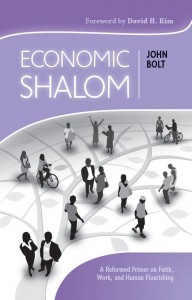 Significant, too, is that in Jesus’ parables as in Lewis’ more modern one, the economic elements are prominent but are not, after all, the ultimate point of the illustrations. Here Lewis is no more attempting to provide a lesson in basic economics than Jesus is attempting to instruct his hearers on the finer points of labor markets with the parable of the workers in the vineyard (Matt. 20:1–16). Instead, as John Bolt observes in his recent book Economic Shalom, in such parables “the economy is a simile for the kingdom of God!” These parables are not primarily about economics, even though, as Bolt continues, such “teachings of course are applicable to the Christian life of discipleship, including our economic life; our stewardship of God’s gifts of grace is not limited to but also includes our possessions.”
And yet the facility with which mundane economic matters are woven into such stories, stories that have rather higher spiritual aims, itself teaches us something about the relationship between the things of God and the things of this world. There is no radical dichotomy or separation such that economic realities like production, investment, debt, or commerce are somehow too profane to serve as vehicles of revealed truth. It is, in fact, a traditional contention among Christian theologians that there is nothing so base or mean in the creation that it is incapable in one way or another of proclaiming the glory of its Creator. Thus, the sixteenth-century Italian reformer Peter Martyr Vermigli asserted of his own work, “I count it sufficient to have said that there can be nothing found in the world so abject and contemptible, which giveth not a testimony of God.” For those with ears to hear, even a dishonest manager who brazenly diverts company funds for private purposes has something to teach us about the kingdom of God!
Sixpence economics, like the economic teachings of Jesus’ parables, shows us the stewardship responsibility that God has given to human beings, created in his image and likeness, and gifted with talents, energies, dispositions, insights, and passions. God gives to us so that we might, in turn, give back to him and in the process become more like him. This is the “great exchange” of sixpence economics.
Purchase Economic Shalom and Our Great Exchange.
(Originally posted at Acton Commentary)
Previous Post

January 4, 2017
Thomas Sowell on the Origins of Prosperity
Next Post

August 14, 2014 Letters to the Exiles: A New Approach to Cultural Engagement
Browse Our Archives
Select a Category Art Charity Church Common Grace Culture Curriculum Economics Education Family Justice Order Theology Uncategorized Vocation Wisdom Wonder Work
Select a Month January 2017 December 2016 November 2016 October 2016 September 2016 August 2016 July 2016 June 2016 May 2016 April 2016 March 2016 February 2016 January 2016 December 2015 November 2015 October 2015 September 2015 August 2015 July 2015 June 2015 May 2015 April 2015 March 2015 February 2015 January 2015 December 2014 November 2014 October 2014 September 2014 August 2014
Follow Us!
TAKE THE
Religious Wisdom Quiz
What color is traditionally worn by priests during the season of Advent?
Select your answer to see how you score.
Purple Red White Green
Related posts from Oikonomia
Thomas Sowell on the Origins of Prosperity


Are Christianity and Communism Mutually Exclusive?

What Christians Can Learn from Adam Smith’s ‘Paradox...
TRENDING AT PATHEOS Business, Finance and Religion

St. Francis by Bill Droel Pope Leo XIV declares 2026 as “Year...

Catholics are schooled in the faith by memorizing dogmatic points and lots...

The Good News of Our Human Limitations -...
After another day of trying to meet deadlines and working on projects,...

Quiet Holy Attentiveness (podcast) with Sarah Clarkson
We know that quiet is an essential aspect of the spiritual life,...

Every Vocation Everywhere All At Once
What is a vocation? How does it endure through the years? Can...

I promise this is not going to become a Taylor Swift Studies...
view all Business, Finance and Religion blogs
Ad-Free & Subscriber Log-In Subscription Support
- About Us
- 2026 Calendar
- Videos
- Podcasts
- Library of World Religions
- Faith In Media Tracker
- Advertise With Us
- Write for Us
- Privacy Policy
- Terms of Service
- Do Not Sell My Data
- Contact Us
- Radiant Digital
- Manage Newsletter Subscriptions
- Unsubscribe From Notifications
- Sitemap
Copyright 2008-2026, Patheos. All rights reserved.
Subscription Support Ad-Free & Subscriber Log-In
Follow Patheos