
BuddhistCatholicContemplativeEvangelicalGeneral ChristianHinduJewishLatter-day SaintMuslimNew VisionsProgressive Christian
Beliefs
- Buddhist
- Catholic
- Contemplative
- Evangelical
- General Christian
- Hindu
- Jewish
- Latter-day Saint
- More Voices
- Muslim
- New Visions
- Pagan
- Progressive Christian
Topics
- Religion News
- Food and Religion
- Sports and Religion
- Religious Art
- Religious Music and Entertainment
- Religious Events
- History and Religion
- Style and Religion
- Politics and Religion
- Women in Religion
- Recreation Outdoors and Religion
- Business Finance and Religion
- Careers Workplace and Religion
- Education and Religion
- Family Parenting and Religion
- Health Fitness and Religion
- Home and Religion
- Relationships and Religion
- Technology and Religion
- Travel and Religion
Columnists
- Buddhist Columnists
- Business Finance and Religion Columnists
- Careers Workplace and Religion Columnists
- Catholic Columnists
- Contemplative Columnists
- Education and Religion Columnists
- Evangelists Columnists
- Family Parenting and Religion Columnists
- General Christian Columnists
- Health Fitness and Religion Columnists
- Hindu Columnists
- History and Religion Columnists
- Home and Religion Columnists
- Jewish Columnists
- More Voices Columnists
- Latter Day Columnists
- Muslim Columnists
- New Visions Columnists
- Nonreligious Columnists
- Pagan Columnists
- Politics and Religion Columnists
- Progressive Columnists
- Recreation Outdoors and Religion Columnists
- Relationships and Religion Columnists
- Religion News Columnists
- Religious Art Columnists
- Religious Events Columnists
- Religious Music and Entertainment Columnists
- Sports and Religion Columnists
- Style and Religion Columnists
- Technology and Religion Columnists
- Travel and Religion Columnists
- Women in Religion Columnists
Resource Library
- 2026 Calendar
- Library of World Religions
- The 100 Most Holy Places on Earth
- Patheos Answers
- Podcasts
- Videos
- Faith Leaders Database
- Anglican Episcopalian
- Bahai
- Baptist
- Buddhism
- Christianity
- Confucianism
- Eastern Orthodoxy
- Hinduism
- Holiness and Pentecostal
- ISKCON
- Islam
- Judaism
- Lutheran
- Methodist
- The Church of Jesus Christ of Latter-day Saints
- New Age
- Paganism
- Presbytarian and Reformed
- Protestantism
- Religion Behind the Scenes
- Roman Catholic
- Scientology
- Shia Islam
- Sikhism
- Sufism
- Sunni Islam
- Taoism
- Zen
- See all religions
Research Tools
 Ad-Free & Subscriber Log-In Subscription Support
Ad-Free & Subscriber Log-In Subscription Support
Follow Patheos 

- Trending:
- Forgiveness
- |
- Marriage
- |
- Consciousness
- |
- Death Penalty
- |
- Election
- |
- Halloween
 Oathbound
- Home
- Pagan
- Tiny Revelations in Magical Practice
Tiny Revelations in Magical Practice
Last updated on: March 11, 2018 at 1:15 pm by Thorn Mooney
Tiny Revelations in Magical Practice 2018-03-11T13:15:57-04:00 Thorn Mooney
Patheos Explore the world's faith through different perspectives on religion and spirituality! Patheos has the views of the prevalent religions and spiritualities of the world.
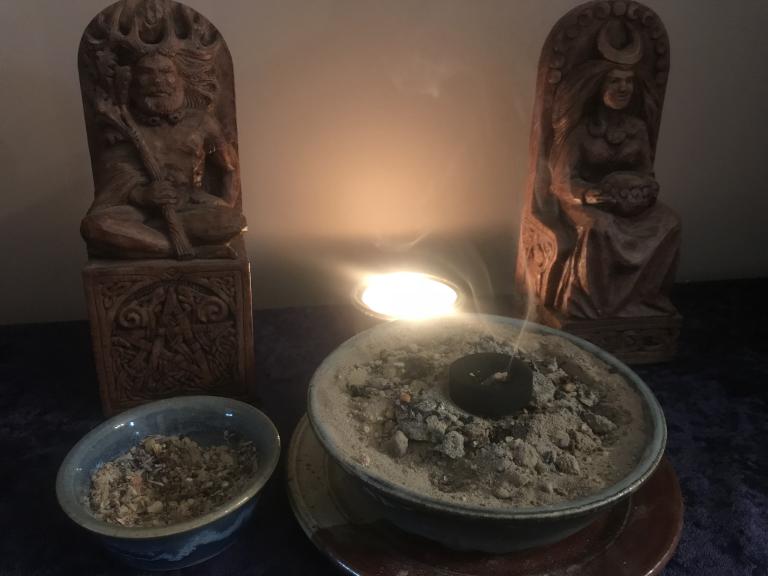 Sometimes the things that impact us the most over time aren’t earth-shaking. I spent some time journaling over the weekend, and I got to thinking about those tiny revelations that have hit out of nowhere and helped me to see my practice in a different light. Here are three:
The incense is not for you.
Sometimes—a lot of the time, actually—the incense isn’t there for your pleasure. Sure, we all like it when things smell good, but this is witchcraft. This is magic. For a lot of us, this is devotional practice to something bigger than ourselves. We’re burning the incense because it does something. Magically speaking, certain herbs and resins have certain properties that impact the world and aid your intent. The gods and spirits have their own preferences, and if we’re trying to make contact with them, we burn what they’re into.
I’ve been in several situations where I’ve watched someone have this realization, but my favorite by far occurred in my own coven. I was talking to one of our outer court members, and she was preparing a devotional ritual to Herne. She had found an incense recipe she wanted to try for the occasion and was assembling the ingredients. It called for juniper berries, but, “I don’t like the way they smell, so I’m going to add frankincense or something instead.”
I looked at her.
“What?” She said. And then, uncomfortably, “What?”
“How does Herne feel about juniper berries?”
And suddenly it hit her.
I can’t personally speak to whether or not Herne likes juniper berries (Scott Cunningham thought so, anyway), but I do know that when I buy wine for my mother, I buy her a sweet white zinfandel or a riesling, even though I would rather have a nice dry cabernet. It’s not for me, so I think about what she would like.
So if I’m making incense for a spirit, my own preferences take a backseat. If I’m making incense for a spell, again, my preferences take a back seat.
Fake it ‘til you make it is a 100% legit strategy.
While I was at PantheaCon, I went to workshops by Devin Hunter and Storm Faerywolf (who are both brilliant, btw, go read them). Each led us through meditative exercises, which were, in many ways, very typical. We breathed mindfully, moved our awareness to our bodies and beyond, listened to a soothing voice, and visualized things as instructed. But one tiny thing was different, and it had a huge impact: we were also instructed to imagine, in the event that we couldn’t do what was instructed.
So instead of “Feel the weight of the energy in your hands,” we got “Feel the weight, or imagine what the weight would feel like.”
It’s a tiny difference of wording, but it has a big impact.
I used to really struggle with guided meditation, ritual, and basically anything that involved extra-sensory skill. I used to think maybe I was just broken. Other people got to have magical experiences and talk about feeling and sensing stuff that clearly wasn’t there, and I was just a brick wall. “Oh, you can just help other people ground afterwards,” someone said to me once when I shared this.
That’s a pretty disappointing takeaway for a teenager attending her first rituals.
One of the reasons I became a scholar and worked so hard to be well-read was because I figured that was really the only thing I was actually good at. I assumed I just wasn’t very magical, and if I wanted to have any kind of expertise as a witch, it would need to be book-based.
If I had been encouraged to imagine, to play, and to pretend from the get-go, I would have figured out what a load of crap all that was a lot sooner.
Being told that it’s okay to imagine what something would feel like would have both validated my own experience, and encouraged me to keep trying. it also would have allowed me to get something tangible out of all those guided meditations and rituals instead of just sitting there thinking, “Shit. It’s not working. Again.”
Some people can do things straight out of the gate, and that’s awesome. But for plenty of us, those skills have to be learned. One of the ways that people learn anything is by incorporating it into play (just watch the games that little kids come up with as they grow up). If an activity is low-pressure and those around us are encouraging, we’re more likely to try it, work at it, and get something out of the experience. Eventually, our “imaginings” become real. Maybe they always were.
Your book of shadows is mostly for you, not future witches.
That’s funny coming from a traditional Wiccan with a shared Book of Shadows, but the truth is that all that copying, journaling, illustrating, and editing is overwhelmingly for your own benefit. Other witches have their own, or can get a lot of the same material from books, the Internet, or just from people with better handwriting.
I’m obsessed with books and history, so I can absolutely appreciate the impact that journals and similar documents can have. I used to think of it as a personal obligation to keep intense records so that some future witch grad student might luck into my stash after I’m dead and have something brilliant to say about it. I also love the idea of passing a book down to children or initiates someday. A lot of us are into that idea (so was my grandma when she was busy taking notes and sticking pictures in the family Bible…oh well). Maybe all of that could happen, but the truth is that all that journaling and record keeping is most beneficial to us.
Copying helps us to remember things and ensures that we actually read the material we have (many questions in traditional Wiccan spaces, for example, could be answered if we would all just read the fucking BOS, as my friends in the New Wiccan Church are fond of saying). Illustrating and adding photos and otherwise beautifying our books helps us to personalize the material, creating a sense of ownership. And magical record keeping and journaling helps us both to get to know ourselves (magical practice is a heck of a lot harder if you’re not particularly self-aware) as well as to see how much we’ve grown over time.
My books of shadows go back to age fourteen, and they’re a shit show, let me tell you. My witch life has been messy, and a lot of it’s embarrassing. But they’re my most precious possessions. Maybe someday someone will read them, or maybe they’ll end up forgotten in someone’s garage somewhere. But that part doesn’t matter as much to me as it used to. The act of making them and reading them myself is what’s proved to be important over the years.
Previous Post
February 24, 2018
Lessons Learned Running a Coven
Next Post
March 18, 2018 Building a Home Shrine
Browse Our Archives
Select a Category Books Coven Life Exciting Life Things Pagan Community Personal Stuff Practical Stuff Tarot Uncategorized Wicca
Select a Month September 2021 July 2021 June 2021 March 2021 February 2021 January 2021 December 2020 November 2020 October 2020 August 2020 July 2020 May 2020 February 2020 January 2020 November 2019 September 2019 June 2019 May 2019 January 2019 July 2018 June 2018 May 2018 March 2018 February 2018 August 2017 July 2017 March 2017 January 2017 December 2016 November 2016 October 2016 August 2016 July 2016 June 2016 May 2016 April 2016 March 2016 February 2016 January 2016 December 2015 November 2015 October 2015 September 2015 August 2015 July 2015 June 2015 May 2015 April 2015
Follow Us!
TAKE THE
Religious Wisdom Quiz
How old was Abraham when Sarah died?
Select your answer to see how you score.
137 years 117 years 127 years 147 years
Related posts from Oathbound

Secular vs. Religious: Making Distinctions as a Witch
Don't Be an Expert Witch: Expertise, Advancement, and...
TRENDING AT PATHEOS Pagan

I was recently chatting with someone on Instagram. She asked me what...

While there are many people who share their results, the end of...

On July 23, I saw Christopher Nolan's The Odyssey which is Homer’s...

As I write this two big events have just finished up. One...

Restoring the Watershed of Divine Love
Perhaps cooperation is not something we manufacture through legislation, ideology, or moral...

Many UUs don’t pray because of bad experiences in a previous religion,...
view all Pagan blogs
Ad-Free & Subscriber Log-In Subscription Support
- About Us
- 2026 Calendar
- Videos
- Podcasts
- Library of World Religions
- Faith In Media Tracker
- Advertise With Us
- Write for Us
- Privacy Policy
- Terms of Service
- Do Not Sell My Data
- Contact Us
- Radiant Digital
- Manage Newsletter Subscriptions
- Unsubscribe From Notifications
- Sitemap
Copyright 2008-2026, Patheos. All rights reserved.
Subscription Support Ad-Free & Subscriber Log-In
Follow Patheos