
BuddhistCatholicContemplativeEvangelicalGeneral ChristianHinduJewishLatter-day SaintMuslimNew VisionsProgressive Christian
Beliefs
- Buddhist
- Catholic
- Contemplative
- Evangelical
- General Christian
- Hindu
- Jewish
- Latter-day Saint
- More Voices
- Muslim
- New Visions
- Pagan
- Progressive Christian
Topics
- Religion News
- Food and Religion
- Sports and Religion
- Religious Art
- Religious Music and Entertainment
- Religious Events
- History and Religion
- Style and Religion
- Politics and Religion
- Women in Religion
- Recreation Outdoors and Religion
- Business Finance and Religion
- Careers Workplace and Religion
- Education and Religion
- Family Parenting and Religion
- Health Fitness and Religion
- Home and Religion
- Relationships and Religion
- Technology and Religion
- Travel and Religion
Columnists
- Buddhist Columnists
- Business Finance and Religion Columnists
- Careers Workplace and Religion Columnists
- Catholic Columnists
- Contemplative Columnists
- Education and Religion Columnists
- Evangelists Columnists
- Family Parenting and Religion Columnists
- General Christian Columnists
- Health Fitness and Religion Columnists
- Hindu Columnists
- History and Religion Columnists
- Home and Religion Columnists
- Jewish Columnists
- More Voices Columnists
- Latter Day Columnists
- Muslim Columnists
- New Visions Columnists
- Nonreligious Columnists
- Pagan Columnists
- Politics and Religion Columnists
- Progressive Columnists
- Recreation Outdoors and Religion Columnists
- Relationships and Religion Columnists
- Religion News Columnists
- Religious Art Columnists
- Religious Events Columnists
- Religious Music and Entertainment Columnists
- Sports and Religion Columnists
- Style and Religion Columnists
- Technology and Religion Columnists
- Travel and Religion Columnists
- Women in Religion Columnists
Resource Library
- 2026 Calendar
- Library of World Religions
- The 100 Most Holy Places on Earth
- Patheos Answers
- Podcasts
- Videos
- Faith Leaders Database
- Anglican Episcopalian
- Bahai
- Baptist
- Buddhism
- Christianity
- Confucianism
- Eastern Orthodoxy
- Hinduism
- Holiness and Pentecostal
- ISKCON
- Islam
- Judaism
- Lutheran
- Methodist
- The Church of Jesus Christ of Latter-day Saints
- New Age
- Paganism
- Presbytarian and Reformed
- Protestantism
- Religion Behind the Scenes
- Roman Catholic
- Scientology
- Shia Islam
- Sikhism
- Sufism
- Sunni Islam
- Taoism
- Zen
- See all religions
Research Tools
 Ad-Free & Subscriber Log-In Subscription Support
Ad-Free & Subscriber Log-In Subscription Support
Follow Patheos 

- Trending:
- Forgiveness
- |
- Marriage
- |
- Consciousness
- |
- Death Penalty
- |
- Election
- |
- Halloween
 Oathbound
- Home
- Pagan
- “Warrior”: Musings on Martial Arts, Paganism, and Victimhood
“Warrior”: Musings on Martial Arts, Paganism, and Victimhood
Last updated on: December 13, 2016 at 7:32 pm by Thorn Mooney
“Warrior”: Musings on Martial Arts, Paganism, and Victimhood 2016-12-13T19:32:48-04:00 Thorn Mooney
Patheos Explore the world's faith through different perspectives on religion and spirituality! Patheos has the views of the prevalent religions and spiritualities of the world.
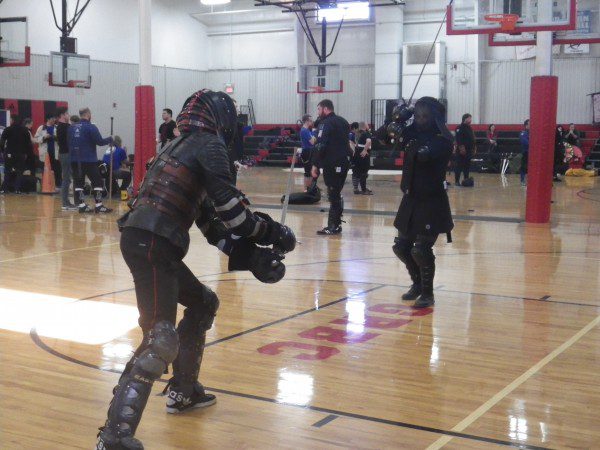 “What did you study before taking up HEMA?”
Tom lowered his feder and took off his mask. Time to take a break from all this partner drilling. It’s day two of the Triangle Sword Guild’s annual fencing social, and it’s been awesome getting to train with people outside of my own club.
“Taekwondo. But it’s been, like, ten years, and I’ve done shit since then aside from running. Why?”
“It’s obvious. You can always tell when someone is a fighter. Look at your posture. Look at how you move into the ring. However much of a beginner you are, you’re clearly a warrior.”
I’ve been dwelling on this comment. I’ve actually been dwelling on this whole concept. For a while now.
The word “warrior” gets tossed around a lot in both Pagan and martial arts communities. I haven’t been keeping tabs in any kind of concrete way, but it seems to me that, at about the same time the Internet became obsessed with “real traditional witchcraft” the wider Pagan community got really into hair braiding and “reclaiming the spirit of the warrior” or some such. Battle deities were suddenly everywhere (or so it looked to me, from the sidelines) and I was suddenly surrounded by guys describing themselves as berserkers. Maybe I was just noticing for the first time (if the gods have their own agency, then maybe they appeared with good reason, on their own time)—I don’t know.
Warrior is one of those words, like witch, that is really hard to pin down. On the one hand, I think the experience of being a soldier on a battlefield must necessarily be distinct from something like an SCA event or a “battle” with illness. My parents are veterans, and their resulting mannerisms are unlike anything I’ve encountered at a martial arts tournament or a Renaissance faire. I can practically hear my dad sighing in my head and rolling his eyes when people use war metaphors to talk about things that are clearly not war. On the other hand, the literal battlefield is not the only place in the world where death is at stake. Where fighting takes place. Abuse victims, for example, are thought to suffer comparable trauma and often receive similar psychological care (if anyone in either camp is lucky enough to receive care at all). In coping with the aftermath of my own Relationship From Hell, I was personally treated by a therapist who often worked with veterans. I received a similar PTSD diagnosis and underwent similar rehabilitation. Many of my own high school students are involved in gang-related violence and live daily with the trauma of growing up in environments characterized by racism and poverty. This is thought by some cognitive development experts to have similar effects.
Being in a state where you think you’re going to die and you are forced to consider killing other people to prevent that from happening seems to fundamentally change people.
I’m not sure death is the lynchpin, though. Lots of things can kill us, after all. There are a lot of tough-sounding hobbies I could take up that might result in death. I’m not sure it’s killing, either. Culturally, we tend to think there’s a fundamental difference between being a warrior and being a killer. “Killer” is what you become when you’ve committed a crime. We don’t usually use that kind of language when we think it’s justified.
If I had to boil it down to something, it might be commitment—at the expense of personal identity—to a cause that may require your death. Soldiers, police, other kinds of first responders. Maybe people fighting for other kinds of political causes in certain ways. Part of that becoming process is a stripping down of self and being rebuilt into something intended for service in the name of a cause. People go into training and come out differently, if things go according to plan. Warriors are set apart from the rest of society (like witches).
But there are many kinds of soldiers. There are many ways to wage war, and not all of them entail being on the battlefield or personally suffering injury.
Nevermind that that train of thought raises lots of questions about the role that glory plays in war. People become soldiers to serve, yes, but there’s usually more at stake at the individual level.
I’m not sure that taking martial arts classes makes me a warrior. I’m not sure being an abuse victim makes me a warrior. We also use a lot of battle metaphors in education, but I’m not sure that’s really fair, either. I’ve never been to war, but I’m not comfortable drawing that kind of comparison to anything I’ve seen in a classroom. My students may be involved in a kind of war, but they’re victims of a system. Being a warrior seems to entail a level of personal agency that my kids don’t have. These are children born into particular circumstances beyond their control.
I see a weird sort of stigma about victimhood at work here, too. I encountered a lot of rhetoric in my own therapy about not “being a victim” or not “adopting a victim mentality.” But I was a victim. Someone victimized me. I had a choice about what to do in the aftermath, but I couldn’t choose not to be a victim. Someone made that choice for me. That’s part of what it means to be victimized. My agency was taken from me. When I’m subsequently told—however indirectly—to not “act like a victim” I’m increasingly less sure what that means. It feels like more shaming. Like we have to be weak in order to be victimized. I think there’s an element of that in the everywhereness of the “warrior” archetype. I’m not a victim; I’m a warrior. There, isn’t that better?
Weapons training has allowed me to reclaim some of that agency, yes. It channels something violent inside of me, and keeps me from misdirecting that violence. Weirdly (maybe), it’s also taught me a lot about love. It’s a way of coping, as well as a way of figuring out who I am in the world. If that makes me a warrior, then surely everyone who’s working to find their way in the world is also a warrior. I still want to save something for my parents—and for the other veterans in my life—that sets their level of commitment apart. When my parents talk about war, they are very clearly expressing something that doesn’t translate to the sparring games that martial artists play (violent, yes, but games nonetheless). I think I’d rather have a different word.
I’d rather be a “fencer” or a “swordswoman” or a “fighter.” In thinking about my past, increasingly, I’m also okay with that word being “victim.” Stigma be damned. Let’s call it what it was. The differences may be more semantic than anything, but I feel a heaviness in “warrior” that I just can’t overlook. I’m not qualified to draw the lines, and, like witch, I’m not going to tell anyone else what labels they get to claim. But I do choose to take greater care in this particular application.
If this is a part of your Pagan practice, how does this distinction play out? What makes someone a warrior?
Previous Post

December 7, 2016
Advice for the Absolute Beginner Wiccan
Next Post
January 6, 2017 There are Fucking Witches in North Carolina
Browse Our Archives
Select a Category Books Coven Life Exciting Life Things Pagan Community Personal Stuff Practical Stuff Tarot Uncategorized Wicca
Select a Month September 2021 July 2021 June 2021 March 2021 February 2021 January 2021 December 2020 November 2020 October 2020 August 2020 July 2020 May 2020 February 2020 January 2020 November 2019 September 2019 June 2019 May 2019 January 2019 July 2018 June 2018 May 2018 March 2018 February 2018 August 2017 July 2017 March 2017 January 2017 December 2016 November 2016 October 2016 August 2016 July 2016 June 2016 May 2016 April 2016 March 2016 February 2016 January 2016 December 2015 November 2015 October 2015 September 2015 August 2015 July 2015 June 2015 May 2015 April 2015
Follow Us!
TAKE THE
Religious Wisdom Quiz
True or False: Cain killed his brother Abel because God rejected Cain's offering.
Select your answer to see how you score.
TRUE FALSE
Related posts from Oathbound

Secular vs. Religious: Making Distinctions as a Witch

My Biggest Mistakes as a Witch

My Initial Reactions to The Craft: Legacy

The Pressure to be a Professional Witch
TRENDING AT PATHEOS Pagan

When we talk about Greek religion, we often begin with the dodekatheion—the...

I was recently chatting with someone on Instagram. She asked me what...

While there are many people who share their results, the end of...

On July 23, I saw Christopher Nolan's The Odyssey which is Homer’s...

As I write this two big events have just finished up. One...

Restoring the Watershed of Divine Love
Perhaps cooperation is not something we manufacture through legislation, ideology, or moral...
view all Pagan blogs
Ad-Free & Subscriber Log-In Subscription Support
- About Us
- 2026 Calendar
- Videos
- Podcasts
- Library of World Religions
- Faith In Media Tracker
- Advertise With Us
- Write for Us
- Privacy Policy
- Terms of Service
- Do Not Sell My Data
- Contact Us
- Radiant Digital
- Manage Newsletter Subscriptions
- Unsubscribe From Notifications
- Sitemap
Copyright 2008-2026, Patheos. All rights reserved.
Subscription Support Ad-Free & Subscriber Log-In
Follow Patheos