
BuddhistCatholicContemplativeEvangelicalGeneral ChristianHinduJewishLatter-day SaintMuslimNew VisionsProgressive Christian
Beliefs
- Buddhist
- Catholic
- Contemplative
- Evangelical
- General Christian
- Hindu
- Jewish
- Latter-day Saint
- More Voices
- Muslim
- New Visions
- Pagan
- Progressive Christian
Topics
- Religion News
- Food and Religion
- Sports and Religion
- Religious Art
- Religious Music and Entertainment
- Religious Events
- History and Religion
- Style and Religion
- Politics and Religion
- Women in Religion
- Recreation Outdoors and Religion
- Business Finance and Religion
- Careers Workplace and Religion
- Education and Religion
- Family Parenting and Religion
- Health Fitness and Religion
- Home and Religion
- Relationships and Religion
- Technology and Religion
- Travel and Religion
Columnists
- Buddhist Columnists
- Business Finance and Religion Columnists
- Careers Workplace and Religion Columnists
- Catholic Columnists
- Contemplative Columnists
- Education and Religion Columnists
- Evangelists Columnists
- Family Parenting and Religion Columnists
- General Christian Columnists
- Health Fitness and Religion Columnists
- Hindu Columnists
- History and Religion Columnists
- Home and Religion Columnists
- Jewish Columnists
- More Voices Columnists
- Latter Day Columnists
- Muslim Columnists
- New Visions Columnists
- Nonreligious Columnists
- Pagan Columnists
- Politics and Religion Columnists
- Progressive Columnists
- Recreation Outdoors and Religion Columnists
- Relationships and Religion Columnists
- Religion News Columnists
- Religious Art Columnists
- Religious Events Columnists
- Religious Music and Entertainment Columnists
- Sports and Religion Columnists
- Style and Religion Columnists
- Technology and Religion Columnists
- Travel and Religion Columnists
- Women in Religion Columnists
Resource Library
- 2026 Calendar
- Library of World Religions
- The 100 Most Holy Places on Earth
- Patheos Answers
- Podcasts
- Videos
- Faith Leaders Database
- Anglican Episcopalian
- Bahai
- Baptist
- Buddhism
- Christianity
- Confucianism
- Eastern Orthodoxy
- Hinduism
- Holiness and Pentecostal
- ISKCON
- Islam
- Judaism
- Lutheran
- Methodist
- The Church of Jesus Christ of Latter-day Saints
- New Age
- Paganism
- Presbytarian and Reformed
- Protestantism
- Religion Behind the Scenes
- Roman Catholic
- Scientology
- Shia Islam
- Sikhism
- Sufism
- Sunni Islam
- Taoism
- Zen
- See all religions
Research Tools
 Ad-Free & Subscriber Log-In Subscription Support
Ad-Free & Subscriber Log-In Subscription Support
Follow Patheos 

- Trending:
- Forgiveness
- |
- Marriage
- |
- Consciousness
- |
- Death Penalty
- |
- Election
- |
- Halloween
 Oathbound
- Home
- Pagan
- The Witch Alone: We’re All Solitary
The Witch Alone: We’re All Solitary
Last updated on: May 3, 2016 at 5:09 pm by Thorn Mooney
The Witch Alone: We’re All Solitary 2016-05-03T17:09:56-04:00 Thorn Mooney
Patheos Explore the world's faith through different perspectives on religion and spirituality! Patheos has the views of the prevalent religions and spiritualities of the world.
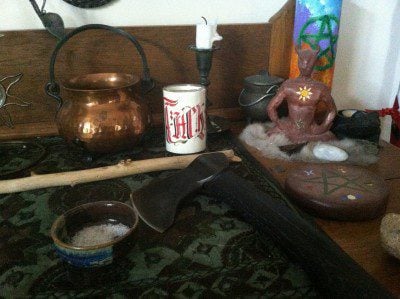
This altar is my own, and it has both nothing and everything to do with my coven and my tradition.
I think one of the biggest misconceptions about witchcraft is that “solitary witch” is a discrete category separate from other kinds of witches. That when you pick up your first book, your first task is deciding whether or not to work alone or in some kind of group. No matter what I write—literally every post—someone comments with, “This is why I’m solitary.” The idea being that one falls into this category because it inherently works for some kinds of people and not for others. If you pursue the comment, the distinction (simplified) usually sounds like this: covens are for people who live in big cities and who like being told what to do and think, and solitaries are free-thinking introverts who don’t want to be bossed around.
Talk about a dumb dichotomy.
The truth is, there’s no one reason to be one or the other, and no one way to do it.
But the reason I say it’s all a misconception is this: all witches are ultimately solitary. Whether or not we belong to a group, we’re on this path alone.
Bold claim, I know, but I stand by it.
When I first began learning about Wicca, I was a young teenager. I didn’t have access to other Wiccans, and I would have been too young for coven practice, anyway (at least, traditional coven practice). So I cultivated a personal practice rooted in my own experience, informed by what I was learning and limited by what I could reasonably pull off as a suburban teenager. That personal, solitary practice evolved with every new book and (eventually) with every public circle I attended and new contact I made. I learned, my life changed, and the wheel turned. I kept building, settling into myself, encountering new challenges, and changing accordingly.
Joining a coven did not halt this process, nor should it have.
I became part of something larger than myself—a tradition—and I signed on to learn from other people in a more formal setting, but I still went home to myself. My own altar, my own magic, my own relationship with the gods and spirits. I never stopped having a solitary practice, and neither did anyone else in our coven (or any coven I’ve been a part of subsequently). If anything, that solitary practice got stronger because it acquired an additional layer of structure and support.
When you choose to circle with others, whether it be with friends or in an established formal training coven, you don’t trade in your individuality or your past. We’re not the Borg. And what good is any of that training or group experience if it’s meaningless when you go home and you’re alone?
Think of it this way:
Let’s pretend you have the perfect coven and the perfect schedule. You meet on every high holiday (let’s say you have, I don’t know, eight), every full and new moon (twenty-six), and let’s say one more per week just for the hell of it (fifty-two more gatherings). That’s eighty-six days per year of coven meetings.
That’s two hundred and seventy-nine days of not meeting with a coven.
I don’t know about you guys, but I’m still a witch on those days (plus all those others where we’re not actually meeting eighty-six days per year because that sounds fucking crazy). And if my tradition didn’t have anything to say and no influence on those other days, then I’d say it probably wasn’t worth much. And a witch who isn’t a witch in between coven meetings isn’t much of a witch, in my mind.
What does that mean? Well, I’m not here to tell you what witchcraft is or what yours has to look like. You’re probably the best authority on whether or not you’re a witch. But for me, those days are a continuation of that personal practice I’ve been building since those first forays as a teenager: I perform ritual, I tend an altar, I talk to the spirits, I worship the gods, I read and write and contemplate.
Having a coven is a valuable experience, but it’s not a substitute for the work you do on your own. In fact, every coven I’ve been involved in has measured progress in part by a member’s developing solitary practice. I expect my own initiates to be building something in their own lives, making meaning and finding techniques and developing ideas that matter when they leave the covenstead.
Because here’s the other reality: your coven won’t last forever.
People move, jobs change, people quit, people die.
You can’t let that stuff stop you. A solitary practice is critical, because when it comes right down to it, you’re going to find yourself alone. And that’s when it counts.
I’m not really sure why so many people think that coven and solitary work is an either/or deal. At one point in Wiccan history, the idea of a purely solitary practitioner was a novelty—a controversy—but the idea was never that other kinds of Wiccans don’t also practice alone. It’s not a dichotomy. You don’t have to choose. In fact, you shouldn’t choose, as though you can possibly know what your practice will look like years from now. A period spent working with a coven or purely as a solitary doesn’t mean that you won’t be doing something else in the future. But we talk about the “solitary practitioner” like it’s an essentialist personality type—to the exclusion of all else—when really it’s just an inherent part of being a witch. It’s no wonder people have such unrealistic notions about what goes on in covens (WE ARE BORG YOU WILL BE ASSIMILATED). And it’s no wonder new witches put so much pressure on themselves to try to live up to some invisible standard for what a personal practice should look like.
It’s not either/or, and we should stop talking like it is.
Previous Post

April 25, 2016
Wiccan Deal-Breakers: Signs to Look Elsewhere
Next Post
May 10, 2016 Hi Patheos! How's life?
Browse Our Archives
Select a Category Books Coven Life Exciting Life Things Pagan Community Personal Stuff Practical Stuff Tarot Uncategorized Wicca
Select a Month September 2021 July 2021 June 2021 March 2021 February 2021 January 2021 December 2020 November 2020 October 2020 August 2020 July 2020 May 2020 February 2020 January 2020 November 2019 September 2019 June 2019 May 2019 January 2019 July 2018 June 2018 May 2018 March 2018 February 2018 August 2017 July 2017 March 2017 January 2017 December 2016 November 2016 October 2016 August 2016 July 2016 June 2016 May 2016 April 2016 March 2016 February 2016 January 2016 December 2015 November 2015 October 2015 September 2015 August 2015 July 2015 June 2015 May 2015 April 2015
Follow Us!
TAKE THE
Religious Wisdom Quiz
Jesus replied: "‘Love the Lord your God with all your heart and with all your soul and with all your mind.’ This is the first and greatest commandment. And the second is like it: ‘__________________’"
Select your answer to see how you score.
Do Not Kill Love Your Neighbor As Yourself Love Others Honor Your Father And Mother
Related posts from Oathbound

Secular vs. Religious: Making Distinctions as a Witch
Don't Be an Expert Witch: Expertise, Advancement, and...
TRENDING AT PATHEOS Pagan

I was recently chatting with someone on Instagram. She asked me what...

While there are many people who share their results, the end of...

On July 23, I saw Christopher Nolan's The Odyssey which is Homer’s...

As I write this two big events have just finished up. One...

Restoring the Watershed of Divine Love
Perhaps cooperation is not something we manufacture through legislation, ideology, or moral...

Many UUs don’t pray because of bad experiences in a previous religion,...
view all Pagan blogs
Ad-Free & Subscriber Log-In Subscription Support
- About Us
- 2026 Calendar
- Videos
- Podcasts
- Library of World Religions
- Faith In Media Tracker
- Advertise With Us
- Write for Us
- Privacy Policy
- Terms of Service
- Do Not Sell My Data
- Contact Us
- Radiant Digital
- Manage Newsletter Subscriptions
- Unsubscribe From Notifications
- Sitemap
Copyright 2008-2026, Patheos. All rights reserved.
Subscription Support Ad-Free & Subscriber Log-In
Follow Patheos