
BuddhistCatholicContemplativeEvangelicalGeneral ChristianHinduJewishLatter-day SaintMuslimNew VisionsProgressive Christian
Beliefs
- Buddhist
- Catholic
- Contemplative
- Evangelical
- General Christian
- Hindu
- Jewish
- Latter-day Saint
- More Voices
- Muslim
- New Visions
- Pagan
- Progressive Christian
Topics
- Religion News
- Food and Religion
- Sports and Religion
- Religious Art
- Religious Music and Entertainment
- Religious Events
- History and Religion
- Style and Religion
- Politics and Religion
- Women in Religion
- Recreation Outdoors and Religion
- Business Finance and Religion
- Careers Workplace and Religion
- Education and Religion
- Family Parenting and Religion
- Health Fitness and Religion
- Home and Religion
- Relationships and Religion
- Technology and Religion
- Travel and Religion
Columnists
- Buddhist Columnists
- Business Finance and Religion Columnists
- Careers Workplace and Religion Columnists
- Catholic Columnists
- Contemplative Columnists
- Education and Religion Columnists
- Evangelists Columnists
- Family Parenting and Religion Columnists
- General Christian Columnists
- Health Fitness and Religion Columnists
- Hindu Columnists
- History and Religion Columnists
- Home and Religion Columnists
- Jewish Columnists
- More Voices Columnists
- Latter Day Columnists
- Muslim Columnists
- New Visions Columnists
- Nonreligious Columnists
- Pagan Columnists
- Politics and Religion Columnists
- Progressive Columnists
- Recreation Outdoors and Religion Columnists
- Relationships and Religion Columnists
- Religion News Columnists
- Religious Art Columnists
- Religious Events Columnists
- Religious Music and Entertainment Columnists
- Sports and Religion Columnists
- Style and Religion Columnists
- Technology and Religion Columnists
- Travel and Religion Columnists
- Women in Religion Columnists
Resource Library
- 2026 Calendar
- Library of World Religions
- The 100 Most Holy Places on Earth
- Patheos Answers
- Podcasts
- Videos
- Faith Leaders Database
- Anglican Episcopalian
- Bahai
- Baptist
- Buddhism
- Christianity
- Confucianism
- Eastern Orthodoxy
- Hinduism
- Holiness and Pentecostal
- ISKCON
- Islam
- Judaism
- Lutheran
- Methodist
- The Church of Jesus Christ of Latter-day Saints
- New Age
- Paganism
- Presbytarian and Reformed
- Protestantism
- Religion Behind the Scenes
- Roman Catholic
- Scientology
- Shia Islam
- Sikhism
- Sufism
- Sunni Islam
- Taoism
- Zen
- See all religions
Research Tools
 Ad-Free & Subscriber Log-In Subscription Support
Ad-Free & Subscriber Log-In Subscription Support
Follow Patheos 

- Trending:
- Forgiveness
- |
- Marriage
- |
- Consciousness
- |
- Death Penalty
- |
- Election
- |
- Halloween
 The Northampton Seminar
- Home
- Evangelical
- Religion News
- Richard Hooker and the Coronavirus
Richard Hooker and the Coronavirus
Last updated on: April 11, 2020 at 9:42 am by Gerald McDermott
Richard Hooker and the Coronavirus 2020-04-11T09:42:28-04:00 Gerald McDermott
Patheos Explore the world's faith through different perspectives on religion and spirituality! Patheos has the views of the prevalent religions and spiritualities of the world.
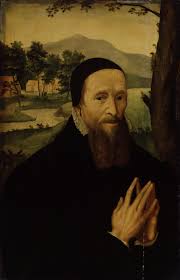 Anglicans are starting to hunger for the Eucharist in this time of the plague. I use that word deliberately because that is the last affliction mentioned (דֶּבֶר dever) before God tells his people to pray and repent of their “wicked ways” if they want healing to come to their land (2 Chron. 7.13-14).
Many Anglicans, accustomed to weekly feeding on the Body and Blood of Christ, are sorely missing the sacrament in these days when they only have the Word, and that through a screen.
But that begs the question: Is the Real Presence of the Body and Blood of Christ in the Anglican Eucharist?
Richard Hooker (1554-1600) is widely acknowledged as the definitive theologian of the Elizabethan Settlement, whose liturgy and theology governed Anglicanism for centuries to come. But Hooker’s “receptionism” has been interpreted by many to rule out a Real Presence of the humanity of Christ in the sacrament. It has been thought to mean that the faith of the recipient marks the moment when the signs of the bread and wine make present a wholly-spiritual remembrance of what Christ did on the cross. Remembrance only, without a genuine presence of Christ’s Body and Blood.
I would argue that this is a misunderstanding of Hooker on the sacrament—and therefore a misconstrual of the most weighty Anglican treatment of the Eucharist in the English Reformation.
Hooker’s Real Presence in his doctrine of the Eucharist is often missed because he has a more dynamic view of consecration than either Thomas Aquinas or Martin Luther, whom he criticizes several times in chapter LXVII of Book V of his Laws of Ecclesiastical Polity. Both Thomas and Luther think that once the priest prays a prayer of consecration, the bread and wine become the Body and Blood in a static way on the table, no matter the action of breaking and giving and taking in faith.
Hooker points out that in the words of Institution Jesus’ words “This is my body” and “This is my blood” come in a certain “order” (6). “First ‘take and eat;’ then ‘this is my Body which was broken for you;’ first ‘drink ye all of this;’ then followeth ‘this is my body of the New Testament which is shed for many for the remission of sins.’” (emph. add.)
Because this is in the section which most explicitly states Hooker’s receptionism, some observers reckon that there is no objective Real Presence. But as Brian Douglas and others have noted, receptionism does not preclude an objective Real Presence. Hooker is clear, as I will show, that for believers taking the elements, they receive “participation of his body and blood” (5).
This is little different from Augustine, who taught his own kind of receptionism. As Article XXIX notes, Augustine argued that the wicked (without repentance and faith) partake of the “sacrament” but not “of Christ” himself.
For both Augustine and Hooker, only those with faith receive the body and blood of Christ. In some passages Augustine puts more emphasis on the Real Presence in the bread and wine themselves in what I am calling a static presence, but in other passages Augustine teaches something more nearly like what I call the dynamic view in Hooker: it is in the faith-filled giving and taking of sacramental action that there is the Real Presence of Christ’s humanity—“his whole entire Person” including his Body and Blood (7)—rather than just his divinity.
Hooker rejects “the popish construction” of transubstantiation because it “abolisheth the substance of bread and substituteth in the place thereof my Body” (12). He dismisses Lutheran “consubstantiation” for two reasons. First, it regards the Body as a “natural substance” (12) in a carnal way without recognizing the “mystical” dimension (8, 12) in which Christ comes to us in the sacrament in his Body and Blood. Second, it adopts its own philosophical explanation of the sacrament by resorting to the “ubiquity” of Christ’s body and analogy to the hypostatic union to the joining of bread and body (10).
Hooker protests that such philosophical explanations and disputes rob believers of the joy of the sacrament: some “enjoyed not” because they “disputed” while others “disputed not because they enjoyed” (3). “Why do we vainly trouble ourselves with so fierce contentions whether by consubstantiation, or else by transubstantiation, the sacrament itself be first [my emphasis] possessed with Christ, or no?” It does not matter “whether [there is] alteration of the element such as they [emphasis added] imagine” (6). All that matters is “the co-operation of his omnipotent power which maketh it his body and blood to us” (6).
Hooker argues that the problem with the Roman and Lutheran views is that they are obsessed with the “order” of God’s working in static ways, apart from the dynamism of “participation.” Lutherans insist that “before participation” there is a “natural substance” of the body based on their philosophy of ubiquity, and Catholics maintain that “before participation” the “force” of God abolishes bread and wine and leaves only body and blood in their place. In neither view is there attention to the order of Presence in the words of institution, where Presence comes only by participation.
This is the key to another problem for those who cannot see Hooker’s doctrine of Real Presence: his use of instrumentality. Some would say that this suggests that the elements themselves have no association with the divine Body and Blood, but that the Real Presence is something in the receivers alone. But Hooker’s instrumentality is similar to that of Aquinas, for whom the sacrament of the Eucharist was an instrumental cause of the Real Presence of the Body and Blood. An instrumental cause, he explained, “works not by its own power but by the power of its principal agent” to “cause grace” (ST 3.62.1).
Similarly, Hooker says the apostles knew that when “their Lord and Master” lifted up the “elements of bread and wine” and blessed and consecrated them “for the endless good of all generations,” that the elements were “made for ever the instruments of life by virtue of his divine benediction” (emphasis added; sect. 4). All who debate eucharistic theology “grant that these holy mysteries received in due manner do instrumentally both make us partakers of the grace of that body and blood . . . and impart unto us even in true and real though mystical manner” the whole Christ, human and divine (8).
Just as Thomas said the sacraments are instrumental causes of grace by divine power, so Hooker says “this hallowed food, through concurrence of divine power, is in verity and truth, unto faithful receivers, instrumentally a cause of that mystical participation . . . [with the] sacrificed body” of Christ (12, emphasis added). It is God’s power that enables mystical participation with Christ’s body and blood: “[W]e are therefore to rest ourselves altogether upon the strength of his glorious power who is able and will bring to pass that the bread and cup which he giveth us shall be truly the thing he promiseth”—the body and blood of Christ.
So instrumentality, for Hooker as for Thomas, signals not a real absence but a Real Presence of Christ’s humanity by divine power. Sacramental action is an instrumental cause of grace coming from the Body and Blood. Instrumentality is Hooker’s Thomistic way of showing God’s way of working in the world by secondary causes, especially the sacraments. It is another way of saying that Christ comes to believers in his humanity by means of the sacramental action of the Eucharist: “[T]he real participation of Christ and of life in his body and blood [is] by means of this sacrament.”
Hooker likens eucharistic instrumentality to baptismal instrumentality. We receive the grace of baptism “by water,” but the grace is not “seated in the water nor the water changed into it” so that it is no longer water (6, emph. add.). Nevertheless there is real grace imparted. Just as baptism is not merely a symbol but conveys grace that changes the baptized, so too the Eucharist does not have grace “before” the sacramental action but works “in us” to change us through the sacramental action (6).
Now that I have cleared up, I hope, the most common objections to a Real Presence of Christ’s humanity in Hooker’s eucharistic theology, I will show Hooker’s many testimonies to that Presence. All of these testimonies are in chapter LXVII (67) of Book V (5).
[The apostles learned from Jesus] “that his flesh and blood are the true cause of eternal life . . . not by the bare force of their own substance [apart from believing reception], but through the dignity and worth of his Person which offered them up by way of sacrifice for the life of the whole world, and doth make them still effectual thereunto . . . [so that] to us they are life in particular, by being particularly received” (4; emph. add.). [Jesus promised to the apostles at the Last Supper] “that not only unto them at the present time but to whomsoever they and their successors after them did duly administer the same, those mysteries should serve as conducts [conduits] of life and conveyances of his body and blood unto them” (4, emph. add.).
“The bread and cup are his body and blood because they are causes instrumental upon the receipt whereof the participation of his body and blood ensueth” (5).
“[W]hat merit, force or virtue soever there is in his sacrificed body and blood, we freely, fully and wholly have it by this sacrament” (7).
“[W]e are therefore to rest ourselves altogether upon the strength of his glorious power who is able and will bring to pass that the bread and cup which he giveth us shall be truly the thing he promiseth” (7).
[Tertullian, Irenaeus, and Theodoret teach] “that Christ assisting this heavenly banquet [the Eucharist] with his personal and true presence doth by his own divine power add to the natural substance thereof supernatural efficacy, which addition to the nature of those consecrated elements changeth them and maketh them that unto us which otherwise they could not be; that to us they are thereby made such instruments as mystically yet truly, invisibly yet really work our communion or fellowship with the person of Jesus Christ as well in that he is man as God, our participation also in the fruit, grace and efficacy of his body and blood, whereuopon there ensueth a kind of transubstantiation in us, a true change both of soul and body, an alteration from death to life. . . [T]he Fathers [held to] this mystical communion [with the Body and Blood rather than] a corporal consubstantiation. . . or . . . transubstantiation” (11).
So Hooker shows a kind of Barthian stress on becoming rather than being in his view of the sacraments. We could call it a kind of sacramental occasionalism. The sacraments don’t produce static elements of water or bread that are a new thing apart from sacramental action for believing recipients. Instead, it is in the dynamic union of Word with elements through the Church’s sacramental liturgy for believing souls that Baptism saves and Eucharist feeds.
And the feeding for Hooker is with the Body and Blood of Christ.
In this time of the Coronavirus, Anglicans can be reassured that the reason they are hungry is that they have been deprived of the Body and Blood of Christ that are in the sacrament. This is on the authority of the greatest Anglican theologian of the English Reformation.
Previous Post

April 5, 2020
The astonishing disappearance of the newest theological classic
Next Post
April 26, 2020 Learning Messiah
Browse Our Archives
Select a Category Uncategorized
Select a Month March 2023 November 2022 October 2022 August 2022 July 2022 June 2022 May 2022 April 2022 November 2021 October 2021 August 2021 July 2021 June 2021 May 2021 April 2021 March 2021 February 2021 January 2021 December 2020 November 2020 October 2020 September 2020 July 2020 June 2020 April 2020 March 2020 February 2020 January 2020 August 2019 July 2019 May 2019 April 2019 February 2019 January 2019 December 2018 November 2018 October 2018 August 2018 July 2018 June 2018 May 2018 April 2018 March 2018 February 2018 January 2018 December 2017 November 2017 October 2017 September 2017 August 2017 July 2017 June 2017 May 2017 April 2017 March 2017 February 2017 January 2017 December 2016 November 2016 October 2016 September 2016 August 2016 July 2016 June 2016 May 2016 April 2016 March 2016 February 2016 January 2016 December 2015 November 2015 October 2015 September 2015 August 2015 July 2015 June 2015 May 2015 April 2015 March 2015 February 2015 January 2015 December 2014 November 2014 October 2014 September 2014 August 2014 July 2014 June 2014 May 2014 April 2014 March 2014 February 2014 January 2014 December 2013 November 2013 October 2013 September 2013 August 2013 July 2013 June 2013 May 2013 April 2013 March 2013 February 2013 January 2013 December 2012 November 2012 October 2012 September 2012 August 2012 July 2012 June 2012 May 2012 April 2012 March 2012 February 2012 January 2012 December 2011 November 2011 October 2011 September 2011 August 2011 July 2011 June 2011 May 2011 April 2011 March 2011 February 2011 January 2011 December 2010 November 2010 October 2010
Follow Us!
TAKE THE
Religious Wisdom Quiz
From a whirlwind, God questioned my understanding of creation's mysteries. What did God ask me to consider that I could not control?
Select your answer to see how you score.
The Behemoth and Leviathan Thunder and lightning The stars and moon The depths of the sea
Related posts from The Northampton Seminar


Interview on what difference Jesus' Jewishness makes and...

News from Israel--the election and Messianic Jews

The third rail in conservative churches
TRENDING AT PATHEOS Evangelical

The REST of Your Life: A Creative Wrestles...
This week I had a conversation with a good friend from church....

How the author of the world's best hymn...
I've been working with John Newton for a while now. This makes...

Long before this Lectio Divina, Psalm 130 - the song - started...

What About the Trees? Another Living Parable
After I finished writing the last article about falling leaves as a...

Why Classical Education Is a Conversation, Not a...
Come and Read: Joy in Classical Education When I was a little...

Cornell University has received a great deal of negative publicity and intense...
view all Evangelical blogs
Ad-Free & Subscriber Log-In Subscription Support
- About Us
- 2026 Calendar
- Videos
- Podcasts
- Library of World Religions
- Faith In Media Tracker
- Advertise With Us
- Write for Us
- Privacy Policy
- Terms of Service
- Do Not Sell My Data
- Contact Us
- Radiant Digital
- Manage Newsletter Subscriptions
- Unsubscribe From Notifications
- Sitemap
Copyright 2008-2026, Patheos. All rights reserved.
Subscription Support Ad-Free & Subscriber Log-In
Follow Patheos