
BuddhistCatholicContemplativeEvangelicalGeneral ChristianHinduJewishLatter-day SaintMuslimNew VisionsProgressive Christian
Beliefs
- Buddhist
- Catholic
- Contemplative
- Evangelical
- General Christian
- Hindu
- Jewish
- Latter-day Saint
- More Voices
- Muslim
- New Visions
- Pagan
- Progressive Christian
Topics
- Religion News
- Food and Religion
- Sports and Religion
- Religious Art
- Religious Music and Entertainment
- Religious Events
- History and Religion
- Style and Religion
- Politics and Religion
- Women in Religion
- Recreation Outdoors and Religion
- Business Finance and Religion
- Careers Workplace and Religion
- Education and Religion
- Family Parenting and Religion
- Health Fitness and Religion
- Home and Religion
- Relationships and Religion
- Technology and Religion
- Travel and Religion
Columnists
- Buddhist Columnists
- Business Finance and Religion Columnists
- Careers Workplace and Religion Columnists
- Catholic Columnists
- Contemplative Columnists
- Education and Religion Columnists
- Evangelists Columnists
- Family Parenting and Religion Columnists
- General Christian Columnists
- Health Fitness and Religion Columnists
- Hindu Columnists
- History and Religion Columnists
- Home and Religion Columnists
- Jewish Columnists
- More Voices Columnists
- Latter Day Columnists
- Muslim Columnists
- New Visions Columnists
- Nonreligious Columnists
- Pagan Columnists
- Politics and Religion Columnists
- Progressive Columnists
- Recreation Outdoors and Religion Columnists
- Relationships and Religion Columnists
- Religion News Columnists
- Religious Art Columnists
- Religious Events Columnists
- Religious Music and Entertainment Columnists
- Sports and Religion Columnists
- Style and Religion Columnists
- Technology and Religion Columnists
- Travel and Religion Columnists
- Women in Religion Columnists
Resource Library
- 2026 Calendar
- Library of World Religions
- The 100 Most Holy Places on Earth
- Patheos Answers
- Podcasts
- Videos
- Faith Leaders Database
- Anglican Episcopalian
- Bahai
- Baptist
- Buddhism
- Christianity
- Confucianism
- Eastern Orthodoxy
- Hinduism
- Holiness and Pentecostal
- ISKCON
- Islam
- Judaism
- Lutheran
- Methodist
- The Church of Jesus Christ of Latter-day Saints
- New Age
- Paganism
- Presbytarian and Reformed
- Protestantism
- Religion Behind the Scenes
- Roman Catholic
- Scientology
- Shia Islam
- Sikhism
- Sufism
- Sunni Islam
- Taoism
- Zen
- See all religions
Research Tools
 Ad-Free & Subscriber Log-In Subscription Support
Ad-Free & Subscriber Log-In Subscription Support
Follow Patheos 

- Trending:
- Forgiveness
- |
- Marriage
- |
- Consciousness
- |
- Death Penalty
- |
- Election
- |
- Halloween
 The Northampton Seminar
- Home
- Evangelical
- Religion News
- Jerusalem vs. Athens: A Talmudic Perspective
Jerusalem vs. Athens: A Talmudic Perspective
Last updated on: March 22, 2020 at 8:26 pm by Gerald McDermott
Jerusalem vs. Athens: A Talmudic Perspective 2020-03-22T20:26:07-04:00 Gerald McDermott
Patheos Explore the world's faith through different perspectives on religion and spirituality! Patheos has the views of the prevalent religions and spiritualities of the world.
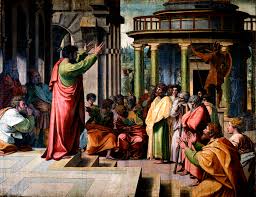 The Talmud is the gigantic Jewish reflection on the Hebrew Bible and especially its first five books. It contains much from which Christians can learn, even if Jews and Christians disagree on the identity of the messiah.
One string of reflection in the Talmud from which we can learn is its thinking about how Athens relates to Jerusalem. Reason vs. revelation. Human thinking vs. God’s unveiling of His own mind and works. Curt Biren is a student of Talmud who explains the rabbis on this: The best reason and God’s revelation will never conflict if the former is exercised in humility. Here is Biren’s take:
The spread of the coronavirus today has challenged our most fundamental notions of what we know and what we don’t know, even in our modern age of advanced medicine and technology. How could any virus be beyond the understanding of our accomplished scientists? It raises age-old questions about what we mortals can figure out ourselves and what is perhaps beyond human reasoning — invoking the enduring debate between Jerusalem and Athens. There is one ancient text that provides some answers.
The legacy of Jerusalem vs. Athens — revelation vs. reason — is legendary. It has led to untold conflict throughout the ages, even if, as some assert, western civilization is itself an uneasy blending of the two. Yet, there is one ancient Jewish collection of writings — the Talmud — that weaves the two traditions together into a coherent whole.
The Talmud, one of Judaism’s most sacred texts, consists of extensive interpretations and commentaries on the Hebrew Bible — covering everything from the spiritual to the practical, from issues of life and death to questions about morality and law. Its profound depth is matched by its voluminous scope. If one reads a page of it daily — which many do as part of the study program called Daf Yomi (Hebrew for a page a day) — it takes 7 1/2 years to finish it.
To be sure, portions of the Talmud are focused on halakha — religious laws and practices relevant primarily for the religiously observant. But much of the text addresses the great questions of life. It’s the source of so much that’s central and enduring in the Jewish tradition. And it constitutes a unique coalescence of reason and revelation.
For many today, reason is the guiding light of our secular world. Revelation is often viewed as antithetical to reason. For some, those immersed in religious life may seem to be guided by dogmas and superstitions, precluding any clear, rational thought. The Talmud reveals a very different picture.
The discussions and debates documented in the many pages of the Talmud actually exemplify the epitome of rational thinking. The ancient rabbis, in their quest for what’s true and right, ask question after question. Upon what is a particular idea based? What is the rationale for it? If it’s based upon an inference, is the inference valid? If it’s based upon an analogy, is the analogy an apt one? Is it logically consistent with other ideas?
When there are differing opinions, which happens often in the Talmud, what precisely is the disagreement? Can the differences be reconciled in some way? If not, how does one decide what’s right?
These and other deliberative questions are carefully addressed throughout the Talmud. The level of reasoning — of precise, rigorous, thoughtful, logical discourse — is extraordinary. It’s beyond what many of us are familiar with. It entails formal hermeneutical principles, which are so foundational they’re included in Jewish prayer books.
Many of the conclusions and judgments explained in the Talmud are d’rabbanan — from the rabbis. They’re the result of the ancient rabbis’ extensive thinking, interpretations and analyses. They push the limits of what we can know.
Yet, they have their own limits. Rulings that are d’rabbanan are typically not definitive. They lack the authority of the tradition’s foundational truths, its first principles. The ancient rabbis deferred to these first principles whenever possible.
What are these first principles? They are d’oraita — from the Torah. The Ten Commandments, for example, including ‘do not murder’ and ‘do not steal’, are first principles. They are deemed to be true in and of themselves. Such foundational truths may need to be carefully considered to fully understand their meaning and import, as well as their applications — no simple matter, as the Talmud makes abundantly clear — but their veracity requires no further reason or justification.
In this sense, while the Talmud is steeped in the most rational discourse conceivable, its first principles are grounded in the Torah’s moral truths — i.e., in God’s divine words revealed at Mt. Sinai. Within the pages of the Talmud, reason and revelation cohere together.
Today, a belief in God and His Biblical words is a leap of faith too great for many to make. While understandable within our secular culture, this does lead to an inevitable question. If one does not believe in revelation — in the Ten Commandments and other moral truths revealed in Scripture — then upon what first principles does one ground one’s ideas?
To this day, the tension continues between revelation and reason, between our Biblical tradition and our philosophical legacy, between Jerusalem and Athens. The Talmud demonstrates that there need be no conflict. To the contrary, for the Talmud, it’s inconceivable to imagine one without the other.
Curt Biren, who has written for First Things, Religion & Liberty and the Jewish Journal, recently completed Daf Yomi — the 7 1/2 year Talmudic study program.
Previous Post

March 21, 2020
Moses and the virus
Next Post
April 5, 2020 The astonishing disappearance of the newest theological classic
Browse Our Archives
Select a Category Uncategorized
Select a Month March 2023 November 2022 October 2022 August 2022 July 2022 June 2022 May 2022 April 2022 November 2021 October 2021 August 2021 July 2021 June 2021 May 2021 April 2021 March 2021 February 2021 January 2021 December 2020 November 2020 October 2020 September 2020 July 2020 June 2020 April 2020 March 2020 February 2020 January 2020 August 2019 July 2019 May 2019 April 2019 February 2019 January 2019 December 2018 November 2018 October 2018 August 2018 July 2018 June 2018 May 2018 April 2018 March 2018 February 2018 January 2018 December 2017 November 2017 October 2017 September 2017 August 2017 July 2017 June 2017 May 2017 April 2017 March 2017 February 2017 January 2017 December 2016 November 2016 October 2016 September 2016 August 2016 July 2016 June 2016 May 2016 April 2016 March 2016 February 2016 January 2016 December 2015 November 2015 October 2015 September 2015 August 2015 July 2015 June 2015 May 2015 April 2015 March 2015 February 2015 January 2015 December 2014 November 2014 October 2014 September 2014 August 2014 July 2014 June 2014 May 2014 April 2014 March 2014 February 2014 January 2014 December 2013 November 2013 October 2013 September 2013 August 2013 July 2013 June 2013 May 2013 April 2013 March 2013 February 2013 January 2013 December 2012 November 2012 October 2012 September 2012 August 2012 July 2012 June 2012 May 2012 April 2012 March 2012 February 2012 January 2012 December 2011 November 2011 October 2011 September 2011 August 2011 July 2011 June 2011 May 2011 April 2011 March 2011 February 2011 January 2011 December 2010 November 2010 October 2010
Follow Us!
TAKE THE
Religious Wisdom Quiz
How did Jeremiah's scribe escape death after Jehoiakim sought to arrest them?
Select your answer to see how you score.
They fled to Babylon They hid They paid a bribe A prophet intervened
Related posts from The Northampton Seminar


Interview on what difference Jesus' Jewishness makes and...

News from Israel--the election and Messianic Jews

The third rail in conservative churches
TRENDING AT PATHEOS Evangelical

The REST of Your Life: A Creative Wrestles...
This week I had a conversation with a good friend from church....

How the author of the world's best hymn...
I've been working with John Newton for a while now. This makes...

Long before this Lectio Divina, Psalm 130 - the song - started...

What About the Trees? Another Living Parable
After I finished writing the last article about falling leaves as a...

Why Classical Education Is a Conversation, Not a...
Come and Read: Joy in Classical Education When I was a little...

Cornell University has received a great deal of negative publicity and intense...
view all Evangelical blogs
Ad-Free & Subscriber Log-In Subscription Support
- About Us
- 2026 Calendar
- Videos
- Podcasts
- Library of World Religions
- Faith In Media Tracker
- Advertise With Us
- Write for Us
- Privacy Policy
- Terms of Service
- Do Not Sell My Data
- Contact Us
- Radiant Digital
- Manage Newsletter Subscriptions
- Unsubscribe From Notifications
- Sitemap
Copyright 2008-2026, Patheos. All rights reserved.
Subscription Support Ad-Free & Subscriber Log-In
Follow Patheos