
BuddhistCatholicContemplativeEvangelicalGeneral ChristianHinduJewishLatter-day SaintMuslimNew VisionsProgressive Christian
Beliefs
- Buddhist
- Catholic
- Contemplative
- Evangelical
- General Christian
- Hindu
- Jewish
- Latter-day Saint
- More Voices
- Muslim
- New Visions
- Pagan
- Progressive Christian
Topics
- Religion News
- Food and Religion
- Sports and Religion
- Religious Art
- Religious Music and Entertainment
- Religious Events
- History and Religion
- Style and Religion
- Politics and Religion
- Women in Religion
- Recreation Outdoors and Religion
- Business Finance and Religion
- Careers Workplace and Religion
- Education and Religion
- Family Parenting and Religion
- Health Fitness and Religion
- Home and Religion
- Relationships and Religion
- Technology and Religion
- Travel and Religion
Columnists
- Buddhist Columnists
- Business Finance and Religion Columnists
- Careers Workplace and Religion Columnists
- Catholic Columnists
- Contemplative Columnists
- Education and Religion Columnists
- Evangelists Columnists
- Family Parenting and Religion Columnists
- General Christian Columnists
- Health Fitness and Religion Columnists
- Hindu Columnists
- History and Religion Columnists
- Home and Religion Columnists
- Jewish Columnists
- More Voices Columnists
- Latter Day Columnists
- Muslim Columnists
- New Visions Columnists
- Nonreligious Columnists
- Pagan Columnists
- Politics and Religion Columnists
- Progressive Columnists
- Recreation Outdoors and Religion Columnists
- Relationships and Religion Columnists
- Religion News Columnists
- Religious Art Columnists
- Religious Events Columnists
- Religious Music and Entertainment Columnists
- Sports and Religion Columnists
- Style and Religion Columnists
- Technology and Religion Columnists
- Travel and Religion Columnists
- Women in Religion Columnists
Resource Library
- 2026 Calendar
- Library of World Religions
- The 100 Most Holy Places on Earth
- Patheos Answers
- Podcasts
- Videos
- Faith Leaders Database
- Anglican Episcopalian
- Bahai
- Baptist
- Buddhism
- Christianity
- Confucianism
- Eastern Orthodoxy
- Hinduism
- Holiness and Pentecostal
- ISKCON
- Islam
- Judaism
- Lutheran
- Methodist
- The Church of Jesus Christ of Latter-day Saints
- New Age
- Paganism
- Presbytarian and Reformed
- Protestantism
- Religion Behind the Scenes
- Roman Catholic
- Scientology
- Shia Islam
- Sikhism
- Sufism
- Sunni Islam
- Taoism
- Zen
- See all religions
Research Tools
 Ad-Free & Subscriber Log-In Subscription Support
Ad-Free & Subscriber Log-In Subscription Support
Follow Patheos 

- Trending:
- Forgiveness
- |
- Marriage
- |
- Consciousness
- |
- Death Penalty
- |
- Election
- |
- Halloween
 The Northampton Seminar
- Home
- Evangelical
- Religion News
- Why do Anglicans pray this way?
Why do Anglicans pray this way?
Last updated on: April 26, 2018 at 3:51 pm by Gerald McDermott
Why do Anglicans pray this way? 2018-04-26T15:51:36-04:00 Gerald McDermott
Patheos Explore the world's faith through different perspectives on religion and spirituality! Patheos has the views of the prevalent religions and spiritualities of the world.
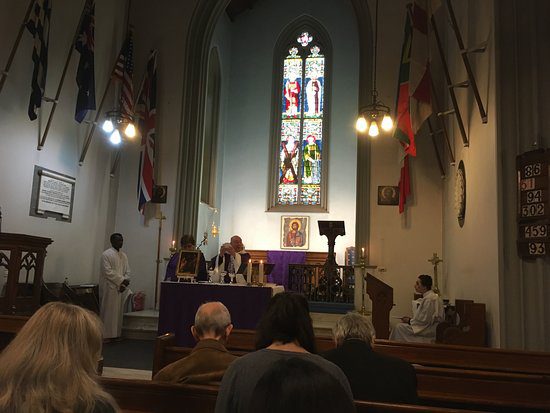
Anglicans are famous for their “liturgical” worship. Generally, this means following set prayers and ways of praying, such as reciting a prescribed confession and one of the ancient creeds. Not to mention following a prescribed way of celebrating the sacraments, especially Holy Communion every week or day.
Liturgy: The Work of the People
The word “liturgy” comes from a Greek word which means “the work of the people.” In this ancient custom of worship, worshipers become as a group of Christians what they cannot be as individuals—the people of God.
The people in the pews participate in worship through song and response and join with the priests and deacons in confession and prayer and worship. In what are called non-liturgical churches, all the action is up front, and the people watching are doing just that—being spectators, not participants.
This is why liturgy is called the “work of the people.”
The liturgy was the ancient prayer of the church. Worshipers thought of it as a journey or procession, picking up each Lord’s Day to resume their journey out of the world and into the Kingdom of God—into the fourth dimension, if you will. It is not an escape from the world, but a way to see the reality of the world from a heavenly vantage point.
Liturgy’s Jewish Heritage
The early church did not make up this liturgy from scratch. They derived most of it from theJewish liturgy and brought out its messianic meanings.
So, for example, there was an entrance rite in the Temple liturgies, based on Ps 122.1, “I was glad when they said to me, ‘Let us go up to the house of the Lord.’” The Levite singers would go in a procession before the priests, who would bring up the ark of the covenant (before the temple was built), which contained the two tablets of God’s words and the manna that God fed them with in the wilderness.
The two basic parts of the Christian liturgy—the liturgy of the Word and the liturgy of the Table—are based ultimately on these two features of Jewish history and worship.
God-given prayer
But let’s go a bit deeper into this mystery of liturgy. We could say that it is an answer to the disciples’ request of Jesus, “Lord teach us to pray.” It is behind Paul’s statement in Romans 8, “We do not know how to pray as we ought.”
It helps explain why God struck down Nadab and Abihu when they offered unholy fire (Lev 10). They thought they could figure out on their own how to worship–rather than recognizing that God had already given precise instruction on how Israel was to worship.
Participation in the Son’s adoration
There is a Christological dimension to liturgy. It is worship that joins in Christ’s worship of His Father. The church fathers taught that liturgy is our participation with Christ in his offering himself and his Body to the Father in adoration. It is joining with the saints and angels in their celestial worship.
This worship fulfills the purpose of the creation. In other words, the purpose of the world and worship are the same—that God might be “all in all” (1 Cor 15.28). The key to understanding what that means is to see that the heart of worship is sacrifice, which is the surrender of what is precious to us. When we surrender that, God sets it apart and fills it with his blessing. Then what God sets apart becomes holy. For “sacrifice” means (Latin sacer + facere) “to make holy,” and holy in Hebrew means “set apart.”
This is best seen in the liturgy of the Eucharist. We worship the Triune God, who in the Father gave up the Son to be sacrificed by the Spirit, to make us holy and to bring all the cosmos into the holy realm under the lordship of Christ and the Father. In the sacred meal of weekly (or daily) liturgical worship, we join in the sacrificial offering which the Son makes to the Father, and we pray that others be joined to that sacrifice, so that we and they might be filled with God’s life, and God will be all in all.
As we see God in that offering of the Son, we see God for who he is in his beauty and glory, and we are drawn into him and his Son by the Spirit.
Liturgy & Time
Liturgy is not just for Sunday morning but for the whole week. Each day Anglicans use liturgies for Morning and Evening Prayer. They join with other Anglicans all across the world reading the same passages of Scripture and joining in the same prayers. Then the solitary Anglican in her prayer closet joins thousands (sometimes millions) of others listening to the same Word and praying with the same words.
The church year has come down from the ancient and medieval church. It takes Anglicans through the great seasons of Christian life every year—seasons that re-present to us the whole history of Israel and Jesus Christ.
The most important days and seasons of the church year are:
- Advent,
- Christmastide(12 days),
- Epiphany,
- Transfiguration Sunday,
- Ash Wednesday,
- Lent,
- Passion week,
- Eastertide (seven weeks)
- Pentecost,
- Reformation Sunday,
- Christ the King Sunday.
The result of following the church year is that every Sunday is different, in its readings and prayers, which means not only that Anglican worship is varied each week but also that they are helped to rediscover a new aspect of the Tri-personal God and his history with his people every week and in each new season.
Liturgy & Candles
One of many distinctive aspects of liturgical worship is candles. Candles are lit on the altar before the service as a symbol of Christ as the light of the world (John 8.12), and a sign that Christ is now present in a special way—speaking through the reading of the Word and preaching on it, and feeding us through the sacrament.
During the Easter season and at baptisms and funerals, the tall Paschal Candle is lit as a symbol of the resurrection of Christ.
Liturgy & Music
Luther said music was the greatest gift of God after theology. The historic church has always made music central to worship, recognizing that music is used by God to lift prayer and praise to a higher level.
The Psalms, which have always been the prayer book of Israel and the church, were set to music by David and other Israelite worship leaders, and have been used for musical worship throughout the 2000-year history of the church.
The Anglican tradition has always been known for its splendid musical worship, using classic hymns from the early and medieval Church, as well as Reformation and later Anglican hymns.
All is all, then, the liturgy is a gift from Israel and the historic church that teaches us how to worship the Tri-personal God. It leads us to experience him more deeply as we follow its lead through the church year.
Previous Post

April 21, 2018
Crazy King Henry: Did Anglicanism begin with lust and divorce?
Next Post
May 4, 2018 Ethics and marriage in an age without boundaries
Browse Our Archives
Select a Category Uncategorized
Select a Month March 2023 November 2022 October 2022 August 2022 July 2022 June 2022 May 2022 April 2022 November 2021 October 2021 August 2021 July 2021 June 2021 May 2021 April 2021 March 2021 February 2021 January 2021 December 2020 November 2020 October 2020 September 2020 July 2020 June 2020 April 2020 March 2020 February 2020 January 2020 August 2019 July 2019 May 2019 April 2019 February 2019 January 2019 December 2018 November 2018 October 2018 August 2018 July 2018 June 2018 May 2018 April 2018 March 2018 February 2018 January 2018 December 2017 November 2017 October 2017 September 2017 August 2017 July 2017 June 2017 May 2017 April 2017 March 2017 February 2017 January 2017 December 2016 November 2016 October 2016 September 2016 August 2016 July 2016 June 2016 May 2016 April 2016 March 2016 February 2016 January 2016 December 2015 November 2015 October 2015 September 2015 August 2015 July 2015 June 2015 May 2015 April 2015 March 2015 February 2015 January 2015 December 2014 November 2014 October 2014 September 2014 August 2014 July 2014 June 2014 May 2014 April 2014 March 2014 February 2014 January 2014 December 2013 November 2013 October 2013 September 2013 August 2013 July 2013 June 2013 May 2013 April 2013 March 2013 February 2013 January 2013 December 2012 November 2012 October 2012 September 2012 August 2012 July 2012 June 2012 May 2012 April 2012 March 2012 February 2012 January 2012 December 2011 November 2011 October 2011 September 2011 August 2011 July 2011 June 2011 May 2011 April 2011 March 2011 February 2011 January 2011 December 2010 November 2010 October 2010
Follow Us!
TAKE THE
Religious Wisdom Quiz
Love is patient, love is kind. Love does not _____ or boast...
Select your answer to see how you score.
Envy Brag Scream
Related posts from The Northampton Seminar


Interview on what difference Jesus' Jewishness makes and...

News from Israel--the election and Messianic Jews

The third rail in conservative churches
TRENDING AT PATHEOS Evangelical

The REST of Your Life: A Creative Wrestles...
This week I had a conversation with a good friend from church....

How the author of the world's best hymn...
I've been working with John Newton for a while now. This makes...

Long before this Lectio Divina, Psalm 130 - the song - started...

What About the Trees? Another Living Parable
After I finished writing the last article about falling leaves as a...

Why Classical Education Is a Conversation, Not a...
Come and Read: Joy in Classical Education When I was a little...

Cornell University has received a great deal of negative publicity and intense...
view all Evangelical blogs
Ad-Free & Subscriber Log-In Subscription Support
- About Us
- 2026 Calendar
- Videos
- Podcasts
- Library of World Religions
- Faith In Media Tracker
- Advertise With Us
- Write for Us
- Privacy Policy
- Terms of Service
- Do Not Sell My Data
- Contact Us
- Radiant Digital
- Manage Newsletter Subscriptions
- Unsubscribe From Notifications
- Sitemap
Copyright 2008-2026, Patheos. All rights reserved.
Subscription Support Ad-Free & Subscriber Log-In
Follow Patheos