
BuddhistCatholicContemplativeEvangelicalGeneral ChristianHinduJewishLatter-day SaintMuslimNew VisionsProgressive Christian
Beliefs
- Buddhist
- Catholic
- Contemplative
- Evangelical
- General Christian
- Hindu
- Jewish
- Latter-day Saint
- More Voices
- Muslim
- New Visions
- Pagan
- Progressive Christian
Topics
- Religion News
- Food and Religion
- Sports and Religion
- Religious Art
- Religious Music and Entertainment
- Religious Events
- History and Religion
- Style and Religion
- Politics and Religion
- Women in Religion
- Recreation Outdoors and Religion
- Business Finance and Religion
- Careers Workplace and Religion
- Education and Religion
- Family Parenting and Religion
- Health Fitness and Religion
- Home and Religion
- Relationships and Religion
- Technology and Religion
- Travel and Religion
Columnists
- Buddhist Columnists
- Business Finance and Religion Columnists
- Careers Workplace and Religion Columnists
- Catholic Columnists
- Contemplative Columnists
- Education and Religion Columnists
- Evangelists Columnists
- Family Parenting and Religion Columnists
- General Christian Columnists
- Health Fitness and Religion Columnists
- Hindu Columnists
- History and Religion Columnists
- Home and Religion Columnists
- Jewish Columnists
- More Voices Columnists
- Latter Day Columnists
- Muslim Columnists
- New Visions Columnists
- Nonreligious Columnists
- Pagan Columnists
- Politics and Religion Columnists
- Progressive Columnists
- Recreation Outdoors and Religion Columnists
- Relationships and Religion Columnists
- Religion News Columnists
- Religious Art Columnists
- Religious Events Columnists
- Religious Music and Entertainment Columnists
- Sports and Religion Columnists
- Style and Religion Columnists
- Technology and Religion Columnists
- Travel and Religion Columnists
- Women in Religion Columnists
Resource Library
- 2026 Calendar
- Library of World Religions
- The 100 Most Holy Places on Earth
- Patheos Answers
- Podcasts
- Videos
- Faith Leaders Database
- Anglican Episcopalian
- Bahai
- Baptist
- Buddhism
- Christianity
- Confucianism
- Eastern Orthodoxy
- Hinduism
- Holiness and Pentecostal
- ISKCON
- Islam
- Judaism
- Lutheran
- Methodist
- The Church of Jesus Christ of Latter-day Saints
- New Age
- Paganism
- Presbytarian and Reformed
- Protestantism
- Religion Behind the Scenes
- Roman Catholic
- Scientology
- Shia Islam
- Sikhism
- Sufism
- Sunni Islam
- Taoism
- Zen
- See all religions
Research Tools
 Ad-Free & Subscriber Log-In Subscription Support
Ad-Free & Subscriber Log-In Subscription Support
Follow Patheos 

- Trending:
- Forgiveness
- |
- Marriage
- |
- Consciousness
- |
- Death Penalty
- |
- Election
- |
- Halloween
 The Northampton Seminar
- Home
- Evangelical
- Religion News
- Protestants and Natural Law
Protestants and Natural Law
Last updated on: May 24, 2017 at 8:27 am by Gerald McDermott
Protestants and Natural Law 2017-05-24T08:27:28-04:00 Gerald McDermott
Patheos Explore the world's faith through different perspectives on religion and spirituality! Patheos has the views of the prevalent religions and spiritualities of the world.
 For most of the twentieth century Protestants rejected natural law, the idea that reason can discern basic moral principles coming from God. Protestants typically objected that Scripture emphasizes the inability of non-Christians to know God and therefore his law.
Today many Protestants are starting to see that natural law is more biblical than they had imagined. Thomas Johnson, J. Daryl Charles, Carl Braaten, Robert Benne, and Stephen Grabill are restoring to Protestant consciousness a way of thinking about God’s witness to the world that had been submerged during the twentieth century.[1] They are reminding Protestants of Paul’s declaration that “God has not left himself without a witness” among the pagans (Acts 14:17), and the apostle’s long statement about what those without God’s written law know of God’s law nonetheless.
When Gentiles who have not the law do by nature things required by the law, they are a law for themselves, even though they do not have the law, since they show that the requirements of the law are written on their hearts, their consciences also bearing witness, and their thoughts now accusing, now even defending them. (Rom 2:14-15)
That is the bright side. Those without the Bible know something of God and his law nevertheless. The dark side is that according to the Bible people tend to suppress that knowledge of God and his law. They pretend they don’t know what they really do know. This causes their minds to darken and believe that what is wrong is right. They do the wrong and approve of others who do the same (Rom 1:18-22). As the prophet Jeremiah wrote, the human heart is deceitful above all things. We don’t understand ourselves (Jer. 17:9). So while people know these truths deep down, they often deny it. But as J. Budziszewski puts it, although their hearts are made of stone, God’s carvings on those stones remain.[2]
Yet the apostles assumed pagans had this knowledge of God’s law. When they reasoned with Jews and god-fearing Gentiles who had been attending the synagogue, they argued from the Scriptures. But when they reasoned with pagans, they began with the testimony of creation, with the Gentiles’ sense of the insufficiency of their gods or their sense of law written on their hearts.[3]
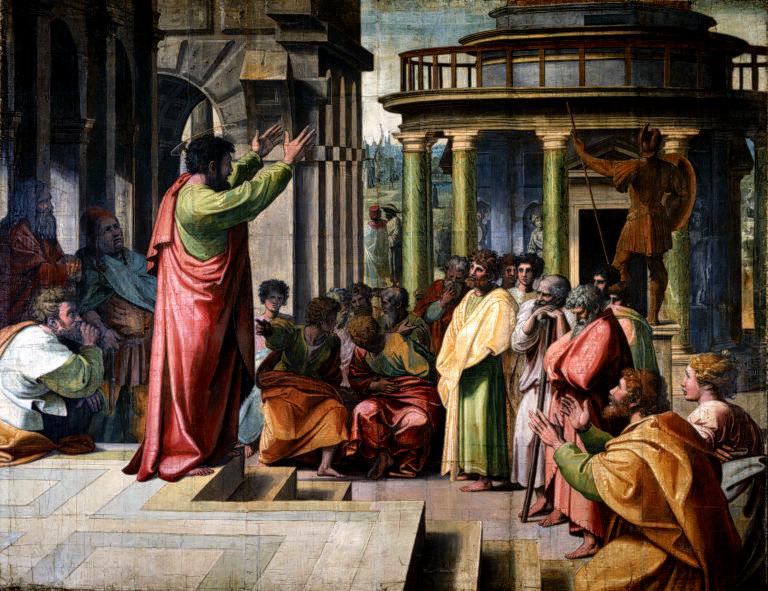
For example, when Paul addressed Greek thinkers on Mars Hill in Athens (Ac 17.16-34), these were men and women who knew nothing about the Bible. Interestingly, Paul said not a word about justification or grace or salvation. Instead he spoke of judgment and the Judge whose role was proved by his resurrection from the dead. Paul was appealing implicitly to knowledge of their guilt against the moral law which he assumed was written on their hearts.
Notice that this is the same Paul who wrote to the Romans and the Ephesians about the noetic consequences of sin. He knew that sin had darkened the minds of these Greek philosophers. But he also appealed to their consciences, sensing that they could still hear something of divine law registering there and the consequent charge of blame. As far as we know from Luke’s telling of this encounter, Paul left his hearers with their guilt and his declaration that he knew who would judge them. Only implicit was the suggestion that there might be a way to avoid punishment by appealing to this judge. But like his teacher Jesus who told parables without explaining them, he left his hearers with an unsolved problem. Like Jesus, he probably assumed that those with ears to hear would come after him with more questions. And some apparently did, for Luke tells us there were at least four converts made by this evangelistic talk. Contrary to the conclusion of some scholars that this apologetic encounter failed, it was remarkably successful. It vindicated Paul’s assumption—and his inspired words in his letter to the Roman church—that pagans had God’s law written on their hearts.
[1] Thomas K. Johnson, Natural Law Ethics: An Evangelical Proposal (Bonn: Verlag für Kultur und Wissenschaft, 2005); J. Daryl Charles, Retrieving the Natural Law: A Return to Moral First Things (Grand Raoids: Eerdmans, 2008); Carl E. Braaten, “Natural Law in Theology and Ethics,” in The Two Cities of God: The Church’s Responsibiluty for the Earthly City, eds. Carl Braaten and Robert Jenson (Grad Rapids: Eerdmans, 1997); Robert Benne, Ordinary Saints—An Introduction to the Christian Life (Minneapolis: Fortress Press, 2003), 68-74; Grabill, Rediscovering the Natural Law.
[2] Budziszewski, Written on the Heart: The Case for Natural Law (Downers Grove: IVP Academic, 1997), 184.
[3] Ibid., 183.
Previous Post

May 16, 2017
What dogs teach us about God - Part 4 (and final)
Next Post
May 24, 2017 A history of Israel - Part 1
Browse Our Archives
Select a Category Uncategorized
Select a Month March 2023 November 2022 October 2022 August 2022 July 2022 June 2022 May 2022 April 2022 November 2021 October 2021 August 2021 July 2021 June 2021 May 2021 April 2021 March 2021 February 2021 January 2021 December 2020 November 2020 October 2020 September 2020 July 2020 June 2020 April 2020 March 2020 February 2020 January 2020 August 2019 July 2019 May 2019 April 2019 February 2019 January 2019 December 2018 November 2018 October 2018 August 2018 July 2018 June 2018 May 2018 April 2018 March 2018 February 2018 January 2018 December 2017 November 2017 October 2017 September 2017 August 2017 July 2017 June 2017 May 2017 April 2017 March 2017 February 2017 January 2017 December 2016 November 2016 October 2016 September 2016 August 2016 July 2016 June 2016 May 2016 April 2016 March 2016 February 2016 January 2016 December 2015 November 2015 October 2015 September 2015 August 2015 July 2015 June 2015 May 2015 April 2015 March 2015 February 2015 January 2015 December 2014 November 2014 October 2014 September 2014 August 2014 July 2014 June 2014 May 2014 April 2014 March 2014 February 2014 January 2014 December 2013 November 2013 October 2013 September 2013 August 2013 July 2013 June 2013 May 2013 April 2013 March 2013 February 2013 January 2013 December 2012 November 2012 October 2012 September 2012 August 2012 July 2012 June 2012 May 2012 April 2012 March 2012 February 2012 January 2012 December 2011 November 2011 October 2011 September 2011 August 2011 July 2011 June 2011 May 2011 April 2011 March 2011 February 2011 January 2011 December 2010 November 2010 October 2010
Follow Us!
TAKE THE
Religious Wisdom Quiz
What was the name of Saul's son who ruled Israel except Judah after Saul died?
Select your answer to see how you score.
Abner Jonathan Ish-bosheth Mephibosheth
Related posts from The Northampton Seminar


Interview on what difference Jesus' Jewishness makes and...

News from Israel--the election and Messianic Jews

The third rail in conservative churches
TRENDING AT PATHEOS Evangelical

The REST of Your Life: A Creative Wrestles...
This week I had a conversation with a good friend from church....

How the author of the world's best hymn...
I've been working with John Newton for a while now. This makes...

Long before this Lectio Divina, Psalm 130 - the song - started...

What About the Trees? Another Living Parable
After I finished writing the last article about falling leaves as a...

Why Classical Education Is a Conversation, Not a...
Come and Read: Joy in Classical Education When I was a little...

Cornell University has received a great deal of negative publicity and intense...
view all Evangelical blogs
Ad-Free & Subscriber Log-In Subscription Support
- About Us
- 2026 Calendar
- Videos
- Podcasts
- Library of World Religions
- Faith In Media Tracker
- Advertise With Us
- Write for Us
- Privacy Policy
- Terms of Service
- Do Not Sell My Data
- Contact Us
- Radiant Digital
- Manage Newsletter Subscriptions
- Unsubscribe From Notifications
- Sitemap
Copyright 2008-2026, Patheos. All rights reserved.
Subscription Support Ad-Free & Subscriber Log-In
Follow Patheos