
BuddhistCatholicContemplativeEvangelicalGeneral ChristianHinduJewishLatter-day SaintMuslimNew VisionsProgressive Christian
Beliefs
- Buddhist
- Catholic
- Contemplative
- Evangelical
- General Christian
- Hindu
- Jewish
- Latter-day Saint
- More Voices
- Muslim
- New Visions
- Pagan
- Progressive Christian
Topics
- Religion News
- Food and Religion
- Sports and Religion
- Religious Art
- Religious Music and Entertainment
- Religious Events
- History and Religion
- Style and Religion
- Politics and Religion
- Women in Religion
- Recreation Outdoors and Religion
- Business Finance and Religion
- Careers Workplace and Religion
- Education and Religion
- Family Parenting and Religion
- Health Fitness and Religion
- Home and Religion
- Relationships and Religion
- Technology and Religion
- Travel and Religion
Columnists
- Buddhist Columnists
- Business Finance and Religion Columnists
- Careers Workplace and Religion Columnists
- Catholic Columnists
- Contemplative Columnists
- Education and Religion Columnists
- Evangelists Columnists
- Family Parenting and Religion Columnists
- General Christian Columnists
- Health Fitness and Religion Columnists
- Hindu Columnists
- History and Religion Columnists
- Home and Religion Columnists
- Jewish Columnists
- More Voices Columnists
- Latter Day Columnists
- Muslim Columnists
- New Visions Columnists
- Nonreligious Columnists
- Pagan Columnists
- Politics and Religion Columnists
- Progressive Columnists
- Recreation Outdoors and Religion Columnists
- Relationships and Religion Columnists
- Religion News Columnists
- Religious Art Columnists
- Religious Events Columnists
- Religious Music and Entertainment Columnists
- Sports and Religion Columnists
- Style and Religion Columnists
- Technology and Religion Columnists
- Travel and Religion Columnists
- Women in Religion Columnists
Resource Library
- 2026 Calendar
- Library of World Religions
- The 100 Most Holy Places on Earth
- Patheos Answers
- Podcasts
- Videos
- Faith Leaders Database
- Anglican Episcopalian
- Bahai
- Baptist
- Buddhism
- Christianity
- Confucianism
- Eastern Orthodoxy
- Hinduism
- Holiness and Pentecostal
- ISKCON
- Islam
- Judaism
- Lutheran
- Methodist
- The Church of Jesus Christ of Latter-day Saints
- New Age
- Paganism
- Presbytarian and Reformed
- Protestantism
- Religion Behind the Scenes
- Roman Catholic
- Scientology
- Shia Islam
- Sikhism
- Sufism
- Sunni Islam
- Taoism
- Zen
- See all religions
Research Tools
 Ad-Free & Subscriber Log-In Subscription Support
Ad-Free & Subscriber Log-In Subscription Support
Follow Patheos 

- Trending:
- Forgiveness
- |
- Marriage
- |
- Consciousness
- |
- Death Penalty
- |
- Election
- |
- Halloween
 The Northampton Seminar
- Home
- Evangelical
- Religion News
- Liturgy and eucharist – Part XV
Liturgy and eucharist – Part XV
Last updated on: April 25, 2017 at 11:46 am by Gerald McDermott
Liturgy and eucharist – Part XV 2017-04-25T11:46:12-04:00 Gerald McDermott
Patheos Explore the world's faith through different perspectives on religion and spirituality! Patheos has the views of the prevalent religions and spiritualities of the world.
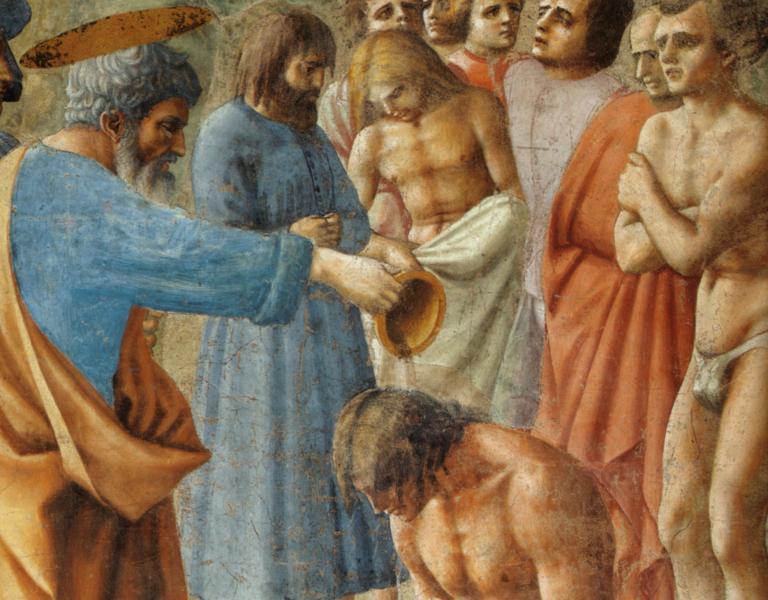
Paul F. Bradshaw, The Search for the Origins of Christian Worship
Ministry, ordination, and the coming of Christendom
193 In the 20th c. German scholars thought the apostolic church had a purely charismatic ministry which eventually gave way to the threefold ordained ministry (bishops, priests, deacons). English scholars, on the other hand, believed Christians derived this pattern from the synagogue. More recently has prevailed the view that there was no original uniformity, as both of these suggest, but instead “independent trajectories”—varied patterns of leadership (194).
196 He concludes that the references to women in leadership are “not unambiguous.”
196 Altho for several generations it was assumed that presbyteros and episcopos were interchangeable, that is now changing. [confirmed by the important recent work by Alistair Stewart, Original Bishops]. For example, in the Shepherd of Hermas (mid 2nd c.) the bishops seem to emerge out of a larger group of elders (199). This fits, Bradshaw says, the Jewish pattern of Levite, priest, high-priest. [actually, the Jewish model was Levite, priest, chief priest, High Priest. There were many of the first three categories at any time, and only one of the last.]
200 The letters of Ignatius (early 2nd c.) provide the earliest clear evidence for the threefold order of deacon, priest, bishop. By the end of the 2nd c., that threefold ministry gained pre-eminence everywhere.
201-05 the application of priestly language to Christian ministers came slowly. At first it was applied to all Christians, then to the bishop, and then to presbyters as they came to be seen as sharing the bishop’s priesthood. This was especially so as the Church fought heresy and schism. Eventually it came to be seen that ordination and not baptism was when clergy entered the priestly life. [This is similar to biblical Judaism, in which all of Israel is a priestly nation, but there are certain ones called to be Levites, others to be priests, still others “chief priests,” and yet others to be a High Priest, one at a time.]
The OT sacrificial worship came to be seen as fulfilled in a more literal way by the minister-led eucharist (Christ’s sacrifice being re-presented) than by the body of Christ as a whole. [this was a departure from the first-century belief that all of the Body participates in Christ’s sacrifice of himself to the Father, mystically joined (not repeated) at the Eucharist.]
206 Bradshaw argues that before the 4th century there is little evidence of an ordination rite, and that before this time it is more presbyters not bishops doing the ordaining. The Council of Nicaea had to legislate the participation of other bishops, so apparently that was not the previous practice everywhere.
210 Yet after all his insistence on diversity, Bradshaw concludes that “at their core” the ordination rites of the ancient churches reveal “a fairly consistent pattern throughout East and West, including the main themes of the prayers” (210).
212 Bradshaw is insistent that earlier scholars were wrong to say that the early church thought Jesus was returning any minute and so did not establish a church year or times of daily prayer. Here Bradshaw cites Dix, agreeing with him.
The so-called Constantinian revolution did not inaugurate new liturgical practices but enabled some to gain pre-eminence over others.
213 Bradshaw also asserts that at the height of the Constantinian changes the Church was beginning to experience decline, and so these liturgical changes were established with the hope of stemming the tide.
215 The 25th of December was chosen in Rome for the date of Christmas for theological reasons: early Christians believed Jesus lived on earth for an exact number of years, and so the date of his death (March 25) must have been the same as his conception. Thus his birth must have been exactly nine months later, Dec. 25. This date was accepted in northern Italy in order to counteract pagan solstice celebrations on that date.
218-19 Bradshaw suggests that liturgy was enhanced in the 4th c. when the unconverted flooded the churches, in the hopes of educating and impressing them.
219-21 Chrysostom’s sermons show this. He warned the unconverted not to commune unless they were spiritually ready. This led to widespread non-communion by most, and continued as a phenomenon for many centuries. This also produced a new clericalism in which the clergy up front were thought to be doing what was important, and parishioners were there to watch. Bradshaw argues that treatment of Eucharistic elements as powerful talismans comes from pagan influence. [Or were the pagans picking up on a theological type which pointed to the use of matter to communicate divine power, as in Paul’s handkerchiefs and aprons bringing healing (Ac 19.12) and Paul’s warning that taking the bread and wine unworthily could produce sickness and death (1 Cor 11.30)?]
222-29 The movement toward liturgical standardization came from pilgrims travelling to the East, especially Jerusalem, and bringing Eastern practices back to the West. This was the origin of seeing Easter as the time for baptism, baptism itself as participation in the death and resurrection of Christ, and a post-baptismal anointing. The epiclesis and Sanctus and narrative of institution were used separately at different places and finally amalgamated into one Eucharistic rite.
Before the 4th c. few liturgies were written down, but passed down orally. Fear of heresy caused the 4th c. to start transmitting them in written form.
The 4th c. debates about the deity of the Holy Spirit helped make the epiclesis more widespread, as well as the post-baptismal anointing.
Cyril of Jerusalem’s statement in the Mystagogical Catecheses that we can help most the souls of the departed while “the most awesome sacrifice is being offered” helped solidify the belief that the Eucharist was a sacrifice.
229-30 Bradshaw’s conclusion is that much of the final shape of the liturgy solidified in the 4th century for counter-cultural reasons, to resist pagan influences on the Church, but also used pagan language and symbols to more effectively communicate to a people raised in a pagan culture.
The result of this homogenization was the “loss of some sense of local self-identity.”
NEXT: a final assessment of Dix after reading Bradshaw.
Previous Post
April 24, 2017
Evangelicals and Catholics Together
Next Post
May 4, 2017 Liturgy and Eucharist - Part XVI
Browse Our Archives
Select a Category Uncategorized
Select a Month March 2023 November 2022 October 2022 August 2022 July 2022 June 2022 May 2022 April 2022 November 2021 October 2021 August 2021 July 2021 June 2021 May 2021 April 2021 March 2021 February 2021 January 2021 December 2020 November 2020 October 2020 September 2020 July 2020 June 2020 April 2020 March 2020 February 2020 January 2020 August 2019 July 2019 May 2019 April 2019 February 2019 January 2019 December 2018 November 2018 October 2018 August 2018 July 2018 June 2018 May 2018 April 2018 March 2018 February 2018 January 2018 December 2017 November 2017 October 2017 September 2017 August 2017 July 2017 June 2017 May 2017 April 2017 March 2017 February 2017 January 2017 December 2016 November 2016 October 2016 September 2016 August 2016 July 2016 June 2016 May 2016 April 2016 March 2016 February 2016 January 2016 December 2015 November 2015 October 2015 September 2015 August 2015 July 2015 June 2015 May 2015 April 2015 March 2015 February 2015 January 2015 December 2014 November 2014 October 2014 September 2014 August 2014 July 2014 June 2014 May 2014 April 2014 March 2014 February 2014 January 2014 December 2013 November 2013 October 2013 September 2013 August 2013 July 2013 June 2013 May 2013 April 2013 March 2013 February 2013 January 2013 December 2012 November 2012 October 2012 September 2012 August 2012 July 2012 June 2012 May 2012 April 2012 March 2012 February 2012 January 2012 December 2011 November 2011 October 2011 September 2011 August 2011 July 2011 June 2011 May 2011 April 2011 March 2011 February 2011 January 2011 December 2010 November 2010 October 2010
Follow Us!
TAKE THE
Religious Wisdom Quiz
Who cried out, "My God, my God, why have you forsaken me?" while dying?
Select your answer to see how you score.
Paul Jesus Stephen David
Related posts from The Northampton Seminar


Interview on what difference Jesus' Jewishness makes and...

News from Israel--the election and Messianic Jews

The third rail in conservative churches
TRENDING AT PATHEOS Evangelical

The REST of Your Life: A Creative Wrestles...
This week I had a conversation with a good friend from church....

How the author of the world's best hymn...
I've been working with John Newton for a while now. This makes...

Long before this Lectio Divina, Psalm 130 - the song - started...

What About the Trees? Another Living Parable
After I finished writing the last article about falling leaves as a...

Why Classical Education Is a Conversation, Not a...
Come and Read: Joy in Classical Education When I was a little...

Cornell University has received a great deal of negative publicity and intense...
view all Evangelical blogs
Ad-Free & Subscriber Log-In Subscription Support
- About Us
- 2026 Calendar
- Videos
- Podcasts
- Library of World Religions
- Faith In Media Tracker
- Advertise With Us
- Write for Us
- Privacy Policy
- Terms of Service
- Do Not Sell My Data
- Contact Us
- Radiant Digital
- Manage Newsletter Subscriptions
- Unsubscribe From Notifications
- Sitemap
Copyright 2008-2026, Patheos. All rights reserved.
Subscription Support Ad-Free & Subscriber Log-In
Follow Patheos