
BuddhistCatholicContemplativeEvangelicalGeneral ChristianHinduJewishLatter-day SaintMuslimNew VisionsProgressive Christian
Beliefs
- Buddhist
- Catholic
- Contemplative
- Evangelical
- General Christian
- Hindu
- Jewish
- Latter-day Saint
- More Voices
- Muslim
- New Visions
- Pagan
- Progressive Christian
Topics
- Religion News
- Food and Religion
- Sports and Religion
- Religious Art
- Religious Music and Entertainment
- Religious Events
- History and Religion
- Style and Religion
- Politics and Religion
- Women in Religion
- Recreation Outdoors and Religion
- Business Finance and Religion
- Careers Workplace and Religion
- Education and Religion
- Family Parenting and Religion
- Health Fitness and Religion
- Home and Religion
- Relationships and Religion
- Technology and Religion
- Travel and Religion
Columnists
- Buddhist Columnists
- Business Finance and Religion Columnists
- Careers Workplace and Religion Columnists
- Catholic Columnists
- Contemplative Columnists
- Education and Religion Columnists
- Evangelists Columnists
- Family Parenting and Religion Columnists
- General Christian Columnists
- Health Fitness and Religion Columnists
- Hindu Columnists
- History and Religion Columnists
- Home and Religion Columnists
- Jewish Columnists
- More Voices Columnists
- Latter Day Columnists
- Muslim Columnists
- New Visions Columnists
- Nonreligious Columnists
- Pagan Columnists
- Politics and Religion Columnists
- Progressive Columnists
- Recreation Outdoors and Religion Columnists
- Relationships and Religion Columnists
- Religion News Columnists
- Religious Art Columnists
- Religious Events Columnists
- Religious Music and Entertainment Columnists
- Sports and Religion Columnists
- Style and Religion Columnists
- Technology and Religion Columnists
- Travel and Religion Columnists
- Women in Religion Columnists
Resource Library
- 2026 Calendar
- Library of World Religions
- The 100 Most Holy Places on Earth
- Patheos Answers
- Podcasts
- Videos
- Faith Leaders Database
- Anglican Episcopalian
- Bahai
- Baptist
- Buddhism
- Christianity
- Confucianism
- Eastern Orthodoxy
- Hinduism
- Holiness and Pentecostal
- ISKCON
- Islam
- Judaism
- Lutheran
- Methodist
- The Church of Jesus Christ of Latter-day Saints
- New Age
- Paganism
- Presbytarian and Reformed
- Protestantism
- Religion Behind the Scenes
- Roman Catholic
- Scientology
- Shia Islam
- Sikhism
- Sufism
- Sunni Islam
- Taoism
- Zen
- See all religions
Research Tools
 Ad-Free & Subscriber Log-In Subscription Support
Ad-Free & Subscriber Log-In Subscription Support
Follow Patheos 

- Trending:
- Forgiveness
- |
- Marriage
- |
- Consciousness
- |
- Death Penalty
- |
- Election
- |
- Halloween
 The Northampton Seminar
- Home
- Evangelical
- Religion News
- Liturgy and eucharist – Part XIV
Liturgy and eucharist – Part XIV
Last updated on: April 24, 2017 at 9:03 am by Gerald McDermott
Liturgy and eucharist – Part XIV 2017-04-24T09:03:05-04:00 Gerald McDermott
Patheos Explore the world's faith through different perspectives on religion and spirituality! Patheos has the views of the prevalent religions and spiritualities of the world.
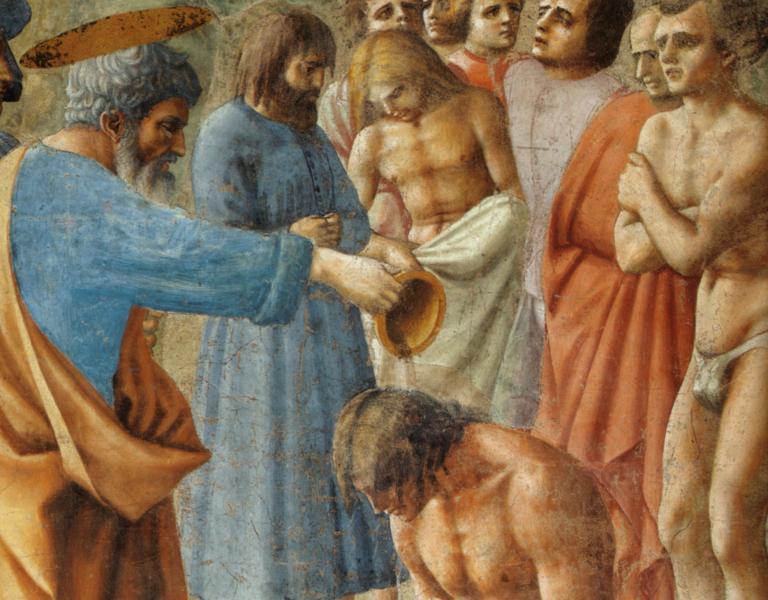 Paul Bradshaw*, Search for the Origins of Early Christian Worship*
Baptism and the Liturgical Year
145 Jungmann, he says, represents the harmonizing approach, built on the assumption that there was a single standardized rite.
147-48 Dix and Manson theorized a pre-baptismal confirmation rite during apostolic days.
149-50 Scholars in the 1970s argued forcefully that the original Syrian practice was an anointing of the head only and not the whole body, involved an anointing before the effusion, and was an imitation of Christ’s baptism.
151 Bradshaw concludes that there was diversity in baptismal practice in early Syria, which includes Antioch, a major center of the early Church in the first century.
152 He also says it is possible that baptism and anointing with oil were two alternative means of Christian initiation before they were later combined in the same rite.
154 In Syria, he says, there was no sign of a long catechumenate, but of a two-stage process: first profession of faith and renunciation of the devil at a public worship, and then later on another date a baptism.
156 In North Africa there were both water baptism and anointing with oil. In addition, there was giving of milk and honey at the first communion.
159 Only with Tertullian (early 3rd c.) is there mention of baptisms at Easter.
160 In Justin’s account of baptism at Rome there is no mention of ministers and there is only water baptism, no mention of oil. [these are implicit arguments from silence—that since they are not mentioned, nothing of that sort was present]
161-63 Bradshaw finds three layers in the Apostolic Tradition, claiming that none of it reflects actual practice in Rome, “even if the core rite does.” The text is “an artificial blending” and probably was never “used as it stands.” [Hard evidence for any of these speculations? Not at all clear]
164 Bradshaw here questions whether Justin’s descriptions are of real practices in Rome. [Yet there is little doubt that Justin was in Rome when he wrote his Apologies.]
Here he concedes that Justin knew of a Trinitarian formula for baptism. [yet elsewhere claims that the mention of baptism in the name of Jesus is quite significant.]
165-66 In northern Italy in the later 4th c. there was an “opening” by the bishop of the ears and nostrils of baptismal candidates on the day before baptism, a pre-baptismal anointing of the body against the devil and his works, and a washing of the feet of the baptized.
169-70 Bradshaw again is a splitter, this time on baptism. He says there was no essential core to the rite but instead much variety. And yet . . . after all the detailing of diversity, he concedes there were “fundamental ritual elements”: preparatory instruction, renunciation and act of faith, anointing, immersion, perhaps imposition of hands. Yet even after listing all these, he protests that if we emphasize these common elements we “distort” our understanding of early Christian baptism. [judge for yourself if this is coherent.]
172-74 On daily prayer, Bradshaw cites Baumstark who argued in the last century (20th!) that in the 4th c. there were two forms, cathedral and monastic. The cathedral office was twice a day and quite ecclesial: here was the Church gathered for prayer, exercising its royal priesthood by a sacrifice of praise and thanksgiving on behalf of all creation and interceding for the salvation of the world. The monastic office, on the other hand, was centered in silent meditation on the Word and its aim was growth into the likeness of Christ. It was not inherently corporate, but when it was, it was five times a day—early in the morning, at the 3rd, 6th, and 9th hours, and again at some point in the night.
175 Surprisingly, after all of Bradshaw’s splitting on Eucharist and baptism, here he is a lumper. He draws a line from early Jewish patterns of daily prayer through the early church and then to post-Constantinian practices. He finds a certain unity!
191 On the church year, Bradshaw sees much diversity in the first three centuries and no amalgamation until the 4th century. So too, he says, the idea of a lectionary did not coalesce until then.
Previous Post
April 21, 2017
Liturgy and eucharist - Part XIII
Next Post
April 24, 2017 Evangelicals and Catholics Together
Browse Our Archives
Select a Category Uncategorized
Select a Month March 2023 November 2022 October 2022 August 2022 July 2022 June 2022 May 2022 April 2022 November 2021 October 2021 August 2021 July 2021 June 2021 May 2021 April 2021 March 2021 February 2021 January 2021 December 2020 November 2020 October 2020 September 2020 July 2020 June 2020 April 2020 March 2020 February 2020 January 2020 August 2019 July 2019 May 2019 April 2019 February 2019 January 2019 December 2018 November 2018 October 2018 August 2018 July 2018 June 2018 May 2018 April 2018 March 2018 February 2018 January 2018 December 2017 November 2017 October 2017 September 2017 August 2017 July 2017 June 2017 May 2017 April 2017 March 2017 February 2017 January 2017 December 2016 November 2016 October 2016 September 2016 August 2016 July 2016 June 2016 May 2016 April 2016 March 2016 February 2016 January 2016 December 2015 November 2015 October 2015 September 2015 August 2015 July 2015 June 2015 May 2015 April 2015 March 2015 February 2015 January 2015 December 2014 November 2014 October 2014 September 2014 August 2014 July 2014 June 2014 May 2014 April 2014 March 2014 February 2014 January 2014 December 2013 November 2013 October 2013 September 2013 August 2013 July 2013 June 2013 May 2013 April 2013 March 2013 February 2013 January 2013 December 2012 November 2012 October 2012 September 2012 August 2012 July 2012 June 2012 May 2012 April 2012 March 2012 February 2012 January 2012 December 2011 November 2011 October 2011 September 2011 August 2011 July 2011 June 2011 May 2011 April 2011 March 2011 February 2011 January 2011 December 2010 November 2010 October 2010
Follow Us!
TAKE THE
Religious Wisdom Quiz
Who was David’s best friend?
Select your answer to see how you score.
Samuel Saul Jonathan Joseph
Related posts from The Northampton Seminar


Interview on what difference Jesus' Jewishness makes and...

News from Israel--the election and Messianic Jews

The third rail in conservative churches
TRENDING AT PATHEOS Evangelical

The REST of Your Life: A Creative Wrestles...
This week I had a conversation with a good friend from church....

How the author of the world's best hymn...
I've been working with John Newton for a while now. This makes...

Long before this Lectio Divina, Psalm 130 - the song - started...

What About the Trees? Another Living Parable
After I finished writing the last article about falling leaves as a...

Why Classical Education Is a Conversation, Not a...
Come and Read: Joy in Classical Education When I was a little...

Cornell University has received a great deal of negative publicity and intense...
view all Evangelical blogs
Ad-Free & Subscriber Log-In Subscription Support
- About Us
- 2026 Calendar
- Videos
- Podcasts
- Library of World Religions
- Faith In Media Tracker
- Advertise With Us
- Write for Us
- Privacy Policy
- Terms of Service
- Do Not Sell My Data
- Contact Us
- Radiant Digital
- Manage Newsletter Subscriptions
- Unsubscribe From Notifications
- Sitemap
Copyright 2008-2026, Patheos. All rights reserved.
Subscription Support Ad-Free & Subscriber Log-In
Follow Patheos