
BuddhistCatholicContemplativeEvangelicalGeneral ChristianHinduJewishLatter-day SaintMuslimNew VisionsProgressive Christian
Beliefs
- Buddhist
- Catholic
- Contemplative
- Evangelical
- General Christian
- Hindu
- Jewish
- Latter-day Saint
- More Voices
- Muslim
- New Visions
- Pagan
- Progressive Christian
Topics
- Religion News
- Food and Religion
- Sports and Religion
- Religious Art
- Religious Music and Entertainment
- Religious Events
- History and Religion
- Style and Religion
- Politics and Religion
- Women in Religion
- Recreation Outdoors and Religion
- Business Finance and Religion
- Careers Workplace and Religion
- Education and Religion
- Family Parenting and Religion
- Health Fitness and Religion
- Home and Religion
- Relationships and Religion
- Technology and Religion
- Travel and Religion
Columnists
- Buddhist Columnists
- Business Finance and Religion Columnists
- Careers Workplace and Religion Columnists
- Catholic Columnists
- Contemplative Columnists
- Education and Religion Columnists
- Evangelists Columnists
- Family Parenting and Religion Columnists
- General Christian Columnists
- Health Fitness and Religion Columnists
- Hindu Columnists
- History and Religion Columnists
- Home and Religion Columnists
- Jewish Columnists
- More Voices Columnists
- Latter Day Columnists
- Muslim Columnists
- New Visions Columnists
- Nonreligious Columnists
- Pagan Columnists
- Politics and Religion Columnists
- Progressive Columnists
- Recreation Outdoors and Religion Columnists
- Relationships and Religion Columnists
- Religion News Columnists
- Religious Art Columnists
- Religious Events Columnists
- Religious Music and Entertainment Columnists
- Sports and Religion Columnists
- Style and Religion Columnists
- Technology and Religion Columnists
- Travel and Religion Columnists
- Women in Religion Columnists
Resource Library
- 2026 Calendar
- Library of World Religions
- The 100 Most Holy Places on Earth
- Patheos Answers
- Podcasts
- Videos
- Faith Leaders Database
- Anglican Episcopalian
- Bahai
- Baptist
- Buddhism
- Christianity
- Confucianism
- Eastern Orthodoxy
- Hinduism
- Holiness and Pentecostal
- ISKCON
- Islam
- Judaism
- Lutheran
- Methodist
- The Church of Jesus Christ of Latter-day Saints
- New Age
- Paganism
- Presbytarian and Reformed
- Protestantism
- Religion Behind the Scenes
- Roman Catholic
- Scientology
- Shia Islam
- Sikhism
- Sufism
- Sunni Islam
- Taoism
- Zen
- See all religions
Research Tools
 Ad-Free & Subscriber Log-In Subscription Support
Ad-Free & Subscriber Log-In Subscription Support
Follow Patheos 

- Trending:
- Forgiveness
- |
- Marriage
- |
- Consciousness
- |
- Death Penalty
- |
- Election
- |
- Halloween
 The Northampton Seminar
- Home
- Evangelical
- Religion News
- Liturgy and Eucharist – Part XI
Liturgy and Eucharist – Part XI
Last updated on: April 19, 2017 at 8:29 am by Gerald McDermott
Liturgy and Eucharist – Part XI 2017-04-19T08:29:18-04:00 Gerald McDermott
Patheos Explore the world's faith through different perspectives on religion and spirituality! Patheos has the views of the prevalent religions and spiritualities of the world.
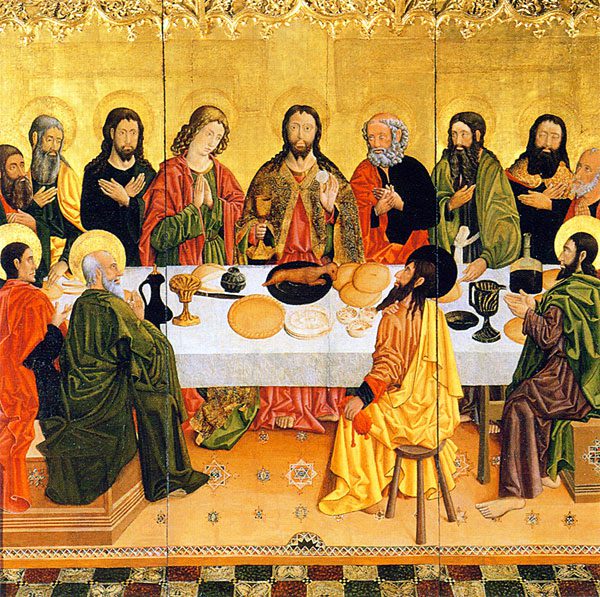
Paul F. Bradshaw, The Search for the Origins of Christian Worship
Worship in the NT
51-2 Bradshaw claims that there is no unambiguous witness in the NT to a particular liturgical practice. He points to Massey Shepherd’s claim that the Book of Revelation is a full-blown baptismal liturgy, and recent scholars who point out that no standardized paschal initiation liturgy existed anywhere before the 4th c.
52-53 He also claims there is no single, uniform liturgical archetype in the NT, and no single archetype in the post-NT church. Evidence? “Contemporary currents in NT scholarship” that stress the “pluriform nature of primitive Xty.” [my question: Is Bradshaw reading his own preconceptions into the NT?]
53 One of the problems, he argues, is that nearly all explicit references to worship occur in the Acts of the Apostles.
53-54 He asks if Acts gives us what really happened, or the church’s practices of the later first century read into the first generation, or “the author’s own imagination” of what ought to happen? [this is historical skepticism, common in NT scholarship, used now in liturgical studies]
56 The other NT books allude to liturgy without describing it explicitly.
57 “It is generally taken for granted that the early Xns did not use incense in their worship, despite reference to it in Rev. 5.8 and 8.3f.” [Why should we accept this skeptical claim?]
59 Early Xns increasingly used eucharisteo (thanksgiving, associated with Greek Gentile “Hellenists”) instead of eulogeo (the Jewish blessing), thus showing increasing distance from synagogue influence.
60 Matthew 28 contains Jesus’ command to baptize all nations, but Bradshaw finds it difficult to accept this as authentic because “Christian baptisms seem at first to have been ‘in the name of Jesus’ rather than of the Trinity.’” [this historical skepticism, refusing to allow for the possibility of both practices at the same time in non-competitive ways, is outdated and arbitrary]
60n The classic debate over whether the early church baptized infants was primarily between Jeremias and Aland. Good bibliography here.
61 Bradshaw concludes that the process of becoming a Xn was interpreted in a variety of ways, with some traditions emphasizing forgiveness of sins and the gift of the Spirit, others the metaphor of birth to new life, others baptism as enlightenment, and in Paul’s theology union with X thru participation in his death and resurrection. “This variation in baptismal theology encourages the supposition that the ritual itself may also have varied from place to place.” Some places might have used foot-washing instead of whole-body washing, others perhaps used anointing with oil rather than water.
62 Bradshaw argues that there is no firm evidence for an institution narrative in the eucharist ceremony until the 4th c., and then it has the marks of an innovation rather than well-established custom. Prior to that, it was catechical rather than liturgical. [here he agrees with Dix, whose four-fold shape leaves out the institution narrative as a part of every early Eucharist]
63-64 Scholars have debated whether the Eucharist was a Passover meal, since it is said to be one in the synoptics but not in John. Dix argued that it was a haburah meal (of friendship but invested with religious solemnity), but Jeremias said there is no evidence for such an institution, and that haburah meals were for circumcisions or weddings or funerals. [In Jesus and the Last Supper (2015) Brant Pitre argues that the date in the synoptics and John is the same: the account of Jesus’ final meal begins on the afternoon of 14 Nisan, continues through the night of 15 Nisan, on which there is a Passover meal, and concludes with the crucifixion on 15 Nisan. The key, he says, is to recognize that the term pascha is used variously to refer to the Passover lamb, the larger Passover meal, the Passover peace offering (later in the weeklong festival), and the Passover week as a whole.]
65 Bradshaw claims that even if the Eucharist was a Passover meal, “no exclusively paschal practices appear to have been retained in the primitive Church’s Eucharistic celebrations.” [This is belied by the synoptics and Paul placing the words of institution about Jesus identifying with the bread and wine at the center of the Last Supper, and bread and wine being central to Passover. But far more important are Luke’s words, “Then came the day of Unleavened Bread, on which the pascha had to be sacrificed. So Jesus sent Peter and John, saying, “Go and prepare the pascha for us, that we may eat it.” They said to him, “Where will you have us prepare it?” (Luke 22:7-8) As Pitre argues, the word for pascha undoubtedly refers to the Passover lamb.]
67 Bradshaw argues for a general consensus among scholars that in the earliest Church the eschatological theme (a joyful meal looking forward to the wedding supper of the Lamb) predominated over the memorial theme (remembering the death of Christ), but that the two were joined in the later first century.
68-70 Bradshaw sides with McGowan, who argues that there was great variation in the form of the Eucharist, some ascetic communities replacing wine with water. [this seems a red herring in light of the exclusive use of wine in the NT]
72 Bradshaw insists we must remain “agnostic about many of the roots of Xn worship practices which we observe clearly for the first time in the following centuries.” [My take: while it is certainly true that liturgy developed over the first few centuries and received definitive form in the 4th c., this skepticism toward the NT documents is more reflective of scholarly trends in Bradshaw’s era (the first edition of this book appeared in 1992) than of what many liturgical and NT scholars are willing to say today.]
Previous Post
April 18, 2017
Liturgy and Eucharist - Part X
Next Post
April 20, 2017 Liturgy and Eucharist - Part XII
Browse Our Archives
Select a Category Uncategorized
Select a Month March 2023 November 2022 October 2022 August 2022 July 2022 June 2022 May 2022 April 2022 November 2021 October 2021 August 2021 July 2021 June 2021 May 2021 April 2021 March 2021 February 2021 January 2021 December 2020 November 2020 October 2020 September 2020 July 2020 June 2020 April 2020 March 2020 February 2020 January 2020 August 2019 July 2019 May 2019 April 2019 February 2019 January 2019 December 2018 November 2018 October 2018 August 2018 July 2018 June 2018 May 2018 April 2018 March 2018 February 2018 January 2018 December 2017 November 2017 October 2017 September 2017 August 2017 July 2017 June 2017 May 2017 April 2017 March 2017 February 2017 January 2017 December 2016 November 2016 October 2016 September 2016 August 2016 July 2016 June 2016 May 2016 April 2016 March 2016 February 2016 January 2016 December 2015 November 2015 October 2015 September 2015 August 2015 July 2015 June 2015 May 2015 April 2015 March 2015 February 2015 January 2015 December 2014 November 2014 October 2014 September 2014 August 2014 July 2014 June 2014 May 2014 April 2014 March 2014 February 2014 January 2014 December 2013 November 2013 October 2013 September 2013 August 2013 July 2013 June 2013 May 2013 April 2013 March 2013 February 2013 January 2013 December 2012 November 2012 October 2012 September 2012 August 2012 July 2012 June 2012 May 2012 April 2012 March 2012 February 2012 January 2012 December 2011 November 2011 October 2011 September 2011 August 2011 July 2011 June 2011 May 2011 April 2011 March 2011 February 2011 January 2011 December 2010 November 2010 October 2010
Follow Us!
TAKE THE
Religious Wisdom Quiz
Who was David’s best friend?
Select your answer to see how you score.
Samuel Saul Jonathan Joseph
Related posts from The Northampton Seminar


Interview on what difference Jesus' Jewishness makes and...

News from Israel--the election and Messianic Jews

The third rail in conservative churches
TRENDING AT PATHEOS Evangelical

The REST of Your Life: A Creative Wrestles...
This week I had a conversation with a good friend from church....

How the author of the world's best hymn...
I've been working with John Newton for a while now. This makes...

Long before this Lectio Divina, Psalm 130 - the song - started...

What About the Trees? Another Living Parable
After I finished writing the last article about falling leaves as a...

Why Classical Education Is a Conversation, Not a...
Come and Read: Joy in Classical Education When I was a little...

Cornell University has received a great deal of negative publicity and intense...
view all Evangelical blogs
Ad-Free & Subscriber Log-In Subscription Support
- About Us
- 2026 Calendar
- Videos
- Podcasts
- Library of World Religions
- Faith In Media Tracker
- Advertise With Us
- Write for Us
- Privacy Policy
- Terms of Service
- Do Not Sell My Data
- Contact Us
- Radiant Digital
- Manage Newsletter Subscriptions
- Unsubscribe From Notifications
- Sitemap
Copyright 2008-2026, Patheos. All rights reserved.
Subscription Support Ad-Free & Subscriber Log-In
Follow Patheos