
BuddhistCatholicContemplativeEvangelicalGeneral ChristianHinduJewishLatter-day SaintMuslimNew VisionsProgressive Christian
Beliefs
- Buddhist
- Catholic
- Contemplative
- Evangelical
- General Christian
- Hindu
- Jewish
- Latter-day Saint
- More Voices
- Muslim
- New Visions
- Pagan
- Progressive Christian
Topics
- Religion News
- Food and Religion
- Sports and Religion
- Religious Art
- Religious Music and Entertainment
- Religious Events
- History and Religion
- Style and Religion
- Politics and Religion
- Women in Religion
- Recreation Outdoors and Religion
- Business Finance and Religion
- Careers Workplace and Religion
- Education and Religion
- Family Parenting and Religion
- Health Fitness and Religion
- Home and Religion
- Relationships and Religion
- Technology and Religion
- Travel and Religion
Columnists
- Buddhist Columnists
- Business Finance and Religion Columnists
- Careers Workplace and Religion Columnists
- Catholic Columnists
- Contemplative Columnists
- Education and Religion Columnists
- Evangelists Columnists
- Family Parenting and Religion Columnists
- General Christian Columnists
- Health Fitness and Religion Columnists
- Hindu Columnists
- History and Religion Columnists
- Home and Religion Columnists
- Jewish Columnists
- More Voices Columnists
- Latter Day Columnists
- Muslim Columnists
- New Visions Columnists
- Nonreligious Columnists
- Pagan Columnists
- Politics and Religion Columnists
- Progressive Columnists
- Recreation Outdoors and Religion Columnists
- Relationships and Religion Columnists
- Religion News Columnists
- Religious Art Columnists
- Religious Events Columnists
- Religious Music and Entertainment Columnists
- Sports and Religion Columnists
- Style and Religion Columnists
- Technology and Religion Columnists
- Travel and Religion Columnists
- Women in Religion Columnists
Resource Library
- 2026 Calendar
- Library of World Religions
- The 100 Most Holy Places on Earth
- Patheos Answers
- Podcasts
- Videos
- Faith Leaders Database
- Anglican Episcopalian
- Bahai
- Baptist
- Buddhism
- Christianity
- Confucianism
- Eastern Orthodoxy
- Hinduism
- Holiness and Pentecostal
- ISKCON
- Islam
- Judaism
- Lutheran
- Methodist
- The Church of Jesus Christ of Latter-day Saints
- New Age
- Paganism
- Presbytarian and Reformed
- Protestantism
- Religion Behind the Scenes
- Roman Catholic
- Scientology
- Shia Islam
- Sikhism
- Sufism
- Sunni Islam
- Taoism
- Zen
- See all religions
Research Tools
 Ad-Free & Subscriber Log-In Subscription Support
Ad-Free & Subscriber Log-In Subscription Support
Follow Patheos 

- Trending:
- Forgiveness
- |
- Marriage
- |
- Consciousness
- |
- Death Penalty
- |
- Election
- |
- Halloween
 The Northampton Seminar
- Home
- Evangelical
- Religion News
- Liturgy and Eucharist – Part X
Liturgy and Eucharist – Part X
Last updated on: April 18, 2017 at 8:35 am by Gerald McDermott
Liturgy and Eucharist – Part X 2017-04-18T08:35:38-04:00 Gerald McDermott
Patheos Explore the world's faith through different perspectives on religion and spirituality! Patheos has the views of the prevalent religions and spiritualities of the world.
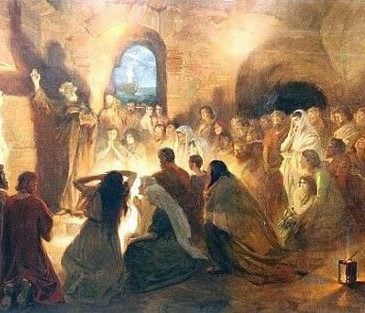
Paul F. Bradshaw, The Search for the Origins of Christian Worship
Jewish background
9-10 Bradshaw faults the “organic” approach for its thinking that liturgy develops like biological nature through an evolutionary process. According to this model the earlier is always simpler and the later is more complex. But, Bradshaw argues, liturgy develops not like nature but like culture. There is no inner essence, and there are not overall laws that govern the evolution. This “Comparative Study of Liturgies” is therefore suspect in its methodological assumptions.
[problems with Bradshaw’s criticisms: while he is right to distinguish between biological and cultural development, he himself seems to agree with what he said was a broad scholarly agreement that development usually proceeds from brevity to prolixity (2-3). He also acknowledges that Baumstark, a leader in this Comparative school, saw both developmental tendencies—from early variety to uniformity and vice-versa, and from simplicity to prolixity and vice-versa (11).]
15 He proposes a hermeneutics of suspicion for liturgical texts: it is dangerous to read them as verbatim accounts of a liturgical act. Directions usually deal not with the accepted and customary but with new or uncertain or controverted points.
17 Authoritative-sounding statements are not always authoritative. For example, Demetrius, patriarch of Alexandria in the 3rd c., said the unordained never preach, yet the practice was defended by the bishops of Caesarea and Jerusalem.
18-19 Liturgical legislation is not always followed, especially if it tried to dislodge a much-loved local custom. If they forbid something, that is good evidence that what was being forbidden was being practiced. E.g., John Chrysostom’s describing those who left the service after communion as resembling Judas Iscariot at the Last Supper.
19 When a variety of explanations is given for a practice, we should not assume that any one is genuine. It may mean that no one knows how that practice started, and each explanation was made up because it supported a local custom.
20 Despite all this historical skepticism, Bradshaw asserts that we can know in a provisional way about how worship began and developed in the first few centuries.
24 Bradshaw says we are much less certain about what was happening in first-century Jewish worship. We used to draw lines from the synagogue and Temple to the early Christian assemblies, but now we are not so sure what those lines were because of the variety of things going on in the synagogues. The basic problem is that our sources date from the 9th and 8th cs AD (Mishna, Tosefta and Talmud), and so we are reading things back into earlier centuries.
25-31 There seems to have been greater variety in Jewish liturgy than had been thought, with no central rabbinic authority, and agreement only on basic elements with freedom on how to express those elements. So, for example, we cannot assume that all the descriptions of worship in Talmud described precisely what was going on rather than the authors’ views of what ought to be done.
33 This opens up the possibility that rules for ritual purity of the first century were not as strict as later rules under Talmud. [So Jesus’ disagreements with some Pharasaic schools might not have meant disagreement with all Pharisees, and might have been in accord with some rabbinic traditions.]
36 A growing number of scholars now doubt that any regular Sabbath liturgy was in place before the third century!
37 Heinemann shows that any uniform cycle of Torah readings (a lectionary) belongs to the realm of fiction.
38 The adoption of daily psalms was not until the 8th c.
40 Yet the twice-daily recitation of the Shema was widely practiced before the destruction of the Temple [70 AD]. Scholars are unsure, however, if the thrice-daily recitation of the Tefillah (Amidah) existed in the 1st c., or was developed later.
44-45 There are variations among Jews from place to place, but there does seem to have been a fairly common practice at meals of saying blessings or thanksgivings for the gift of food and the gift of the Land, and supplications for mercy on the people, the city of Jerusalem, and the Temple.
Previous Post
April 17, 2017
Liturgy and Eucharist - Part IX
Next Post
April 19, 2017 Liturgy and Eucharist - Part XI
Browse Our Archives
Select a Category Uncategorized
Select a Month March 2023 November 2022 October 2022 August 2022 July 2022 June 2022 May 2022 April 2022 November 2021 October 2021 August 2021 July 2021 June 2021 May 2021 April 2021 March 2021 February 2021 January 2021 December 2020 November 2020 October 2020 September 2020 July 2020 June 2020 April 2020 March 2020 February 2020 January 2020 August 2019 July 2019 May 2019 April 2019 February 2019 January 2019 December 2018 November 2018 October 2018 August 2018 July 2018 June 2018 May 2018 April 2018 March 2018 February 2018 January 2018 December 2017 November 2017 October 2017 September 2017 August 2017 July 2017 June 2017 May 2017 April 2017 March 2017 February 2017 January 2017 December 2016 November 2016 October 2016 September 2016 August 2016 July 2016 June 2016 May 2016 April 2016 March 2016 February 2016 January 2016 December 2015 November 2015 October 2015 September 2015 August 2015 July 2015 June 2015 May 2015 April 2015 March 2015 February 2015 January 2015 December 2014 November 2014 October 2014 September 2014 August 2014 July 2014 June 2014 May 2014 April 2014 March 2014 February 2014 January 2014 December 2013 November 2013 October 2013 September 2013 August 2013 July 2013 June 2013 May 2013 April 2013 March 2013 February 2013 January 2013 December 2012 November 2012 October 2012 September 2012 August 2012 July 2012 June 2012 May 2012 April 2012 March 2012 February 2012 January 2012 December 2011 November 2011 October 2011 September 2011 August 2011 July 2011 June 2011 May 2011 April 2011 March 2011 February 2011 January 2011 December 2010 November 2010 October 2010
Follow Us!
TAKE THE
Religious Wisdom Quiz
Which book in the New Testament is the shortest?
Select your answer to see how you score.
Jude 3 John Philemon 2 John
Related posts from The Northampton Seminar


Interview on what difference Jesus' Jewishness makes and...

News from Israel--the election and Messianic Jews

The third rail in conservative churches
TRENDING AT PATHEOS Evangelical

The REST of Your Life: A Creative Wrestles...
This week I had a conversation with a good friend from church....

How the author of the world's best hymn...
I've been working with John Newton for a while now. This makes...

Long before this Lectio Divina, Psalm 130 - the song - started...

What About the Trees? Another Living Parable
After I finished writing the last article about falling leaves as a...

Why Classical Education Is a Conversation, Not a...
Come and Read: Joy in Classical Education When I was a little...

Cornell University has received a great deal of negative publicity and intense...
view all Evangelical blogs
Ad-Free & Subscriber Log-In Subscription Support
- About Us
- 2026 Calendar
- Videos
- Podcasts
- Library of World Religions
- Faith In Media Tracker
- Advertise With Us
- Write for Us
- Privacy Policy
- Terms of Service
- Do Not Sell My Data
- Contact Us
- Radiant Digital
- Manage Newsletter Subscriptions
- Unsubscribe From Notifications
- Sitemap
Copyright 2008-2026, Patheos. All rights reserved.
Subscription Support Ad-Free & Subscriber Log-In
Follow Patheos