
BuddhistCatholicContemplativeEvangelicalGeneral ChristianHinduJewishLatter-day SaintMuslimNew VisionsProgressive Christian
Beliefs
- Buddhist
- Catholic
- Contemplative
- Evangelical
- General Christian
- Hindu
- Jewish
- Latter-day Saint
- More Voices
- Muslim
- New Visions
- Pagan
- Progressive Christian
Topics
- Religion News
- Food and Religion
- Sports and Religion
- Religious Art
- Religious Music and Entertainment
- Religious Events
- History and Religion
- Style and Religion
- Politics and Religion
- Women in Religion
- Recreation Outdoors and Religion
- Business Finance and Religion
- Careers Workplace and Religion
- Education and Religion
- Family Parenting and Religion
- Health Fitness and Religion
- Home and Religion
- Relationships and Religion
- Technology and Religion
- Travel and Religion
Columnists
- Buddhist Columnists
- Business Finance and Religion Columnists
- Careers Workplace and Religion Columnists
- Catholic Columnists
- Contemplative Columnists
- Education and Religion Columnists
- Evangelists Columnists
- Family Parenting and Religion Columnists
- General Christian Columnists
- Health Fitness and Religion Columnists
- Hindu Columnists
- History and Religion Columnists
- Home and Religion Columnists
- Jewish Columnists
- More Voices Columnists
- Latter Day Columnists
- Muslim Columnists
- New Visions Columnists
- Nonreligious Columnists
- Pagan Columnists
- Politics and Religion Columnists
- Progressive Columnists
- Recreation Outdoors and Religion Columnists
- Relationships and Religion Columnists
- Religion News Columnists
- Religious Art Columnists
- Religious Events Columnists
- Religious Music and Entertainment Columnists
- Sports and Religion Columnists
- Style and Religion Columnists
- Technology and Religion Columnists
- Travel and Religion Columnists
- Women in Religion Columnists
Resource Library
- 2026 Calendar
- Library of World Religions
- The 100 Most Holy Places on Earth
- Patheos Answers
- Podcasts
- Videos
- Faith Leaders Database
- Anglican Episcopalian
- Bahai
- Baptist
- Buddhism
- Christianity
- Confucianism
- Eastern Orthodoxy
- Hinduism
- Holiness and Pentecostal
- ISKCON
- Islam
- Judaism
- Lutheran
- Methodist
- The Church of Jesus Christ of Latter-day Saints
- New Age
- Paganism
- Presbytarian and Reformed
- Protestantism
- Religion Behind the Scenes
- Roman Catholic
- Scientology
- Shia Islam
- Sikhism
- Sufism
- Sunni Islam
- Taoism
- Zen
- See all religions
Research Tools
 Ad-Free & Subscriber Log-In Subscription Support
Ad-Free & Subscriber Log-In Subscription Support
Follow Patheos 

- Trending:
- Forgiveness
- |
- Marriage
- |
- Consciousness
- |
- Death Penalty
- |
- Election
- |
- Halloween
 The Northampton Seminar
- Home
- Evangelical
- Religion News
- Liturgy and Eucharist – Part V
Liturgy and Eucharist – Part V
Last updated on: April 5, 2017 at 11:50 am by Gerald McDermott
Liturgy and Eucharist – Part V 2017-04-05T11:50:37-04:00 Gerald McDermott
Patheos Explore the world's faith through different perspectives on religion and spirituality! Patheos has the views of the prevalent religions and spiritualities of the world.
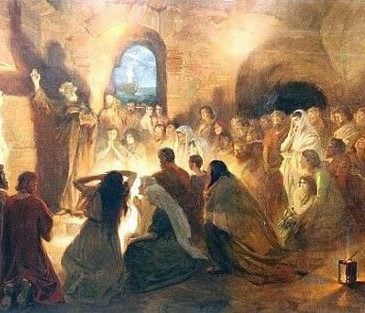 Continuing from Dix’s Shape of the Liturgy. . . .
Chap 10: The theology of consecration
Dix argues that the Eucharist manifests the true being of the Church in the following way. It is the act of Christ in His Body, the Church, transferring all who are in Him into the eternal Kingdom beyond time. The heavenly Christ as the abiding “propitiation for our sins” [1 Jn 2.2] is the supernatural life of all who are His, who in the eucharist are at once “offered” and “brought to” the Father. The individual fulfills himself in the world discharging his proper liturgy (as bishop, cleric or layman) whose climax is his share in the “doing” of the great corporate action of that Body prescribed by our Lord. 268
Because Christ is One in Himself, any particular Eucharist is not the act of the local church only but the act of the whole catholic Body of Christ throughout the world and the ages. It is the “coming” to the Father of redeemed humanity “in Christ.” 269
The celebrant is the “high-priest” in the midst of the priestly people. [Just as in ancient Israel there were the one High Priest, several high-priests, and thousands of priests, amidst a whole people called priestly.] 271
Consecration is nothing else but the acceptance by the Father of the sacrifice of Christ in His members–the sacrifice of “the Body of Christ” in all its meanings. 272
It was the common Jewish expectation that the “thank-offering” alone of all the Levitical sacrifices would continue during the days of the Messiah (Pesachim 79a). 273
In pre-Nicene eucharists, the consecration was indebted to the Jewish berakhah or blessing of food, which presumed that setting apart food to God brought a blessing or holy state to that food. So Irenaeus says, “The bread receiving the epiklesis (naming) of God is no more common bread but eucharist” (Adv. Haer. 4.18.5). Dix suggests in a footnote that in the second century every use of epiklesis is connected with Jewish berakhah, but that as connections with Judaism diminished in the 3rd and 4th cs. the word loses this meaning. In the second century Christian writers associated the Spirit with the Word in such a way as to suggest Spirit-as-Presence-of-God in a Jewish sense of recalling the Name. 275-76
An important change appears with Cyril of Jerusalem in the 4th c. Christ is the passive victim now at the Eucharist, whose Body and Blood are “made” by the Holy Spirit, so that the Church might offer Him to the Father in propitiation for its sins. The older tradition was that Christ is the active agent in the eucharist, who offers the Church as found “in Him.” 278
An old caricature is that the Western Church finds its entire inspiration in Calvary, while the Eastern Church ia focused on the Resurrection. There is no basis for this distinction in the actual liturgies of East and West. The Western rite is the anamnesis of the passion and resurrection and ascension of the same Christ Your Son our Lord–just as it is in the East. 288
The Eastern Church claims that the petition for consecration (the epiklesis) is the moment of consecration. Some scholars claim this is what was primitively universal, but it is hard to find that idea before the 4th c. 302
Previous Post
April 4, 2017
Liturgy and Eucharist - Part IV
Next Post
April 6, 2017 Liturgy and Eucharist - Part VI
Browse Our Archives
Select a Category Uncategorized
Select a Month March 2023 November 2022 October 2022 August 2022 July 2022 June 2022 May 2022 April 2022 November 2021 October 2021 August 2021 July 2021 June 2021 May 2021 April 2021 March 2021 February 2021 January 2021 December 2020 November 2020 October 2020 September 2020 July 2020 June 2020 April 2020 March 2020 February 2020 January 2020 August 2019 July 2019 May 2019 April 2019 February 2019 January 2019 December 2018 November 2018 October 2018 August 2018 July 2018 June 2018 May 2018 April 2018 March 2018 February 2018 January 2018 December 2017 November 2017 October 2017 September 2017 August 2017 July 2017 June 2017 May 2017 April 2017 March 2017 February 2017 January 2017 December 2016 November 2016 October 2016 September 2016 August 2016 July 2016 June 2016 May 2016 April 2016 March 2016 February 2016 January 2016 December 2015 November 2015 October 2015 September 2015 August 2015 July 2015 June 2015 May 2015 April 2015 March 2015 February 2015 January 2015 December 2014 November 2014 October 2014 September 2014 August 2014 July 2014 June 2014 May 2014 April 2014 March 2014 February 2014 January 2014 December 2013 November 2013 October 2013 September 2013 August 2013 July 2013 June 2013 May 2013 April 2013 March 2013 February 2013 January 2013 December 2012 November 2012 October 2012 September 2012 August 2012 July 2012 June 2012 May 2012 April 2012 March 2012 February 2012 January 2012 December 2011 November 2011 October 2011 September 2011 August 2011 July 2011 June 2011 May 2011 April 2011 March 2011 February 2011 January 2011 December 2010 November 2010 October 2010
Follow Us!
TAKE THE
Religious Wisdom Quiz
What did fire from heaven consume to prove Elijah's God was real?
Select your answer to see how you score.
A chariot Sacrifice on Mount Carmel The temple A golden calf
Related posts from The Northampton Seminar


Interview on what difference Jesus' Jewishness makes and...

News from Israel--the election and Messianic Jews

The third rail in conservative churches
TRENDING AT PATHEOS Evangelical

The REST of Your Life: A Creative Wrestles...
This week I had a conversation with a good friend from church....

How the author of the world's best hymn...
I've been working with John Newton for a while now. This makes...

Long before this Lectio Divina, Psalm 130 - the song - started...

What About the Trees? Another Living Parable
After I finished writing the last article about falling leaves as a...

Why Classical Education Is a Conversation, Not a...
Come and Read: Joy in Classical Education When I was a little...

Cornell University has received a great deal of negative publicity and intense...
view all Evangelical blogs
Ad-Free & Subscriber Log-In Subscription Support
- About Us
- 2026 Calendar
- Videos
- Podcasts
- Library of World Religions
- Faith In Media Tracker
- Advertise With Us
- Write for Us
- Privacy Policy
- Terms of Service
- Do Not Sell My Data
- Contact Us
- Radiant Digital
- Manage Newsletter Subscriptions
- Unsubscribe From Notifications
- Sitemap
Copyright 2008-2026, Patheos. All rights reserved.
Subscription Support Ad-Free & Subscriber Log-In
Follow Patheos