
BuddhistCatholicContemplativeEvangelicalGeneral ChristianHinduJewishLatter-day SaintMuslimNew VisionsProgressive Christian
Beliefs
- Buddhist
- Catholic
- Contemplative
- Evangelical
- General Christian
- Hindu
- Jewish
- Latter-day Saint
- More Voices
- Muslim
- New Visions
- Pagan
- Progressive Christian
Topics
- Religion News
- Food and Religion
- Sports and Religion
- Religious Art
- Religious Music and Entertainment
- Religious Events
- History and Religion
- Style and Religion
- Politics and Religion
- Women in Religion
- Recreation Outdoors and Religion
- Business Finance and Religion
- Careers Workplace and Religion
- Education and Religion
- Family Parenting and Religion
- Health Fitness and Religion
- Home and Religion
- Relationships and Religion
- Technology and Religion
- Travel and Religion
Columnists
- Buddhist Columnists
- Business Finance and Religion Columnists
- Careers Workplace and Religion Columnists
- Catholic Columnists
- Contemplative Columnists
- Education and Religion Columnists
- Evangelists Columnists
- Family Parenting and Religion Columnists
- General Christian Columnists
- Health Fitness and Religion Columnists
- Hindu Columnists
- History and Religion Columnists
- Home and Religion Columnists
- Jewish Columnists
- More Voices Columnists
- Latter Day Columnists
- Muslim Columnists
- New Visions Columnists
- Nonreligious Columnists
- Pagan Columnists
- Politics and Religion Columnists
- Progressive Columnists
- Recreation Outdoors and Religion Columnists
- Relationships and Religion Columnists
- Religion News Columnists
- Religious Art Columnists
- Religious Events Columnists
- Religious Music and Entertainment Columnists
- Sports and Religion Columnists
- Style and Religion Columnists
- Technology and Religion Columnists
- Travel and Religion Columnists
- Women in Religion Columnists
Resource Library
- 2026 Calendar
- Library of World Religions
- The 100 Most Holy Places on Earth
- Patheos Answers
- Podcasts
- Videos
- Faith Leaders Database
- Anglican Episcopalian
- Bahai
- Baptist
- Buddhism
- Christianity
- Confucianism
- Eastern Orthodoxy
- Hinduism
- Holiness and Pentecostal
- ISKCON
- Islam
- Judaism
- Lutheran
- Methodist
- The Church of Jesus Christ of Latter-day Saints
- New Age
- Paganism
- Presbytarian and Reformed
- Protestantism
- Religion Behind the Scenes
- Roman Catholic
- Scientology
- Shia Islam
- Sikhism
- Sufism
- Sunni Islam
- Taoism
- Zen
- See all religions
Research Tools
 Ad-Free & Subscriber Log-In Subscription Support
Ad-Free & Subscriber Log-In Subscription Support
Follow Patheos 

- Trending:
- Forgiveness
- |
- Marriage
- |
- Consciousness
- |
- Death Penalty
- |
- Election
- |
- Halloween
 The Northampton Seminar
- Home
- Evangelical
- Religion News
- Liturgy and Eucharist-Part III
Liturgy and Eucharist-Part III
Last updated on: April 3, 2017 at 10:47 am by Gerald McDermott
Liturgy and Eucharist-Part III 2017-04-03T10:47:22-04:00 Gerald McDermott
Patheos Explore the world's faith through different perspectives on religion and spirituality! Patheos has the views of the prevalent religions and spiritualities of the world.
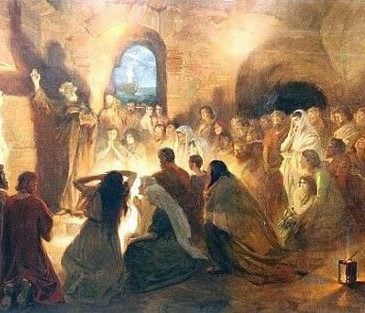
This is the third in a series analyzing two books, one by Dom Gregory Dix and the other by Paul Bradshaw. Today we continue with Dix, The Shape of the Liturgy.
-
The classical shape of the liturgy—the Eucharist
-
It was regarded as the solemn putting into act before God of the whole Xn living of the church’s members
-
In the East in the 3rd c. the deacon would cry, while the kiss was being exchanged, “Is there any man who keeps anything against his fellow?”
-
By the 4th c. it had become this warning: “Let none keep rancor against any! Let none (give the kiss) in hypocrisy!” 107
-
The Church inherited the kiss of peace from Judaism
- In Jesus’ time the kiss was a courteous preliminary to any ceremonial meal.
-
-
Although the offertory (at first merely “taking” the bread and wine before they could be blessed) was not always sharply distinguished from what followed, it was a ritual act with a significance of its own.
- In the Apostolic Tradition [according to Bradshaw, from mid-2nd to 4th c.]: “To (the bishop) then let the deacons bring up the oblation (prosphora) and he with all the presbyters laying his hand on the oblation shall say “eucharistising” thus . . .”
- Back in the mid-2nd c. Justin Martyr uses the technical term prospheretai and refers to them as “sacrifices which are offered to God by us gentiles, that is the bread of the eucharist and the cup likewise of the eucharist” (Dialogue 41).
- Back in the last years of the first c. Clement of Rome wrote that the “bishop’s office” was to “offer the gifts” (prospherein ta dora) (1 Clement 44). 111
- Soon after 200 Tertullian is explicit that the eucharist is a sacrificium, and that the material of the sacrifice is the oblationes brought by the people.
- In the mid-3rd c. Cyprian specifies how the eucharist is thought to be a sacrifice: “The passion [of Jesus at Calvary] is the Lord’s sacrifice which we offer” (Ep. 63, 17). 115
- Irenaeus (d. 202) wrote that each communicant gave himself under the forms of bread and wine to God, as God gives Himself to them under the same forms. Dix: “In Christ, as His Body, the church is ‘accepted’ by God ‘in the Beloved.’ Its sacrifice of itself is taken up into His sacrifice of Himself. . . . The offering of themselves by the members of Christ could not be acceptable to God unless taken up into the offering of Himself by Christ in consecration and communion.” 117-18
-
The Last Supper was not a eucharist properly speaking because Calvary was not yet an accomplished fact.
-
No ancient liturgical institution narrative was simply a quotation from scripture. They all adapt and expand our Lord’s words as reported in the NT, sometimes very boldly. 133
-
Every 2nd writer is strong on the identification of the consecrated elements with the Body and Blood. In Justin’s First Apology, e.g., he writes, the consecrated bread and wine “is (esti) the Flesh and Blood of that Jesus who was made flesh” (Ap. I, 65).
-
A subtle transformation of understanding took place over the 3rd and 4th cs: the original eschatological understanding of the eucharist as an irruption into time of the heavenly Christ, and of the eucharist as actualizing an eternal redemption in the earthly church as Body of Christ in the world, was replaced by a new insistence on the purely historical achievement of redemption w/in this world and time by Christ, at a particular moment and by particular actions in the past. 139
-
-
The pre-Nicene background of the liturgy
-
Early Christians, in an Empire where it was dangerous to worship as a Xn, would not run risks to attend worship merely to rememeber with thankfulness in a specially moving way the death of Jesus which had redeemed them. 151
-
There were no devotional practices in the primitive Eucharistic rite that were calculated to arouse a subjective piety—such as confession or devotions in preparation for communion, not even a corporate thanksgiving—nothing except the bare requisites for the sacramental act. 151
- “It was a burning faith in the vital importance of that Eucharistic action as such, its importance to God and to the church and to a man’s own soul, for this world and for the next, which made the Xns cling to the rite of the eucharist against all odds.” 151
-
The Middle Ages distorted that corporate act into a focus for subjective individual piety. 155
-
Previous Post
April 2, 2017
Liturgy and Eucharist-Part II
Next Post
April 4, 2017 Liturgy and Eucharist - Part IV
Browse Our Archives
Select a Category Uncategorized
Select a Month March 2023 November 2022 October 2022 August 2022 July 2022 June 2022 May 2022 April 2022 November 2021 October 2021 August 2021 July 2021 June 2021 May 2021 April 2021 March 2021 February 2021 January 2021 December 2020 November 2020 October 2020 September 2020 July 2020 June 2020 April 2020 March 2020 February 2020 January 2020 August 2019 July 2019 May 2019 April 2019 February 2019 January 2019 December 2018 November 2018 October 2018 August 2018 July 2018 June 2018 May 2018 April 2018 March 2018 February 2018 January 2018 December 2017 November 2017 October 2017 September 2017 August 2017 July 2017 June 2017 May 2017 April 2017 March 2017 February 2017 January 2017 December 2016 November 2016 October 2016 September 2016 August 2016 July 2016 June 2016 May 2016 April 2016 March 2016 February 2016 January 2016 December 2015 November 2015 October 2015 September 2015 August 2015 July 2015 June 2015 May 2015 April 2015 March 2015 February 2015 January 2015 December 2014 November 2014 October 2014 September 2014 August 2014 July 2014 June 2014 May 2014 April 2014 March 2014 February 2014 January 2014 December 2013 November 2013 October 2013 September 2013 August 2013 July 2013 June 2013 May 2013 April 2013 March 2013 February 2013 January 2013 December 2012 November 2012 October 2012 September 2012 August 2012 July 2012 June 2012 May 2012 April 2012 March 2012 February 2012 January 2012 December 2011 November 2011 October 2011 September 2011 August 2011 July 2011 June 2011 May 2011 April 2011 March 2011 February 2011 January 2011 December 2010 November 2010 October 2010
Follow Us!
TAKE THE
Religious Wisdom Quiz
In 1 Thessalonians, what does Paul say about the dead in Christ when the Lord returns?
Select your answer to see how you score.
They will be caught up in glory They will rise first They will rise last They will be judged
Related posts from The Northampton Seminar


Interview on what difference Jesus' Jewishness makes and...

News from Israel--the election and Messianic Jews

The third rail in conservative churches
TRENDING AT PATHEOS Evangelical

The REST of Your Life: A Creative Wrestles...
This week I had a conversation with a good friend from church....

How the author of the world's best hymn...
I've been working with John Newton for a while now. This makes...

Long before this Lectio Divina, Psalm 130 - the song - started...

What About the Trees? Another Living Parable
After I finished writing the last article about falling leaves as a...

Why Classical Education Is a Conversation, Not a...
Come and Read: Joy in Classical Education When I was a little...

Cornell University has received a great deal of negative publicity and intense...
view all Evangelical blogs
Ad-Free & Subscriber Log-In Subscription Support
- About Us
- 2026 Calendar
- Videos
- Podcasts
- Library of World Religions
- Faith In Media Tracker
- Advertise With Us
- Write for Us
- Privacy Policy
- Terms of Service
- Do Not Sell My Data
- Contact Us
- Radiant Digital
- Manage Newsletter Subscriptions
- Unsubscribe From Notifications
- Sitemap
Copyright 2008-2026, Patheos. All rights reserved.
Subscription Support Ad-Free & Subscriber Log-In
Follow Patheos