
BuddhistCatholicContemplativeEvangelicalGeneral ChristianHinduJewishLatter-day SaintMuslimNew VisionsProgressive Christian
Beliefs
- Buddhist
- Catholic
- Contemplative
- Evangelical
- General Christian
- Hindu
- Jewish
- Latter-day Saint
- More Voices
- Muslim
- New Visions
- Pagan
- Progressive Christian
Topics
- Religion News
- Food and Religion
- Sports and Religion
- Religious Art
- Religious Music and Entertainment
- Religious Events
- History and Religion
- Style and Religion
- Politics and Religion
- Women in Religion
- Recreation Outdoors and Religion
- Business Finance and Religion
- Careers Workplace and Religion
- Education and Religion
- Family Parenting and Religion
- Health Fitness and Religion
- Home and Religion
- Relationships and Religion
- Technology and Religion
- Travel and Religion
Columnists
- Buddhist Columnists
- Business Finance and Religion Columnists
- Careers Workplace and Religion Columnists
- Catholic Columnists
- Contemplative Columnists
- Education and Religion Columnists
- Evangelists Columnists
- Family Parenting and Religion Columnists
- General Christian Columnists
- Health Fitness and Religion Columnists
- Hindu Columnists
- History and Religion Columnists
- Home and Religion Columnists
- Jewish Columnists
- More Voices Columnists
- Latter Day Columnists
- Muslim Columnists
- New Visions Columnists
- Nonreligious Columnists
- Pagan Columnists
- Politics and Religion Columnists
- Progressive Columnists
- Recreation Outdoors and Religion Columnists
- Relationships and Religion Columnists
- Religion News Columnists
- Religious Art Columnists
- Religious Events Columnists
- Religious Music and Entertainment Columnists
- Sports and Religion Columnists
- Style and Religion Columnists
- Technology and Religion Columnists
- Travel and Religion Columnists
- Women in Religion Columnists
Resource Library
- 2026 Calendar
- Library of World Religions
- The 100 Most Holy Places on Earth
- Patheos Answers
- Podcasts
- Videos
- Faith Leaders Database
- Anglican Episcopalian
- Bahai
- Baptist
- Buddhism
- Christianity
- Confucianism
- Eastern Orthodoxy
- Hinduism
- Holiness and Pentecostal
- ISKCON
- Islam
- Judaism
- Lutheran
- Methodist
- The Church of Jesus Christ of Latter-day Saints
- New Age
- Paganism
- Presbytarian and Reformed
- Protestantism
- Religion Behind the Scenes
- Roman Catholic
- Scientology
- Shia Islam
- Sikhism
- Sufism
- Sunni Islam
- Taoism
- Zen
- See all religions
Research Tools
 Ad-Free & Subscriber Log-In Subscription Support
Ad-Free & Subscriber Log-In Subscription Support
Follow Patheos 

- Trending:
- Forgiveness
- |
- Marriage
- |
- Consciousness
- |
- Death Penalty
- |
- Election
- |
- Halloween
 The Northampton Seminar
- Home
- Evangelical
- Religion News
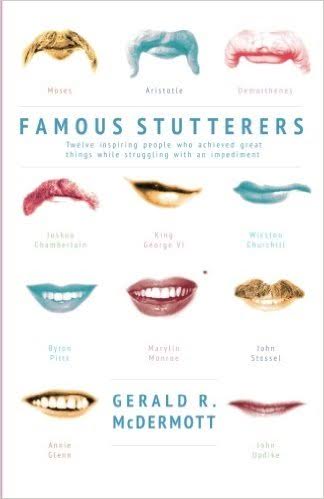
- Famous Stutterers–the book trailer
Famous Stutterers–the book trailer
Last updated on: March 24, 2017 at 1:16 pm by Gerald McDermott
Famous Stutterers–the book trailer 2017-03-24T13:16:53-04:00 Gerald McDermott
Patheos Explore the world's faith through different perspectives on religion and spirituality! Patheos has the views of the prevalent religions and spiritualities of the world.
“>
Click here for the book trailer.
Here is a little background.
In 2010 the movie “The King’s Speech” took the world by storm. Winning four Academy Awards and seven British Academy Film Awards, the film depicted King George VI’s painful struggle with stuttering. Its popularity was due to two factors. First, it was a gripping psychological drama revealing the king’s inner frustrations and family conflicts, and tracing the efforts of Australian speech therapist Lionel Logue to tame the king’s unruly tongue. Second, most viewers were startled that such a well-known historical figure was afflicted with such a serious debility, and that he somehow found a way to give important speeches in a time of great crisis while England was at war with Hitler’s Germany.
Just after my wife and I watched the film, a friend asked me if I enjoyed it.
“No, I suffered through it,” I replied. “But it was a great movie.”
I have been a stutterer since the age of six. Every time the king (Colin Firth) puffed his cheeks helplessly as he tried to get out a word, I felt his frustration and humiliation.
We stutterers know all too well “Bertie’s” fear of situations that would force us to read a text publicly or speak before a group. Most stutterers fear the telephone because we cannot control the dialogue. We remember painfully the innumerable occasions when we had all the right words in our heads but could not utter them. We groan as we think of all the well-meaning friends and family who tell us—as they told the British king—to take a breath or just relax. If we could, we would!
Much of our agony is invisible. People who hear us block on words occasionally think it must be trivial, or a minor annoyance at most. But they don’t know the times when occasional blocks mysteriously morph into paralysis, when even sounds that are normally effortless become mountains to climb. They have no idea of the apprehension when answering the phone, or the nervousness when in conversation that goes quickly, we are afraid we won’t be able to reply at the right pace, and all eyes will turn to us as the conversation suddenly stops. They don’t know of the worry for weeks about upcoming speeches or presentations—not over what to say but whether we can get our tongue to cooperate.
Famous stutterers include Moses, Demosthenes, Churchill (whose problem the movie alludes to), Marilyn Monroe, Oral Roberts, Carly Simon, James Earl Jones, Tiger Woods, John Updike, Annie Glenn, and John Stossel. Eighty percent of all stutterers are males. It is estimated by specialists that roughly one percent of the population (3 million Americans) stutters, and that upwards of five percent (15 million) have stuttered at some time in their lives.
Like most stutterers, my disability started when I was very young. My mother feared I would flunk kindergarten because no one but she could understand me. Somehow I passed. But then in first grade my teacher put me in front of the class to help me enunciate. My panic developed into stuttering, which I would be helpless to manage for the next thirty-two years.
Stuttering often turned school into a nightmare. Fellow students looked at me quizzically and mockingly. In high school, one considerate lad asked me publicly why I could not talk like everyone else. I was glad to take Latin and Greek, so-called dead languages because reading them was important—not speaking them. But I dreaded French class every day, when I would sweat rivers of living water down my sides as the recitation exercise made its way up and down the rows until it came to me. Everyone sighed because they knew I would take so much longer than everyone else, while I tried to force words from my uncooperative mouth.
In college I had to join in class discussion because the University of Chicago prided itself on small classes with lots of conversation. Sometimes, with the running start seen in “The King’s Speech,” I might be fluent for a few sentences. But invariably I would grind to a halt, utterly tongue-tied before an intractable consonant.
I was humiliated when my grad school advisor recommended speech therapy. How did he know? Strangely, many of us stutterers are in denial. But the speech therapy I received there made no real attempt to cure me, instead trying to help me accept myself. It was a waste of time, at least for me.
Other speech therapists adopted something like the psychological theory used by the King’s therapist in the movie—thinking the cause of stuttering is childhood trauma. Attempts to help me talk through my supposed traumas did nothing for my speech. Later in life it dawned on me that many non-stutterers had childhood trauma, and many stutterers did not, or dealt with their traumas in healthy ways.
I wrote this book for a couple of reasons. The first is that the subject is fascinating. Most people are amazed that the famous people profiled in this book were bedeviled by such a difficult problem. For each, the ways it manifested were different, and the therapies they used to cope with it varied. But the fact that these great and famous people faced what could have been a debilitating problem and somehow accomplished great things anyway is intriguing. This fact surprises and gratifies most of us. We are surprised that they had a serious obstacle–and this obstacle in particular. We are gratified that their lives were not painless, for the thought that others can skate through life without serious problems would be unnerving for all of us who face our own serious problems.
The stories are also inspiring. For all of these accomplished persons, stuttering was an enormous difficulty. None had a sure-fire remedy. Most had to blunder and stumble through. The persistence and courage they displayed tells us that there might be ways we too can survive and achieve—despite our own serious difficulties.
Previous Post

March 17, 2017
Our Benedict Option
Next Post

March 29, 2017 How gay marriage and divorce are connected
Browse Our Archives
Select a Category Uncategorized
Select a Month March 2023 November 2022 October 2022 August 2022 July 2022 June 2022 May 2022 April 2022 November 2021 October 2021 August 2021 July 2021 June 2021 May 2021 April 2021 March 2021 February 2021 January 2021 December 2020 November 2020 October 2020 September 2020 July 2020 June 2020 April 2020 March 2020 February 2020 January 2020 August 2019 July 2019 May 2019 April 2019 February 2019 January 2019 December 2018 November 2018 October 2018 August 2018 July 2018 June 2018 May 2018 April 2018 March 2018 February 2018 January 2018 December 2017 November 2017 October 2017 September 2017 August 2017 July 2017 June 2017 May 2017 April 2017 March 2017 February 2017 January 2017 December 2016 November 2016 October 2016 September 2016 August 2016 July 2016 June 2016 May 2016 April 2016 March 2016 February 2016 January 2016 December 2015 November 2015 October 2015 September 2015 August 2015 July 2015 June 2015 May 2015 April 2015 March 2015 February 2015 January 2015 December 2014 November 2014 October 2014 September 2014 August 2014 July 2014 June 2014 May 2014 April 2014 March 2014 February 2014 January 2014 December 2013 November 2013 October 2013 September 2013 August 2013 July 2013 June 2013 May 2013 April 2013 March 2013 February 2013 January 2013 December 2012 November 2012 October 2012 September 2012 August 2012 July 2012 June 2012 May 2012 April 2012 March 2012 February 2012 January 2012 December 2011 November 2011 October 2011 September 2011 August 2011 July 2011 June 2011 May 2011 April 2011 March 2011 February 2011 January 2011 December 2010 November 2010 October 2010
Follow Us!
TAKE THE
Religious Wisdom Quiz
What was the name of Saul's son who ruled Israel except Judah after Saul died?
Select your answer to see how you score.
Abner Jonathan Ish-bosheth Mephibosheth
Related posts from The Northampton Seminar


Interview on what difference Jesus' Jewishness makes and...

News from Israel--the election and Messianic Jews

The third rail in conservative churches
TRENDING AT PATHEOS Evangelical

The REST of Your Life: A Creative Wrestles...
This week I had a conversation with a good friend from church....

How the author of the world's best hymn...
I've been working with John Newton for a while now. This makes...

Long before this Lectio Divina, Psalm 130 - the song - started...

What About the Trees? Another Living Parable
After I finished writing the last article about falling leaves as a...

Why Classical Education Is a Conversation, Not a...
Come and Read: Joy in Classical Education When I was a little...

Cornell University has received a great deal of negative publicity and intense...
view all Evangelical blogs
Ad-Free & Subscriber Log-In Subscription Support
- About Us
- 2026 Calendar
- Videos
- Podcasts
- Library of World Religions
- Faith In Media Tracker
- Advertise With Us
- Write for Us
- Privacy Policy
- Terms of Service
- Do Not Sell My Data
- Contact Us
- Radiant Digital
- Manage Newsletter Subscriptions
- Unsubscribe From Notifications
- Sitemap
Copyright 2008-2026, Patheos. All rights reserved.
Subscription Support Ad-Free & Subscriber Log-In
Follow Patheos