
BuddhistCatholicContemplativeEvangelicalGeneral ChristianHinduJewishLatter-day SaintMuslimNew VisionsProgressive Christian
Beliefs
- Buddhist
- Catholic
- Contemplative
- Evangelical
- General Christian
- Hindu
- Jewish
- Latter-day Saint
- More Voices
- Muslim
- New Visions
- Pagan
- Progressive Christian
Topics
- Religion News
- Food and Religion
- Sports and Religion
- Religious Art
- Religious Music and Entertainment
- Religious Events
- History and Religion
- Style and Religion
- Politics and Religion
- Women in Religion
- Recreation Outdoors and Religion
- Business Finance and Religion
- Careers Workplace and Religion
- Education and Religion
- Family Parenting and Religion
- Health Fitness and Religion
- Home and Religion
- Relationships and Religion
- Technology and Religion
- Travel and Religion
Columnists
- Buddhist Columnists
- Business Finance and Religion Columnists
- Careers Workplace and Religion Columnists
- Catholic Columnists
- Contemplative Columnists
- Education and Religion Columnists
- Evangelists Columnists
- Family Parenting and Religion Columnists
- General Christian Columnists
- Health Fitness and Religion Columnists
- Hindu Columnists
- History and Religion Columnists
- Home and Religion Columnists
- Jewish Columnists
- More Voices Columnists
- Latter Day Columnists
- Muslim Columnists
- New Visions Columnists
- Nonreligious Columnists
- Pagan Columnists
- Politics and Religion Columnists
- Progressive Columnists
- Recreation Outdoors and Religion Columnists
- Relationships and Religion Columnists
- Religion News Columnists
- Religious Art Columnists
- Religious Events Columnists
- Religious Music and Entertainment Columnists
- Sports and Religion Columnists
- Style and Religion Columnists
- Technology and Religion Columnists
- Travel and Religion Columnists
- Women in Religion Columnists
Resource Library
- 2026 Calendar
- Library of World Religions
- The 100 Most Holy Places on Earth
- Patheos Answers
- Podcasts
- Videos
- Faith Leaders Database
- Anglican Episcopalian
- Bahai
- Baptist
- Buddhism
- Christianity
- Confucianism
- Eastern Orthodoxy
- Hinduism
- Holiness and Pentecostal
- ISKCON
- Islam
- Judaism
- Lutheran
- Methodist
- The Church of Jesus Christ of Latter-day Saints
- New Age
- Paganism
- Presbytarian and Reformed
- Protestantism
- Religion Behind the Scenes
- Roman Catholic
- Scientology
- Shia Islam
- Sikhism
- Sufism
- Sunni Islam
- Taoism
- Zen
- See all religions
Research Tools
 Ad-Free & Subscriber Log-In Subscription Support
Ad-Free & Subscriber Log-In Subscription Support
Follow Patheos 

- Trending:
- Forgiveness
- |
- Marriage
- |
- Consciousness
- |
- Death Penalty
- |
- Election
- |
- Halloween
 New Wineskins
- Home
- Evangelical
- Has “Irresistible” Cracked the Code to Reach the Nones?
Has “Irresistible” Cracked the Code to Reach the Nones?
Last updated on: September 17, 2018 at 7:24 pm by Josh Daffern
Has “Irresistible” Cracked the Code to Reach the Nones? 2018-09-17T19:24:43-06:00 Josh Daffern
Patheos Explore the world's faith through different perspectives on religion and spirituality! Patheos has the views of the prevalent religions and spiritualities of the world.
andystanley.com
Last week I finished reading two profound pieces of information on the same day. In the morning I read an opinion piece online entitled “Young Christians are Leaving the Church – Here’s Why.” While the findings are disheartening to me as a pastor, they are not surprising. The tornado siren screeching a warning of impending disaster has been blaring for years in the evangelical world as the ‘Nones,’ those who self-identify with no religious affiliation, metastasizes at a cataclysmic rate. We know the church is hemorrhaging the next generation, but we’re not quite sure what to do about it. This isn’t just a problem about those that never grew up in church. This isn’t just a mainline church problem anymore. Southern Baptists (my denomination) thought we fixed those problems with the Conservative Resurgence and the election of Charles Stanley as the president of the Southern Baptist Convention in 1984. That slowed the bleeding for awhile, long enough for churches to think the problem had passed. But it’s undeniable today. The church is losing our own children, those raised in the faith, at a rate that is simply not sustainable.
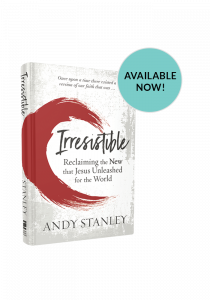
Twenty-four years after the election that helped make Charles Stanley the face of a new day in the evangelical world, his son Andy Stanley steps forward to try and take the church into its next chapter. That was the second piece of profound information I finished last week. An hour before I read the disheartening statistics and state of the Nones, I finished a book that blazes a trail forward. Andy Stanley’s explosive new book Irresistible releases today, and it has the potential to be as disruptive to church as we know it as Martin Luther’s 95 Theses were when they were nailed to the door of Wittenburg Church hundreds of years ago.
For years I’ve heard the undeniable statistics about those growing up in the church who decided to walk away from the faith. I have heard the responding travail, despair, and calls to double down on what used to work years ago. Lately, it seems like the focus has shifted from trying to take any new ground for the kingdom to trying to desperately hold onto what little we have left. Irresistible changes the narrative of defeat and plots a clear path forward, not to merely preserve our shrinking voice in society but to regain those who have walked away from the faith and create a platform from which to legitimately interact with those who describe themselves as Nones.
Irresistible claims that the way we talk about ‘the Bible’ creates an unnecessary hurdle for those who can’t see the nuances between the old covenant of the Old Testament that we honor and hold as inspired (although we don’t live underneath that Law anymore) and the new covenant of Jesus. Many if not most of the issues Nones have with ‘the Bible’ concerns the practices, customs and laws as revealed in the Old Testament. The nuance between the two Testaments is lost on those on the outside, and many times how we talk about the two Testaments do little to clear up the confusion. They see one Bible with 66 books, all equally adhered to by Christians, even the laws in Leviticus that Christians have never adhered to. It’s not Jesus that most Nones have an issue with, it’s the messaging. It’s the way we talk about ‘the Bible,’ not the Bible itself.
For Christians that don’t see the big deal, it’s because we grew up on the inside. But think about the confusion that it would create if Americans put the Articles of Confederation (the binding document that preceded the Constitution) together with the Constitution and saidthey are both authoritative, even though we only live under the Constitution. It could get confusing to those on the outside. Or it would be like being married to your current spouse but still maintaining an intimate relationship with your ex-spouse or your ex-girlfriend or boyfriend. Things probably wouldn’t work out so well. The Old Testament makes sense to those of us on the inside (but Stanley makes a strong case that how we interact with it may in fact be dangerous), but to those on the outside, to the Nones, our messaging is creating an unnecessary hurdle to the gospel.
In a day of skepticism, relentless church scandals, evolution and the internet purveying multiple alternate theories on just about everything, how we talk about our faith becomes important, and for those genuinely interested in reaching those outside the faith (and to be honest, not all Christians are genuinely interested in reaching outside the walls of the church), Irresistible paints a picture of how to convey our faith to a new generation of the unchurched and dechurched, in much the same way Paul interacted with the intellectual skeptics of Athens in Acts 17.
Although some will be quick to erroneously conclude that Stanley is encouraging us to jettison the Old Testament, Irresistible in fact walks through a new way to interact with the old covenant, one that appears revolutionary but actually follows how Jesus and the New Testament authors interacted with the old covenant. If you gear up to wade through Irresistible, be prepared to walk through a systematic and thorough study of the New Testament. It is much more than one man’s opinions. If you want to refute his logic, you better know your Bible, and not just the cherry-picked verses we tend to quote out of context. For the first three hundred years of church history, there was no ‘the Bible’ as we currently refer to it. The documents all existed, but they weren’t bound together in one book and referred to as ‘the Bible’ until 300 years after Christ. In those first 300 years, the church with no ‘the Bible’ had its most explosive growth and transformed human history. We are today living in a society where ‘the Bible’ is not respected or held universally as authoritative. Like the first Christians, can we recapture what it was that propelled the early church to such heights?
There is so much more to discuss with this book, but here are a few of the groundbreaking topics discussed in Irresistible:
- Stanley makes strong and provocative statements about the old covenant (Old Testament) and how we interact with it. For those born and raised on the inside (the majority of those who will read Irresistible, Stanley’s comments on the Old Testament will sound at best provocative and at worst heretical). But remember that this book is primarily a guide on how to engage with those who are outside of the faith or who have walked away from the faith. Some will call Stanley’s conclusions heretical, but I would argue that anyone who claims to live under the Great Commission of Matthew 28:19-20 and yet makes no concerted effort to reach those outside the faith would be guilty of a far greater heresy.
- Andy Stanley creates a compelling explanation of the meta narrative of church history and why the church has gotten it so wrong so many times. As a student of church history, it has always baffled me how so many atrocities have been committed in the name of God. Stanley’s explanation and warning of mixing and matching the old and new covenants is worth the read in and of itself for it offers a compelling theory behind so much of our troubled church history.
- Flowing from the transition from the old to the new covenant, Stanley reinforces Jesus’ transition from vertical to horizontal morality and how adherence to it would radically alter the religious landscape in America.
You may not agree with everything Andy Stanley says, but his book is worth your time because it sets forth a path on how to take new ground for the kingdom and reach a new generation of skeptics and Nones. Few books have had the audacity to suggest such bold changes, but we live in an age where anything less than bold changes will only accelerate the catastrophic exodus of those walking away from faith. When we get right down to it, much of what the Nones find resistible about Christianity are things we as Christians should be resisting ourselves. The church was once irresistible, and it can be so again!
Pick up a copy and let me know what you think.
Previous Post

September 17, 2018
Burger King and Why We Aren't Experiencing Freedom
Next Post

October 1, 2018 Now You Know, And Knowing is Half the Battle
Browse Our Archives
Select a Category Family Matters Ministry in the Trenches Morning Brew MTVpastor New Wineskins Top Menu Truth from Life Uncategorized Watch Sermons
Select a Month June 2020 May 2020 April 2020 March 2020 February 2020 December 2019 November 2019 October 2019 September 2019 August 2019 July 2019 June 2019 May 2019 April 2019 March 2019 February 2019 January 2019 December 2018 November 2018 October 2018 September 2018 August 2018 July 2018 June 2018 May 2018 April 2018 March 2018 February 2018 January 2018 December 2017 November 2017 October 2017 September 2017 August 2017 June 2017 May 2017 April 2017 March 2017 February 2017 January 2017 December 2016 November 2016 October 2016 September 2016 August 2016 July 2016 June 2016 May 2016 April 2016 March 2016 February 2016 January 2016 December 2015 November 2015 October 2015 September 2015 August 2015 July 2015 June 2015 May 2015 April 2015 March 2015 February 2015 January 2015 December 2014 November 2014 October 2014 September 2014 August 2014 July 2014 June 2014 May 2014 April 2014 March 2014 February 2014 January 2014 December 2013 November 2013 October 2013 September 2013 August 2013 July 2013 June 2013 May 2013 April 2013 March 2013 February 2013 January 2013 December 2012 November 2012 October 2012 September 2012 August 2012
Follow Us!
TAKE THE
Religious Wisdom Quiz
How many days between resurrection and Pentecost?
Select your answer to see how you score.
40 days 50 days 30 days 60 days
Related posts from New Wineskins

5 Things I've (re)Learned Recently as a White...

9 Reasons Why Online Groups May Actually Be...

5 Ways COVID-19 is Refining My Church (and...

This is the Moment for the Church at...
TRENDING AT PATHEOS Evangelical

The REST of Your Life: A Creative Wrestles...
This week I had a conversation with a good friend from church....

How the author of the world's best hymn...
I've been working with John Newton for a while now. This makes...

Long before this Lectio Divina, Psalm 130 - the song - started...

What About the Trees? Another Living Parable
After I finished writing the last article about falling leaves as a...

Why Classical Education Is a Conversation, Not a...
Come and Read: Joy in Classical Education When I was a little...

Cornell University has received a great deal of negative publicity and intense...
view all Evangelical blogs
Ad-Free & Subscriber Log-In Subscription Support
- About Us
- 2026 Calendar
- Videos
- Podcasts
- Library of World Religions
- Faith In Media Tracker
- Advertise With Us
- Write for Us
- Privacy Policy
- Terms of Service
- Do Not Sell My Data
- Contact Us
- Radiant Digital
- Manage Newsletter Subscriptions
- Unsubscribe From Notifications
- Sitemap
Copyright 2008-2026, Patheos. All rights reserved.
Subscription Support Ad-Free & Subscriber Log-In
Follow Patheos