
BuddhistCatholicContemplativeEvangelicalGeneral ChristianHinduJewishLatter-day SaintMuslimNew VisionsProgressive Christian
Beliefs
- Buddhist
- Catholic
- Contemplative
- Evangelical
- General Christian
- Hindu
- Jewish
- Latter-day Saint
- More Voices
- Muslim
- New Visions
- Pagan
- Progressive Christian
Topics
- Religion News
- Food and Religion
- Sports and Religion
- Religious Art
- Religious Music and Entertainment
- Religious Events
- History and Religion
- Style and Religion
- Politics and Religion
- Women in Religion
- Recreation Outdoors and Religion
- Business Finance and Religion
- Careers Workplace and Religion
- Education and Religion
- Family Parenting and Religion
- Health Fitness and Religion
- Home and Religion
- Relationships and Religion
- Technology and Religion
- Travel and Religion
Columnists
- Buddhist Columnists
- Business Finance and Religion Columnists
- Careers Workplace and Religion Columnists
- Catholic Columnists
- Contemplative Columnists
- Education and Religion Columnists
- Evangelists Columnists
- Family Parenting and Religion Columnists
- General Christian Columnists
- Health Fitness and Religion Columnists
- Hindu Columnists
- History and Religion Columnists
- Home and Religion Columnists
- Jewish Columnists
- More Voices Columnists
- Latter Day Columnists
- Muslim Columnists
- New Visions Columnists
- Nonreligious Columnists
- Pagan Columnists
- Politics and Religion Columnists
- Progressive Columnists
- Recreation Outdoors and Religion Columnists
- Relationships and Religion Columnists
- Religion News Columnists
- Religious Art Columnists
- Religious Events Columnists
- Religious Music and Entertainment Columnists
- Sports and Religion Columnists
- Style and Religion Columnists
- Technology and Religion Columnists
- Travel and Religion Columnists
- Women in Religion Columnists
Resource Library
- 2026 Calendar
- Library of World Religions
- The 100 Most Holy Places on Earth
- Patheos Answers
- Podcasts
- Videos
- Faith Leaders Database
- Anglican Episcopalian
- Bahai
- Baptist
- Buddhism
- Christianity
- Confucianism
- Eastern Orthodoxy
- Hinduism
- Holiness and Pentecostal
- ISKCON
- Islam
- Judaism
- Lutheran
- Methodist
- The Church of Jesus Christ of Latter-day Saints
- New Age
- Paganism
- Presbytarian and Reformed
- Protestantism
- Religion Behind the Scenes
- Roman Catholic
- Scientology
- Shia Islam
- Sikhism
- Sufism
- Sunni Islam
- Taoism
- Zen
- See all religions
Research Tools
 Ad-Free & Subscriber Log-In Subscription Support
Ad-Free & Subscriber Log-In Subscription Support
Follow Patheos 

- Trending:
- Forgiveness
- |
- Marriage
- |
- Consciousness
- |
- Death Penalty
- |
- Election
- |
- Halloween

- Home
- Progressive Christian
- Politics and Religion
- Two Desperate Attempts at Peace: Force Versus Transformation
Two Desperate Attempts at Peace: Force Versus Transformation
Last updated on: July 21, 2026 at 2:52 pm by Dorian Scott Cole
Two Desperate Attempts at Peace: Force Versus Transformation 2026-07-21T14:52:47-06:00 Dorian Scott Cole
Patheos Explore the world's faith through different perspectives on religion and spirituality! Patheos has the views of the prevalent religions and spiritualities of the world.
Open and Relational Theology & Social Psychology
The 60-Second Read
Two Desperate Attempts: The Clash of Force and Transformation
The Global Dilemma: We are witnessing a collision between two ancient philosophies. On one side, the “Department of War” mentality uses “maximum lethality” and “Peace through Strength” to keep a lid on aggressive bullies like Iran and Russia. On the other, the Pope’s “Diplomacy of Hope” argues that force only undermines the international order and that true peace requires justice and dialogue.
The Insight: Both sides suffer from a critical blind spot. The Hawk ignores that force treats symptoms without changing the underlying fanaticism, potentially creating “cornered animal” dynamics. The Dove often fails to account for bad actors who view negotiation as a sign of weakness or a way to buy time. We are stuck in a cycle of managing symptoms because we haven’t found a cure for power-hunger.
The Action: The “Third Way” lies in Micro-Diplomacy and the psychology of respect. By integrating people into the global world rather than isolating them, we “hack” a dictator’s control system. When we treat others with respect and lower the cost of agreement, we break the momentum of fanaticism and empower individuals to demand change from within.
Themes: Transactional vs. Transformational Power, Social Psychology of Reactance, and the Third Side.
The Series:
- Chapter 1: The Quest for Peace
- Chapter 2: The Stress Test
- Chapter 3 Quest: The Ivory Tower Hits the Ground
- Chapter 4 Quest: The Friction of the Street
- Chapter 5: Quest for the Architect’s Blueprint
- Chapter 6: Quest – Preparing to Defeat the System
- Chapter 7: The quest for working with opponents
- Chapter 8: The Quest for Doing it Right
- Chapter 9: The Quest for Societal Protection
- Chapter 10: The Quest for the Systemic Fix
- Chapter 11: The Continued Quest for the Systemic Fix
- Chapter 12: The Quest to Confront the System
- Chapter 13: The Quest for the Spear of Truth
- Chapter 14: The Quest for the Apocalypse (Revealing)
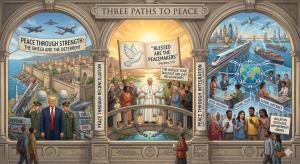
Three Paths to Peace – Gemini generated image
Two Desperate Attempts at Peace: The Clash of Force and Transformation
Peace is a heavy, complex landscape that essentially weighs two of the oldest philosophies in human history: the “Peace through Strength” (or even “Peace through Total Dominance”) approach versus the “Peace through Reconciliation” (the peacemaker’s path) approach. Platitudes don’t work here.
Trump’s approach
The “Department of War” Reality
The shift in language from “Defense” to “War” isn’t just a name change; it’s a psychological pivot. By framing the military as an instrument of “maximum lethality” (as Secretary Hegseth put it), the administration is leaning into the “Bully Theory.” The logic is that if you are the biggest, most unpredictable force on the block, smaller “bullies” like Iran or Russia will eventually hit a wall they can’t break through.
- The Iran Example: Operation Midnight Hammer and the subsequent degradation of their navy and air force have certainly changed the math in the Middle East. From a “strength” perspective, the argument is that you can’t negotiate with a regime driven by religious fanaticism—you can only remove their tools of destruction.
- The Risks: The danger of keeping a lid on a nation is that it often leaves a vacuum. Removing leaders (Venezuela) or isolating nations (Cuba) can create “cornered animal” dynamics where the regime becomes more desperate or the local population suffers the most.
The Pope’s Approach
The “Blessed are the Peacemakers” Reality
Pope Francis’s call for a “diplomacy of hope” in this 2025-2026 Jubilee Year. He focuses on the human cost. His stance suggests that peace isn’t just the absence of war but the presence of justice and dialogue.
- The Moral Argument: The peacemaker’s path argues that when we use force to “take over” (like the Greenland crisis or the Venezuelan intervention), we undermine the very international order that has kept the world relatively peaceful since 1945. The risk of shattering the international order is that all nations can now ignore it for their own gain.
- The Long Game: Diplomacy is slow and often frustrating, but its goal is a sustainable peace. While “Peace through Strength” may only last as long as the person holding the hammer continues to hold the hammer over their heads and they don’t find ways to slip out, a sustainable peace goes on without the hammer. Enemies become friends.
One of my favorite Bible verses is used by the Pope: “Blessed are the peacemakers, for they will be called children of God.” — Matthew 5:9
I’m a peacemaker at heart. The long game eventually can be transformative. But sometimes it fails.
“Peace is not the product of terror or fear. Peace is not the silence of cemeteries.” — Oscar Romero
Which Way is Better?
Since WWII, the world has been a much more peaceful place. Only five nations have tried to take other’s land: Russia, China (Taiwan), Iran versus Iraq, and Israel. The US now has threatened Greenland, potentially casting itself into that band of rogue nations.
Is the US correct in its stance? His self-declared mentors are strong-arm leaders like Putin, Saddam Hussein, and Kim Jong Un. He kind of uses the Monroe Doctrine of Separate Spheres of influence, also echoed by Henry Kissinger, combined with a manifest destiny approach of Admiral Perry in using Gunboat Diplomacy to end Japanese isolation. Trump also more directly embodies Roosevelt’s “Speak Softly and Carry a Big Stick.” Does it work? The Japanese became an empire and struck back during WWII with their own “gunboat diplomacy.” What you send out comes back. Force doesn’t create friends, it creates animosity.
Iraq is still a mess after years of intervention, and many there continue to hate the US. At least it isn’t so threatening to world peace. Neither Russia nor the US could tame Afghanistan, of which it is said, “You can conquer them, but you cannot change them.” It’s still run by religious fundamentalists who suppress their own people, but at least the weakened Taliban hasn’t been able to gain control of Pakistan.
Revolutions in Morocco and the US required blood. But both gained their independence when the people stood up and were willing to fight for it against bigger colonialist powers.
Trump’s actions are an authoritarian gamble of big-stick diplomacy. Perhaps Venezuela and Cuba will become more prosperous nations that treat their people better.
Will it work in Iran? Maybe. Persia is steeped in magnificent history, for which their people can be proud. Most of the younger generation wants a more peaceful, Western way of life and has actively been fighting the regime… and losing. But do they now have the power to resist the Iranian Revolutionary Guard, run by a religious fanatic regime bent on empire building? The Arab Spring demonstrated that younger generations could make some gains in several countries but couldn’t gain control.
After Trump’s maximum pressure approach to North Korea, it shifted its approach to South Korea and the US from engagement to open hostility in 2024 by abandoning the goal of unification, designating the South as a “principal enemy.” In doing so, it hopes the “two hostile state solution” will stop the import of S. Korean culture, which may be more powerful than the threat of conflict.
US military doctrine has always been that military power doesn’t bring permanent change. This requires diplomacy. But can diplomacy really work with a country like Iran that threatens the world?
The Middle Ground (The “Hated by Both Sides” Zone)
The harsh truth: Both sides have a blind spot.
- The Diplomat’s Blind Spot: Diplomacy often fails to account for bad actors who view negotiation as a sign of weakness or a way to buy time (Russia and Iran).
- The Strongman’s Blind Spot: Force often treats symptoms rather than causes. You can destroy a navy, but you haven’t necessarily changed the “religious fanaticism” or the societal structures that drive the conflict.
Trump is writing a “Hero/Warrior” narrative where the world is a dangerous place that needs a sheriff and is working on Venezuela, Cuba, Russia, and Iran all at the same time. The reality is, we’ve found we can’t be the policeman for the entire world—this is what brought down the Roman Empire.
The Pope is writing a “Redemption/Brotherhood” narrative where the world is a family that needs a father figure. I really like the pope and his predecessor, and I agree. But Iran exports terrorism and death into Saudi Arabia and Israel through proxies and suppresses its own people and threatens its neighbors and the US (The Great Satan). How much of that torture should the world endure while waiting on transformation that seems a very distant possibility? Isn’t it better to keep a lid on their ambitions?
The political cost: Trump supports Israel’s destruction of Gaza and the intrusion into the West Bank. This is what helped lose Biden-Harris the election because the younger generation won’t stand for mistreatment of others. This is what will lose Trump associates the next election. You can’t steal people’s land, overreact when they become violent, and then basically destroy their nation. This is what brought Iran into the conflict.
The “lowered conflict” we are seeing now with the degradation of Iran’s military might be a functional peace (less ability to strike), but it isn’t a relational peace (less desire to strike). The effort has to be for a relational peace.
So movements involving violence and military action are mixed. They seem rarely to accomplish their goals, but neither does diplomacy. Both have an abysmal track record.
- The Hawks hate hearing that “might” doesn’t actually make “right” (or stability).
- The Doves hate hearing that “talking” often just gives a fanatic time to reload.
Exploring Methods from Social Psychology
The “Transactional vs. Transformational” gap.
- Trump’s approach is Transactional: “I destroy your radar, you stop moving missiles.” It treats nations like chess pieces.
- The Pope’s approach is Transformational: “Change your heart, and the missiles won’t matter.” It treats nations like people.
The tragedy I’m highlighting is that transactional moves are too shallow to last, and transformational moves are too slow to stop a current massacre. Recognizing this is a lonely, but very honest, place to stand.
I don’t have an answer and am comfortable with the cognitive dissonance of enduring both sides. I think Jesus meant it when he said to turn the other cheek and endure some mistreatment while others are growing and transforming. I don’t think he meant for us to let others destroy the universe while we wait.
There is a better way
My focus on this spiritual crisis point and the empowerment of the individual shifts the conversation from geopolitics to “human systems.” Here are three pillars that help to bridge the “divided:”
1. The Power of “Micro-Diplomacy”
The Internet and voting empower people. While Trump and the Pope represent “Macro-Diplomacy” (state-level power), I’m describing a bottom-up transformation.
- When people are integrated into the global world via the internet, they see alternatives to fanaticism. Those with democracies do vote out authoritarian leaders (or as they did in South Korea, throw them in prison).
- This supports “slow, positive change.”
- The counter is isolation, like we’ve done to Cuba, which often freezes a culture in time, whereas integration enables it to adapt to the 21st century. Vietnam and China have become powerhouses through adaptation. They aren’t perfect, but they are improving.
2. The “Historical Pivot” Theory
This is a time of transition like the time of Christ. His was a period of intense Roman “hard power” (the Pax Romana, in which peace was maintained by the sword), and an authoritarian religion paralyzed by stiff rules, clashing with a new spiritual message of love, freedom, individual worth, and universal peace.
We are seeing a modern version of that clash. We have “Digital Power” (information flow) clashing with “Industrial Power” (tanks, oil, and borders). The tension we feel is the “old world” trying to maintain control using 20th-century tools while the “new world” is already thinking beyond them. People around the world want to live in peace and leave empire-building behind so they can raise their families and pursue their lives.
3. Respect as a Practical Tool
Respect brings a more friendly response. This isn’t just a moral stance; it’s a psychological reality. In my work in social psychology, I know that reactance (the urge to rebel when one’s freedom and identity are threatened) is a primary driver of fanaticism.
- If a country feels “bullied” or “shamed,” the population often rallies around their dictator out of nationalistic pride. This is happening in Venezuela, Cuba, and Iran, even though major portions of the civilizations are ready to change.
- If a country feels “respected” but its leaders are held accountable, the population is more likely to turn inward and demand reform themselves.
4. The Third Way – the most important
Pakistan, like other hosting countries of negotiations, has been doing a fantastic job of moderating the two sides. It shows the power of having an unbiased entity to help bring sides together.
In “Unleash Movements that Matter,” I explore how social psychology can break through barriers. Some books I mentioned in it or more recently are:
William Ury used his “Third Side” to broker peace to end civil wars that were extremely polarized and entrenched for decades. They seemed impossible. But he got it done, and describes the process in his book, “Getting to Peace: Transforming Conflict at Home, at Work, and in the World.”
Caroline Fleck, in her book, “Validation,” explains the very powerful effect validating others has on gaining cooperation. I highly recommend reading it—it will change how you work with people to become much more effective.
In my book, I talk about the powerful role of identity in people’s lives. They will fight to the death to preserve their feeling of identity and purpose. You have to work with this differently and help them see a better path by giving them a new vision. I talk about the power of momentum in driving them forward and how to break that by lowering the cost of agreeing so that it’s possible. I talk about mitigating risk and fear so that change becomes acceptable.
And I use Jesus as an example because he created immense change for people who are ready. Getting people ready is a key. He didn’t argue and create polarization that people couldn’t get past. In an argument, someone has to lose, and people avoid that cost. Jesus discussed things with people rather than argue. In this winner-takes-all society we live in, this is a lost art. He respected all others and their points of view and treated them with love. In our polarized society, this is also a lost art.
There are many people who it is impossible to change. But they can change over time if they are treated with respect and they see something better from us. And after change does occur, people gradually accept it. So there is hope that these nations can change if treated well.
I’ll copy some from the book on handling polarized people:
“The absolute best thing to do is to avoid these people like the plague. They can block both sides from effective action. However, complete avoidance isn’t always feasible, so alternative approaches are necessary.
The second-best thing to do is not put labels on yourself. They love labels because labels identify you as someone to hate. They will put one on your lapel if you let them do it. So don’t wear lapels.
The third best thing to do is not antagonize them. Don’t seek them out to argue with them. Don’t say you’re opposed to what they’re saying or doing. Just work on solving a problem that affects too many people, and finding the most effective answers.
You can also try the following to work with the radically polarized:
- Appreciate who they are—make them feel admired and their opinion respected. They should be. Validation is often vital to building intimate, trusting, and supportive relationships.
- Don’t present yourself as the opposition—listen to them and respect what they have to say. We all want respect for our opinions. We should all get respect.
- Don’t negate what they say. This only starts an argument, and losing can come at an unacceptable cost.
- Don’t ask what the solution is—they already have that entrenched in their head.
- We mostly have the same values. It’s threats to our values that drive people to reject anything but their opinion.
- Appeal to higher values. We all share the following moral foundations: Care, Fairness, Loyalty, Authority, and Purity.
Standford News reports that the public is not more polarized than it was in 1976. Most voters want a middle ground found on issues. This emphasis on shared values is supported by research indicating that the public may be less polarized than commonly perceived.
- Use the “Yes and” technique used in improvisation. Agree and add more to think about. Example: “That’s very true, and I agree about that, and something else to think about is seeing other cultures is something that has given me an appreciation for what other people go through. We have it tough, but they have it even worse.”
- Beyond verbal techniques, broadening perspectives can also be effective. Add to or broaden their assumptions. For example, people may not like immigrants and assume they are a hit on the economy, but the stabilizing or falling US population, like happened in Europe, may cause areas to dry up with fewer people, fewer services, and fewer grocery stores, so their entire area declines. This is already happening in the US. Immigrants reverse economic decay.
Don’t try to make this your winning argument, just a conversation point because reality often doesn’t defeat opinion. For example, In Freemont Nebraska there are 27 workers available for every 100 job openings. Most residents leave to find work they like better. Immigrants fill these jobs. But they face increased discrimination and harassment according to the ACLU.
Planting seeds of alternative perspectives requires patience.
- Let the new information cook. Rome wasn’t built in a day. They may become more reasonable, or perhaps invent counter arguments. The powerful forces that work against change inoculate their followers with counter arguments as needed. Even with patience, it’s important to understand that not everyone will change their mind.
- Appreciate that some minds can never be changed. Jesus ran into this a lot. He planted seeds everywhere but didn’t expect growth from barren ground.”
Summary
Authoritarianism thrives on isolation. With false egos as big as the universe, belief in their ultimate omnipotence, ignoring injustice, and malice in their hearts toward anything different, they move forward with destruction as their self-appointed divine imperative.
Transformation is the better way. But waiting on transformation isn’t always realistic in the real world. You can be dead for centuries waiting for transformation, while millions are oppressed and killed.
Using or adding a third way is better. By respecting people, appreciating them, and integrating people into the global internet and economy, we aren’t just being “nice”—we are effectively “hacking” the dictator’s operating system. When people have something to lose (a Western lifestyle, global connection, or economic stability), they are much harder to convince to die for a fanatic’s “empire.”
Injustice is the fuel of conflict and terrorism. Peace is possible if we keep working on resolving injustice and bringing others into our fold, keeping our enemies close, and using techniques that I described to avoid conflict and help others.
It’s a costly lesson for Iran, Israel, and the US that force doesn’t create transformation that is essential to change. The US tried force in Korea, Vietnam, Iraq, Afghanistan, and Iran. What we end up with is an expensive standoff where the people where bombs dropped hate us and will take any opportunity to get back at us. Diplomacy isn’t just using sanctions and waiting.
What is effective? This is the first article post in a 14-chapter series that illustrates the wrong ways and right ways to come to agreement over change.
I’ll leave you with these quotes from major change-makers when the outcome seemed bleak:
“Darkness cannot drive out darkness; only light can do that. Hate cannot drive out hate; only love can do that.” — Martin Luther King Jr.
And more humorously:
“Diplomacy is the art of telling people to go to hell in such a way that they ask for directions.” — Winston Churchill
Our answer is God. God’s answer is us. Together we make the world better.
– Dorian Scott Cole
Author’s book Unleash Movements that Matter: Break through barriers to change
Author’s Website with life and spiritual resources: Dorian Scott Cole .com
Recent website articles
- Theology of Catastrophe: a dissertaton style paper on why catastrophes happen.
- Ekklesia: a new format for a Jesus Gathering.
- Systematic Theology for the 21st Century
- Major Decision Matrix
 Open and Relational Theology[/caption]
General Christian
Politics and Religion
History and Religion

About Dorian Scott Cole
Additional information about the author is on the About tab. You can read more about the author here.
Previous Post

April 9, 2026
The Three Trees
Next Post
April 20, 2026 Chapter 2: The Stress Test
Recent Comments
Browse Our Archives
Select a Category Uncategorized
Select a Month October 2026 September 2026 August 2026 July 2026 June 2026 May 2026 April 2026 March 2026 February 2026 January 2026 December 2025 November 2025 October 2025 September 2025 August 2025 July 2025 June 2025 May 2025 April 2025 March 2025 February 2025 January 2025 December 2024 November 2024 October 2024 September 2024 August 2024 July 2024 June 2024 May 2024 April 2024 March 2024 February 2024 January 2024 December 2023 November 2023 October 2023 September 2023 June 2023 May 2023 April 2023 March 2023 February 2023 January 2023 December 2022 November 2022 October 2022 September 2022 August 2022 July 2022 June 2022 May 2022 April 2022 March 2022 February 2022 January 2022 December 2021 November 2021
Follow Us!
TAKE THE
Religious Wisdom Quiz
How many times does the book of Genesis mention "God created"?
Select your answer to see how you score.
5 9 7 11
Books by This Author Books by New Generations Explore Faith
Related posts from New Generations Explore Faith

Chapter 9, Julian: The Menu and the Meal
Chapter 7: The Commencement and the Glowing Screen
Chapter 6, Elena: The Quest for Peaceful Connection
TRENDING AT PATHEOS Progressive Christian

Looking at the Largest Orthodox Cathedral on Earth
There is often a considerable amount of anger and, shall we...

The Problem with False Prophets
Miller’s Station UMC| 10/18/26| Anchor Verse: Jeremiah 23: 1, 9-23 I...

Emotion in Early Christianity by Andrew Crislip
Andrew Crislip’s Emotion in Early Christianity examines an often overlooked dimension of...

16 Spiritual Touchstones for a More Grounded Life
After decades of spiritual study, here are 16 principles I try...

Catholic Evangelization: Sharing Your Faith Every Day
Welcome back to the Graceful Awakening mini-series called, “From Faith to Mission.” ...

The Pillar of the Boatmen: the Ancient Monument...
The Pillar of the Boatmen is a Romano-Gaulish sculpture that dates from...
view all Progressive Christian blogs
What Are Your Thoughts?leave a comment
Ad-Free & Subscriber Log-In Subscription Support
- About Us
- 2026 Calendar
- Videos
- Podcasts
- Library of World Religions
- Faith In Media Tracker
- Advertise With Us
- Write for Us
- Privacy Policy
- Terms of Service
- Do Not Sell My Data
- Contact Us
- Radiant Digital
- Manage Newsletter Subscriptions
- Unsubscribe From Notifications
- Sitemap
Copyright 2008-2026, Patheos. All rights reserved.
Subscription Support Ad-Free & Subscriber Log-In
Follow Patheos