
BuddhistCatholicContemplativeEvangelicalGeneral ChristianHinduJewishLatter-day SaintMuslimNew VisionsProgressive Christian
Beliefs
- Buddhist
- Catholic
- Contemplative
- Evangelical
- General Christian
- Hindu
- Jewish
- Latter-day Saint
- More Voices
- Muslim
- New Visions
- Pagan
- Progressive Christian
Topics
- Religion News
- Food and Religion
- Sports and Religion
- Religious Art
- Religious Music and Entertainment
- Religious Events
- History and Religion
- Style and Religion
- Politics and Religion
- Women in Religion
- Recreation Outdoors and Religion
- Business Finance and Religion
- Careers Workplace and Religion
- Education and Religion
- Family Parenting and Religion
- Health Fitness and Religion
- Home and Religion
- Relationships and Religion
- Technology and Religion
- Travel and Religion
Columnists
- Buddhist Columnists
- Business Finance and Religion Columnists
- Careers Workplace and Religion Columnists
- Catholic Columnists
- Contemplative Columnists
- Education and Religion Columnists
- Evangelists Columnists
- Family Parenting and Religion Columnists
- General Christian Columnists
- Health Fitness and Religion Columnists
- Hindu Columnists
- History and Religion Columnists
- Home and Religion Columnists
- Jewish Columnists
- More Voices Columnists
- Latter Day Columnists
- Muslim Columnists
- New Visions Columnists
- Nonreligious Columnists
- Pagan Columnists
- Politics and Religion Columnists
- Progressive Columnists
- Recreation Outdoors and Religion Columnists
- Relationships and Religion Columnists
- Religion News Columnists
- Religious Art Columnists
- Religious Events Columnists
- Religious Music and Entertainment Columnists
- Sports and Religion Columnists
- Style and Religion Columnists
- Technology and Religion Columnists
- Travel and Religion Columnists
- Women in Religion Columnists
Resource Library
- 2026 Calendar
- Library of World Religions
- The 100 Most Holy Places on Earth
- Patheos Answers
- Podcasts
- Videos
- Faith Leaders Database
- Anglican Episcopalian
- Bahai
- Baptist
- Buddhism
- Christianity
- Confucianism
- Eastern Orthodoxy
- Hinduism
- Holiness and Pentecostal
- ISKCON
- Islam
- Judaism
- Lutheran
- Methodist
- The Church of Jesus Christ of Latter-day Saints
- New Age
- Paganism
- Presbytarian and Reformed
- Protestantism
- Religion Behind the Scenes
- Roman Catholic
- Scientology
- Shia Islam
- Sikhism
- Sufism
- Sunni Islam
- Taoism
- Zen
- See all religions
Research Tools
 Ad-Free & Subscriber Log-In Subscription Support
Ad-Free & Subscriber Log-In Subscription Support
Follow Patheos 

- Trending:
- Forgiveness
- |
- Marriage
- |
- Consciousness
- |
- Death Penalty
- |
- Election
- |
- Halloween

- Home
- Progressive Christian
- Politics and Religion
- Stopping the Gun Violence Plague
Stopping the Gun Violence Plague
Last updated on: September 3, 2025 at 2:43 pm by Dorian Scott Cole
Stopping the Gun Violence Plague 2025-09-03T14:43:28-06:00 Dorian Scott Cole
Patheos Explore the world's faith through different perspectives on religion and spirituality! Patheos has the views of the prevalent religions and spiritualities of the world.
How to create change series
It just happened again in Minnesota when a gunman shot through a church window and killed two children.
The biggest killer of our children in the US is gun violence. Like the Black Death with its monstrous boils and organ failure, gun violence destroys entire families.
Drowning in a swamp of misinformation and pressure campaigns by gun activists, it feels like no one can see straight, let alone do anything about it. Yes, we can!
In my book, Unleash Movements that Matter: Break through Barriers to Change, I dive deep into this situation, carefully looking at other countries with similar cultural demographics to the US. They’ve taken action and have few problems.
Here is what you need to know and some ideas for how to make change. This series is about helping people make change.
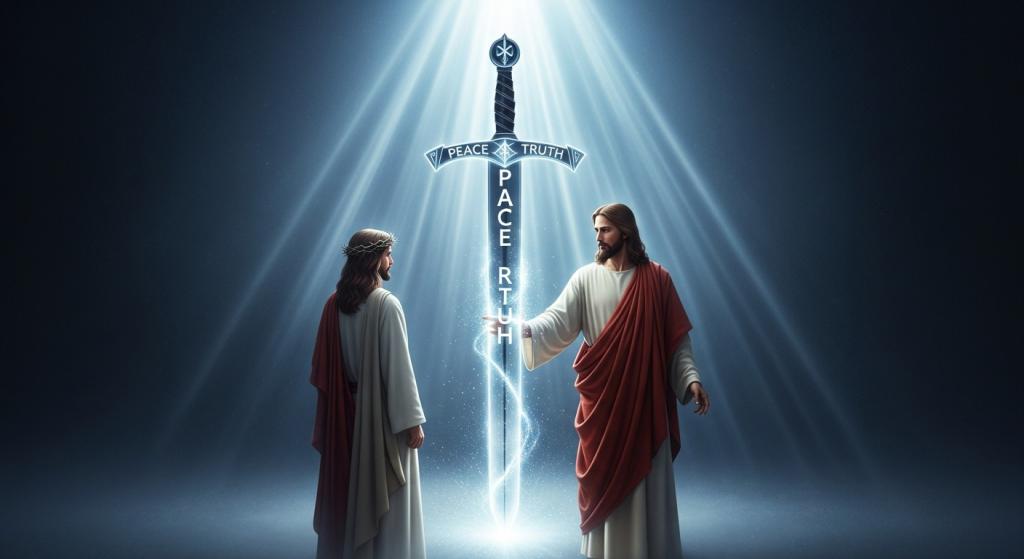
Sword of Peace through Truth by Gemini
Reference Bible Verses
“Wisdom is better than weapons of war, but one sinner destroys much good.” – Ecclesiastes 9:18
“When a strong man, fully armed, guards his own house, his possessions are undisturbed. But when someone stronger than he attacks him and overpowers him, he takes away from him all his armor on which he had relied and distributes his plunder.”
– Luke 11:21-22
We have a cultural problem
Many believe the answer to many of our crime problems is a hammer. Stalin used this method and killed millions of dissidents and anyone near them.
Saddam Hussein used it in Iraq to quell dissent, and human rights advocates were faced with atrocities.
Iran uses it to even control women’s hair and clothing and suppress dissidents.
The Taliban in Afghanistan uses it to curtail any unrest and keep women hidden and uneducated.
Idi Amin used extreme and widespread violence, political purges, and gross human rights abuses, including purges of the Christian population. Israel is using it against Arabs and Christians in Gaza.
Brazil’s military dictatorship captured and tortured dissidents, and killed many of them. Some they simply dropped from planes into the ocean. Today government violence in Brazil primarily involves police killings of civilians, often in low-income communities, with a disproportionate impact on Black individuals.
In Venezuela, thousands of arbitrary arrests were carried out against political opponents, human rights defenders and journalists—hundreds of children were among those detained. Detainees, including women and children, were allegedly tortured.
The misery created by those who choose a hammer to temporarily solve crime problems and silence dissidents shows that it produces only human misery and fear. It doesn’t solve problems.
The hammer is just wish fulfillment that problems just go away. It’s the will to power to erase things. It’s not an answer.
Studies show that criminal behavior is the result of various interconnected factors, not a single motive.
From AI (to avoid any bias I might have):
- Poverty and economic hardship: While not the sole cause, significant data correlates low socioeconomic status and economic insecurity with a higher likelihood of incarceration. For individuals struggling to meet basic needs, crime may be perceived as a last resort.
- Substance abuse: A high percentage of incarcerated individuals have a substance use disorder, which is frequently linked to criminal behavior. The need to fund an addiction is a powerful motivator for crime driven by dependence.
- Psychological and family factors: Other major contributing factors include family dysfunction, childhood trauma, antisocial traits, and mental health challenges.
- Limited alternatives: Many individuals involved in crime face poor educational or work histories, making legitimate employment difficult to obtain. This lack of opportunity can make crime seem more appealing as a way to “make ends meet.”
Pockets of poverty in inner cities and very poor rural areas are examples of how economic hardship, substance abuse, childhood trauma, and lack of opportunity create a perfect door for crime.
The “fix it with a hammer” attitude reflects many things. We aren’t in touch with these neighborhoods and avoid them. We don’t know how to fix them and don’t try to find out. Instead, we resort to pithy slogans about how it’s all their fault and not our problem. This also reflects our spiritual condition, showing that we are uncaring and can’t be bothered with the issue, so we just take a hammer to it.
Part of the problem is our gun culture. The U.S.’s violent beginnings and frequent wars have indoctrinated us into using guns to solve difficult problems. Militarism is a tool used to keep world peace, and it works for that. However, military leaders tell us that war itself doesn’t bring peace; it’s a last resort. Diplomacy brings peace between nations. In society, guns and hammers only disguise the underlying problems.
We have a gun problem
Many people feel that the Second Amendment, which allows people to own guns for their defense, is a right worth the sacrifice of two school shootings a day and frequent mass shootings in our schools. Our children are perceived as of less value than guns.
Yet guns are of dubious value for self-protection and often get people killed. Even experiments with an experienced gunman taking down a mass shooter often yield more tragic results for the experienced person and for others. It’s a useless contest. In real life, brave people rushing a shooter yields better results.
The tales and distorted statistics provided by some gun enthusiasts terribly distort the real picture. Even some statesmen use these to remain in office, with gun enthusiast support being critical to re-election.
In my bookI dive deeply into the gun violence situation and ways to resolve it. What I show is that other countries with similar cultural demographics to the US, same problems, similar desire for independent action, with similar violent tendencies, don’t have this gun violence or murder problem. Murders are miniscule compared to the US.
In my book, Unleash Movements that Matter: Break through Barriers to Change, I dive deeply into the gun violence situation and ways to resolve it. I show that other countries with similar cultural demographics to the U.S.—with similar problems, a similar desire for independent action, and similar violent tendencies—don’t have this gun violence or murder problem. Their murder rates are miniscule compared to the U.S.
People in the UK, Australia, and New Zealand can own guns, contrary to popular vitriol. They just have to show a need for them. And many can own them for sport. They resisted gun laws, but accepted them after they were in place.
The only real differences between us and them are the prevalence of guns and respect for authority. They respect authority. In the US, fewer people respect authority.
The statistics in the US are clear. The murder rate increases at nearly a 1 to 1 ratio with more guns. One more gun, one more murder. This is more true in the South.
Guns don’t fix problems. People fix problems.
Mass shooters are usually very disturbed people. They’re disturbed, not insane. They have few friends, feel socially isolated, and believe they can’t resolve their problems. Similar to what drives terrorists, frustrated and hopeless, they shoot others to make a big statement. This is a major problem in our society that people exclude other people.
If we want problems fixed in the US, (I do), then we have to address the causes of crime and fix those. And it won’t happen overnight because much of this criminal behavior is learned.
In poverty areas in inner cities and rural areas, there are ways to resolve these problems, as I outline in Systemic and intractable problems – Part 3 – inner cities.
The real question before us is whether we have the will to resolve these problems such as gun violence and poverty. We’ve already dragged 20th century problems through the first quarter of the 21st century. We prefer to ignore them, letting them fester and grow, telling the police to hit them with a hammer, and blaming anything but ourselves for not fixing them.”
This reflects our spiritual condition, exemplified by Jesus second command to love others as ourselves. Many in the US claim the US is a Christian country. Is Christianity a label to justify what we want to believe? Or do we reflect the Second Commandment to love others as ourselves?
This raises the question of whether we are a good society or if our role in the world as a beacon of freedom, hope, and love should be terminated? Other countries might reflect better results in our experiment in democracy.
Conclusion
Gun violence is a reflection of our spiritual condition. We either display it through our approval of guns and the resulting violence, or through our indifference. A better reflection of our spiritual condition would be to find the facts and resolve the problems that cause crime and violence in our society.
Concluding challenge
Look at the facts. Explore solutions. Take action.
For a limited time, get my book free, Unleash Movements that Matter: Break through barriers to change.
“Our answer is God. God’s answer is us. Together we make the world better.” – Dorian Scott Cole
“With hate we have more to lose than gain. Break the cycle.” – Dorian Scott Cole
Author’s website: DorianScottCole.com
General Christian
Politics and Religion
History and Religion

About Dorian Scott Cole
Additional information about the author is on the About tab. You can read more about the author here.
Previous Post

August 27, 2025
Turning the World Upside Down
Next Post
September 7, 2025 American Dream, Dead or Alive
Recent Comments
Browse Our Archives
Select a Category Uncategorized
Select a Month October 2026 September 2026 August 2026 July 2026 June 2026 May 2026 April 2026 March 2026 February 2026 January 2026 December 2025 November 2025 October 2025 September 2025 August 2025 July 2025 June 2025 May 2025 April 2025 March 2025 February 2025 January 2025 December 2024 November 2024 October 2024 September 2024 August 2024 July 2024 June 2024 May 2024 April 2024 March 2024 February 2024 January 2024 December 2023 November 2023 October 2023 September 2023 June 2023 May 2023 April 2023 March 2023 February 2023 January 2023 December 2022 November 2022 October 2022 September 2022 August 2022 July 2022 June 2022 May 2022 April 2022 March 2022 February 2022 January 2022 December 2021 November 2021
Follow Us!
TAKE THE
Religious Wisdom Quiz
Who predicted Persia's rise?
Select your answer to see how you score.
Ezekiel Daniel Isaiah Jeremiah
Books by This Author Books by New Generations Explore Faith
Related posts from New Generations Explore Faith
Chapter 14: The Quest for the Apocalypse (Revealing)
Chapter 13: The Quest for the Spear of...
Chapter 10: The Quest for the Systemic Fix
Another Day, Another Mass Shooting
TRENDING AT PATHEOS Progressive Christian

The Problem with False Prophets
Miller’s Station UMC| 10/18/26| Anchor Verse: Jeremiah 23: 1, 9-23 I...

Emotion in Early Christianity by Andrew Crislip
Andrew Crislip’s Emotion in Early Christianity examines an often overlooked dimension of...

16 Spiritual Touchstones for a More Grounded Life
After decades of spiritual study, here are 16 principles I try...

Catholic Evangelization: Sharing Your Faith Every Day
Welcome back to the Graceful Awakening mini-series called, “From Faith to Mission.” ...

The Pillar of the Boatmen: the Ancient Monument...
The Pillar of the Boatmen is a Romano-Gaulish sculpture that dates from...

In one sense walking into Westminster Abbey is like walking down the...
view all Progressive Christian blogs
What Are Your Thoughts?leave a comment
Ad-Free & Subscriber Log-In Subscription Support
- About Us
- 2026 Calendar
- Videos
- Podcasts
- Library of World Religions
- Faith In Media Tracker
- Advertise With Us
- Write for Us
- Privacy Policy
- Terms of Service
- Do Not Sell My Data
- Contact Us
- Radiant Digital
- Manage Newsletter Subscriptions
- Unsubscribe From Notifications
- Sitemap
Copyright 2008-2026, Patheos. All rights reserved.
Subscription Support Ad-Free & Subscriber Log-In
Follow Patheos