
BuddhistCatholicContemplativeEvangelicalGeneral ChristianHinduJewishLatter-day SaintMuslimNew VisionsProgressive Christian
Beliefs
- Buddhist
- Catholic
- Contemplative
- Evangelical
- General Christian
- Hindu
- Jewish
- Latter-day Saint
- More Voices
- Muslim
- New Visions
- Pagan
- Progressive Christian
Topics
- Religion News
- Food and Religion
- Sports and Religion
- Religious Art
- Religious Music and Entertainment
- Religious Events
- History and Religion
- Style and Religion
- Politics and Religion
- Women in Religion
- Recreation Outdoors and Religion
- Business Finance and Religion
- Careers Workplace and Religion
- Education and Religion
- Family Parenting and Religion
- Health Fitness and Religion
- Home and Religion
- Relationships and Religion
- Technology and Religion
- Travel and Religion
Columnists
- Buddhist Columnists
- Business Finance and Religion Columnists
- Careers Workplace and Religion Columnists
- Catholic Columnists
- Contemplative Columnists
- Education and Religion Columnists
- Evangelists Columnists
- Family Parenting and Religion Columnists
- General Christian Columnists
- Health Fitness and Religion Columnists
- Hindu Columnists
- History and Religion Columnists
- Home and Religion Columnists
- Jewish Columnists
- More Voices Columnists
- Latter Day Columnists
- Muslim Columnists
- New Visions Columnists
- Nonreligious Columnists
- Pagan Columnists
- Politics and Religion Columnists
- Progressive Columnists
- Recreation Outdoors and Religion Columnists
- Relationships and Religion Columnists
- Religion News Columnists
- Religious Art Columnists
- Religious Events Columnists
- Religious Music and Entertainment Columnists
- Sports and Religion Columnists
- Style and Religion Columnists
- Technology and Religion Columnists
- Travel and Religion Columnists
- Women in Religion Columnists
Resource Library
- 2026 Calendar
- Library of World Religions
- The 100 Most Holy Places on Earth
- Patheos Answers
- Podcasts
- Videos
- Faith Leaders Database
- Anglican Episcopalian
- Bahai
- Baptist
- Buddhism
- Christianity
- Confucianism
- Eastern Orthodoxy
- Hinduism
- Holiness and Pentecostal
- ISKCON
- Islam
- Judaism
- Lutheran
- Methodist
- The Church of Jesus Christ of Latter-day Saints
- New Age
- Paganism
- Presbytarian and Reformed
- Protestantism
- Religion Behind the Scenes
- Roman Catholic
- Scientology
- Shia Islam
- Sikhism
- Sufism
- Sunni Islam
- Taoism
- Zen
- See all religions
Research Tools
 Ad-Free & Subscriber Log-In Subscription Support
Ad-Free & Subscriber Log-In Subscription Support
Follow Patheos 

- Trending:
- Forgiveness
- |
- Marriage
- |
- Consciousness
- |
- Death Penalty
- |
- Election
- |
- Halloween

- Home
- Progressive Christian
- History and Religion
- What’s Beyond the Veil: Spiritual Dimensions
What’s Beyond the Veil: Spiritual Dimensions
Last updated on: July 3, 2025 at 6:53 pm by Dorian Scott Cole
What’s Beyond the Veil: Spiritual Dimensions 2025-07-03T18:53:59-06:00 Dorian Scott Cole
Patheos Explore the world's faith through different perspectives on religion and spirituality! Patheos has the views of the prevalent religions and spiritualities of the world.
“I’ve gone to prepare a place for you.” – Jesus.
Our focus should be on the here and now, meaning how we treat others. But every once in a while, we get a peek behind the veil. Some peeks come from Jesus, some from the apostles, some from mystics, and some from NDEs.
Like the different pieces of an elephant or a platypus, these glimpses of parts don’t show us the full picture. An elephant ear is huge, and so is a leg. But an elephant is not a huge flat leaf or a large pole.
I’ve had a peek behind the veil. My wife told me, “I can make your life heaven or hell. You choose.” I can tell you heaven is good.
The apostles and the church shied away from esoteric and more spiritual aspects of religion, as found in Gnostic-type books, instead focusing on what could be described as “true religion,” which comes from Jesus’ saying that we must worship in spirit and in truth.
True worship comes, as the Jewish prophets told us, our songs of praise are irritating noise to God if we don’t treat others right. You can choose for others to make your life heaven or hell, depending on how you treat them. Hint: Treat them as you would want to be treated. This is Biblical.
Yet, inquiring minds want to know what is at the top of the staircase, the end of the carriage ride, or the light at the end of the tunnel.
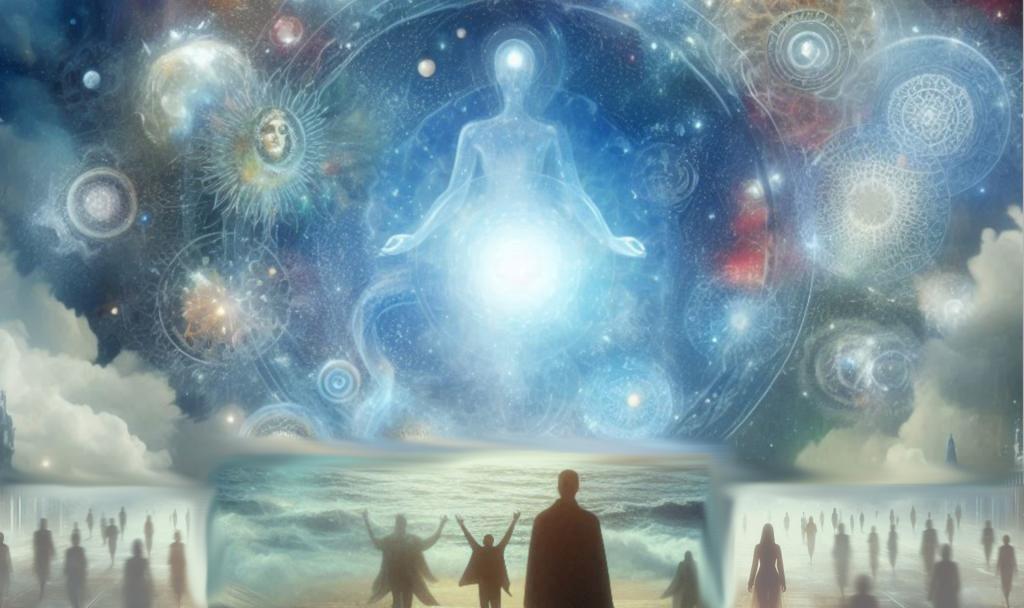
Heaven images of acceptance and love by MS Designer. Composition by Dorian Scott Cole.
Scripture Reference:
“In My Father’s house are many dwelling places; if it were not so, I would have told you; for I go to prepare a place for you. If I go and prepare a place for you, I will come again and receive you to Myself, that where I am, there you may be also.” Jesus to his apostles in John 14:2-3
Let’s get spiritual
The spirituality of today is often disconnected from community and can be more gnostic, emphasizing wisdom without emphasizing love of others. Love of others was the primary teaching of Jesus. Wisdom isn’t raw knowledge—it’s a product of experience.
An example that applies to Christianity as well is the Kundalini mystical experience. Kundalini in the Hindu religions is an example of gaining wisdom through experience. “Kundalini awakening is a process of spiritual awakening characterized by the ascent of a dormant energy (kundalini) through the body’s energy centers (chakras). This awakening can be understood in stages, including initial awakening, seeking, crisis, integration, transformation, and transcendence. These stages involve a progression of experiences and shifts in consciousness, often accompanied by physical, emotional, and psychological changes.” The Transformative Journey: Stages of Kundalini Awakening for Growth
It’s essentially the same for personal growth in spirituality and Christianity. Christians don’t emphasize stages, but rather continual spiritual growth.
Spiritual growth isn’t simply gaining knowledge. Knowledge without experience is weak. Spiritual growth is experiential.
Jesus and the Apostles about Heaven
Jesus told the apostles that he was going to Heaven to prepare a place for them.
Judaism had no official doctrine of the afterlife, including Heaven and Hell. “Ashes to ashes, dust to dust.” Personally I’m mostly dust blowing in the wind, getting in people’s eyes and irritating them. Kansas – Dust in the Wind.
The Sadducees in Jesus’ time had no belief in angels or life beyond the living. Beliefs in later Judaism probably came from other religions in the last five hundred years before Jesus’ time. Jesus had to address these new ideas.
By King David’s time, there was an inkling that the soul continued. In ancient Judaism, Sheol [the grave, realm of the dead] was the belief in an underworld or realm of the dead, where all individuals, regardless of their righteousness, descended after death.
Sheol was not a place of reward or punishment, but rather a shadowy existence, a state of separation from God and the world of the living. Sheol was often depicted as a subterranean place, a vast, silent, and inactive realm. It was very similar to the ancient Greek idea of Hades (Matthew 11:23, Matthew 16:18).
The writer of the Psalm16:9-11, possibly David, said:
“Therefore my heart is glad and my glory rejoices;
My flesh also will dwell securely.
For You will not abandon my soul to Sheol;
Nor will You allow Your Holy One to undergo decay.
You will make known to me the path of life;
In Your presence is fullness of joy;
In Your right hand there are pleasures forever.”
King David was probably a worse sinner than most of us. He sent a man into battle on the front lines to get him killed so he could have his wife, whom he lusted after.
Jesus, after his crucifixion, descended into Hell and led those there into everlasting life (1 Peter 3:18-20, Ephesians 4:9). In this, he triumphed over death and the accuser (Satan), who kept people captive through the guilt and shame of their sins. This could be interpreted either figuratively or literally. It ended the belief that Satan rules this world and individuals, and brings to light that the forgiveness of God, unearned, brings eternal life.
Jesus said that in Heaven, there is no male or female, meaning social distinctions like gender, ethnicity, and social status are erased, and all are one. We’re all equal in Christ. There is no giving in marriage. This means the earthly state of marriage, with its specific legal and social structures, will not continue in the same way in Heaven.
The Apostle Paul said he knew someone who had visited the “Third Heaven,” but he wasn’t supposed to talk about it (2 Corinthians 12:1-6). Apparently, his mentioning it had something to do with establishing his authority since he was otherwise seen as weak in a world filled with Roman aristocrats and soldiers who spoke authoritatively and well.
Paul also said that at death (resurrection) we are instantly transformed into incorruptible bodies, which we can think of as spirit (1 Corinthians 15:51-57).
Current Judaism views Heaven as an “open door policy” in which “The righteous of any people and any faith have a place. Our actions, not our specific beliefs, determine our fate.” There still is no concept of Hell in Judaism. Perhaps Hell is a state of being cut off from God as a choice.
The Mystics on Heaven
The Christian Mystic, Edgar Cayce, believed that Heaven isn’t somewhere we go, but a state we attain. Attaining Heaven, for want of a better description, occurs through spiritual growth. He believed that aligning your conscience, ideals, hopes, and desires with one’s true purpose is essential for spiritual growth.
He stated, consistent with Christian teaching, that “You get to heaven on the arms of people you have helped. In Christianity, we believe that our “fruits,” which are our good deeds, are the proof we follow Jesus.
According to Cayce, we continue to exist after death and can help and communicate with those who are here.
If there’s hope for me, there will be a level in Heaven for those with training wheels who are still seeking a quiet mind.
If there are seven heavens, according to some traditions, the first three have to do with the earthly plane. The remaining four are the Golden City, the “dwelling” of rest from struggles, the City of God which is a storehouse of all good things, and finally the vast plain of the infinite God and contentment.
Other mystics describe the beauty and joy of Heaven, which are beyond description. There is a direct presence of God or a divine being. It’s a state of unending joy and bliss, a culmination of spiritual perfection.
NDEs about Heaven
Some believe we are pre-existent souls that come to earth for a purpose. According to the Bible, God knew us before our birth and knows all about us. We don’t know for certain.
A minister, a priest and a rabbi were discussing when life begins.
The minister argued eloquently that life begins at birth.
The Priest argued that the teachings of the Church made it clear that life begins at conception.
The Rabbi replied, “you both have it wrong! Life begins when the last child moves out and the dog dies.” – Found on Ship of Fools
NDEs are very personalized experiences. They don’t appeal to the material desires within us like many earthly illusions and temptations. They clarify and they don’t mislead. They have profound positive impact on the lives of those who have them. Their fruits are godly.
They defy scientific explanation because scientifically they aren’t possible. They aren’t projections of the desires people have or their beliefs. Often people learn information that contradicts what they know or believe and sending them on a more wholesome path.
There is evidence some NDEs are made up for a specific agenda, such as promoting a particular viewpoint. They are sometimes couched in the religious garb of the individual believer, which is unavoidable. Perhaps that person’s life is about that. So, we have to be spiritually discerning. If NDEs are the opposite of the love of God for all, about hate and exclusion, they likely are false, and certainly don’t apply to others.
As a result, the findings can’t be generalized to everyone. But there are trends that are consistent across nearly all of them as experiences. They involve clinical death, in which the heart and all brain activity is stopped for several minutes or hours. Formation of a long, coherent story, vision, or hallucination is impossible in that state.
There is a sense of leaving your body. Some see things in the physical environment that it is impossible for them to see. They have a sense of travel to another place, and arrive in a realm of profound love, peace, and sometimes encounters with deceased loved ones and divine beings.
The realm is usually described as beyond words. There is beautiful scenery, celestial music, and it generally supports interpretations of Biblical scripture. (Obviously some interpret the Bible more narrowly.) People often see Jesus or God.
He’s Studied 1,000+ Near-Death Experiences and Says This Is Why He Believes They Prove the Bible
People from every religion, every walk of life, and every place in the world have similar experiences. This includes atheists and skeptics, those with strong religious beliefs, and those with no religion.
Many experience a life review. This is not a Heaven or Hell determination, as commonly conceived, and is experienced without judgment. It reveals life events and their consequences. Many see how others were affected by their acts or their words, whether negative or positive. Christians are continuously forgiven and improving (hopefully), and others can be also. So, all is forgotten and eternal judgment is no longer in the picture. It’s certainly not an end-of-life review.
Many experience some aspect of learning what their path in life was to be, and are told to return and finish the task. They re-enter life with renewed purpose.
Perhaps at some point after our lives are fulfilled, a determination is made where we belong in the hierarchy of Heaven, if there is one.
Many are reminded what their path in life was to be, so they get back on the right path. Some are shown places like a hall of records for each soul, and shown grand environments created especially for them where they will live. Rarely does an NDE have any negative imagery.
The specific content of NDEs seems subjective and individualized. It’s “seen through the eyes of a child, a believer, etc.,” rather than nailed down as boards and concrete.
What we can draw from NDEs is that life continues after physical death. Most of us go to a very pleasant place where we are accepted, loved, fit in, are with our families and friends, and dogs and cats, in a beautiful world in which we are no longer separated from God. We retain our personalities, and our burdens are left behind. What could be better than that? Well, maybe some rock music to go with it.
Conclusion
Whether we’re looking at the Bible, the Church, mystics, or NDEs, we know that our experience is for our transformation through being loved to loving others, and there is a place for us where there is no pain.
Let’s get on with being transformed in Jesus and loving others. Rather than about what you know, it’s about what you do.
“With hate, we have more to lose than gain – break the cycle.” – Dorian Scott Cole
“Our answer is God. God’s answer is us. Together we make the world better.” – Dorian Scott Cole
Probability Space
What probability spaces can we open in our minds to find one act of kindness to give today? One kind word, one kind action, one hug to someone hurting, one smile of encouragement and acceptance? Just one. It will make their day and yours.
(A probability space is where all the elements necessary for something to happen are present and it’s almost inevitable. All it takes is intention.)
Potential Space
If you think creatively and allow your mind to wander and explore, how can we be more discerning about what helps us grow spiritually and transform?”
(A potential space is a new space created by pushing the limits of what we know, believe, and how we behave into entirely new areas.)
Would love to hear your thoughts in the comments below. This helps me improve my work.
Please subscribe to my Patheos Newsletter.
Author Website: Dorian Scott Cole
General Christian
History and Religion

About Dorian Scott Cole
Additional information about the author is on the About tab You can read more about the author here.
Previous Post

June 25, 2025
Wanna Know a Secret?
Next Post
July 8, 2025 Homily: A Peek at What’s Behind the Veil
Recent Comments
Browse Our Archives
Select a Category Uncategorized
Select a Month October 2026 September 2026 August 2026 July 2026 June 2026 May 2026 April 2026 March 2026 February 2026 January 2026 December 2025 November 2025 October 2025 September 2025 August 2025 July 2025 June 2025 May 2025 April 2025 March 2025 February 2025 January 2025 December 2024 November 2024 October 2024 September 2024 August 2024 July 2024 June 2024 May 2024 April 2024 March 2024 February 2024 January 2024 December 2023 November 2023 October 2023 September 2023 June 2023 May 2023 April 2023 March 2023 February 2023 January 2023 December 2022 November 2022 October 2022 September 2022 August 2022 July 2022 June 2022 May 2022 April 2022 March 2022 February 2022 January 2022 December 2021 November 2021
Follow Us!
TAKE THE
Religious Wisdom Quiz
Skin for skin! All that a man has he will give for something precious. What is it?
Select your answer to see how you score.
His soul His family His wealth His life
Books by This Author Books by New Generations Explore Faith
Related posts from New Generations Explore Faith
Homily: A Peek at What’s Behind the Veil

The Kingdom of God, here, now, and forever

Love Your Enemies but Jesus Love Sends Them...

Chapter 9, Julian: The Menu and the Meal
TRENDING AT PATHEOS Progressive Christian

Jad Gillies on New Hillsong Worship Songs and...
For worship leader Jad Gillies, Hillsong Worship’s next chapter is not about...

Looking at the Largest Orthodox Cathedral on Earth
There is often a considerable amount of anger and, shall we...

The Problem with False Prophets
Miller’s Station UMC| 10/18/26| Anchor Verse: Jeremiah 23: 1, 9-23 I...

Emotion in Early Christianity by Andrew Crislip
Andrew Crislip’s Emotion in Early Christianity examines an often overlooked dimension of...

16 Spiritual Touchstones for a More Grounded Life
After decades of spiritual study, here are 16 principles I try...

Catholic Evangelization: Sharing Your Faith Every Day
Welcome back to the Graceful Awakening mini-series called, “From Faith to Mission.” ...
view all Progressive Christian blogs
What Are Your Thoughts?leave a comment
Ad-Free & Subscriber Log-In Subscription Support
- About Us
- 2026 Calendar
- Videos
- Podcasts
- Library of World Religions
- Faith In Media Tracker
- Advertise With Us
- Write for Us
- Privacy Policy
- Terms of Service
- Do Not Sell My Data
- Contact Us
- Radiant Digital
- Manage Newsletter Subscriptions
- Unsubscribe From Notifications
- Sitemap
Copyright 2008-2026, Patheos. All rights reserved.
Subscription Support Ad-Free & Subscriber Log-In
Follow Patheos