
BuddhistCatholicContemplativeEvangelicalGeneral ChristianHinduJewishLatter-day SaintMuslimNew VisionsProgressive Christian
Beliefs
- Buddhist
- Catholic
- Contemplative
- Evangelical
- General Christian
- Hindu
- Jewish
- Latter-day Saint
- More Voices
- Muslim
- New Visions
- Pagan
- Progressive Christian
Topics
- Religion News
- Food and Religion
- Sports and Religion
- Religious Art
- Religious Music and Entertainment
- Religious Events
- History and Religion
- Style and Religion
- Politics and Religion
- Women in Religion
- Recreation Outdoors and Religion
- Business Finance and Religion
- Careers Workplace and Religion
- Education and Religion
- Family Parenting and Religion
- Health Fitness and Religion
- Home and Religion
- Relationships and Religion
- Technology and Religion
- Travel and Religion
Columnists
- Buddhist Columnists
- Business Finance and Religion Columnists
- Careers Workplace and Religion Columnists
- Catholic Columnists
- Contemplative Columnists
- Education and Religion Columnists
- Evangelists Columnists
- Family Parenting and Religion Columnists
- General Christian Columnists
- Health Fitness and Religion Columnists
- Hindu Columnists
- History and Religion Columnists
- Home and Religion Columnists
- Jewish Columnists
- More Voices Columnists
- Latter Day Columnists
- Muslim Columnists
- New Visions Columnists
- Nonreligious Columnists
- Pagan Columnists
- Politics and Religion Columnists
- Progressive Columnists
- Recreation Outdoors and Religion Columnists
- Relationships and Religion Columnists
- Religion News Columnists
- Religious Art Columnists
- Religious Events Columnists
- Religious Music and Entertainment Columnists
- Sports and Religion Columnists
- Style and Religion Columnists
- Technology and Religion Columnists
- Travel and Religion Columnists
- Women in Religion Columnists
Resource Library
- 2026 Calendar
- Library of World Religions
- The 100 Most Holy Places on Earth
- Patheos Answers
- Podcasts
- Videos
- Faith Leaders Database
- Anglican Episcopalian
- Bahai
- Baptist
- Buddhism
- Christianity
- Confucianism
- Eastern Orthodoxy
- Hinduism
- Holiness and Pentecostal
- ISKCON
- Islam
- Judaism
- Lutheran
- Methodist
- The Church of Jesus Christ of Latter-day Saints
- New Age
- Paganism
- Presbytarian and Reformed
- Protestantism
- Religion Behind the Scenes
- Roman Catholic
- Scientology
- Shia Islam
- Sikhism
- Sufism
- Sunni Islam
- Taoism
- Zen
- See all religions
Research Tools
 Ad-Free & Subscriber Log-In Subscription Support
Ad-Free & Subscriber Log-In Subscription Support
Follow Patheos 

- Trending:
- Forgiveness
- |
- Marriage
- |
- Consciousness
- |
- Death Penalty
- |
- Election
- |
- Halloween

- Home
- Progressive Christian
- Home and Religion
- Neither Do I Condemn You
Neither Do I Condemn You
Last updated on: March 12, 2024 at 10:24 am by Dorian Scott Cole
Neither Do I Condemn You 2024-03-12T10:24:23-06:00 Dorian Scott Cole
Patheos Explore the world's faith through different perspectives on religion and spirituality! Patheos has the views of the prevalent religions and spiritualities of the world.
Practical Spirituality series
Some Scribes who kept the written law for their communities, and Pharisees who interpreted the Law according to their perspective, were always trying to trap Jesus. One day, as Jesus came to the Temple, they brought a woman before Jesus who was caught in the act of adultery. They made no mistake about this: According to Biblical law, adultery was an offence punished by stoning to death. Guilt was undeniable. They asked Jesus to weigh in on this.
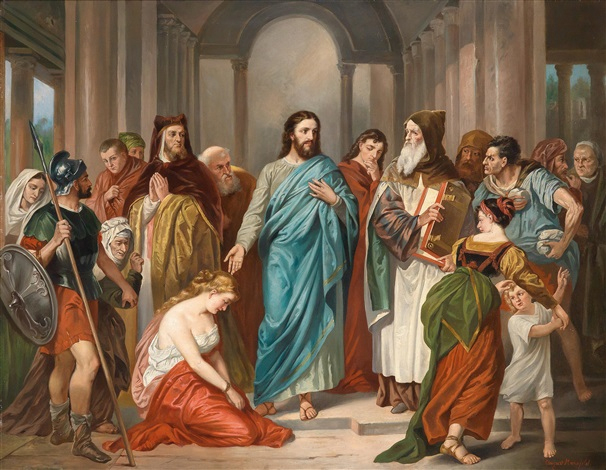
Image of Jesus and the Adulterous Woman by August Heinrich Mansfeld, Public domain, via Wikimedia Commons
Jesus stooped to the ground and wrote. We don’t know what he wrote, but judging from the delayed reaction, it was probably several commandments from the Bible. They were literate people who were well versed in scripture, so Jesus didn’t have to say the verses aloud or elaborate on them. They each knew what they had done in the past.
Midway, Jesus rose and said to them, “He who is without sin among you, let him be the first to throw a stone at her.” Then he stooped again and continued writing in the dirt.
Moments later, he looked up and asked where her accusers were. “Did no one condemn you?” She said, “No one, Lord.” And then Jesus said, “I do not condemn you, either. Go. From now on sin no more.” (John 8: 1-11 (NASB).)
Walking classes in school
High schools now offer “walking classes.” I think that’s a good thing. It’s even better exercise than sitting in class trying not to learn. I’m thinking there should be grades.
For those folks who just lean forward and catch themselves, or falter along, that style is an automatic D for presence and lack of effort.
For the leisurely walkers, those who meander, stroll, amble, or mosey, they should get a C. Show some initiative people. Put your brain on hold and move your arms and legs, and maybe get a B. Flap your arms and tell people you identify as an airplane. Identifying is now huge.
B should go to the power walkers who put a lot of initiative and energy into it.
An A should be reserved for those who skip, hop, jump, side step, side skip, side hop, dance, or do other cool maneuvers. These show more style, initiative, and energy. Exercise can bring out the creativity in us. They should walk to music. Music gets the entire body involved.
I should run the schools. Although in elementary school I told my mom I didn’t want to make As because it might become an expectation. I just wanted to skate through. Maybe I shouldn’t run the schools.
What about those who won’t do anything?
Some choose to sit on the sideline and complain, giving every excuse imaginable for not moving. They encounter two problems. First, they don’t want to cooperate or learn anything. Second, by not participating, they learn nothing from the experience. They’re flunking life. We should give them a B for all the harsh realities life has thrown at them and recognize them at a banquet. Jesus said, go into the streets and alleys of the town and bring in the poor, disabled, lame, and blind to banquets (Luke 14:12-24).
Wait a minute! We honor those whose performance is outstanding or acceptable. Not the troublemakers and loafers.
We don’t get the struggles others go through unless they’re visibly mistreated.
Few of us have to tackle the obstacles in their lives. They endure things like low self-esteem, abuse, and bad parenting. Some feel no one understands them. They have poor relationships with family, no friends, and teachers who hate them. Their peers say school is useless. They endure anxiety, depression. They feel they don’t have any competence or skills, and they have conditions no one understands. That’s harsh. That’s difficult.
My wife, and sometimes myself, work with a wide range of people. Some of the horror stories she tells me about kids she works with are unimaginable. The things these children have to overcome in life are things that would crush many of us. Yet many of them overcome.
Several people close to me have endured physical and mental abuse, and many have been in dire need at times. I’ve experienced enough of this to know how difficult it is to handle. They overcome.
I’m not joking about recognizing them. Give them a B for walking or sitting on the sidelines and brighten up their lives a bit. Try understanding rather than criticism. Then maybe when they walk, their head will be a little higher. It’s amazing what a little recognition will do both for their self-esteem and relationship with you. They need a friend who accepts them just as they are, warts and all.
Jesus accepted others
Jesus and the Apostles met so many kinds of people who the public condemned. One of Jesus’ miracles was that he accepted them all.
Jesus had harsh words for the leaders that were snakes and hypocrites who were always trying to trap him and mistreated others.
In Matthew 23, Jesus talked about people who do everything for show but neglect the weightier provisions of the law: justice, mercy, and faithfulness. He said they not only don’t enter the Kingdom of Heaven, they prevent others from entering because they insist on false beliefs, placing the appearance of godliness above doing God’s work.
The rejected people Jesus accepted
The Jews had potent feelings about who was not acceptable to them. Their were laws preventing associating with those who weren’t Jews. They thought anyone with a sickness was suffering because of sin. Their powerful sense of ritual cleanliness excluded others who they considered unclean.
Jesus had no such sense of rejection of others. He said to go into the streets and alleys of the town and bring in the poor, disabled, lame, and blind. The tax collectors with whom he associated were both hated by the Jews and were often thieves. He said to the thief next to him on the cross, who understood he had done wrong as most of us do, that he would be with him in Paradise.
He went to the Samaritans, a sect keeping the Torah, who the Jews hated because of their differences. He spoke to women there, which was against Jewish custom. The Roman soldiers he also accepted and helped despite the Jews hating them. The adulterous woman he refused to condemn—sin didn’t mean exclusion.
Jesus also ministered to the Gentiles (non-Jews). Jesus’ first visitors as a baby were the Magi, who were priests of the Zoroastrian religion in Iran. Symbolically they brought gifts to Jesus who was to usher in an age of peace. Jesus noted that some Gentiles had astonishing faith greater than that of the Jews. He said that some will feast with him. (Matthew 8:5-10, 8:11)
Jesus came to condemn no one. Yet many Christians today spend their time condemning others for what they consider their sins. They avoid others because they aren’t like them.
We’re all accustomed to those who scream all the day long about things they don’t like. Many don’t stop short of condemning you to their version of hell. They wade in with both feet and condemn. To them Jesus would probably say, “Take the board out of your own eye before trying to remove tiny splinters from others’ eyes.” “Don’t judge others or you will be judged by the same standard you set.” (He said these things in Matthew 7:3-5 and Matthew 7:1-3).
Conclusion
No doubt one reason the Jewish leaders wanted Jesus removed was because of the people he associated with. How many of us use the same reason to avoid others?
Jesus wasn’t about excluding others. Jesus accepts all of us. “All” is one of those very little words with a very big meaning. It reflects God. God wants mercy, not sacrifice (Matthew 9:13 and 12:7, Hosea 6:6.)
God is inclusive of his children. We’re “all” God’s children. In this life, and perhaps the next, we can enter God’s Kingdom, which is here now and forever. It’s a spiritual kingdom that is here now, not a physical one in some far off time.
It’s our role in this kingdom to be a light to the world. Not through the things we say but through the examples of helping others we set, showing love, mercy, justice, mercy, and faithfulness.
Jesus said that love of God and love of others is what the entire Bible (Law and prophets) is about. What do we make it about?
Probability Space
People in need are always around us. They stand on street corners and ask for help. They live in cars or in poverty situations. All we have to do is notice them and be prepared to help.
Ask yourself like Abraham did with the Lord when they headed for a city to destroy the evil inhabitants who mistreated others: “How many good or bad people will hinder me from helping others?” Is it one in ten who are takers? Five in ten? Nine in ten?
Can we create a space in our minds for noticing others in need, thinking of ways to help them, and understanding how many takers are too many?
Potential Space
If you think creatively and allow your mind to wander and explore, how can we help others in ways that get them taking care of their own needs? Teach them to fish instead of perpetually giving them fish.
One way is to direct them to the many resources available to them. We carry a handout in our car that lists warming places for people during extreme cold weather, and agencies that provide temporary housing, meals for them and their families, and assist in finding a job.
When people with limited means have a car breakdown, this often means they don’t have the money to fix it and lose their income. This often leads to families becoming homeless. What are ways in which you could help? For example, could you and a bunch of friends start a car rental service (or rent to own), that would enable people in this situation to keep going?
What other ways can you think of to help others in need?
– Dorian
Our answer is God. God’s answer is us. Together we make the world better.
General Christian
Home and Religion

About Dorian Scott Cole
Additional information about the author is on the About tab. You can read more about the author here.
Previous Post

March 4, 2024
Maundy Thursday 2024
Next Post

March 25, 2024 God Makes New Things
Recent Comments
Browse Our Archives
Select a Category Uncategorized
Select a Month October 2026 September 2026 August 2026 July 2026 June 2026 May 2026 April 2026 March 2026 February 2026 January 2026 December 2025 November 2025 October 2025 September 2025 August 2025 July 2025 June 2025 May 2025 April 2025 March 2025 February 2025 January 2025 December 2024 November 2024 October 2024 September 2024 August 2024 July 2024 June 2024 May 2024 April 2024 March 2024 February 2024 January 2024 December 2023 November 2023 October 2023 September 2023 June 2023 May 2023 April 2023 March 2023 February 2023 January 2023 December 2022 November 2022 October 2022 September 2022 August 2022 July 2022 June 2022 May 2022 April 2022 March 2022 February 2022 January 2022 December 2021 November 2021
Follow Us!
TAKE THE
Religious Wisdom Quiz
What does the Greek word 'Christos' mean?
Select your answer to see how you score.
Savior Lord Redeemer Anointed One
Books by This Author Books by New Generations Explore Faith
Related posts from New Generations Explore Faith

Chapter 9, Julian: The Menu and the Meal
Chapter 7: The Commencement and the Glowing Screen
Chapter 6, Elena: The Quest for Peaceful Connection
TRENDING AT PATHEOS Progressive Christian

Emotion in Early Christianity by Andrew Crislip
Andrew Crislip’s Emotion in Early Christianity examines an often overlooked dimension of...

16 Spiritual Touchstones for a More Grounded Life
After decades of spiritual study, here are 16 principles I try...

Catholic Evangelization: Sharing Your Faith Every Day
Welcome back to the Graceful Awakening mini-series called, “From Faith to Mission.” ...

The Pillar of the Boatmen: the Ancient Monument...
The Pillar of the Boatmen is a Romano-Gaulish sculpture that dates from...

In one sense walking into Westminster Abbey is like walking down the...

'Super Scam Me' Exposes AI Jon Bon Jovi...
Leslie Pickett believed she was in a relationship with Jon Bon Jovi....
view all Progressive Christian blogs
What Are Your Thoughts?leave a comment
Ad-Free & Subscriber Log-In Subscription Support
- About Us
- 2026 Calendar
- Videos
- Podcasts
- Library of World Religions
- Faith In Media Tracker
- Advertise With Us
- Write for Us
- Privacy Policy
- Terms of Service
- Do Not Sell My Data
- Contact Us
- Radiant Digital
- Manage Newsletter Subscriptions
- Unsubscribe From Notifications
- Sitemap
Copyright 2008-2026, Patheos. All rights reserved.
Subscription Support Ad-Free & Subscriber Log-In
Follow Patheos