
BuddhistCatholicContemplativeEvangelicalGeneral ChristianHinduJewishLatter-day SaintMuslimNew VisionsProgressive Christian
Beliefs
- Buddhist
- Catholic
- Contemplative
- Evangelical
- General Christian
- Hindu
- Jewish
- Latter-day Saint
- More Voices
- Muslim
- New Visions
- Pagan
- Progressive Christian
Topics
- Religion News
- Food and Religion
- Sports and Religion
- Religious Art
- Religious Music and Entertainment
- Religious Events
- History and Religion
- Style and Religion
- Politics and Religion
- Women in Religion
- Recreation Outdoors and Religion
- Business Finance and Religion
- Careers Workplace and Religion
- Education and Religion
- Family Parenting and Religion
- Health Fitness and Religion
- Home and Religion
- Relationships and Religion
- Technology and Religion
- Travel and Religion
Columnists
- Buddhist Columnists
- Business Finance and Religion Columnists
- Careers Workplace and Religion Columnists
- Catholic Columnists
- Contemplative Columnists
- Education and Religion Columnists
- Evangelists Columnists
- Family Parenting and Religion Columnists
- General Christian Columnists
- Health Fitness and Religion Columnists
- Hindu Columnists
- History and Religion Columnists
- Home and Religion Columnists
- Jewish Columnists
- More Voices Columnists
- Latter Day Columnists
- Muslim Columnists
- New Visions Columnists
- Nonreligious Columnists
- Pagan Columnists
- Politics and Religion Columnists
- Progressive Columnists
- Recreation Outdoors and Religion Columnists
- Relationships and Religion Columnists
- Religion News Columnists
- Religious Art Columnists
- Religious Events Columnists
- Religious Music and Entertainment Columnists
- Sports and Religion Columnists
- Style and Religion Columnists
- Technology and Religion Columnists
- Travel and Religion Columnists
- Women in Religion Columnists
Resource Library
- 2026 Calendar
- Library of World Religions
- The 100 Most Holy Places on Earth
- Patheos Answers
- Podcasts
- Videos
- Faith Leaders Database
- Anglican Episcopalian
- Bahai
- Baptist
- Buddhism
- Christianity
- Confucianism
- Eastern Orthodoxy
- Hinduism
- Holiness and Pentecostal
- ISKCON
- Islam
- Judaism
- Lutheran
- Methodist
- The Church of Jesus Christ of Latter-day Saints
- New Age
- Paganism
- Presbytarian and Reformed
- Protestantism
- Religion Behind the Scenes
- Roman Catholic
- Scientology
- Shia Islam
- Sikhism
- Sufism
- Sunni Islam
- Taoism
- Zen
- See all religions
Research Tools
 Ad-Free & Subscriber Log-In Subscription Support
Ad-Free & Subscriber Log-In Subscription Support
Follow Patheos 

- Trending:
- Forgiveness
- |
- Marriage
- |
- Consciousness
- |
- Death Penalty
- |
- Election
- |
- Halloween

- Home
- Progressive Christian
- History and Religion
- Why Worship God?
Why Worship God?
Last updated on: November 5, 2022 at 10:13 am by Dorian Scott Cole
Why Worship God? 2022-11-05T10:13:29-06:00 Dorian Scott Cole
Patheos Explore the world's faith through different perspectives on religion and spirituality! Patheos has the views of the prevalent religions and spiritualities of the world.
Some astute people have asked why God needs the worship of people. Some have even asked if God is a narcissist requiring constant worship. We don’t anthropomorphize God (apply human characteristics). God has no needs that we’re aware of that people can address. Following God (or Jesus) means following the way we have been shown to behave.
Someone said, if you think people don’t care about gender, just call God a she. Funny how we are. I try not to use personal pronouns with God. He, she, and it don’t seem to apply. So what is this worship business of this invisible person all about?
“But an hour is coming, and now is, when the true worshipers will worship the Father in spirit and truth; for such people the Father seeks to be His worshipers.” – John 4:23-24 (NASB)
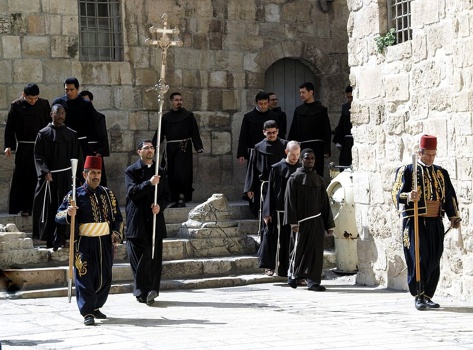
Image by lehava nazareth Pikiwiki Israel: “Religion in Israel – Procession on the parvis of the Church of the Holy Sepulchre headed by Kawas (Ottoman guards)”
How would we honor God?
Our tradition is to go to church. There we sing songs of praise and we listen to Bible passages which God brings to life in each one of us. Or not. We share a common experience, and commune with Christ. But does this really honor God?
Historical experience with God
From ancient days until today people all over the world in all religions have understood the profound presence of God in their lives. It usually isn’t something “felt,” not a feeling, but more of a compulsion to understand and do the right thing. It’s an experiential thing.
Praising God, which is not the same as worship but part of it, is based on a variety of things that God does in our lives. God is love. God is merciful.
By this we mean that God gives us space to grow and overcome the shortcomings in our lives. God is tolerant, not quick to punish, patiently enduring our faults just as we do small children.
God is forgiving when we do things and aren’t right, we recognize this as the thief on the cross did, then turn away from those things. In doing this God leads us to better lives.
God isn’t just someone who transforms us from being selfish and uncaring people who might hurt others to people who avoid hurting others and instead help them. God helps us in our times of need. God answers prayer.
Church has a lot to do with community. God helps us form caring communities that are centered around common interests. Others who worship God do help others.
God heals our bodies and souls. Prayer works.
We show our love, thanks, and joy in many different creative ways. We express the person that God created us to be through using our gifts, talents, education, and aptitudes by sharing them with others. Church is a place we can help others through education, sharing our talent in entertainment, educating others on life skills, and giving assistance or money to social causes.
Praise essentially means to tell what God means to us or has done in our lives.
What does it mean to worship God?
In the Hebrew Bible (Old Testament) the word translated “worship,” (shâchâh) essentially means to bow down, even to the point of being prostrate in homage, obeisance, and/or reverence – worship. In more common terms this means special honor or respect, bowing in respect, deep respect. This was the common meaning at least until the time of Jesus.
For example, the Catholic Vulgate translation of the word commonly translated from shâchâh as worship in Ezekiel 46:2-9, renders the passage as “adore.”
The word “worship” didn’t enter usage until around the year 1300.
To honor – verb
Perhaps it might be better to zoom in on the older and newer idea of worship as how to “honor God.” Honor as a verb keeps the meaning of respect, but carries with it “fulfill (an obligation) or keep (an agreement).” The Israelites had an agreement (covenant) with God about being his people and God would be their God.
One article defines honor as: “. .. the idea of a bond between an individual and a society as a quality of a person that is both of social teaching and of personal ethos, that manifests itself as a code of conduct, and has various elements such as valour, chivalry, honesty, and compassion. It is an abstract concept entailing a perceived quality of worthiness and respectability that affects both the social standing and the self-evaluation of an individual or institutions such as a family, school, regiment or nation. Accordingly, individuals (or institutions) are assigned worth and stature based on the harmony of their actions with a specific code of honour, and the moral code of the society at large.”
In the New Testament in John 4:23, the word translated as “worship” comes from the Greek word, “proskuneo” from which you can easily see the word prostrate. “Like a dog licking its masters hand.” Homage, reverence, adore.
For example, the Catholic Vulgate translation of the word commonly translated as “worship” in the New Testament in John 4:23, is rendered: “but the hour is coming, and now is when the true worshipers will worship the Father in spirit and in truth.”
To honor God would be more in line with what Jesus taught about “doing,” not just praising.
Jesus and the prophets
Jesus called out the people who only pay lip service to God, quoting Isaiah: “‘This people honors Me with their lips, But their heart is far away from Me. ‘But in vain do they worship Me, Teaching as doctrines the precepts of men.’””
By precepts Jesus was referring to the oral torah which were traditions of the Fathers that sometimes were put in higher regard than the Torah (first five books of the Bible). The Torah was at minimum guidance in life and at maximum rigid laws.
Note: Tithing (literally 10% of what you grow) is a Hebrew Bible edict. The food was intended to be shared with the religious leaders, the poor, and yourself at a feast. When the leaders were too far away the crop portion could be converted into money and whatever your heart desired could be purchased with it. Deuteronomy 14:22-26.
Jesus said to give as you are prospered.
Like the day of rest (Sabbath) these customs grew into other traditions.
For example, giving was a tradition while helping others is a command. In this situation Jesus said to them that the Torah says to honor mother and father, but instead they say ““Whatever I have that would help you [mother and father] has been given to God ….””
The strong message from Jesus is that you are not to neglect people in need while giving to God.
The True Worship Jesus refers to is what the prophets Amos, Jeremiah, Isaiah, and Ezekiel talked about. They spoke harshly of those who ignore duties while paying lip service to God through following traditions, but in Jesus’ words, ““Woe to you, scribes and Pharisees, hypocrites! For you tithe mint and dill and cummin, and have neglected the weightier provisions of the law: justice and mercy and faithfulness ….” – Matthew 23:23 (NASB)
Related articles
What is meant by truth (worship in spirit and I truth)
Takeaway
The worship traditions we have are largely good things. They bring people together into community in which we are supportive of each other and are more powerful in addressing needs.
But worship traditions can’t displace our duties to others. We honor God by doing what God asks of us – that is, service to others.
________________________
The standard of belief and conduct for Christianity is love. God is love. Be like God.
________________________
If you find these articles intriguing, please consider joining the mailing list.
If I’ve challenged your thinking, I’ve done my job.
___________________
Our answer is God. God’s answer is us. Together we make the world better.
– Dorian
Nonreligious
New Visions
More Voices
Interfaith
Humanist
General Christian
Evangelical
Contemplative
History and Religion
Education and Religion

About Dorian Scott Cole
Additional information about the author is on the About tab. You can read more about the author here.
Previous Post

October 26, 2022
Another Day, Another Mass Shooting
Next Post

November 7, 2022 Blood Moon tonight. Does it have meaning?
Browse Our Archives
Select a Category Uncategorized
Select a Month October 2026 September 2026 August 2026 July 2026 June 2026 May 2026 April 2026 March 2026 February 2026 January 2026 December 2025 November 2025 October 2025 September 2025 August 2025 July 2025 June 2025 May 2025 April 2025 March 2025 February 2025 January 2025 December 2024 November 2024 October 2024 September 2024 August 2024 July 2024 June 2024 May 2024 April 2024 March 2024 February 2024 January 2024 December 2023 November 2023 October 2023 September 2023 June 2023 May 2023 April 2023 March 2023 February 2023 January 2023 December 2022 November 2022 October 2022 September 2022 August 2022 July 2022 June 2022 May 2022 April 2022 March 2022 February 2022 January 2022 December 2021 November 2021
Follow Us!
TAKE THE
Religious Wisdom Quiz
Who dreamed of a ladder reaching heaven?
Select your answer to see how you score.
Paul Jacob Elijah Abraham
Books by This Author Books by New Generations Explore Faith
Related posts from New Generations Explore Faith

Chapter 9, Julian: The Menu and the Meal
Chapter 7: The Commencement and the Glowing Screen
Chapter 6, Elena: The Quest for Peaceful Connection
TRENDING AT PATHEOS Progressive Christian

Emotion in Early Christianity by Andrew Crislip
Andrew Crislip’s Emotion in Early Christianity examines an often overlooked dimension of...

16 Spiritual Touchstones for a More Grounded Life
After decades of spiritual study, here are 16 principles I try...

Catholic Evangelization: Sharing Your Faith Every Day
Welcome back to the Graceful Awakening mini-series called, “From Faith to Mission.” ...

The Pillar of the Boatmen: the Ancient Monument...
The Pillar of the Boatmen is a Romano-Gaulish sculpture that dates from...

In one sense walking into Westminster Abbey is like walking down the...

'Super Scam Me' Exposes AI Jon Bon Jovi...
Leslie Pickett believed she was in a relationship with Jon Bon Jovi....
view all Progressive Christian blogs
Ad-Free & Subscriber Log-In Subscription Support
- About Us
- 2026 Calendar
- Videos
- Podcasts
- Library of World Religions
- Faith In Media Tracker
- Advertise With Us
- Write for Us
- Privacy Policy
- Terms of Service
- Do Not Sell My Data
- Contact Us
- Radiant Digital
- Manage Newsletter Subscriptions
- Unsubscribe From Notifications
- Sitemap
Copyright 2008-2026, Patheos. All rights reserved.
Subscription Support Ad-Free & Subscriber Log-In
Follow Patheos