
BuddhistCatholicContemplativeEvangelicalGeneral ChristianHinduJewishLatter-day SaintMuslimNew VisionsProgressive Christian
Beliefs
- Buddhist
- Catholic
- Contemplative
- Evangelical
- General Christian
- Hindu
- Jewish
- Latter-day Saint
- More Voices
- Muslim
- New Visions
- Pagan
- Progressive Christian
Topics
- Religion News
- Food and Religion
- Sports and Religion
- Religious Art
- Religious Music and Entertainment
- Religious Events
- History and Religion
- Style and Religion
- Politics and Religion
- Women in Religion
- Recreation Outdoors and Religion
- Business Finance and Religion
- Careers Workplace and Religion
- Education and Religion
- Family Parenting and Religion
- Health Fitness and Religion
- Home and Religion
- Relationships and Religion
- Technology and Religion
- Travel and Religion
Columnists
- Buddhist Columnists
- Business Finance and Religion Columnists
- Careers Workplace and Religion Columnists
- Catholic Columnists
- Contemplative Columnists
- Education and Religion Columnists
- Evangelists Columnists
- Family Parenting and Religion Columnists
- General Christian Columnists
- Health Fitness and Religion Columnists
- Hindu Columnists
- History and Religion Columnists
- Home and Religion Columnists
- Jewish Columnists
- More Voices Columnists
- Latter Day Columnists
- Muslim Columnists
- New Visions Columnists
- Nonreligious Columnists
- Pagan Columnists
- Politics and Religion Columnists
- Progressive Columnists
- Recreation Outdoors and Religion Columnists
- Relationships and Religion Columnists
- Religion News Columnists
- Religious Art Columnists
- Religious Events Columnists
- Religious Music and Entertainment Columnists
- Sports and Religion Columnists
- Style and Religion Columnists
- Technology and Religion Columnists
- Travel and Religion Columnists
- Women in Religion Columnists
Resource Library
- 2026 Calendar
- Library of World Religions
- The 100 Most Holy Places on Earth
- Patheos Answers
- Podcasts
- Videos
- Faith Leaders Database
- Anglican Episcopalian
- Bahai
- Baptist
- Buddhism
- Christianity
- Confucianism
- Eastern Orthodoxy
- Hinduism
- Holiness and Pentecostal
- ISKCON
- Islam
- Judaism
- Lutheran
- Methodist
- The Church of Jesus Christ of Latter-day Saints
- New Age
- Paganism
- Presbytarian and Reformed
- Protestantism
- Religion Behind the Scenes
- Roman Catholic
- Scientology
- Shia Islam
- Sikhism
- Sufism
- Sunni Islam
- Taoism
- Zen
- See all religions
Research Tools
 Ad-Free & Subscriber Log-In Subscription Support
Ad-Free & Subscriber Log-In Subscription Support
Follow Patheos 

- Trending:
- Forgiveness
- |
- Marriage
- |
- Consciousness
- |
- Death Penalty
- |
- Election
- |
- Halloween

- Home
- Progressive Christian
- Biblical Context – it’s everything
Biblical Context – it’s everything
Last updated on: September 10, 2022 at 4:21 pm by Dorian Scott Cole
Biblical Context – it’s everything 2022-09-10T16:21:57-06:00 Dorian Scott Cole
Patheos Explore the world's faith through different perspectives on religion and spirituality! Patheos has the views of the prevalent religions and spiritualities of the world.
Can we believe this story?
The Hebrew Bible (Old Testament) offers the story of Elisha and the Two Bears (2 Kings 2:23-25). A large group of young men insulted Elisha by insulting him with “baldy” (“Go up [to Heaven], you baldhead”). Elisha cursed them then two bears came out and “tore up” 24 of their number. Some believe this story is real and justify it.
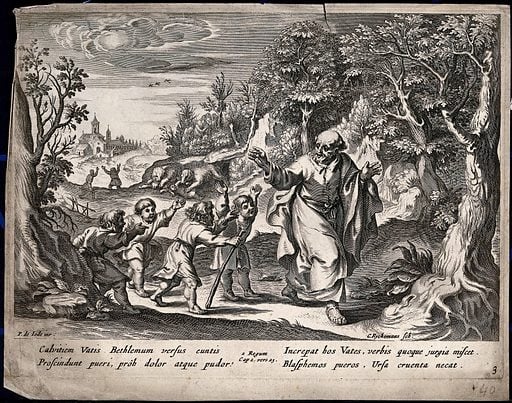
Elisha and the Bears. Image by Pieter de Jode I, Welcome Collection, on Look and Learn
Elisha and the Bears
On the face of it, the story doesn’t seem true to the character of Elisha or of God. It seems unlikely that the two bears mauled 24 young men (twelve to thirty years old) running in 24 different directions.
This is a perfect example of context. Does it fit with the example of the love God shows to us or that he expects from us, as taught by Judaism, Christianity, and other religions? Or is it just some tale told to get more respect from young people? Or does it belong in the Bible at all? Can the Bible be believed with stories in it that seem opposite to what we know?
In defense, if there can be any defense, Bethel was a place of idolatry and rebellion. “These youths were typical of a nation that “mocked the messengers of God, despised His words, and scoffed at His prophets.” This may have been a mob (exceeded 42), more like a gang, not just taunting the prophet, but bent on violence. Both Deuteronomy 27-28 and Leviticus 26 promise God will send depending on how the people act: blessings for obedience and curses for disobedience. The story can be seen in the light of Leviticus 26:22: “I will let loose among you the beasts of the field, which will bereave you of your children and destroy your cattle and reduce your number so that your roads lie deserted.” It was a very harsh time and according to God’s agreement with the people there would be harsh penalties for disobedience. Even the King’s disobedience brought calamity on the people.
Today we would likely refuse such an agreement and see it as egregious. But regarding Elisha’s actions, they may have been in self-defense from a mob that would have done him harm.
True Witness
Does the Bible even purport to be a true witness to God and give us the meaning of the events in it?
“And He [Jesus] did not let him, but He said to him, “Go home to your people and report to them what great things the Lord has done for you, and how He had mercy on you.” (Mark 5:19, Luke 8:39.)
How does Elisha’s actions compare On the Biblical view on how to treat children, see Matthew 19: 13 – 15, Mark 10: 13 – 16, and Luke 18: 15 – 17.
Do Elisha’s actions bring respect or disrespect for prophets? Culturally it might have depended on the era and notions of respect in that era.
Actions of people are most telling
““Beware of the false prophets, who come to you in sheep’s clothing, but inwardly are ravenous wolves. You will know them by their fruits. Grapes are not gathered from thorn bushes nor figs from thistles, are they? So every good tree bears good fruit, but the bad tree bears bad fruit. A good tree cannot produce bad fruit, nor can a bad tree produce good fruit. Every tree that does not bear good fruit is cut down and thrown into the fire. So then, you will know them by their fruits.”
Elisha in 2 Kings 2 is portrayed as a strong supporter of Elijah, but who wanted more power (double dose of his spirit) as a prophet. His actions demonstrate miracles and benevolent acts. What was the benevolent act or miracle in this story? That Elisha or God would destroy young people on a whim? Could God not have swept them away with a sudden storm?
What was the enduring “fruit” of this story?
Literary Analysis view
The person who assembled these texts into “book” form seemed to favor the prophets and showed kingship only brings calamity because of King after King’s failure to worship God properly and they disregarded the prophets. Not having a king is a strong theme in the Hebrew Bible – it took power from the prophets.
The “Deuteronomist” who assembled these texts brought together the official annals of the kings and prophets into one book in around 700 BCE, and in variations in the text there is evidence he added his own thoughts in places and edited in places. He could have chosen to leave out the Elisha story.
The Deuteronomist seemed to have an agenda of slanting the narrative into destroying the power of kingship while glorifying the power of the prophets.
The individual reader will have to decide whether or not the story does bring respect for God and God’s representatives, or says that punitive measures on the young are appropriate. Certainly individual preferences will sway people one way or another.
God breathes life into writings. Life in the Bible generally means: “the real life, the vital connection with the world and God, the sum total of man’s highest interests.” This story likely makes people uneasy and doesn’t seem to fit for a reason.
As this section illustrates, the Bible is complex and not at all easy to understand. It might be that it isn’t even beneficial for people without a critical mind and a good knowledge of history to even be reading sections like this. I don’t feel that the Hebrew Bible and much of the New Testament are good for much but scholarship.
Takeaway
Since the printing press was developed, the job of twisting the words and meaning of the Bible transferred from priests to individuals. It’s wasn’t and isn’t a pretty picture.
For many people the Bible is a knotty and perilous book. For some it’s a source for examples that tell the vicious things they want to put on others. For some it’s a way to justify their ill intent. For many it’s a book that inspires them to better living and greater things. Yet the Bible should never fall solely into the hands of an elite class – we know from history that way brings insufferable corruption.
For people who want to be led by the ways God has shown us, they can read portions of the Bible and find God has breathed life into the words and into them. Each individual can prove the value of Scripture in their own lives.
For those who have their own agenda when reading the Bible, distorted perception is not reality. It’s the path to insanity and ruin.
________________________
The standard of belief and conduct for Christianity is love. Legal standard.
________________________
If you find these articles intriguing, please consider joining the mailing list.
If I’ve challenged your thinking, I’ve done my job.
___________________
Our answer is God. God’s answer is us. Together we make the world better.
– Dorian

About Dorian Scott Cole
Additional information about the author is on the About tab. You can read more about the author here.
Previous Post
September 6, 2022
Bible and Religion – What To Believe?
Next Post

September 13, 2022 What is love: The Apostles
Browse Our Archives
Select a Category Uncategorized
Select a Month October 2026 September 2026 August 2026 July 2026 June 2026 May 2026 April 2026 March 2026 February 2026 January 2026 December 2025 November 2025 October 2025 September 2025 August 2025 July 2025 June 2025 May 2025 April 2025 March 2025 February 2025 January 2025 December 2024 November 2024 October 2024 September 2024 August 2024 July 2024 June 2024 May 2024 April 2024 March 2024 February 2024 January 2024 December 2023 November 2023 October 2023 September 2023 June 2023 May 2023 April 2023 March 2023 February 2023 January 2023 December 2022 November 2022 October 2022 September 2022 August 2022 July 2022 June 2022 May 2022 April 2022 March 2022 February 2022 January 2022 December 2021 November 2021
Follow Us!
TAKE THE
Religious Wisdom Quiz
True or False: The Sermon on the Mount includes the Lord's Prayer.
Select your answer to see how you score.
TRUE FALSE
Books by This Author Books by New Generations Explore Faith
Related posts from New Generations Explore Faith


Chapter 9, Julian: The Menu and the Meal
Chapter 7: The Commencement and the Glowing Screen
TRENDING AT PATHEOS Progressive Christian

The Iron Gates and the Lion of the...
Yesterday, I didn't finish my report about, well, yesterday. So I'll...

Dolly Parton’s Last Song Wins Dove Award with...
Bluegrass band The Grascals, speaking on the red carpet at the 57th...

The Image: On the Horror of Capitalism and...
The Image Then went the Pharisees, and took counsel how they might...

We are approaching the date of our new American national holiday: October...

Letters on Living the Faith by C.S. Lewis
Most of us met C.S. Lewis as a public intellectual. Mere Christianity....

When Halloween Unmasks Married Hearts
Written by Dr. David K. Ewen from Eternal Truth Bible College Behind...
view all Progressive Christian blogs
Ad-Free & Subscriber Log-In Subscription Support
- About Us
- 2026 Calendar
- Videos
- Podcasts
- Library of World Religions
- Faith In Media Tracker
- Advertise With Us
- Write for Us
- Privacy Policy
- Terms of Service
- Do Not Sell My Data
- Contact Us
- Radiant Digital
- Manage Newsletter Subscriptions
- Unsubscribe From Notifications
- Sitemap
Copyright 2008-2026, Patheos. All rights reserved.
Subscription Support Ad-Free & Subscriber Log-In
Follow Patheos