
BuddhistCatholicContemplativeEvangelicalGeneral ChristianHinduJewishLatter-day SaintMuslimNew VisionsProgressive Christian
Beliefs
- Buddhist
- Catholic
- Contemplative
- Evangelical
- General Christian
- Hindu
- Jewish
- Latter-day Saint
- More Voices
- Muslim
- New Visions
- Pagan
- Progressive Christian
Topics
- Religion News
- Food and Religion
- Sports and Religion
- Religious Art
- Religious Music and Entertainment
- Religious Events
- History and Religion
- Style and Religion
- Politics and Religion
- Women in Religion
- Recreation Outdoors and Religion
- Business Finance and Religion
- Careers Workplace and Religion
- Education and Religion
- Family Parenting and Religion
- Health Fitness and Religion
- Home and Religion
- Relationships and Religion
- Technology and Religion
- Travel and Religion
Columnists
- Buddhist Columnists
- Business Finance and Religion Columnists
- Careers Workplace and Religion Columnists
- Catholic Columnists
- Contemplative Columnists
- Education and Religion Columnists
- Evangelists Columnists
- Family Parenting and Religion Columnists
- General Christian Columnists
- Health Fitness and Religion Columnists
- Hindu Columnists
- History and Religion Columnists
- Home and Religion Columnists
- Jewish Columnists
- More Voices Columnists
- Latter Day Columnists
- Muslim Columnists
- New Visions Columnists
- Nonreligious Columnists
- Pagan Columnists
- Politics and Religion Columnists
- Progressive Columnists
- Recreation Outdoors and Religion Columnists
- Relationships and Religion Columnists
- Religion News Columnists
- Religious Art Columnists
- Religious Events Columnists
- Religious Music and Entertainment Columnists
- Sports and Religion Columnists
- Style and Religion Columnists
- Technology and Religion Columnists
- Travel and Religion Columnists
- Women in Religion Columnists
Resource Library
- 2026 Calendar
- Library of World Religions
- The 100 Most Holy Places on Earth
- Patheos Answers
- Podcasts
- Videos
- Faith Leaders Database
- Anglican Episcopalian
- Bahai
- Baptist
- Buddhism
- Christianity
- Confucianism
- Eastern Orthodoxy
- Hinduism
- Holiness and Pentecostal
- ISKCON
- Islam
- Judaism
- Lutheran
- Methodist
- The Church of Jesus Christ of Latter-day Saints
- New Age
- Paganism
- Presbytarian and Reformed
- Protestantism
- Religion Behind the Scenes
- Roman Catholic
- Scientology
- Shia Islam
- Sikhism
- Sufism
- Sunni Islam
- Taoism
- Zen
- See all religions
Research Tools
 Ad-Free & Subscriber Log-In Subscription Support
Ad-Free & Subscriber Log-In Subscription Support
Follow Patheos 

- Trending:
- Forgiveness
- |
- Marriage
- |
- Consciousness
- |
- Death Penalty
- |
- Election
- |
- Halloween

- Home
- Progressive Christian
- Criticism of studies on prayer, and of science – Part 9 of Why Pray?
Criticism of studies on prayer, and of science – Part 9 of Why Pray?
Last updated on: September 14, 2022 at 4:03 pm by Dorian Scott Cole
Criticism of studies on prayer, and of science – Part 9 of Why Pray? 2022-09-14T16:03:02-06:00 Dorian Scott Cole
Patheos Explore the world's faith through different perspectives on religion and spirituality! Patheos has the views of the prevalent religions and spiritualities of the world.
The ridiculous contention between science and religion.
We believe from compelling evidence that prayer works. There are things we can’t explain by science. But does God exist only where science doesn’t have an answer? When science learns more, does God disappear? Theologian Dietrich Bonhoeffer, who was martyred by the Nazis, said, “We are to find God in what we know, not in what we don’t know.”
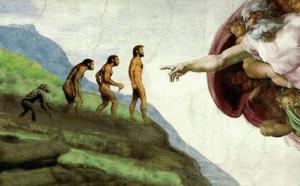
Evolucionismo Teísta by Felipe Ligeiro FL on Wikipedia
What we know is, while things we can’t explain happen, we actually find God in our daily life as the result of the effects of allowing love to work within us and others. This results in the transformation of people. The intervention by God in nature is rare and has always been considered rare. But answered prayer has always been the realized expectation.
So why the collision of science and religion?
We’re our own worst enemy when it comes to faith. It’s very hard for many to accept that there is anything beyond the world that can be seen. We don’t live in the ancient world in which myths were easy to believe and people dug up dead relatives and drove stakes through their vampire hearts. We live in a world where science and philosophy say, “Not so fast! Let’s look at that and subject it to scientific scrutiny.”
Some in science have the attitude that if they can’t sense it, measure it, repeat it, then it doesn’t exist. This means they can’t accept any evidence beyond the microscope, and aren’t looking.
It isn’t just science – we are often the same
Can we count on prayer, and can it be subjected to scientific studies, truth, and experiences?
Does science even apply? Religion and science are two very different fields. Science is involved with investigating and harnessing the physical world to improve our lives. Religion helps us understand how to live with and treat each other. Science examines and guides the material world. Religion examines and guides the moral and ethical world. It isn’t up to one to negate the other. But people try. They use philosophy and science to try and undo people’s belief in God.
Studies on prayer
The National Institutes of Health (US Government) collects scientific studies on prayer. The studies are conflicting. Why? It may be the nature of studies. Science is very demanding. Medical studies are done by very strict standards and are usually very reliable. The FDA and doctors always probe for problems to make sure they stay that way.
It’s easy to skew a study. If the research doesn’t involve enough people or the researcher selects the wrong end point, the results can errantly point to the researchers’ personal views. In medicine, many doctors who aren’t early adopters (quick to try new things), will wait for the medication to be used for years before they try it, because they know studies may not tell all there is to know about long-term effects. The larger and longer the trial, the more risks and individual differences show up. This guides prescribing medications to risk groups.
In contrast to prayer expectations, how reliable is science?
Interestingly in the soft sciences like psychology and economics, where perceived methodological rigor, exactitude, and objectivity are considered less, around 50% of studies of psychology and 30% in economics can’t be replicated with the same result.
For example in psychology, a ready supply of students are often used in experiments and the results can be very different for older people. And in economics, start and end points are often fudged to give the researcher the result they want. Results like these are now considered a replication crisis in science research.
Even the hard sciences like physics admit exceptions, which are considered further areas for research. Yet somehow studies in both soft and hard science still have overall credibility.
Difficulty designing studies on prayer
I think designing studies to assess the effectiveness of prayer is more difficult than people assume. For example, are those elderly who have reached the end of their life and are dying, going to be cured by prayer? I have doubts about most of them. Should I have gone ahead and spent twelve years to become a psychiatrist, supported by other’s prayers, just to find out I chose the wrong profession? That’s a lot of time invested in the wrong profession.
A hypertension study asks if interventional prayer can lower blood pressure. That kind of means, does God grant prayer requests to remove plaque buildup in arteries? I would suggest that usually mountains remain unmoved, but I can’t argue that in total confidence – the heart has several pathways for blood pressure control. What is the specific pathway being assessed?
My wife’s father prayed to live to see her through high school. He had several heart attacks, and had one while being monitored in a hospital. The clot created a new hole through the plaque that allowed him to continue living. That’s got to be close to a miracle. Never say never. Just say, “Improbable, but we can try.”
Subtle influences on the body
We know the mind has an influence on the body’s health. An article in Health.com, Can Negative Thinking Make You Sick? Stated, “Take cynicism, for example: A 2014 study published in the journal Neurology linked high levels of cynicism later in life, i.e. a general distrust of people (and their motives), to a greater risk of dementia compared to those who were more trusting, even after accounting for other risk factors like age, sex, certain heart health markers, smoking status, and more.” And, “the most cynical participants were more likely to have heart disease than the least cynical folks. The more pessimistic women also had a higher chance of dying over the study period, versus those who were more optimistic about humanity.”
An 80-year Harvard study found a major influence on our health is our state of mind. Their article, Good genes are nice, but joy is better, tells about it.
We’re beginning to understand the more subtle influences on our health. Perhaps instead of designing studies about moving mountains, we need to examine more subtle pathways when designing experiments about the effectiveness of prayer. After all, God speaks to us through a still, small voice, not through thunder.
The Institute of Noetic Sciences (IONS), formed by former astronaut Edgar Mitchell, explores the more subtle influences in measurable ways, with rigid scientific controls. Between this and scientific research into quantum mechanics, perhaps science will begin to understand more about how subtle things work at least in effect if not in identifying the hidden mechanisms.
The power of prayer
God guides us, but it’s our choice how we respond to make a difference. The world’s hills, if not mountains, are moved by our hands, inspired by our faith in God. Pray, have faith, but expect the best and prepare for the worst.
Take Home Points
Many scientists are religious, but many criticize religion. Scientific studies allow for exceptions, and in the soft sciences of psychology and economics, they aren’t all that reliable.
The world’s hills, if not mountains, are moved by our hands, inspired by our faith in God.
Pray and keep communicating with God. It works.
Series Links
Some think they deserve to suffer and die
Is prayer a conveyor belt of miracles?
Is the action of God in the universe responsible for much?
Criticism of studies on prayer, and of science
Science and philosophy have their own standard: 100%
Our answer is God. God’s answer is us. Together we make the world a better place.
– Dorian
Other Patheos writers on prayer

About Dorian Scott Cole
Information about the author is on the About tab. You can read more about the author here.


Browse Our Archives
Select a Category Uncategorized
Select a Month October 2026 September 2026 August 2026 July 2026 June 2026 May 2026 April 2026 March 2026 February 2026 January 2026 December 2025 November 2025 October 2025 September 2025 August 2025 July 2025 June 2025 May 2025 April 2025 March 2025 February 2025 January 2025 December 2024 November 2024 October 2024 September 2024 August 2024 July 2024 June 2024 May 2024 April 2024 March 2024 February 2024 January 2024 December 2023 November 2023 October 2023 September 2023 June 2023 May 2023 April 2023 March 2023 February 2023 January 2023 December 2022 November 2022 October 2022 September 2022 August 2022 July 2022 June 2022 May 2022 April 2022 March 2022 February 2022 January 2022 December 2021 November 2021
Follow Us!
TAKE THE
Religious Wisdom Quiz
What part of the body does the Breastplate of Righteousness protect?
Select your answer to see how you score.
The back The head The heart The stomach
Books by This Author Books by New Generations Explore Faith
Related posts from New Generations Explore Faith


Science and philosophy have their own standard: 100%...
Some think they deserve to suffer and die...

Expectations of prayer - Part 3 of Why...
TRENDING AT PATHEOS Progressive Christian

Looking at the Largest Orthodox Cathedral on Earth
There is often a considerable amount of anger and, shall we...

The Problem with False Prophets
Miller’s Station UMC| 10/18/26| Anchor Verse: Jeremiah 23: 1, 9-23 I...

Emotion in Early Christianity by Andrew Crislip
Andrew Crislip’s Emotion in Early Christianity examines an often overlooked dimension of...

16 Spiritual Touchstones for a More Grounded Life
After decades of spiritual study, here are 16 principles I try...

Catholic Evangelization: Sharing Your Faith Every Day
Welcome back to the Graceful Awakening mini-series called, “From Faith to Mission.” ...

The Pillar of the Boatmen: the Ancient Monument...
The Pillar of the Boatmen is a Romano-Gaulish sculpture that dates from...
view all Progressive Christian blogs
Ad-Free & Subscriber Log-In Subscription Support
- About Us
- 2026 Calendar
- Videos
- Podcasts
- Library of World Religions
- Faith In Media Tracker
- Advertise With Us
- Write for Us
- Privacy Policy
- Terms of Service
- Do Not Sell My Data
- Contact Us
- Radiant Digital
- Manage Newsletter Subscriptions
- Unsubscribe From Notifications
- Sitemap
Copyright 2008-2026, Patheos. All rights reserved.
Subscription Support Ad-Free & Subscriber Log-In
Follow Patheos