
BuddhistCatholicContemplativeEvangelicalGeneral ChristianHinduJewishLatter-day SaintMuslimNew VisionsProgressive Christian
Beliefs
- Buddhist
- Catholic
- Contemplative
- Evangelical
- General Christian
- Hindu
- Jewish
- Latter-day Saint
- More Voices
- Muslim
- New Visions
- Pagan
- Progressive Christian
Topics
- Religion News
- Food and Religion
- Sports and Religion
- Religious Art
- Religious Music and Entertainment
- Religious Events
- History and Religion
- Style and Religion
- Politics and Religion
- Women in Religion
- Recreation Outdoors and Religion
- Business Finance and Religion
- Careers Workplace and Religion
- Education and Religion
- Family Parenting and Religion
- Health Fitness and Religion
- Home and Religion
- Relationships and Religion
- Technology and Religion
- Travel and Religion
Columnists
- Buddhist Columnists
- Business Finance and Religion Columnists
- Careers Workplace and Religion Columnists
- Catholic Columnists
- Contemplative Columnists
- Education and Religion Columnists
- Evangelists Columnists
- Family Parenting and Religion Columnists
- General Christian Columnists
- Health Fitness and Religion Columnists
- Hindu Columnists
- History and Religion Columnists
- Home and Religion Columnists
- Jewish Columnists
- More Voices Columnists
- Latter Day Columnists
- Muslim Columnists
- New Visions Columnists
- Nonreligious Columnists
- Pagan Columnists
- Politics and Religion Columnists
- Progressive Columnists
- Recreation Outdoors and Religion Columnists
- Relationships and Religion Columnists
- Religion News Columnists
- Religious Art Columnists
- Religious Events Columnists
- Religious Music and Entertainment Columnists
- Sports and Religion Columnists
- Style and Religion Columnists
- Technology and Religion Columnists
- Travel and Religion Columnists
- Women in Religion Columnists
Resource Library
- 2026 Calendar
- Library of World Religions
- The 100 Most Holy Places on Earth
- Patheos Answers
- Podcasts
- Videos
- Faith Leaders Database
- Anglican Episcopalian
- Bahai
- Baptist
- Buddhism
- Christianity
- Confucianism
- Eastern Orthodoxy
- Hinduism
- Holiness and Pentecostal
- ISKCON
- Islam
- Judaism
- Lutheran
- Methodist
- The Church of Jesus Christ of Latter-day Saints
- New Age
- Paganism
- Presbytarian and Reformed
- Protestantism
- Religion Behind the Scenes
- Roman Catholic
- Scientology
- Shia Islam
- Sikhism
- Sufism
- Sunni Islam
- Taoism
- Zen
- See all religions
Research Tools
 Ad-Free & Subscriber Log-In Subscription Support
Ad-Free & Subscriber Log-In Subscription Support
Follow Patheos 

- Trending:
- Forgiveness
- |
- Marriage
- |
- Consciousness
- |
- Death Penalty
- |
- Election
- |
- Halloween
 NbA Muslims
- Home
- Muslim
- Latina American Muslimah on Khimars and World Hijab Day
Latina American Muslimah on Khimars and World Hijab Day
Last updated on: February 1, 2021 at 9:28 pm by NbAMuslims
Latina American Muslimah on Khimars and World Hijab Day 2021-02-01T21:28:41-04:00 NbAMuslims
Patheos Explore the world's faith through different perspectives on religion and spirituality! Patheos has the views of the prevalent religions and spiritualities of the world.
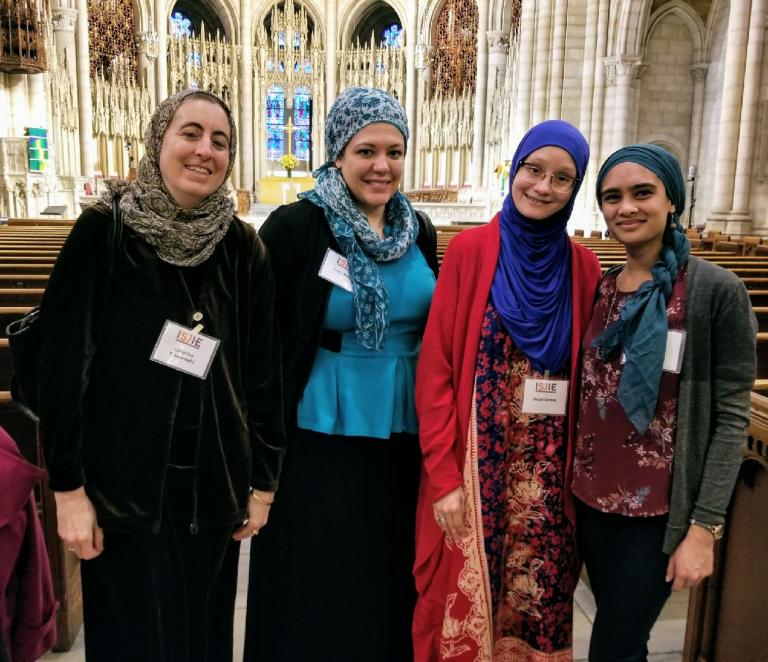
Gomez (third from the left) with 2018 Muslim Women Leadership Program cohorts [source: Hazel Gomez]
By Hazel Gómez
In this strange era of the increased attempt of institutionalizing Islamophobia from the right and the subtle cultural Islamophobic blows from the left, Muslim women who choose to cover with the khimar aka ḥijāb/headscarf are at the receiving end of it all. From governments trying to implement ḥijāb bans to fellow citizens being hostile to the point of physical harm, wearing the khimar– an outward religious expression of a woman’s adherence to the Islamic faith – has become politicized.
Not only does our mere presence as covered Muslim women tell the world that we believe in One Creator, One God and that we believe in the final Messenger of God, the Prophet Muḥammad, peace be upon him, but it also lets  society know that we are trying to live God-conscious and moral lives; our physical presence in any space becomes public engagement.
Muslim women choosing to cover their heads are usually asked that one question by curious onlookers: “Why do you wear that scarf on your head?” The answers are as varied as there are Muslim women in the world. Each woman has her reason for wanting to wear the ḥijāb. Some women choose to wear it as a form of gratitude to her Lord, others wear it because they want to embody the traits of the early believers such as the Virgin Mary – upon her be peace – and some wear it as a form of da’wah/outreach in order to draw people in to ask about Islam.
Yes, wearing the khimar is a command from God Almighty, but in the end, a woman’s decision to wear it is between her and her Lord – and no one else.
God says in the Holy Qur’ān in Chapter al-Aḥzāb (33), verse 59, “for the women of the believers…to be known,” meaning to be known as believing women. It is meant to be an outward expression of an inward spiritual journey towards God. Men should have absolutely nothing to do with a woman’s choice to cover; they are not, and have never been, a part of the equation.
As a Latina convert, wearing the khimar was not an easy decision. Coming from non-Muslim majority cultures as a Puerto Rican and Mexican, I knew that wearing the scarf would make me stand out in my neighborhood, I knew I’d get inquisitive looks and get asked a multitude of questions, but I was ready for it. In my mind, I thought, “Why not  wear it? God has given me so much and all my Creator asks of me is to cover and dress modestly? So, why not?”
Over the years, I have seen how the khimar has kept me conscious with how I interact with the world around me; it has given me self-confidence and agency as a woman that I didn’t even think I possessed. I became my full self when I started wearing the headscarf, and for that, I am eternally grateful to Allāh.
World Hijab Day is a great way to start some form of solidarity and awareness, but it isn’t and shouldn’t be made a mockery. The khimar is sacred and should be treated as such; it isn’t just a piece of cloth, it represents a conscious way of life for women. On this World Ḥijāb Day, many women from other faith traditions or no faith choose to wear the headscarf in solidarity with Muslim women. Women wear it to experience what it is like to be a ḥijābi for a day. They color coordinate the scarf with their outfits, post it on Instagram under the hashtags #ootd and #worldhijabday, and proceed to explore the world as a perceived covered Muslim woman.
 Well, I have some questions: if you are willing to wear the headscarf for one day, are you willing to stand up for me and my rights as a covered Muslim woman? Are you ready to be my accomplice as I fight for my voice to be heard in a society that tells me I don’t belong here? Are you willing to stand by my side as I fight off Islamophobic trolls, many of whom are in your own family, who wish to see my religious identity and practice eradicated from the public sphere? We need more allies and accomplices who want to live God-conscious and moral lives as we do as Muslims.
I know why I decided to wear the ḥijāb. Do you?
Hazel Gómez
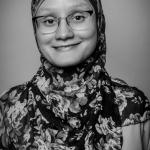 Hazel Gómez graduated from Loyola University Chicago with a Bachelor’s degree in Forensic Science. Currently, she is studying the Islamic sciences with Rabata.org’s Ribaat Academic Program under the tutelage of Shaykha Tamara Gray.
Hazel is a community organizer with Dream of Detroit, a nonprofit that combines community organizing with strategic housing and land development to build a healthy community and empower a marginalized
neighborhood. She also dedicates her time as an advisor and board member to various nonprofits ranging from community development and convert care to anti-racism work and mosque development within the Muslim community.
Previously, Hazel worked as a research assistant on the Muslims for American Progress study at the Institute for Social Policy and Understanding and also spent time as a community organizer with the Inner-City Muslim Action Network (IMAN) in Chicago focusing on the intersection of immigration and criminal justice reform. She also worked as the lead research assistant at the Alternative Education Research Institute focusing on the analysis of the criminal justice systems, reentry programs, and conversion to Islam of certain Latin American countries.
She is an avid reader of all things about Muslims in America and is interested in the research and creation of an authentic Latinx Muslim experience.
Previous Post
December 2, 2020
Giving Tuesday and Nonprofit Fundraising
Next Post
February 20, 2021 Black Muslim Authors Celebrate Race and Faith
Browse Our Archives
Select a Category #nbamuslims 500 #nbamuslims book review African-American Muslims Asian American Muslims Authors Speak Latinx Muslims Race/Ethnicity Sex and Gender Uncategorized
Select a Month February 2021 December 2020 November 2020 October 2020 September 2020 July 2020 June 2020 May 2020 April 2020 March 2020 October 2019 September 2019 July 2019 June 2019 May 2019 March 2019 February 2019 January 2019 December 2018 November 2018 October 2018 August 2018 July 2018 June 2018 May 2018 April 2018 March 2018 February 2018 January 2018 December 2017 November 2017 September 2017 August 2017 July 2017 June 2017 May 2017 April 2017 March 2017 February 2017 January 2017 December 2016 November 2016 October 2016 September 2016 August 2016 July 2016 May 2016 April 2016 March 2016 February 2016 January 2016 December 2015 November 2015 October 2015 September 2015 August 2015 July 2015 June 2015 May 2015 April 2015 October 2014 September 2014
Follow Us!
TAKE THE
Religious Wisdom Quiz
In this Gospel, Jesus' first miracle is not recorded, and the narrative begins with a voice crying in the wilderness. Which Gospel starts with John the Baptist's ministry?
Select your answer to see how you score.
Matthew Luke John Mark
Related posts from NbA Muslims
Black Muslim Authors Celebrate Race and Faith
Giving Tuesday and Nonprofit Fundraising
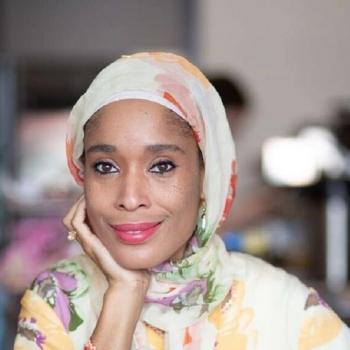
Nutrionist YaQutullah Muhammad Tackles Diet Culture

Racism Health Crisis and Black Muslims
TRENDING AT PATHEOS Muslim

25 Years Later: How Much Has Changed for...
As we approach the 25th anniversary of September 11th, I’ve found myself...

Podcast: Third Spaces & The Rise of Yemeni...
In the latest episode of The Artistic Foodies Podcast, hosts Abbas...

HalalFest Picks: Best 60 Halal Spots for Super...
Back in 2016, I came up with a list of 29...

Unity Is America’s Strength — Division Is Its...
by Hidayatullah Ahsan When Valentina Gomez, a Republican candidate for Congress in...

Zohran Mamdani and New York’s Fight Against Islamophobia
This past June, against all odds, Zohran Mamdani won the Democratic primary...

What the Fourth of July Means to a...
As we mark another Fourth of July, millions of Americans will celebrate...
view all Muslim blogs
Ad-Free & Subscriber Log-In Subscription Support
- About Us
- 2026 Calendar
- Videos
- Podcasts
- Library of World Religions
- Faith In Media Tracker
- Advertise With Us
- Write for Us
- Privacy Policy
- Terms of Service
- Do Not Sell My Data
- Contact Us
- Radiant Digital
- Manage Newsletter Subscriptions
- Unsubscribe From Notifications
- Sitemap
Copyright 2008-2026, Patheos. All rights reserved.
Subscription Support Ad-Free & Subscriber Log-In
Follow Patheos