
BuddhistCatholicContemplativeEvangelicalGeneral ChristianHinduJewishLatter-day SaintMuslimNew VisionsProgressive Christian
Beliefs
- Buddhist
- Catholic
- Contemplative
- Evangelical
- General Christian
- Hindu
- Jewish
- Latter-day Saint
- More Voices
- Muslim
- New Visions
- Pagan
- Progressive Christian
Topics
- Religion News
- Food and Religion
- Sports and Religion
- Religious Art
- Religious Music and Entertainment
- Religious Events
- History and Religion
- Style and Religion
- Politics and Religion
- Women in Religion
- Recreation Outdoors and Religion
- Business Finance and Religion
- Careers Workplace and Religion
- Education and Religion
- Family Parenting and Religion
- Health Fitness and Religion
- Home and Religion
- Relationships and Religion
- Technology and Religion
- Travel and Religion
Columnists
- Buddhist Columnists
- Business Finance and Religion Columnists
- Careers Workplace and Religion Columnists
- Catholic Columnists
- Contemplative Columnists
- Education and Religion Columnists
- Evangelists Columnists
- Family Parenting and Religion Columnists
- General Christian Columnists
- Health Fitness and Religion Columnists
- Hindu Columnists
- History and Religion Columnists
- Home and Religion Columnists
- Jewish Columnists
- More Voices Columnists
- Latter Day Columnists
- Muslim Columnists
- New Visions Columnists
- Nonreligious Columnists
- Pagan Columnists
- Politics and Religion Columnists
- Progressive Columnists
- Recreation Outdoors and Religion Columnists
- Relationships and Religion Columnists
- Religion News Columnists
- Religious Art Columnists
- Religious Events Columnists
- Religious Music and Entertainment Columnists
- Sports and Religion Columnists
- Style and Religion Columnists
- Technology and Religion Columnists
- Travel and Religion Columnists
- Women in Religion Columnists
Resource Library
- 2026 Calendar
- Library of World Religions
- The 100 Most Holy Places on Earth
- Patheos Answers
- Podcasts
- Videos
- Faith Leaders Database
- Anglican Episcopalian
- Bahai
- Baptist
- Buddhism
- Christianity
- Confucianism
- Eastern Orthodoxy
- Hinduism
- Holiness and Pentecostal
- ISKCON
- Islam
- Judaism
- Lutheran
- Methodist
- The Church of Jesus Christ of Latter-day Saints
- New Age
- Paganism
- Presbytarian and Reformed
- Protestantism
- Religion Behind the Scenes
- Roman Catholic
- Scientology
- Shia Islam
- Sikhism
- Sufism
- Sunni Islam
- Taoism
- Zen
- See all religions
Research Tools
 Ad-Free & Subscriber Log-In Subscription Support
Ad-Free & Subscriber Log-In Subscription Support
Follow Patheos 

- Trending:
- Forgiveness
- |
- Marriage
- |
- Consciousness
- |
- Death Penalty
- |
- Election
- |
- Halloween
 NbA Muslims
- Home
- Muslim
- NbA Black Muslims #WeMustWin National Call
NbA Black Muslims #WeMustWin National Call
Last updated on: November 7, 2016 at 5:35 pm by NbAMuslims
NbA Black Muslims #WeMustWin National Call 2016-11-07T17:35:47-04:00 NbAMuslims
Patheos Explore the world's faith through different perspectives on religion and spirituality! Patheos has the views of the prevalent religions and spiritualities of the world.
By Layla Abdullah-Poulos
On 9/23/16, the Muslim Anti-Racism Collaboration and Sapelo Square co-sponsored the #WeMustWin national call. Organized by Margari Hill and Su’ad Abdul Khabeer, the main purpose of the call was to create a space for Muslims to discuss the Movement for Black Lives after the recent deaths of Terence Crutcher and Keith Lamont Scott by law enforcement, which is part of a disturbing trend of loss of lives in Black communities.
The #WeMustWin national call comprised of a spectrum of Muslim leaders from across the country, including:
Imam Johari Abdul Malik, Dar Al Hijrah (Virginia)
Kalia Abiade, Center for New Community (Chicago)
Minister Carlos Muhammad, Nation of Islam (Baltimore)
Kameelah Mu’min Rashad, Muslim Wellness Foundation, Inc.- (Philadelphia)
Amir Sulaiman, Poet, recording artist, activist (Oakland, CA)
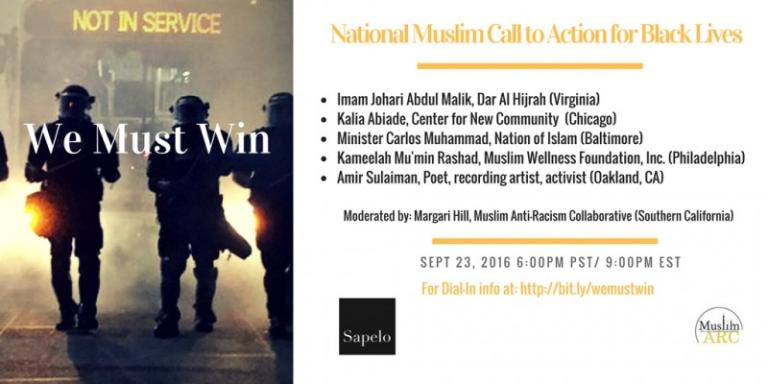
The panel represented a cross-section of Black Muslim activism in the arts, chaplaincy, advocacy, and health and wellness. Organizers afforeded each panelist time to talk about Muslim responses to instances of injustice and multiple ways to engage in everyday resistance. There was also discussion about the importance of self-care in activism and with constant exposure to the multiple images of oppression.
All of the speakers were inspiring, motivating and empowering while addressing issues pertinent to the lives of NbA Black Muslims, who frequently find their voices and concerns dampened in American Muslim communities.
We Must Win
Amir Sulaiman read his poem, We Must Win, which inspired the name of the hashtag. Sulaiman’s poem lyrically laid before listeners the disgraceful continuum of degradation and decimation to which African American bodies have been subjected throughout the country’s history.
“Every people has been sent an author to tell their story. This is a tale of what turns a man into a monster and what turns that monster into a martyr and a shadow of untold trauma.”
As Sulaiman spoke his words, the reality of our dehumanization resounded from the phone and into the air.
“We’re just trying to make Black history, but it’s like they want to make Blacks history and won’t even write a Eulogy for you and me.”
Sulaiman served listeners with a reminder that for millions of Muslims in America, their skin color places them at a precarious precipice of race and that a victorious struggle is the only way to stave off annihilation.
Turn Tragedy into Triumph
Imam Johari Abdul Malik advised on strategies to empower Black Muslims and the broader community against racism and oppression. He encouraged an assessment of the multiple engagement approaches such as nonviolent resistance, civil disobedience, town hall meetings, leadership training and rapid response plans, which are essential to productively addressing instances of racial injustice.
“That would mean establishing teachers, ones that would talk about the history of our movements and to get people to understand the psychology of engaging in civil disobedience and nonviolent action [and] move from being afraid to being empowered.”
Imam Johari also asserted the need for seeing beyond particular incidents of injustice to appreciate the need to acquire more socio-political power. Drawing on Islamic history, he provided a clear outline for Muslims to organize and respond.
“There is a difference between revolution and revolt. The essential difference is that revolutions are organized and revolts are not. That means understanding our historical victories. The incident at Hudhabiyyah and the treaty that the Prophet (SAWS) negotiated was a nonviolent victory. [The conquest at] Mecca was a nonviolent victory. The Muslims had been able to identify allies [and] strategies, and in an environment where they were nonviolent, they could express their concepts and ideas that would allow them to organize.”
“In the context of organizing, the issue is not about the particular incident; it is about building power in that community. The important element is to use the tragedy to create triumph in our community.”
Muslims Must Unite
Minister Carlos Muhammad fortified the idea of maintaining connections to the community when fighting injustice.
“One of the things we ran into as members of the Nation of Islam is that naturally, the Nation of Islam has had a history of being connected to the community and serving the people that may be considered non-Muslim. So when we took to the streets, we took to the streets, not because of the situation itself but because we understood that this was our city, and our city was in a situation that could have really gone bad. We were united and organized together.”
Minister Muhammad also talked about the need for Muslim unity.
“As Muslims, we already have a call to order. Allah says, ‘Oh you who believe, stand out firmly for justice as witnesses to Allah’ [4:135]. So when we see injustices taking place across the country, we should really be the first people out there. [Our Prophet] always stood up against injustice, whether it is Muslims or non-Muslims. Thus, Muslims in the Muslim communities in these cities must be united.
The first thing we have to do is follow the commandment of Allah (SWT) in the Quran when he is telling us to set aright our differences. But if we’re arguing over the pettiness of views on Quran and hadith, then when injustices are in our cities and near our masaajid or just in where we live, then we will find it very difficult to affect change.”
Racism, Injustice and Psychological Trauma
Kameelah Mu’min Rashad stressed the importance of addressing the psychological and emotional impact of exposure to racism, and injustice as well as the engaging in the draining work of activism.
“We are impacted by both by anti-racism and anti-Muslim bigotry. We are deeply wounded by the deaths of Black people, and we are also hypervigilant as it relates to the rise of hate crimes against Muslims across the country. With that vigilance and strength in the face of these assaults, it takes an emotional and psychological toll that we don’t often acknowledge, recognize, or know how to address.”
Rashad explained the toll that unaddressed trauma may have on the individual and the significance of drawing strength from Islam and the Black experience.
“Unfortunately, it will manifest itself in self-destructive ways. We will experience anger, rage, confusion, doubt, irritability, even at times a diminished sense of wondering whether or not we are still under Allah’s (SWT) protection and mercy.
I encourage everyone to experience those ranges of emotions. The minute we limit our right to do that, it also diminishes our humanity.
We can organize, we address some of the internal divisions within the Muslim community that impede our progress, but at the core of that is acknowledging the ways in which we are emotionally impacted.
We have to be able to develop a level of emotional literacy and safety in being able to express how vulnerable and angry we may feel.
We draw from the strength of our cultural background. We are strong people; we have dealt with hundreds of years of oppression, and we draw from our spiritual legacy. We only place our trust in Allah (SWT).”
Rashad conveyed to listeners to the importance of Black Muslims developing self-care to address the psychological trauma of racism as well as the need for non-Black Muslims to appreciate the influence of the intersection of race on their fellow Black Muslim experiences.
Multifaceted Activism
Kalia Abiade described the various approaches to activism in which Muslims may engage.
“Across the country, people are pouring their energy into different forms of activism. We got the elections six weeks away; many people are working on that. There is law enforcement accountability work, media engagement, people working on school bullying curriculum, opposition to mosque construction and Countering Violent Extremism programs that are using social service programs to target our young people. There are also organic programs healing circles, community forums and town halls.
All of this plays a really important role, and there is something for everyone in there.”
Although she did mention efforts for predominantly non-Black Muslim organizations to explore the intersections of race and religion for Black Muslims and how it impacts their work, Abaide told call listeners that there is still need to highlight Black Muslim voices in American Muslim culture.
“There is still a lot of space to create Black Muslim voices and perspectives. We don’t have to wait for anyone else to make that space for us. It’s not just so that we can be seen, or so our voices can be heard; we can contribute to the creation of solutions for many of the social issues that are really urgent and pressing right now. That includes national security and policing, but it also exceeds those issues. Therefore, it is really important that we are not afraid to create that space, we are unapologetic about it, and that we insert ourselves into this conversation.”
A Q&A session followed the presentations.
Immediate Impact
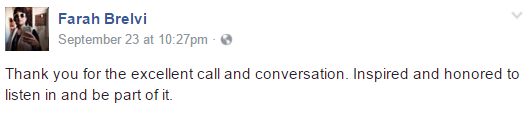
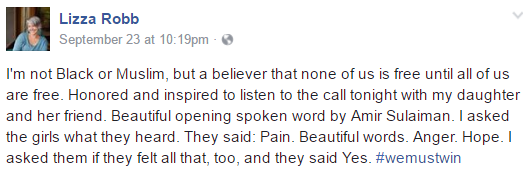
After the call, listeners took to social media to share their appreciation for the #WeMustWin national call and share how it affected them.
Many NbA Black Muslims (including me) attested that the call helped to strengthen their deflated spirits.
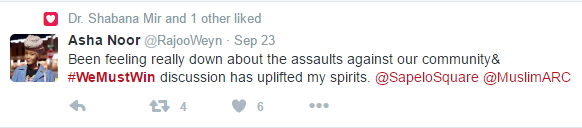
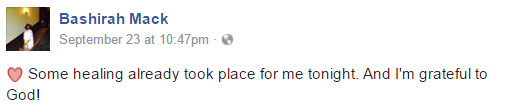
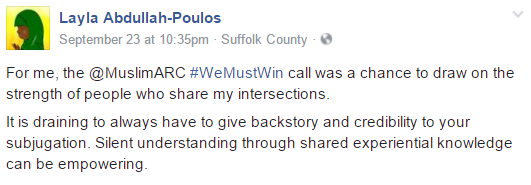
The call also received accolades from non-Black Muslims and non-Muslims.

Black Muslim Voices
The need for spaces where Black Muslims have a platform to assert their perspectives is essential to forming a strong American Muslim presence in the social justice sphere and alleviating the national and intra-cultural racism that causes so much psychological and emotional damage. The ability to congregate, strategize, organize, and provide solutions to social issues will not only contribute to the empowerment of Black Muslims but to non-Black Muslims and the broader society and make the United States a truly egalitarian nation.
A full recording of the #WeMustWin national phone call is available on the MuslimARC website.
Visit http://www.blackmuslimpsychology.org/ for information about the psychological effects of oppression and self-care strategies.
Note: Quotes have been slightly edited and condensed for clarity.
Previous Post
September 23, 2016
MuslimARC National Call for Muslims to #SupportStandingRock

Browse Our Archives
Select a Category #nbamuslims 500 #nbamuslims book review African-American Muslims Asian American Muslims Authors Speak Latinx Muslims Race/Ethnicity Sex and Gender Uncategorized
Select a Month February 2021 December 2020 November 2020 October 2020 September 2020 July 2020 June 2020 May 2020 April 2020 March 2020 October 2019 September 2019 July 2019 June 2019 May 2019 March 2019 February 2019 January 2019 December 2018 November 2018 October 2018 August 2018 July 2018 June 2018 May 2018 April 2018 March 2018 February 2018 January 2018 December 2017 November 2017 September 2017 August 2017 July 2017 June 2017 May 2017 April 2017 March 2017 February 2017 January 2017 December 2016 November 2016 October 2016 September 2016 August 2016 July 2016 May 2016 April 2016 March 2016 February 2016 January 2016 December 2015 November 2015 October 2015 September 2015 August 2015 July 2015 June 2015 May 2015 April 2015 October 2014 September 2014
Follow Us!
TAKE THE
Religious Wisdom Quiz
How many disciples did Jesus have?
Select your answer to see how you score.
Seven Thirty One hundred Twelve
Related posts from NbA Muslims
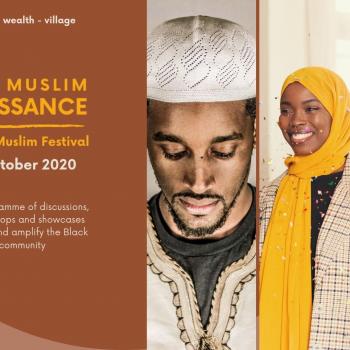
Black Muslim Renaissance - Celebrating Global Black History
Black Muslims, Honoring Juneteenth
CFS: Black Muslim Reads Anthology
Alienating Converts in Muslim Spaces During Ramadan
TRENDING AT PATHEOS Muslim

25 Years Later: How Much Has Changed for...
As we approach the 25th anniversary of September 11th, I’ve found myself...

Podcast: Third Spaces & The Rise of Yemeni...
In the latest episode of The Artistic Foodies Podcast, hosts Abbas...

HalalFest Picks: Best 60 Halal Spots for Super...
Back in 2016, I came up with a list of 29...

Unity Is America’s Strength — Division Is Its...
by Hidayatullah Ahsan When Valentina Gomez, a Republican candidate for Congress in...

Zohran Mamdani and New York’s Fight Against Islamophobia
This past June, against all odds, Zohran Mamdani won the Democratic primary...

What the Fourth of July Means to a...
As we mark another Fourth of July, millions of Americans will celebrate...
view all Muslim blogs
Ad-Free & Subscriber Log-In Subscription Support
- About Us
- 2026 Calendar
- Videos
- Podcasts
- Library of World Religions
- Faith In Media Tracker
- Advertise With Us
- Write for Us
- Privacy Policy
- Terms of Service
- Do Not Sell My Data
- Contact Us
- Radiant Digital
- Manage Newsletter Subscriptions
- Unsubscribe From Notifications
- Sitemap
Copyright 2008-2026, Patheos. All rights reserved.
Subscription Support Ad-Free & Subscriber Log-In
Follow Patheos