
BuddhistCatholicContemplativeEvangelicalGeneral ChristianHinduJewishLatter-day SaintMuslimNew VisionsProgressive Christian
Beliefs
- Buddhist
- Catholic
- Contemplative
- Evangelical
- General Christian
- Hindu
- Jewish
- Latter-day Saint
- More Voices
- Muslim
- New Visions
- Pagan
- Progressive Christian
Topics
- Religion News
- Food and Religion
- Sports and Religion
- Religious Art
- Religious Music and Entertainment
- Religious Events
- History and Religion
- Style and Religion
- Politics and Religion
- Women in Religion
- Recreation Outdoors and Religion
- Business Finance and Religion
- Careers Workplace and Religion
- Education and Religion
- Family Parenting and Religion
- Health Fitness and Religion
- Home and Religion
- Relationships and Religion
- Technology and Religion
- Travel and Religion
Columnists
- Buddhist Columnists
- Business Finance and Religion Columnists
- Careers Workplace and Religion Columnists
- Catholic Columnists
- Contemplative Columnists
- Education and Religion Columnists
- Evangelists Columnists
- Family Parenting and Religion Columnists
- General Christian Columnists
- Health Fitness and Religion Columnists
- Hindu Columnists
- History and Religion Columnists
- Home and Religion Columnists
- Jewish Columnists
- More Voices Columnists
- Latter Day Columnists
- Muslim Columnists
- New Visions Columnists
- Nonreligious Columnists
- Pagan Columnists
- Politics and Religion Columnists
- Progressive Columnists
- Recreation Outdoors and Religion Columnists
- Relationships and Religion Columnists
- Religion News Columnists
- Religious Art Columnists
- Religious Events Columnists
- Religious Music and Entertainment Columnists
- Sports and Religion Columnists
- Style and Religion Columnists
- Technology and Religion Columnists
- Travel and Religion Columnists
- Women in Religion Columnists
Resource Library
- 2026 Calendar
- Library of World Religions
- The 100 Most Holy Places on Earth
- Patheos Answers
- Podcasts
- Videos
- Faith Leaders Database
- Anglican Episcopalian
- Bahai
- Baptist
- Buddhism
- Christianity
- Confucianism
- Eastern Orthodoxy
- Hinduism
- Holiness and Pentecostal
- ISKCON
- Islam
- Judaism
- Lutheran
- Methodist
- The Church of Jesus Christ of Latter-day Saints
- New Age
- Paganism
- Presbytarian and Reformed
- Protestantism
- Religion Behind the Scenes
- Roman Catholic
- Scientology
- Shia Islam
- Sikhism
- Sufism
- Sunni Islam
- Taoism
- Zen
- See all religions
Research Tools
 Ad-Free & Subscriber Log-In Subscription Support
Ad-Free & Subscriber Log-In Subscription Support
Follow Patheos 

- Trending:
- Forgiveness
- |
- Marriage
- |
- Consciousness
- |
- Death Penalty
- |
- Election
- |
- Halloween

- Home
- Pagan
- Wheel of the Year: Yule
Wheel of the Year: Yule
Last updated on: December 19, 2020 at 10:31 pm by Dr. Mary Ann Clark
Wheel of the Year: Yule 2020-12-19T22:31:49+00:00 Dr. Mary Ann Clark
Patheos Explore the world's faith through different perspectives on religion and spirituality! Patheos has the views of the prevalent religions and spiritualities of the world.
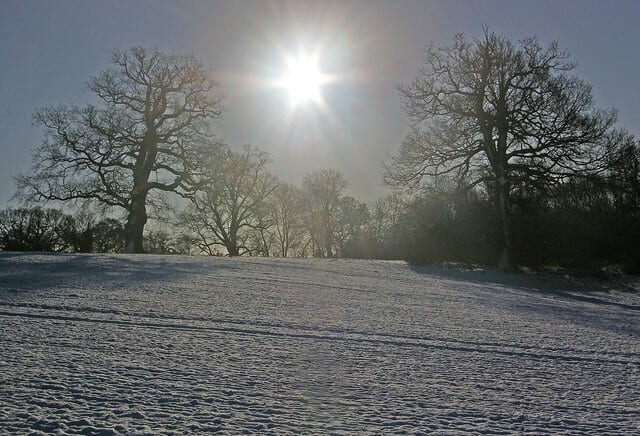
Ian Capper CC BY-SA 2.0 (http://creativecommons.org/licenses/by-sa/2.0), via Wikimedia Commons
Introduction
Contemporary Paganism is deeply rooted in a European past. For all of us who have some European heritage, those ancestors were pagan before the introduction of Christianity. Although modern Pagans draw on many non-European sources including the ancient beliefs and practices from Egyptian, Roman and Greek, Asian, Native American and African cultures, the native religions of pre-Christian Europe are our own heritage.
In this series, I will use the Wheel of the Year used by many modern Pagans to explore seasonal practices that you can incorporate into your life. I am using the generic descriptions of the seasons as if they apply to everyone. I know that they don’t. If you don’t live in North America or Europe, or if you live in certain areas of the United States, some of these descriptions of the seasons won’t make sense to you. Feel free to adjust my suggestions based on your own environment.
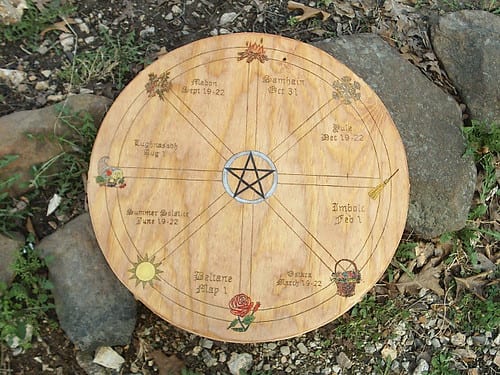
“Celtic Wheel of the Year Plaque” by dragonoak is licensed under CC BY-NC-ND 2.0
Yule (Winter Solstice)
Yule (December 20) is the pagan holiday that has been most integrated into secular culture. Much of what we Americans think of as Christmas rituals, practices, and symbols actually come from various pagan winter holidays around the time of the solstice. In fact, the date celebrated by Christians for their winter holiday was probably chosen to coincide with the Roman celebration of Dies Natalis Solis Invictus, the birthday of the Unconquered Sun as well as the revelry of Saturnalia.
The solstice is the longest night of the year when the sun has moved to the farthest point in its southern journey. Many pagan rituals including a calling back of the light along with the celebration of the conception or birth of the sun child. If Samhain was the end of the Pagan year, Yule is its beginning, a time of the unconscious, deep hibernation when old ways of being and acting might be discarded to prepare for a new solar cycle.
The colors of this season are the blue and white of snow and frost, as well as red and green of holly and other winter trees and plants. Since many of the symbols of the Christmas season are not Biblical but have been appropriated from different Pagan societies, modern Pagans can take them back and incorporate them into their own celebrations. These include evergreen trees and wreaths, gift giving, feasting, singing and dancing, candles and all the bright shiny decorations that remind us that the light will return.
This is the time of gestation and rebirth, a time to remember the darkness of the womb that nourishes and creates new life. We too can plant the seeds of our hopes and dreams, and nourish our visions of love, joy and peace. For out of the darkness, new light is born anew. This is also the time to enjoy the pleasures of hearth and home, to tell the stories of our lives and those of our families. In some ways, the days between Thanksgiving and the New Year are the most hectic time of the year with feasting, decorating, gift giving, parties and celebrations. But this can also be a good time to step back and enjoy the long, dark nights. Taking time to read or write or create, to sing or dance, to see within ourselves that which we might ignore in brighter times.
This year especially, we may need to embrace the darkness while planting the seeds of the future. It is a time to re-consider old rituals and create new ones. Perhaps we will share our feast with the birds and wild animals instead of traveling to or welcoming distant family. Perhaps we will need to reconsider our ways of celebrating and embrace a more solitary practice appropriate for this dark time.
Yule Rituals
Many of us have one or more boxes of seasonal decorations that we bring out each year and place together, always in the same way. Since everything is different this year, you might want to spend time reconsidering your seasonal practices. Perhaps you could turn a single room or even your entire home into special ritual space. Think first of the directions. East is the direction of air, south fire, west water and north earth. But you don’t have to be tied to those correspondences. Be creative. Perhaps you’ll make your living or family room the area of family, fire. The nominal South. A bathroom might embody West, water. The kitchen, home of food and nourishment might become North, the earth. Your bedroom, craft space, study, office or other special space, can be the East, Air. Make these spaces work for you, even if they don’t lie on the “right” compass points. Now make each space its own season altar, scattering your decorations throughout the house according to each room’s designation. Include your immediate family or housemates in this new scheme. Make it an adventure.
While you’re doing, or even thinking about this, you might create your own opposition. “I can’t put that in the bathroom,” you’ll tell yourself. Avoid absolutes. Remember, for this one time, only you and your immediate family will see what you’re doing. If you’re quarantining as you should, you won’t have to justify your choices to your extended family, friends or acquaintances. You can do what feels right.
When you’re done, use your own words to call the directions in each part of your home. Remind yourself of what energy you’ve placed in each space and what you want to manifest over this season of darkness and new life. You can end your invocation with something like “This circle is sealed, and all herein are completely and totally apart from the outside world.” When you finish, you will have turned the room or your entire home into sacred space. Although you can do special rituals for the Solstice and other seasonal holidays, now everything you do during this time can become part of your sacred practice.

About Dr. Mary Ann Clark
Dr. Mary Ann Clark is a self-initiated Pagan who has been a CUUPS member in congregations in Texas and Arizona. She is the Coordinator of her local CUUPS chapter. Holding a PhD in Religious Studies from Rice University, she has taught comparative religion at the University of Houston and Yavapai College, in Prescott, Arizona. In her retirement, she has reinvented herself as an author of speculative fiction. You can read more about the author here.
Previous Post
December 19, 2020
Respite
Next Post

January 15, 2021 An Imagination Is Not Just For Kids - Go Play & Find Yours
Browse Our Archives
Select a Category Current Events CUUPS Press Release Interfaith liturgy Media Review podcast Religious Education Seasonal Reflection Spiritual Practice Summary Uncategorized
Select a Month July 2026 June 2026 April 2026 January 2026 December 2025 October 2025 August 2025 July 2025 June 2025 April 2025 March 2025 February 2025 December 2024 November 2024 October 2024 August 2024 July 2024 June 2024 May 2024 April 2024 February 2024 December 2023 November 2023 October 2023 September 2023 August 2023 June 2023 May 2023 April 2023 March 2023 February 2023 January 2023 December 2022 October 2022 September 2022 August 2022 July 2022 June 2022 May 2022 April 2022 March 2022 February 2022 January 2022 December 2021 November 2021 October 2021 September 2021 August 2021 July 2021 June 2021 May 2021 April 2021 March 2021 February 2021 January 2021 December 2020 November 2020 October 2020 September 2020 August 2020 July 2020 June 2020 May 2020 April 2020 March 2020 February 2020 January 2020 December 2019 November 2019 October 2019 September 2019 August 2019 July 2019 June 2019 May 2019 April 2019 March 2019 February 2019 January 2019 December 2018 November 2018 October 2018 September 2018 August 2018 July 2018 June 2018 May 2018 April 2018 March 2018 February 2018 January 2018 December 2017 November 2017 October 2017 September 2017 August 2017 July 2017 June 2017 May 2017 April 2017 March 2017 February 2017 January 2017 December 2016 November 2016 October 2016 September 2016 August 2016 July 2016 June 2016 May 2016 April 2016 March 2016 February 2016 January 2016 December 2015 November 2015 October 2015 September 2015 August 2015 July 2015 June 2015 May 2015 April 2015 March 2015 February 2015 January 2015
Follow Us!
TAKE THE
Religious Wisdom Quiz
What is the Hebrew name for the first five books of the Bible?
Select your answer to see how you score.
Tanakh Torah Apocrypha Mishnah
Related posts from Nature's Sacred Journey
April 22 Earth Day, its Our Power and...

Fear, conquer it with affirmations and meditation

Samhain — three aspects; one holiday and...Halloween
TRENDING AT PATHEOS Pagan

When we talk about Greek religion, we often begin with the dodekatheion—the...

I was recently chatting with someone on Instagram. She asked me what...

While there are many people who share their results, the end of...

On July 23, I saw Christopher Nolan's The Odyssey which is Homer’s...

As I write this two big events have just finished up. One...

Restoring the Watershed of Divine Love
Perhaps cooperation is not something we manufacture through legislation, ideology, or moral...
view all Pagan blogs
Ad-Free & Subscriber Log-In Subscription Support
- About Us
- 2026 Calendar
- Videos
- Podcasts
- Library of World Religions
- Faith In Media Tracker
- Advertise With Us
- Write for Us
- Privacy Policy
- Terms of Service
- Do Not Sell My Data
- Contact Us
- Radiant Digital
- Manage Newsletter Subscriptions
- Unsubscribe From Notifications
- Sitemap
Copyright 2008-2026, Patheos. All rights reserved.
Subscription Support Ad-Free & Subscriber Log-In
Follow Patheos