
BuddhistCatholicContemplativeEvangelicalGeneral ChristianHinduJewishLatter-day SaintMuslimNew VisionsProgressive Christian
Beliefs
- Buddhist
- Catholic
- Contemplative
- Evangelical
- General Christian
- Hindu
- Jewish
- Latter-day Saint
- More Voices
- Muslim
- New Visions
- Pagan
- Progressive Christian
Topics
- Religion News
- Food and Religion
- Sports and Religion
- Religious Art
- Religious Music and Entertainment
- Religious Events
- History and Religion
- Style and Religion
- Politics and Religion
- Women in Religion
- Recreation Outdoors and Religion
- Business Finance and Religion
- Careers Workplace and Religion
- Education and Religion
- Family Parenting and Religion
- Health Fitness and Religion
- Home and Religion
- Relationships and Religion
- Technology and Religion
- Travel and Religion
Columnists
- Buddhist Columnists
- Business Finance and Religion Columnists
- Careers Workplace and Religion Columnists
- Catholic Columnists
- Contemplative Columnists
- Education and Religion Columnists
- Evangelists Columnists
- Family Parenting and Religion Columnists
- General Christian Columnists
- Health Fitness and Religion Columnists
- Hindu Columnists
- History and Religion Columnists
- Home and Religion Columnists
- Jewish Columnists
- More Voices Columnists
- Latter Day Columnists
- Muslim Columnists
- New Visions Columnists
- Nonreligious Columnists
- Pagan Columnists
- Politics and Religion Columnists
- Progressive Columnists
- Recreation Outdoors and Religion Columnists
- Relationships and Religion Columnists
- Religion News Columnists
- Religious Art Columnists
- Religious Events Columnists
- Religious Music and Entertainment Columnists
- Sports and Religion Columnists
- Style and Religion Columnists
- Technology and Religion Columnists
- Travel and Religion Columnists
- Women in Religion Columnists
Resource Library
- 2026 Calendar
- Library of World Religions
- The 100 Most Holy Places on Earth
- Patheos Answers
- Podcasts
- Videos
- Faith Leaders Database
- Anglican Episcopalian
- Bahai
- Baptist
- Buddhism
- Christianity
- Confucianism
- Eastern Orthodoxy
- Hinduism
- Holiness and Pentecostal
- ISKCON
- Islam
- Judaism
- Lutheran
- Methodist
- The Church of Jesus Christ of Latter-day Saints
- New Age
- Paganism
- Presbytarian and Reformed
- Protestantism
- Religion Behind the Scenes
- Roman Catholic
- Scientology
- Shia Islam
- Sikhism
- Sufism
- Sunni Islam
- Taoism
- Zen
- See all religions
Research Tools
 Ad-Free & Subscriber Log-In Subscription Support
Ad-Free & Subscriber Log-In Subscription Support
Follow Patheos 

- Trending:
- Forgiveness
- |
- Marriage
- |
- Consciousness
- |
- Death Penalty
- |
- Election
- |
- Halloween

- Home
- Pagan
- Lessons From the Maples
Lessons From the Maples
Last updated on: February 8, 2019 at 6:49 pm by Erica Baron
Lessons From the Maples 2019-02-08T18:49:29+00:00 Erica Baron
Patheos Explore the world's faith through different perspectives on religion and spirituality! Patheos has the views of the prevalent religions and spiritualities of the world.
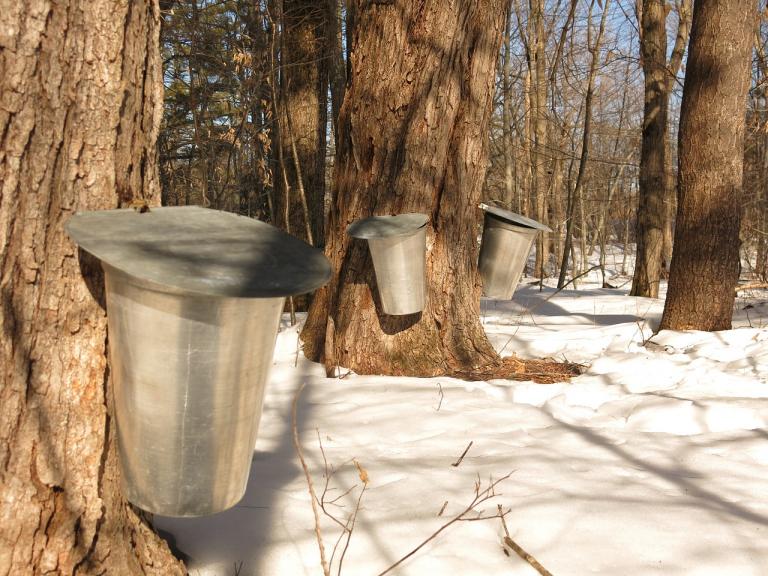
This reflection was in large part inspired by the essay “Maple Sugar Moon,” in Braiding Sweetgrass, by Robin Wall Kimmerer. This is such an amazing book – I highly recommend reading not just this essay but the whole book.
Real maple syrup is one of my very most favorite foods in the whole world. I grew up in Vermont, maple syrup central for the US at least, so that makes a certain kind of sense. My family tried to make our own maple syrup once – and only once. We just tapped a single tree, with one or two taps. We used repurposed plastic milk cartons to collect the sap. My mom tried boiling it down outside over an open fire. We ended up with a melted plastic garbage can when she put it too close to the fire hoping it would be a wind-guard. When the fire proved difficult to maintain, and the first tiny bit of syrup tasted a little too much like wood smoke, we moved the operation inside to the stove, boiling down the sap in our kitchen. We learned the hard way about needing to be vigilant at the end – the inside batch burned at the very last moment. I mean, don’t get me wrong, it was delicious! Just a little thick and a bit smoky. And we discovered why no one who knows what they’re doing boils sap in their kitchen – every surface, and I mean EVERY surface was sticky for months afterward.
As a family, we had always loved maple syrup, and eaten a good Vermont family’s share of it. But we did not appreciate it as fully until we tried to make it ourselves. After that, we gladly paid the people who do it right and were even more grateful for its sweetness.
The Value of Diligence
One of the lessons that maple trees teach human beings is the value of diligence. That good things come through sustained effort and patient attentiveness. That the maple syrup is sweeter and more precious because of the work it takes to bring it forth from the sap. As my family discovered, this process is long and difficult and challenging, and knowing that in a visceral way makes the end product oh so very much more precious.
And isn’t that true in other areas of our lives? That when we give our all to a project, when it takes time and skill and asks something of us, the end result is sweeter, more satisfying. There is so much more meaning infusing something that we’ve poured effort into. These things, be they home cooked meals or homemade clothes, art or writing or music, or work projects of all kinds – these things that have asked something of us, when they are complete and accomplished are oh so very much more precious than the things that come easily to hand or that have not required our whole selves. Maples show us the value of sustained effort.
The process of the tree using sap in the spring teaches another lesson, too. For the trees which lose their leaves in the fall, maples included, there is going to be a period of intense growth in the spring before the new leaves are ready to make new energy for the tree. Those buds and baby leaves are going to need food to open and grow until they are big enough to process sunlight into sugar to feed the tree through the summer. And that means that the tree has to store enough energy before the fall to give back to the baby leaves in the early spring. The tree cannot use up its supply of energy in the summer and fall, or it will not have enough to grow new leaves in the spring, and it will die.
Conserving Your Energy
This suggests to me another profound lesson that maples have to teach humans. If we use every ounce of energy we have and do not store any for the future, we will be in trouble. On some level, I think, we know this. That if we just keep pushing, eventually there will be a consequence. We will get sick if we get too tired. But on another level, we are immersed in a culture which values work ever so much more than it values rest, which has turned the adjective “tireless” into a complement of the highest order, though of course no one is actually endlessly tireless, which valorizes effort and productivity beyond what our bodies and minds and hearts and souls can actually bear without consequence.
Into this culture, the maple trees whisper to us, “You can’t use every bit of your energy. You have to save some for the spring. Those baby leaves are going to be hungry, and you need to have something left to feed them.”
Those projects that mean something, that ask something of us that makes us grow and learn and become better at something we value. Those projects are going to take some energy when they come along. So, we had better have some energy left to give them. It cannot be all effort all the time. There have to be periods of rest and dormancy, and we have to go into those periods with enough sugar to jumpstart the process of creating again when the time comes.
Honest, meaningful, sustained, intentional effort is a good thing, something that imbues everything we do in this way with meaning and gratitude, and deep value. We need to reserve some of our energy and not work to the point of exhaustion. These are the two lessons of the maples, and they seem a bit contradictory. The value of work. The value of rest. They point in different directions, call us to opposite impulses.
And yet, both are deeply true, paradox though they might be. The secret lies, I think, in the turning of the seasons. I’m so grateful to have spent all my life living in places where the full cycle of the seasons is nearly impossible to ignore. Everything around us here in the Northeast reminds us of the seasonal cycle. Even a single glance outside is enough to see the difference between spring and fall, summer and winter. Despite my artificially heated house and my electric lights, I cannot help but be aware of the changes in temperature, humidity, quantity and quality of light. And in case all that was not enough, the maples will remind us – bare branches, new buds, tiny leaves, full canopies, rainbow brilliance of dying leaves. There is a cycle all around us.
Life is Cyclical
And if we will listen, this cycle has lessons for us, too. That our lives also have cycles. That there are times for furious effort, as the tree uses all of its resources, all the cells that usually have other jobs, to get that sugar up to those buds in the early spring. Times for furious effort, as at the end of the sugaring process when the end stage of all that boiling requires a burst of energy to ensure that it becomes syrup or sugar or whatever our goal is. Times of furious effort in our own lives, when something important and immediate requires everything we have to give.
There are times for a gentler effort, as the huge canopy of mature leaves steadily produces the food for the tree and is steadily processed and used or stored as needed. Times of gentle effort as the long watch as sap boils toward syrup, requiring attentiveness and patience, but not huge outputs of energy. Times of gentle effort in our own lives, as we steadily work toward a long-term goal, taking the next step and the next and the next, one at a time toward something worth doing well and patiently.
There are times to rest. Times to let the leaves die. Time to store away sugar for the distant spring and then sleep through the winter. Most of the year is rest for sugaring. The sugar shack is closed up, and the buckets or lines are put away to await the next spring. And there are times for rest in our own lives. Times when we conserve a little sugar for the future and go within for a while.
What season are you in right now? Is this a time in your life that calls for furious effort or slow and steady work toward a goal? Are you in need of rest before you use up the last of the sugar that will get you started again? Have you already used up the last of your energy and need a period of deeper and longer rest to recover? What do you need to learn from the maples right now?
Previous Post

February 2, 2019
A New Chant for Imbolc
Next Post
March 8, 2019 Spiritual Anger
Browse Our Archives
Select a Category Current Events CUUPS Press Release Interfaith liturgy Media Review podcast Religious Education Seasonal Reflection Spiritual Practice Summary Uncategorized
Select a Month July 2026 June 2026 April 2026 January 2026 December 2025 October 2025 August 2025 July 2025 June 2025 April 2025 March 2025 February 2025 December 2024 November 2024 October 2024 August 2024 July 2024 June 2024 May 2024 April 2024 February 2024 December 2023 November 2023 October 2023 September 2023 August 2023 June 2023 May 2023 April 2023 March 2023 February 2023 January 2023 December 2022 October 2022 September 2022 August 2022 July 2022 June 2022 May 2022 April 2022 March 2022 February 2022 January 2022 December 2021 November 2021 October 2021 September 2021 August 2021 July 2021 June 2021 May 2021 April 2021 March 2021 February 2021 January 2021 December 2020 November 2020 October 2020 September 2020 August 2020 July 2020 June 2020 May 2020 April 2020 March 2020 February 2020 January 2020 December 2019 November 2019 October 2019 September 2019 August 2019 July 2019 June 2019 May 2019 April 2019 March 2019 February 2019 January 2019 December 2018 November 2018 October 2018 September 2018 August 2018 July 2018 June 2018 May 2018 April 2018 March 2018 February 2018 January 2018 December 2017 November 2017 October 2017 September 2017 August 2017 July 2017 June 2017 May 2017 April 2017 March 2017 February 2017 January 2017 December 2016 November 2016 October 2016 September 2016 August 2016 July 2016 June 2016 May 2016 April 2016 March 2016 February 2016 January 2016 December 2015 November 2015 October 2015 September 2015 August 2015 July 2015 June 2015 May 2015 April 2015 March 2015 February 2015 January 2015
Follow Us!
TAKE THE
Religious Wisdom Quiz
How many chapters are in Proverbs?
Select your answer to see how you score.
31 40 50 28
Related posts from Nature's Sacred Journey
Wheel of the Year: Beltane (May Day)

We Are Warriors for Mother Earth
TRENDING AT PATHEOS Pagan

I was recently chatting with someone on Instagram. She asked me what...

While there are many people who share their results, the end of...

On July 23, I saw Christopher Nolan's The Odyssey which is Homer’s...

As I write this two big events have just finished up. One...

Restoring the Watershed of Divine Love
Perhaps cooperation is not something we manufacture through legislation, ideology, or moral...

Many UUs don’t pray because of bad experiences in a previous religion,...
view all Pagan blogs
Ad-Free & Subscriber Log-In Subscription Support
- About Us
- 2026 Calendar
- Videos
- Podcasts
- Library of World Religions
- Faith In Media Tracker
- Advertise With Us
- Write for Us
- Privacy Policy
- Terms of Service
- Do Not Sell My Data
- Contact Us
- Radiant Digital
- Manage Newsletter Subscriptions
- Unsubscribe From Notifications
- Sitemap
Copyright 2008-2026, Patheos. All rights reserved.
Subscription Support Ad-Free & Subscriber Log-In
Follow Patheos