
BuddhistCatholicContemplativeEvangelicalGeneral ChristianHinduJewishLatter-day SaintMuslimNew VisionsProgressive Christian
Beliefs
- Buddhist
- Catholic
- Contemplative
- Evangelical
- General Christian
- Hindu
- Jewish
- Latter-day Saint
- More Voices
- Muslim
- New Visions
- Pagan
- Progressive Christian
Topics
- Religion News
- Food and Religion
- Sports and Religion
- Religious Art
- Religious Music and Entertainment
- Religious Events
- History and Religion
- Style and Religion
- Politics and Religion
- Women in Religion
- Recreation Outdoors and Religion
- Business Finance and Religion
- Careers Workplace and Religion
- Education and Religion
- Family Parenting and Religion
- Health Fitness and Religion
- Home and Religion
- Relationships and Religion
- Technology and Religion
- Travel and Religion
Columnists
- Buddhist Columnists
- Business Finance and Religion Columnists
- Careers Workplace and Religion Columnists
- Catholic Columnists
- Contemplative Columnists
- Education and Religion Columnists
- Evangelists Columnists
- Family Parenting and Religion Columnists
- General Christian Columnists
- Health Fitness and Religion Columnists
- Hindu Columnists
- History and Religion Columnists
- Home and Religion Columnists
- Jewish Columnists
- More Voices Columnists
- Latter Day Columnists
- Muslim Columnists
- New Visions Columnists
- Nonreligious Columnists
- Pagan Columnists
- Politics and Religion Columnists
- Progressive Columnists
- Recreation Outdoors and Religion Columnists
- Relationships and Religion Columnists
- Religion News Columnists
- Religious Art Columnists
- Religious Events Columnists
- Religious Music and Entertainment Columnists
- Sports and Religion Columnists
- Style and Religion Columnists
- Technology and Religion Columnists
- Travel and Religion Columnists
- Women in Religion Columnists
Resource Library
- 2026 Calendar
- Library of World Religions
- The 100 Most Holy Places on Earth
- Patheos Answers
- Podcasts
- Videos
- Faith Leaders Database
- Anglican Episcopalian
- Bahai
- Baptist
- Buddhism
- Christianity
- Confucianism
- Eastern Orthodoxy
- Hinduism
- Holiness and Pentecostal
- ISKCON
- Islam
- Judaism
- Lutheran
- Methodist
- The Church of Jesus Christ of Latter-day Saints
- New Age
- Paganism
- Presbytarian and Reformed
- Protestantism
- Religion Behind the Scenes
- Roman Catholic
- Scientology
- Shia Islam
- Sikhism
- Sufism
- Sunni Islam
- Taoism
- Zen
- See all religions
Research Tools
 Ad-Free & Subscriber Log-In Subscription Support
Ad-Free & Subscriber Log-In Subscription Support
Follow Patheos 

- Trending:
- Forgiveness
- |
- Marriage
- |
- Consciousness
- |
- Death Penalty
- |
- Election
- |
- Halloween

- Home
- Pagan
- Asklepios and Nepenthe
Asklepios and Nepenthe
Last updated on: March 8, 2018 at 6:56 pm by Maggie Beaumont
Asklepios and Nepenthe 2018-03-08T18:56:07+00:00 Maggie Beaumont
Patheos Explore the world's faith through different perspectives on religion and spirituality! Patheos has the views of the prevalent religions and spiritualities of the world.
Nowadays I work as a chaplain in Home Hospice – helping patients and their families voice their hopes and fears around the process of a life ending, bring forward the joys and sorrows of that life and the relationships in it, acknowledge and begin to process the grief-in-advance that may be present.

Jennifer at Dad’s Deathbed – photo by Max (cc) 2009.
Hospice Chaplaincy As A UU-Pagan
It’s important work, and it may be that Unitarian Universalists are uniquely qualified to do it, or at least to be trained to do it. I’ve nothing against my Christian colleagues, some of whom are truly gifted chaplains, but I do keep noticing that their worldview sometimes gets in the way.
“What’s your religion?” is a fine, seemingly-inclusive question, until the Atheist patient bristles at it, or the long-lapsed Catholic feels shame before a clergyone. “Everybody believes in something” is certainly true – but many people’s beliefs don’t include “God” (or at least, the “God” of the particular chaplain’s understanding).
Many of the UUs I know have come to one religious tradition from another, knowing deeply that there can be more than one spiritual “truth” – and then we come together to worship with unanimity of purpose, but not unanimity of dogma.
Maybe a UU-Pagan chaplain is best placed to hear, “That’s just too much God-talk for me” and not feel personally shut down. Or maybe I’ve finally arrived at neutrality (which maybe I can do for a few hours at a time, but don’t bet on my having arrived there permanently).
Hospice chaplaincy is good work, and I’m grateful to be able to do it. I’m also learning a lot about how life ends, and how that process is for the people most closely involved. A preview for myself, of course, and also a way to understand the people in my life better (even though few of them have been through this process, even now).
The emotional and spiritual end-of-life process is so different from one patient to the next, one family to the next. (Identifying details changed to protect their privacy).
One patient feels bereft, and somewhat abandoned, because he has recently moved away from the friends who have been most important – and now it’s too far for any of them to visit, and he is too hard of hearing to talk with them by phone.
Another patient asked her friends and even her pastor to stop visiting weeks ago. She greeted me briefly: “You seem like a nice person, but I just don’t have the energy for another relationship; I hope you understand.” Then she closed her eyes and turned her head away – and her son escorted me out of the room.
One family sits around the patient’s bed, singing favorite songs – some from the hymnal, some quite bawdy (the oldest daughter looks askance at the chaplain, afraid of giving offense, then looks relieved when she sees I’m grinning at the lyrics).
Another family argues about whose turn it is to go sit with the old man, who is lonely and repetitive and smells bad because of his illness even though he had a bath this morning.
The Witch asks: is this what you want to be talking about? I reply that I’ve been afraid to talk about these things. She says I must.
Asklepios and Nepenthe
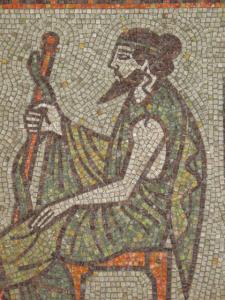
Asklepios mosaic in Bulgaria from Wikipedia
Earlier this week I spent several hours in the company of Asklepios, Greek god of healing, and Nepenthe, a goddess named for the (probably fictional) drink of ‘forgetfulness of sorrow’ mentioned in Homer. During a rite-of-passage ritual, these two upheld my participation and lent me their strength and focus. Afterward I realized that both have been with me for weeks, in almost every hospice visit.
Asklepios started out as a demi-god, with mostly human characteristics, who became a great healer. Eventually he even tried to restore the dead to life, which angered Zeus so much that he killed him with a thunderbolt, after which Asklepios became a god.
As I visit patients, Asklepios sometimes seems to tend old spiritual wounds – disappointments and sorrows, broken relationships and regrets, painful incidents that have been long repressed but now reappear for healing in the last weeks of a person’s life.
In some families, He shows me that the patient may become a divine figure for the family after death – from ‘what would Grandma do?’ to insisting the deceased was perfect in every way (and stifling the stories in which they were not).
Once in awhile I watch as families invoke a modern equivalent of Asklepios to try to bring their dying patient back to life, even when that life seems to be burdensome to the patient, and even when the patient says they are done.
Nepenthe has less of a written history, but in some ways She is clearer to me because of that. Wikipedia talks about the fictional drink and its citations (all dependent upon Homer) in the works of Poe and other writers, all the way up to 20th-Century popular music. She began appearing in my dreams, bringing forgetfulness of some of the sorrows in my life, and talking about being ‘forgotten’ Herself.
When I’m with patients, She often helps me see that speaking about what troubles them can allow it to lift … and acknowledging the pain (physical or mental) can allow it to recede, to be forgotten.
The Witch asks me what I am not saying.
Sometimes I envy my patients – the ones who are dying in their own homes, surrounded by loving family members who speak fondly of good times shared and good deeds done, spouses who look at each other with such deep love.
Sometimes I recognize the irony of my warm relationship with a Goddess of Forgetfulness, as my own memory disappears down a rabbit-hole. Perhaps it would be better to work with a Deity in charge of tiny scraps of paper with incomprehensible notes.
You should go back to speak with Mnemosyne, says the Witch, and I see at once that this is so. How could I have forgotten the Goddess of Memory? The Witch asks me what I am so afraid of.
I fear the moments when my lapses of memory cause hurt to someone else. This has already happened to some of my friends, who have been patiently forgiving even when their feelings have been hurt. What will happen when I make that kind of mistake with a patient? or the patient’s family? What if it makes them angry with our whole agency?
I fear the moments when I run into someone in public who clearly recognizes me from this intimate work … and I clearly don’t recognize them at all.
Sometimes, too, I fear the moments when some medical professional half my age reads my forgetfulness as something to patronize, or takes it for the kind of dottiness that means I won’t want to (or be able to) make my own decisions.
For some of our patients, the worst part of dying is the loss of control before it happens. Needing help to get up from a chair is bad enough, but it’s worse when your caregiver says ‘just a minute’ and makes you wait half an hour. Needing pain medication is bad enough, but it’s worse when the choice comes down to ‘be in pain’ or ‘take a medication that makes you feel weird.’ Having no appetite is bad enough, but worse when your beloved family keeps begging you to take just one more bite.
Sometimes I fear becoming that patient, too.
The Witch reminds me that, by the time I arrive in Hospice for myself, everyone around me will have heard a lot about what I want — because I keep talking and teaching about it.
The Witch reminds me to remind you: Fill out your advance directive. Sign it before witnesses. Choose your health-care proxy. Tell them what you want, to the best of your knowledge now. Don’t leave those decisions to some well-meaning stranger who doesn’t know you at all.
Previous Post

March 5, 2018
Visiting The Temple of Sekmet Near Las Vegas
Next Post

March 14, 2018 Finding The Balance
Browse Our Archives
Select a Category Current Events CUUPS Press Release Interfaith liturgy Media Review podcast Religious Education Seasonal Reflection Spiritual Practice Summary Uncategorized
Select a Month July 2026 June 2026 April 2026 January 2026 December 2025 October 2025 August 2025 July 2025 June 2025 April 2025 March 2025 February 2025 December 2024 November 2024 October 2024 August 2024 July 2024 June 2024 May 2024 April 2024 February 2024 December 2023 November 2023 October 2023 September 2023 August 2023 June 2023 May 2023 April 2023 March 2023 February 2023 January 2023 December 2022 October 2022 September 2022 August 2022 July 2022 June 2022 May 2022 April 2022 March 2022 February 2022 January 2022 December 2021 November 2021 October 2021 September 2021 August 2021 July 2021 June 2021 May 2021 April 2021 March 2021 February 2021 January 2021 December 2020 November 2020 October 2020 September 2020 August 2020 July 2020 June 2020 May 2020 April 2020 March 2020 February 2020 January 2020 December 2019 November 2019 October 2019 September 2019 August 2019 July 2019 June 2019 May 2019 April 2019 March 2019 February 2019 January 2019 December 2018 November 2018 October 2018 September 2018 August 2018 July 2018 June 2018 May 2018 April 2018 March 2018 February 2018 January 2018 December 2017 November 2017 October 2017 September 2017 August 2017 July 2017 June 2017 May 2017 April 2017 March 2017 February 2017 January 2017 December 2016 November 2016 October 2016 September 2016 August 2016 July 2016 June 2016 May 2016 April 2016 March 2016 February 2016 January 2016 December 2015 November 2015 October 2015 September 2015 August 2015 July 2015 June 2015 May 2015 April 2015 March 2015 February 2015 January 2015
Follow Us!
TAKE THE
Religious Wisdom Quiz
How long was Israel in Egyptian bondage?
Select your answer to see how you score.
200 years 500 years 300 years 400 years
Related posts from Nature's Sacred Journey

My story – discovering UU, starting a CUUPs...

Ostara & Commitment; Planting Seeds & Growing With...


TRENDING AT PATHEOS Pagan

I was recently chatting with someone on Instagram. She asked me what...

While there are many people who share their results, the end of...

On July 23, I saw Christopher Nolan's The Odyssey which is Homer’s...

As I write this two big events have just finished up. One...

Restoring the Watershed of Divine Love
Perhaps cooperation is not something we manufacture through legislation, ideology, or moral...

Many UUs don’t pray because of bad experiences in a previous religion,...
view all Pagan blogs
Ad-Free & Subscriber Log-In Subscription Support
- About Us
- 2026 Calendar
- Videos
- Podcasts
- Library of World Religions
- Faith In Media Tracker
- Advertise With Us
- Write for Us
- Privacy Policy
- Terms of Service
- Do Not Sell My Data
- Contact Us
- Radiant Digital
- Manage Newsletter Subscriptions
- Unsubscribe From Notifications
- Sitemap
Copyright 2008-2026, Patheos. All rights reserved.
Subscription Support Ad-Free & Subscriber Log-In
Follow Patheos