
BuddhistCatholicContemplativeEvangelicalGeneral ChristianHinduJewishLatter-day SaintMuslimNew VisionsProgressive Christian
Beliefs
- Buddhist
- Catholic
- Contemplative
- Evangelical
- General Christian
- Hindu
- Jewish
- Latter-day Saint
- More Voices
- Muslim
- New Visions
- Pagan
- Progressive Christian
Topics
- Religion News
- Food and Religion
- Sports and Religion
- Religious Art
- Religious Music and Entertainment
- Religious Events
- History and Religion
- Style and Religion
- Politics and Religion
- Women in Religion
- Recreation Outdoors and Religion
- Business Finance and Religion
- Careers Workplace and Religion
- Education and Religion
- Family Parenting and Religion
- Health Fitness and Religion
- Home and Religion
- Relationships and Religion
- Technology and Religion
- Travel and Religion
Columnists
- Buddhist Columnists
- Business Finance and Religion Columnists
- Careers Workplace and Religion Columnists
- Catholic Columnists
- Contemplative Columnists
- Education and Religion Columnists
- Evangelists Columnists
- Family Parenting and Religion Columnists
- General Christian Columnists
- Health Fitness and Religion Columnists
- Hindu Columnists
- History and Religion Columnists
- Home and Religion Columnists
- Jewish Columnists
- More Voices Columnists
- Latter Day Columnists
- Muslim Columnists
- New Visions Columnists
- Nonreligious Columnists
- Pagan Columnists
- Politics and Religion Columnists
- Progressive Columnists
- Recreation Outdoors and Religion Columnists
- Relationships and Religion Columnists
- Religion News Columnists
- Religious Art Columnists
- Religious Events Columnists
- Religious Music and Entertainment Columnists
- Sports and Religion Columnists
- Style and Religion Columnists
- Technology and Religion Columnists
- Travel and Religion Columnists
- Women in Religion Columnists
Resource Library
- 2026 Calendar
- Library of World Religions
- The 100 Most Holy Places on Earth
- Patheos Answers
- Podcasts
- Videos
- Faith Leaders Database
- Anglican Episcopalian
- Bahai
- Baptist
- Buddhism
- Christianity
- Confucianism
- Eastern Orthodoxy
- Hinduism
- Holiness and Pentecostal
- ISKCON
- Islam
- Judaism
- Lutheran
- Methodist
- The Church of Jesus Christ of Latter-day Saints
- New Age
- Paganism
- Presbytarian and Reformed
- Protestantism
- Religion Behind the Scenes
- Roman Catholic
- Scientology
- Shia Islam
- Sikhism
- Sufism
- Sunni Islam
- Taoism
- Zen
- See all religions
Research Tools
 Ad-Free & Subscriber Log-In Subscription Support
Ad-Free & Subscriber Log-In Subscription Support
Follow Patheos 

- Trending:
- Forgiveness
- |
- Marriage
- |
- Consciousness
- |
- Death Penalty
- |
- Election
- |
- Halloween

- Home
- Pagan
- How To Use A Myth
How To Use A Myth
Last updated on: August 11, 2017 at 6:14 am by Valerie Freseman
How To Use A Myth 2017-08-11T06:14:24+00:00 Valerie Freseman
Patheos Explore the world's faith through different perspectives on religion and spirituality! Patheos has the views of the prevalent religions and spiritualities of the world.
“Where’s the theological reflection? I want to see some theological reflection!”
Where indeed was the theological reflection? After all, I am supposed to be a minister!
Fallen Short
My supervisor looked at me with concern- it seemed I had fallen short this time. It was probably half way through my nine-month residency in chaplaincy at a mid-sized hospital. Clinical Pastoral Education, the standard method of training in chaplaincy, requires amongst other tools the use of written verbatims- remembered accounts of patient encounters accompanied by analysis. These verbatims are presented to your CPE cohort- a small group of fellow student chaplains who are journeying with you; the goal is to prod and poke your pastoral interventions and, to some extent, your stumbling blocks. And my verbatim of this encounter had contained no stories or theology to speak of. Was theological reflection a stumbling block?!

Waiting at the hospital. Photo by Orbis. (cc) 2013
Meeting with people in crisis, whether that occur in a congregation or in a hospital, is a process of meaning-making. How do you make meaning of this disruption? What myths, stories, beliefs, and assumptions are you using in that meaning making? Where does your unique fear met universal human conditions? By engaging in the process of holding a mirror to an individual, we help them find them completeness during disruption and fear.
“So, you felt like you did not know which family member needed your help. What did this remind you of?”
When she spoke, I Immediately thought about the ICU (Intensive Care Unit) waiting room. It’s one of those waiting rooms in the hospital where large families and groups of friends typically gather for long-periods of time or even overnight- not just because their loved ones are in the most intensive and precarious state of health, but also because the nature of the care means that people can see their family members and friends only in small groups and for short periods of time.
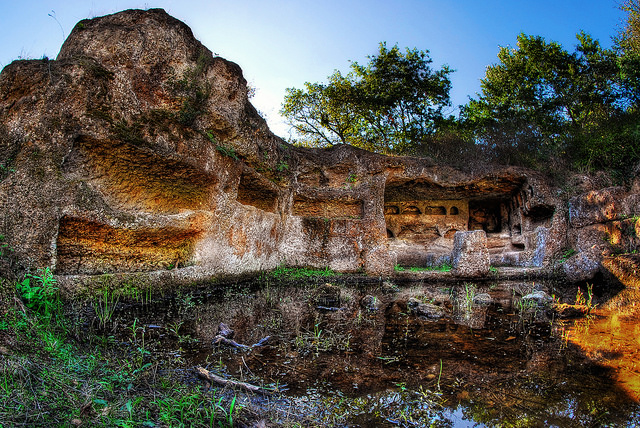
Myth. Photo by Riccardo Cuppini. (cc) 2016.
Four Element Spiritual Assessment Tool
As I was crossing through the ICU during my weekend on-call shift, I observed groups of people. A typical group would always be together, and yet apart at the same time. In one family, for example, children were watching tv, two adult siblings were engaged in an animated conversation, a third adult looked at their phone distractedly, and an older spouse looked lost and sad. I thought of the four elements- the typical building blocks of a Wiccan circle. The sibling on the phone was distracting themselves through communication- the air aspect. The adults were engaging around their emotions, passionately- the fire aspect. The spouse was in a state of emotional reflection- a state of being “governed” by water in my book. Without knowing it, I had developed the four-elements spiritual assessment tool. It helped me think about ways that I, as the chaplain, needed to reach each person. Although this tool might easily become a distraction if I let it, it provided me with a framework for understanding and calibrating my responses, of knowing what interventions might be applied, when to just listen, what to speak, what to offer, and when to offer it. The raw materials of emotion, anxiety, and fear is always present in people undergoing a transformation not of their own making; an alchemy in which I was the catalyst and the calibrator, but not the key ingredient.
After I thought about and developed my “four elements assessment tool” – as my supervisor dubbed it, I felt more free and creative in my spiritual assessments. I could use the Bible, I could use experiences and stories of Unitarian Universalists, I could use a host of resources.
Every day, I had entered conversations with people whose theological center was different from mine. I had to, as one colleague put it, “meet people in their language but never deploy my own.” Of course, this is a given in chaplaincy. The point is to learn how to de-center yourself, but still paradoxically use yourself and your compassion, to reflect back the experiences of others. But it left me feeling drained at times. I love language, I love teaching and reaching people through worship; how much more joy it gave me when I could engage in the process of spiritual reflection with people who shared my spirituality? How could I inspire?
Indeed, how do we use our myths, or frameworks? How do we use our earth-centered practice when we are in crisis? A distinguishing feature of one of my core spiritualities, my earth-centered practice, was that it was rested on practice and experience- not intellect alone.
I had grown used to the careful construction of sermons in seminary, to the linkage of my metaphysical orientation and curiosity with the very different realities of social justice. I had found parallels, sometimes in ways that were successful to others, sometimes not, in my own deeply held and felt faith, in the ways that I was oriented towards the divine.
But I almost always thought of my theological language as something “planned” “deployed” and “well-supported”. When I light the chalice in a worship service, or explain John Murray and the founding of Universalism, I convey in through action and speech a feeling of reverence towards people who are likely to share my reverence because we are Unitarian Universalists. Likewise, when I experience the transcendent power of dancing under a full moon in a city park, I had no words to explain their meaning; but we know what we felt. These are practices lived in common. They are often planned, and they are communal, as opposed to just particular.
Meaning Making Isn’t Just for Professionals
This meaning-making is not a practice for religious professionals alone. Everyone faces crisis- and even if the reflecting comes not in the heat of the moment but later, even if we do call upon a trained chaplain to help- we need our myths and our beliefs to help us.
So what myths spring to your mind? What tools are a balm? What are the touchstones we use in a crisis?
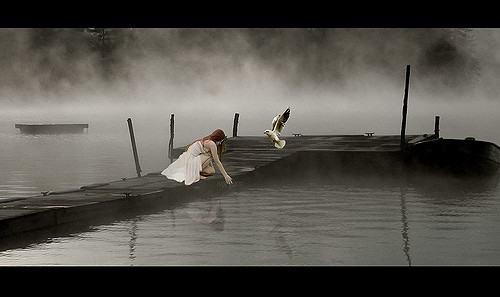
lethe. photo by Ozge Gurer Vatandas (cc) 2006.
I could use the Greek Myth of the river Lethe- the river of forgetfulness- to explain what I heard when one family member was counseling the others who had just suffered an unexpected loss. I could use the anger of Macha cursing the men of Ulster to understand the women’s march on Washington in January. I could use the wily behavior of Brigid- the saint-goddess of the Celtic tradition, to understand why crafting is healing for me. The stories that fascinate and compel us- whether we know or find them in our culture, tradition, family background, or any place- can act as a salve, binding lived experience to the universal. They can also act as a contrast; we discover, as well, who we are not when we reject what does not help us.
This process of self-discovery is open to all. It is not a process for the pews alone or for the circle- it is a process of life and living itself. Many of us are lucky to be able to find the time and the resources to cultivate meaning before we have a health or other crisis, but often, we find our most reliable tools in difficult spaces.
So how are you going to use a myth today? What have you internalized, and what will you, weeks or days after a crisis, think of as the story, the framework, or the idea that helped you the most? May whole self be blessed by it, even when it hurts.
Previous Post
August 9, 2017
Embracing Our Gifts
Next Post
August 14, 2017 Leadership Changes at CUUPS
Browse Our Archives
Select a Category Current Events CUUPS Press Release Interfaith liturgy Media Review podcast Religious Education Seasonal Reflection Spiritual Practice Summary Uncategorized
Select a Month July 2026 June 2026 April 2026 January 2026 December 2025 October 2025 August 2025 July 2025 June 2025 April 2025 March 2025 February 2025 December 2024 November 2024 October 2024 August 2024 July 2024 June 2024 May 2024 April 2024 February 2024 December 2023 November 2023 October 2023 September 2023 August 2023 June 2023 May 2023 April 2023 March 2023 February 2023 January 2023 December 2022 October 2022 September 2022 August 2022 July 2022 June 2022 May 2022 April 2022 March 2022 February 2022 January 2022 December 2021 November 2021 October 2021 September 2021 August 2021 July 2021 June 2021 May 2021 April 2021 March 2021 February 2021 January 2021 December 2020 November 2020 October 2020 September 2020 August 2020 July 2020 June 2020 May 2020 April 2020 March 2020 February 2020 January 2020 December 2019 November 2019 October 2019 September 2019 August 2019 July 2019 June 2019 May 2019 April 2019 March 2019 February 2019 January 2019 December 2018 November 2018 October 2018 September 2018 August 2018 July 2018 June 2018 May 2018 April 2018 March 2018 February 2018 January 2018 December 2017 November 2017 October 2017 September 2017 August 2017 July 2017 June 2017 May 2017 April 2017 March 2017 February 2017 January 2017 December 2016 November 2016 October 2016 September 2016 August 2016 July 2016 June 2016 May 2016 April 2016 March 2016 February 2016 January 2016 December 2015 November 2015 October 2015 September 2015 August 2015 July 2015 June 2015 May 2015 April 2015 March 2015 February 2015 January 2015
Follow Us!
TAKE THE
Religious Wisdom Quiz
Which book of the Bible contains the Ten Plagues of Egypt?
Select your answer to see how you score.
Exodus Deuteronomy Leviticus Genesis
Related posts from Nature's Sacred Journey

My Pagan path - a look back into...


Fallow Season ~ Burnout, Fatigue, and Sacred Rest
The Autumn Awakening ~ Returning to Center
TRENDING AT PATHEOS Pagan

I was recently chatting with someone on Instagram. She asked me what...

While there are many people who share their results, the end of...

On July 23, I saw Christopher Nolan's The Odyssey which is Homer’s...

As I write this two big events have just finished up. One...

Restoring the Watershed of Divine Love
Perhaps cooperation is not something we manufacture through legislation, ideology, or moral...

Many UUs don’t pray because of bad experiences in a previous religion,...
view all Pagan blogs
Ad-Free & Subscriber Log-In Subscription Support
- About Us
- 2026 Calendar
- Videos
- Podcasts
- Library of World Religions
- Faith In Media Tracker
- Advertise With Us
- Write for Us
- Privacy Policy
- Terms of Service
- Do Not Sell My Data
- Contact Us
- Radiant Digital
- Manage Newsletter Subscriptions
- Unsubscribe From Notifications
- Sitemap
Copyright 2008-2026, Patheos. All rights reserved.
Subscription Support Ad-Free & Subscriber Log-In
Follow Patheos